
Thomas Aquinas wrote, “Law is an ordinance of reason for the common good, made by him who has care of the community.” Aristotle described the importance of law when he said, “At his best, man is the noblest of all animals; separated from law and justice he is the worst.” In God’s great Story, He gave law. In its fullest expression, it is seen in the Law of Moses which revolutionized the world’s understanding of justice. But before and after of Moses, civilizations developed laws for the better ordering of society which are in many cases grounded in a God-given conscience based on experience and precedent. Laws on a social level, at their best, balance the common good with private rights–order and liberty. (A trinitarian concept of the unity of the One and Many.) One of the biggest advances toward this end in the ancient world was the Code of Hammurabi. The laws of Hammurabi were far from perfect and had many less than desirable elements. Yet, these would help set the stage for such great works as the Magna Carta, Declaration of Independence, and U.S. Constitution. What is notable about them is:
- they prescribed specific penalties, with limits, for each crime.
- they were among the first codes to establish the presumption of innocence.
- they were displayed publicly for all to show that they applied for all.
In this article, we will examine where Hammurabi’s Code advanced God’s order of a just society. We will further see how these laws would be greatly improved upon by the Law of Moses.
Who Is Hammurabi?

We have seen previously that God advanced his plans for human flourishing with the Akkadians, who started the first empire, lasting a century, through establishing services for the common good (though there was much brutality and violence). After them the Amorites created and held an empire for 400 years. They did this through an interconnected network of outsiders who slowly became insiders. One of the city-states of the Amorites was Babylon. Hammurabi, who reigned from 1792-1750 B.C. (43 years) brought Babylon to prominence. He was raised as the crown prince of Babylon where he was taught about the Babylonian gods and the history of the great leaders of Mesopotamia. As he grew, he also learned how to fight and lead an army. Diplomacy and statecraft were modeled by watching his father, who was king, and listening to his advisors. When Hammurabi turned eighteen years old, his father became very sick and died, and the young ruler was crowned king of the city-state of Babylon. At this time, Babylon was a smaller kingdom. It was overshadowed by older, larger, and more powerful kingdoms such as Assyria. Overtime through military power and political skill, Hammurabi built it into an empire that stretched from the Persian Gulf inland for 250 miles along the Tigris and Euphrates rivers.
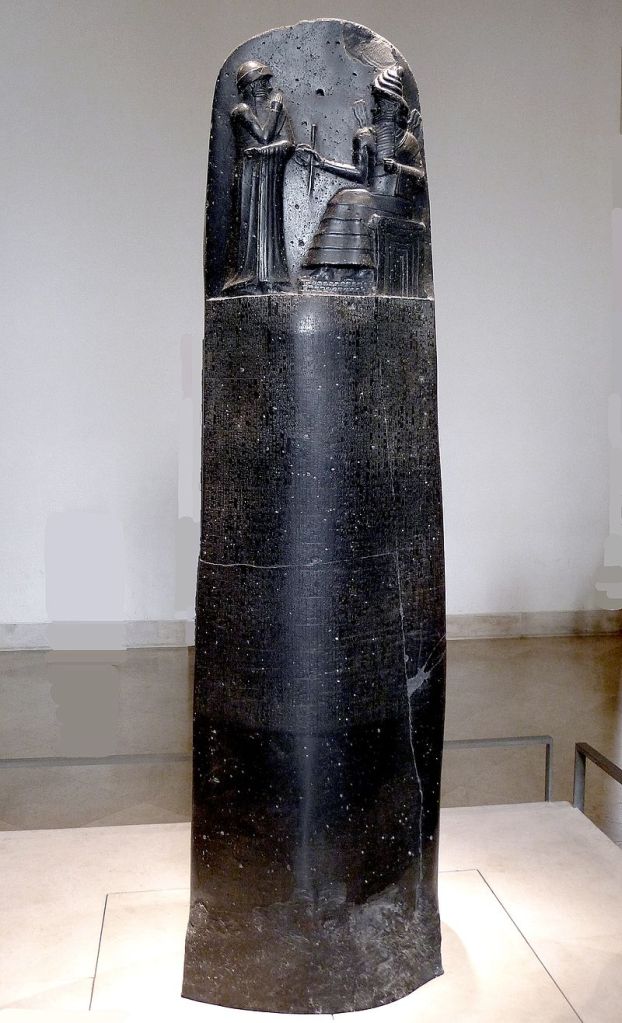
To govern his territories with justice and peace, he established a code of laws known today as the Code of Hammurabi. The original code was discovered on a black stone stele (an upright stone slab), some 7 ft. tall. It contains 282 laws reflecting the Babylonian judicial regime of the 18th century B.C. It wasn’t the first legal system. Hammurabi actually included laws created by previous kings. What set it apart was the idea that a society should be built upon the principle of law and order and applied to everyone. Before the codes, each case was judged separately and in a chaotic way. In contrast the Code states in the prologue, “to make justice visible in the land, to destroy the wicked person and the evil-doer, that the strong might not injure the weak.” He stands out as probably the first king who was concerned with the welfare of his people and thought of himself as the “shepherd.”
Code of Hammurabi
The codes regulated trade, business, and social relationships in Babylon. Below are some examples:
Laws for Debtors
If any one owe a debt for a loan, and a storm prostrates the grain, or the harvest fail, or the grain does not grow for lack of water; in that year he need not give his creditor any grain, he washes his debt-tablet in water and pays no rent for this year.
Law 48
Laws to Protect Against Neglect
If any one be too lazy to keep his dam in proper condition, and does not so keep it; if then the dam break and all the fields be flooded, then shall he in whose dam the break occurred be sold for money, and the money shall replace the corn which he has caused to be ruined.
Law 53
If any one open his ditches to water his crop, but is careless, and the water flood the field of his neighbor, then he shall pay his neighbor corn for his loss.
Law 55
Protection of Property Due to Wrongful Use
If a shepherd, without the permission of the owner of the field, and without the knowledge of the owner of the sheep, lets the sheep into a field to graze, then the owner of the field shall harvest his crop, and the shepherd, who had pastured his flock there without permission of the owner of the field, shall pay to the owner twenty gur of corn for every ten gan. (a GUR is about 80 gallons)
Law 57
Punishment for theft
If a man has committed robbery and is caught, that man shall be put to death.
Law 22
Regulation of wages
If a man has hired a farm-laborer, he shall give him 8 GUR of corn a year.
Law 257.
If a man has hired an ox-herd, he shall give him 6 GUR of corn a year.
Law 258.
Builder’s Responsibilities
If a builder has built a house for a man and has not made his work sound, and the house which he has built has fallen down and so caused the death of the householder, that builder shall be put to death.
Law 229
Hammurabi and the Law of Moses
There are similarities between the Code of Hammurabi and the Law of Moses. Both impose the death penalty in cases of adultery and kidnapping (Leviticus 20:10; Exodus 21:16; cf. Law 14 and 129). Also, there are similarities in the law of retaliation, such as “an eye for an eye” (Leviticus 24:20; cf. Law 196). Others can be cited, as well. Yet, the differences are incomparably greater than the similarities. The superiority of God’s Laws is that the desired outcome is the walking in covenant relationship with God, whereas the goal of the Law of Hammurabi is for longevity of the king and prosperity for the nation. The Law of Moses went far beyond the Code of Hammurabi which sought to regulate societal behaviors. The Law of Moses was rooted in the worship of one God, supreme over all (Deuteronomy 6:4-5) and sought the blessing and flourishing of humanity who is created in God’s image. Because of this the Mosaic Law emphasized mercy, forgiveness and the value of humans made in the image of God. Mercy is largely absent from Hammurabi. There was only regulation and retribution. Here are some marked differences:
- Sanctity of human life. The death penalty for thievery in the Code of Hammurabi seems to indicate that the nation valued goods over human life, while God’s Covenant valued people over things, not requiring a thief to die.
- Favoring the privileged vs. protecting the oppressed. Protection of the oppressed is near to God’s heart; not so much with Hammurabi. Many of Hammurabi’s laws favor the free and wealthy.
Do not mistreat or oppress a foreigner, for you were foreigners in Egypt. “Do not take advantage of the widow or the fatherless. If you do and they cry out to me, I will certainly hear their cry.
Exodus 22:21-23
He defends the cause of the fatherless and the widow, and loves the foreigner residing among you, giving them food and clothing. And you are to love those who are foreigners, for you yourselves were foreigners in Egypt.
Deuteronomy 10:18-19
Mercy. The notion of mercy is exceedingly rare in Hammurabi but appears with regularity in Moses.
And he passed in front of Moses, proclaiming, “The Lord, the Lord, the compassionate and gracious God, slow to anger, abounding in love and faithfulness, maintaining love to thousands, and forgiving wickedness, rebellion and sin. “
Exodus 34:6-7
- The focus of the laws. The vast majority of The Code of Hammurabi concerns money, property, and business transactions. While these are addressed in Moses, they flow out of living a covenant relationship with God.
Hear, O Israel: The Lord our God, the Lord is one. Love the Lord your God with all your heart and with all your soul and with all your strength. These commandments that I give you today are to be on your hearts.
Exodus 6:4-6
Summary
Evolving Moral Conscience: The Code of Hammurabi shows progress in the understanding of societal justice and fairness. Old Testament scholar John Walton has pointed out that of the thousands of court documents which have been discovered not one shows a reference to any of the 282 laws of this ancient Babylonian king. But this code most likely reflected a growing awareness and understanding of righteousness among leaders in the ancient Mediterranean. Many of those who have studied this Code see it as a compilation of verdicts handed down by Hammurabi himself and/or maybe kings before him. Paul clearly states that there is a universal law in the conscience of humanity.
Indeed, when Gentiles, who do not have the law, do by nature things required by the law, they are a law for themselves, even though they do not have the law. They show that the requirements of the law are written on their hearts, their consciences also bearing witness…
Romans 2:14-15
Hammurabi’s Code was a building block to but a far distance from the ideals of all humanity made in the image of God, later to be affirmed in Mosaic Law and Declaration of Independence. Yuval Noah Harari compares:
Both the Code of Hammurabi and the American Declaration of Independence claim to outline universal and eternal principles of justice, but according to the Americans, all people are equal, whereas according to the Babylonians people are decidedly unequal.
Nonetheless, God’s Story of Grace still continues through history.
 Story of Grace