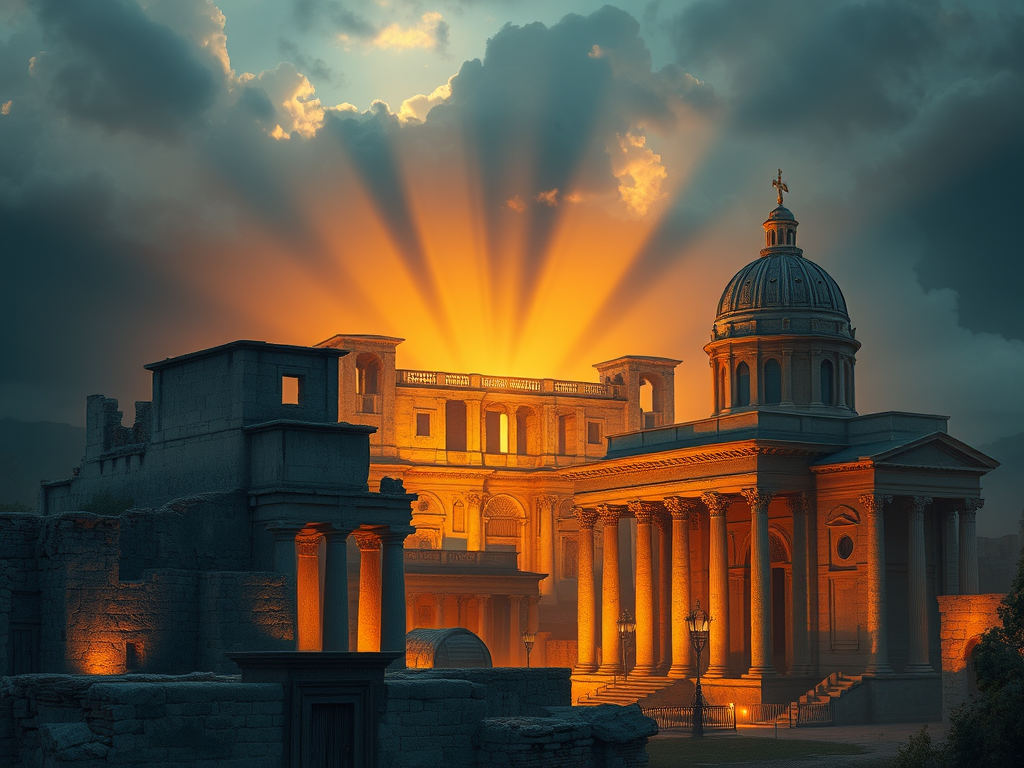
In The City of God, Augustine characterized the City of Man as loud, a quality that reflected its earthly passions and fleeting nature. Its walls were made more of ambition, pride, and ceaseless clamor even more than of stone and mortar. Its streets echoed with the tramp of victorious legions and the roar of the arena crowds. People built colossal monuments, wrote grand histories of their conquests, and told themselves they were great. They sought peace, but it was a fragile peace, purchased with a sword and maintained by the constant flexing of power. He tellingly described that its “victories… either bring death or are themselves doomed to be short-lived.” But in the heart of this earthly city, a different kind of city existed, almost invisibly. Its walls were not of stone, but of faith; its streets, not of paving stones, but of prayer. This was the City of God, and its citizens were mere sojourners in this noisy, transient world. He famously draws out the contrast, “Two cities have been formed by two loves: the earthly by the love of self, even to the contempt of God; the heavenly by the love of God, even to the contempt of self.”
In this article, we will discuss how The City of God helps the church understand its role in world history within God’s Story of Grace. Through this writing, a larger framework for forming the image of the Trinity in the world is provided: a society that reflects a larger community of mutual and self-giving love. Written by Augustine in response to the declining Roman Empire, this work became a guide for believers in the rebuilding of civilization. It explains the difference between the City of Man and the City of God, stressing the need to identify as citizens of heaven while getting involved in the world. Augustine’s ideas urge Christians to stay strong in their faith and focus on justice, compassion, and mercy, ultimately changing society through the love and grace shown by Jesus Christ.
The Two Cities Lived Out
Two Lives: Lucius and Marcus
To better understand The City of God, imagine one citizen of the City of God was a weaver named Marcus. His hands, calloused and nimble, wove tapestries in a workshop that hummed with the daily gossip of the earthly city. Marcus heard the rumors of war, the scandals of the powerful, and the anxious chatter of his neighbors. He listened but did not despair. He knew that the earthly city, with all its glory, was built on a foundation of shifting sand. Its triumphs were fleeting, its peace a temporary truce. His neighbor, a merchant named Lucius, lived for the buzz of the marketplace. He loved the glint of gold, the rustle of contracts, and the thrill of a successful deal. Lucius saw Marcus and his kind as naive fools, waiting for a savior who never came while ignoring the tangible, earthly rewards that were right before them. Yet, despite his successes, a gnawing restlessness plagued Lucius. His wealth brought him security, but it could not buy him rest. His possessions were vast, but he lived in fear of losing them. His victories felt hollow; there was always a bigger deal, a higher rung to climb.
The difference was in their loves. Lucius’s love was a well of self-glorification, a desire to fill an empty space within himself with the perishable goods of the world. It was a love that ultimately led to conflict, as it inevitably pitted his desires against his neighbors. Marcus’s love, by contrast, flowed outward, drawn toward God. This love gave him a peace that Lucius could not comprehend. Marcus worked diligently in the earthly city and sought its temporary peace, not for its own sake, but because it allowed him to live alongside his fellow humans and serve the greater, divine purpose of his eternal city.
When the barbarians finally came, they did not distinguish between the monumental arches and the quiet workshops. The City of Man, for all its pride, crumbled. Lucius’s empire of wealth disappeared in the smoke of the burning porticoes, and his love for self was finally revealed for the hollow, transient thing it had always been. But Marcus found refuge in a church, where the barbarians, surprisingly, did not bring the sword. He saw that the fall of Rome was not the end of the world, but merely the downfall of one earthly city among many. The two cities, interwoven in this mortal world, began to separate in that moment of crisis. Lucius, stripped of all that he had loved, faced a terrifying emptiness. Marcus, though he had lost his home, did not lose his true city. He knew that the end of time would bring the final cosmic separation, when the city of self would face eternal punishment and the city of God would finally rest in an unshakeable, eternal peace.
Two Perspectives: City of God and City of Man
The Romans, as reflected in the attitude of Lucius, had always seen their city as eternal, the pinnacle of human achievement and divine favor. When the Visigoths sacked Rome in 410 AD, it wasn’t just a military defeat; it was a crisis of faith and identity. Augustine provided the philosophical and theological tools to manage this profound grief and, ultimately, to rebuild. He argued that the earthly city, with all its glory and political structures, was inherently transient and flawed. Its collapse was not the end of the world but a predictable outcome of its focus on temporal glory and power.
According to Augustine, the City of God influences the City of Man not by ruling it, but by being a pilgrim community within it. The City of God’s influence comes through its citizens, who, founded on the love of God, live with humility and righteousness, contrasting with the self-love and temporal desires of the earthly city. This influence is a form of spiritual guidance that aims to shape individual behavior and the collective conscience toward eternal rather than material ends. Augustine states as follows:
And the heavenly city—or, rather, that part of it which is on pilgrimage in this mortal existence and which lives by faith—must of necessity make use of this peace as well, at least until this mortal existence, for which such peace is necessary, passes away. Consequently, for as long as it leads its pilgrim life as a captive, so to speak, in the earthly city, even though it has already received the promise of redemption and the gift of the Spirit as a pledge of that redemption, it does not hesitate to obey the laws of the earthly city, by which the things needed for sustaining this mortal life are administered. For, since this mortal existence is common to both cities, its obedience serves to maintain a concord between the two with regard to the things that pertain to our mortal life.
In living out this pilgrim journey, the influence of the City of God expands and brings transformation to the City of Man. This accelerates the influence of forming the trinitarian image on a world more representative of mutual and self-giving love in God’s Story of Grace.
The Sojourner’s Impact
Let’s end this article by looking at three impacts.
Impact # 1: A countercultural alternative to Rome: The City of God functions as a “pilgrim” (alien sojourner)1 in the City of Man, representing a life above and beyond the limits of the Roman Empire. It is beyond in that it contrasts with the pride and self-centeredness of earthly politics. Augustine’s distinction between the temporary “City of Man” and the eternal “City of God” helped Christians understand Rome’s fall and their role in the world. Without this, they might have faced a crisis of faith, viewing the Empire’s collapse as a failure of Christianity instead of a realization of its core teachings.2 Augustine was able to write with a determined but calm serenity, showing a new way to be in and with community.3
Impact # 2: A model of co-existence with the City of Man: The church would learn its spiritual authority while living within the state, engaging in various dialogues that would foster mutual understanding and respect, enabling both the church and the civil realms to coexist. Western civilization would see a way forward to make continuous progress toward the City of God, fostering a deeper understanding of our shared values and ethics while promoting a culture of wisdom, compassion, and inclusivity that transcends barriers and unites diverse communities in pursuit of a common good. It presented Christianity as a coherent alternative to paganism and a new, vital essence that absorbed and recontextualized elements from existing cultures, helping to build a new intellectual and moral framework for a post-Roman world.
Impact # 3: A new vision of history: The classical world viewed history as a cyclical repetition of events, emphasizing the predictable nature of human affairs. The City of God introduced a linear, progressive, and God-centered view of history, from Creation to the Last Judgment. This significant shift in perspective meant that each event in history could be seen as part of a divine plan leading toward a purposeful conclusion. Without this work, classical cyclical narratives might have held more sway, and the worldview which saw history as a divinely guided, purposeful narrative might have developed differently, if at all.4 Augustine’s The City of God fundamentally shifted Western civilization by reframing history as a linear, God-led progression from Creation to Judgment, rather than a cyclical one.
Conclusion
By positioning the City of God as an eternal, spiritual community existing alongside the earthly City of Man, he provided a new, God-centered worldview that offered hope and a profound new interpretation of worldly events, particularly the fall of Rome.5 This innovative perspective not only emphasized the transitory nature of earthly power and success but also framed the challenges and struggles faced by humanity within a divine context, suggesting that these trials were part of a greater plan. This work was vital in God’s Story of Grace.
_______________________________________________________________________
- Augustine used the Latin terms peregrinus (pilgrim, wanderer, resident foreigner) and peregrinatio (pilgrimage, sojourning) extensively in his major work City of God to characterize the temporary, transient status of Christians on earth. A key expression of this is found in Book 18.1 of City of God, where he states: I also promised that I would then go on to write about the origin, the course, and the destined ends of the two cities, one of which is the city of God and the other the city of this world, in which the city of God dwells so far as its human element is concerned, but only as a pilgrim.
- Augustine speaks of the internal conflicts and self-contradictions which arise in the City of Man: “…the earthly city is often divided against itself by lawsuits, wars and conflicts, and by seeking. For, if any part of it rises up in war against another part, it seeks to be the victor over nations when it is itself the prisoner of its vices; and if, when it triumphs, it is puffed up with pride, its victory brings death. (Book 19, Chapter 12)
- This is in contrast to Jerome who declared: “when the bright light of all the world was put out, or, rather, when the Roman Empire was decapitated . . . the whole world perished in one city. Who would believe that Rome, built up by the conquest of the whole world, had collapsed, that the mother of all nations became their tomb?”
- Augustine’s new linear view of history is primarily developed in the second major section of The City of God, which spans Books XI through XXII. Within this larger section, the historical progression of the two cities (the Earthly City and the City of God) is specifically detailed in Books XV through XVIII. Key aspects of this linear view are demonstrated in the following areas: Book XV: Augustine begins tracing the history of the two cities from the time of Cain and Abel to the Flood, establishing the two distinct “lines” of humanity based on their love for self versus love for God. Book XVIII: This book specifically covers the parallel history of the earthly and heavenly cities from the time of Abraham up to the end of the world, contrasting the temporary rise and fall of empires (like Rome) with the continuous, purposeful progression of the City of God. The Six Ages of History: Augustine re-applies a framework of six historical ages, from Adam to the second coming of Christ, which he details in Book 23 (though most sources refer to this material being in the latter books like Book XVIII or XXII, as Book 23 doesn’t exist) to show history moving in a single, purposeful direction from Creation to the Final Judgment.
- The Parable of the Wheat and Tares loomed large in Augustine’s thinking as he work through the coexistence of both cities: 24 “The kingdom of heaven is like a man who sowed good seed in his field. 25 But while everyone was sleeping, his enemy came and sowed weeds among the wheat, and went away. 26 When the wheat sprouted and formed heads, then the weeds also appeared.27 “The owner’s servants came to him and said, ‘Sir, didn’t you sow good seed in your field? Where then did the weeds come from?’28 “‘An enemy did this,’ he replied. “The servants asked him, ‘Do you want us to go and pull them up?’29 “‘No,’ he answered, ‘because while you are pulling the weeds, you may uproot the wheat with them. 30 Let both grow together until the harvest. At that time I will tell the harvesters: First collect the weeds and tie them in bundles to be burned; then gather the wheat and bring it into my barn.’” (Matthew 13:24-30)
 storyofgrace.org