
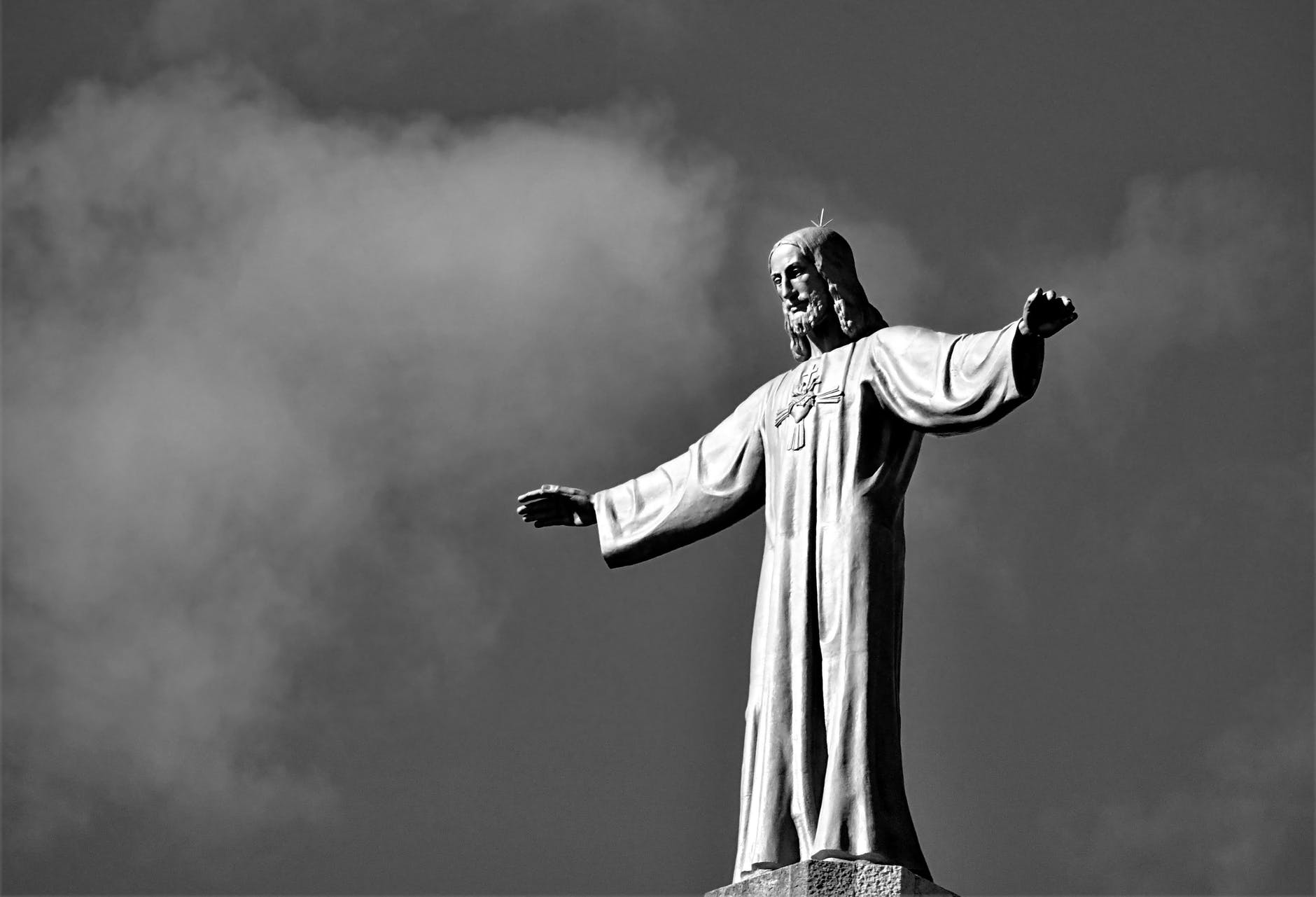
Christ, by highest heaven adored,
Christ, the everlasting Lord,
late in time behold him come,
offspring of the Virgin's womb:
veiled in flesh the Godhead see;
hail the incarnate Deity,
pleased with us in flesh to dwell,
Jesus, our Immanuel.
Christ is celebrated in this song as “everlasting Lord” and “incarnate Deity.” The question, then, arises as to how Jesus could be God and at the same time be born as a son. Was this Jesus, born of Mary, always the Son of God or did he become the Son of God at his incarnation (human birth)? How could Jesus be a Son and be equal to God the Father? Doesn’t a son come after a father? Doesn’t a father have parenting authority over a son? How could Jesus then be equal to the Father when sons are usually lower in authority to fathers? Let’s tackle these questions and lay out their importance.
Sonship of Christ
A great passage in the Bible to approach these questions is Paul’s remarkable description of Jesus in Colossians 1:15-17:
15 The Son is the image of the invisible God, the firstborn over all creation. 16 For in him all things were created: things in heaven and on earth, visible and invisible, whether thrones or powers or rulers or authorities; all things have been created through him and for him. 17 He is before all things, and in him all things hold together.
Colossians 1:15-17
When it come to Christmas time, the baby wrapped in swaddling clothes, laying in the manger, is God himself. Paul declares Jesus “the image of the invisible God.” (Colossians 1:15) The Greek word for image is eikon: it means “mirror-like representation” or a “high-definition projection.” In the days when photography was done on film, there was what was known as the latent image. When a picture was taken a light entered the lens, and it formed an image on the film that couldn’t be seen. If you took the film out at that point, only the latent or barely visible image was seen. It was there but hidden. When the film was put in a liquid developer, what was unseen becomes seen. The Father’s express image is only revealed—developed if you will—in the Son. Paul explains four verses later: “God was pleased to have all his fullness dwell in him.” (Colossians 1:19)
Then Paul reveals Jesus to be “the firstborn over all creation” (Colossians 1:15) This description has sparked significant debate. What does it mean that Jesus is “firstborn” and how does this shed light on Jesus as the Son of God? Let’s look at three wrong answers to this question and then the historic view of the Christian faith.
Wrong Answers on Sonship
Wrong Answer # 1: Created Sonship
This idea, which is most commonly held by the Jehovah Witnesses, claims that Jesus was a created being: the created son and not the eternal Son. This persuasion would see the designation “first born over creation” meaning that Jesus is the first created being. This is a flat out denial of the Trinity which holds that Jesus is co-eternal and co-equal with the Father, which is the testimony of scripture:
No one has ever seen God, but the one and only Son, who is himself God and is in closest relationship with the Father, has made him known.
John 1:18
…while we wait for the blessed hope—the appearing of the glory of our great God and Savior, Jesus Christ
Titus 2:13
Theirs are the patriarchs, and from them is traced the human ancestry of the Messiah, who is God over all, forever praised! Amen.
Romans 9:5
And we are in him who is true by being in his Son Jesus Christ. He is the true God and eternal life.
1 John 5:20
Wrong Answer # 2: Modalism (Three Hats View)
Modalism holds that there is no Trinity; rather, the one God shows himself in three different modes of being. (T.D. Jakes is a prominent pastor who holds to this position.) One way to understand this doctrine is to think of a man who puts on three different hats or roles: the dad hat, the employee hat (e.g. electrician), and the husband hat. He is the same man while wearing three different hats. In a similar way it is claimed that God is one God while wearing three hats (roles): the Father hat, the Son hat and Holy Spirit hat. These are not distinct persons but distinct roles or functions. This persuasion claims Jesus being “the firstborn over creation” means that God showed up in a new hat (form): God the Son. The inaccuracy is that it disregards the very clear relational interactions of Father, Son and Holy Spirit.
Here the Father speaks while the Holy Spirit descends at Jesus’ baptism:
16 As soon as Jesus was baptized, he went up out of the water. At that moment heaven was opened, and he saw the Spirit of God descending like a dove and alighting on him. 17And a voice from heaven said, “This is my Son, whom I love; with him I am well pleased.”
Matthew 3:16-17
Before his crucifixion, Jesus displays the relational interactions between the Father, the Spirit to himself:
16 And I will ask the Father, and he will give you another advocate to help you and be with you forever— 17 the Spirit of truth.
John 14:16-17
Look how Jesus refers to his relationship to the Father:
Jesus said, “Do not hold on to me, for I have not yet ascended to the Father. Go instead to my brothers and tell them, ‘I am ascending to my Father and your Father, to my God and your God.’”
John 20:17
The writer of Hebrews communicates clearly:
The Son is the radiance of God’s glory and the exact representation of his being, sustaining all things by his powerful word. After he had provided purification for sins, he sat down at the right hand of the Majesty in heaven.
Hebrews 1:3
Wrong Answer # 3: Incarnational Son
Some would suggest that Jesus is not the eternal Son but the incarnational Son. This view asserts that Jesus became the Son of God at his conception/birth but was not the Son from eternity. This is significantly better than the last two in that it holds that Jesus is a distinct person who is co-eternal and co-equal with the Father and the Holy Spirit. It does not deny the nature of Trinity. Its downfall is its denial of the identity of the Trinity. Jesus as Son is a title Jesus assumes rather than who Jesus actually is. Being “the firstborn over creation” means that he took on the role of Son only in relation to redeeming creation.
The Eternal Son
Supreme Honor (v.15)
The historic view of the Christian faith is that Jesus is the Son of God from eternity. There was never a time that he was not the Son; it was essential to his identity and not a title or role he assumed. When Paul refers to Jesus as “the firstborn over creation,” he is using this as a common designation at the time to express that Jesus is supreme over creation. New Testament scholar Donald Guthrie writes, “Firstborn must be understood in the sense of supreme rather than in the temporal sense of born…” William Barclay explains that the Greek word for “firstborn” is rarely used in any other sense but to mean the privilege of a firstborn son who is pre-eminent or supreme. Firstborn, then, refers only to Jesus’ perfect supremacy in his manhood and deity over creation.
Supreme Creator (vs. 16-17)
Paul then affirms:
For in him all things were created: things in heaven and on earth, visible and invisible, whether thrones or powers or rulers or authorities; all things have been created through him and for him. He is before all things…
Colossians 1:16-17
We see that Jesus, as the Creator, was the Son at creation, not after when he entered Mary’s womb. Plant your flag for the age of the universe as far back as you’d like and Jesus will step out of eternity to meet you. In the great prophecy of Jesus’ earthly origins being from Bethlehem, it reveals that his ultimate origins are from the days of eternity:
But as for you, Bethlehem Ephrathah,
Too little to be among the clans of Judah,
From you One will come forth for Me to be ruler in Israel.
His times of coming forth are from long ago,
From the days of eternity. --Micah 5:2
Supreme Sustainer
Next, Paul makes this astounding declaration:
…and in him all things hold together.
Colossians 1:17
The verb tense Paul uses for hold indicates that Jesus continues to hold all things together. The basic element of life is an atom. Atoms consist of protons, neutrons and electrons. Protons and neutrons, because of their similar electric charges, should pull away from each other causing life to fundamentally fall apart. Particle physicists tell us that they don’t because there is a strong nuclear force which holds them together. Whatever truth there is to this, we know that the constant which empowers these forces to function, keeping even atoms together, is Jesus Christ, the sustainer of all things. He has put the laws in place which keep the universe functioning. What would happen if he released his grasp or hold? Everything would fly apart. Here is the wonder of Christmas: the baby in the manger is the eternal Son holding the entire universe together.
Why Is Jesus As Eternal Son Important?
13 This is how we know that we live in him and he in us: He has given us of his Spirit. 14 And we have seen and testify that the Father has sent his Son to be the Savior of the world. 15 If anyone acknowledges that Jesus is the Son of God, God lives in them and they in God.
1 John 4:13-15
God maintains his eternal identity.
As John testifies that “the Father has sent his Son to be Savior of the world.” (1 John 4:14) Because of this sending of the Son, God “has given us his Spirit.” (1 John 4:13) This affirmation is central to God’s life being in us and our lives being in God. (1 John 4:15) Jesus from eternity has been the “sent one.” God is eternally three distinct persons with three distinct names: Father, Son, and Holy Spirit. Without eternal Sonship we end up with a nameless Trinity prior to the incarnation. God would have then revealed himself only by titles or roles that he became, not by who he is from eternity. He is the Son because he has always been the “sent one” from the Father. The Father nor the Holy Spirit could have been sent to be born of Mary. Only Jesus, as the eternal Son, could do this.
To follow Jesus means that we will be on mission, as well:
Again Jesus said, “Peace be with you! As the Father has sent me, I am sending you.”
John 20:21
God manifests his eternal identity.
T.F. Torrance, one of the greatest theologians of the 20th century, served as a chaplain during World War II. One day, on a battlefield in Italy, he attended to a dying nineteen-year-old soldier. The dying man asked him, “Is God really like Jesus?” For Torrance, this question captured “the deepest cry of the human heart”–is the God that we’ll meet on the other side of the death the same God that came to earth as a lowly babe? Torrance assured the dying man with these words: “God is indeed really like Jesus. There is no unknown God behind the back of Jesus for us to fear. To see the Lord Jesus is to see the very face of God.”
When we see Jesus as the Son of God in the manger, we see the very God who has existed in relation to the Father and the Holy Spirit, sent to us from everlasting to everlasting. That infant in the manger who was holding the universe together can continue to hold your life together as you place your trust in him.
For further equipping:
Memorize: John 1:14
Additional reading:
What is the doctrine of eternal Sonship and is it biblical?
The Trinity: Does It make Sense?
 Story of Grace