
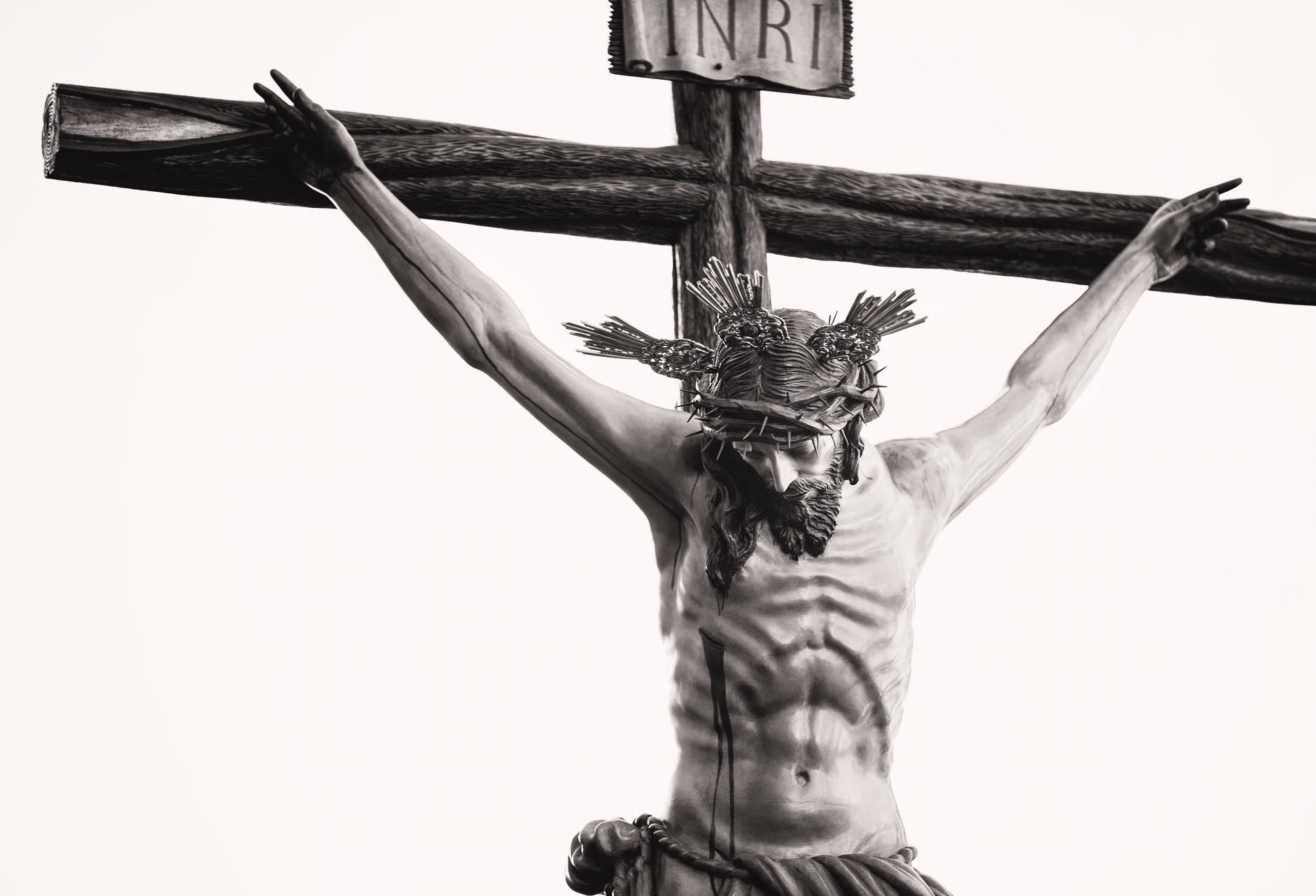
British Evangelist Steve Chalke in his book, The Lost Message of Jesus, used the provocative description when referencing the atonement of Christ as “cosmic child abuse.” The atonement of Christ declares that Jesus bore the punishment for humanity’s sin so that we could be declared forgiven and righteous before God. Chalke characterizes this doctrine as:
….a vengeful Father, punishing his Son for an offence he has not even committed. Understandably, both people inside and outside of the Church have found this twisted version of events morally dubious and a huge barrier to faith. Deeper than that, however, is that such a concept stands in total contradiction to the statement: “God is love”.
He states further, “‘Why can’t God do what he asks us to be able to do; to freely forgive without demanding punishment first?” This is a fair question. In our day, the doctrine of the atonement has come under disfavor by increasing numbers of people inside and outside the church. Let’s clarify what the atonement means and then look at the answers to three of its big objections.
What Is the Atonement?
As stated above the atonement is the work Jesus Christ did in bearing our punishment for sin so we could be declared forgiven and righteous. The word itself breaks down into three parts: at-one-ment. Put simply, atonement is how we are brought into “oneness” with God through Jesus. In the atonement God brought a fundamental exchange of humanity’s unrighteousness for Christ’s righteousness. This is beautifully and simply expressed by Paul below:
God made him who had no sin to be sin for us, so that in him we might become the righteousness of God.
2 Corinthians 5:21
Objections and Answers to Atonement
Objection # 1: How can Christ, an innocent person, be justly punished for our sins? It would seem unjust of God to punish an innocent party for the wrong-doing of others.
Answer: Here it is crucial that we distinguish between what has been called imputation and infusion. Imputation is a legal transaction in which we declare something legally to be so. Specifically when the Bible says that Jesus “became sin” for us, it means the guilt of sin was imputed to Jesus. He was declared to be the bearer of our guilt though having done nothing wrong. Infusion is different. It is to actually impart the guilt and wrong of our sin upon Jesus. William Lane Craig writes, “…our sin should not be understood to be infused into Christ so that he is made into a selfish, unloving, cruel, etc., person. Rather the blame for my crimes is legally imputed to Christ, and so he is punished in my place.” The guilt was transferred legally from us to Jesus.
Objection # 2: How can God be loving if his wrath and anger have to be appeased? The picture of the atonement expresses a wrathful father taking out his anger on his merciful and loving son. It is difficult to see how this is loving. It appears on par with child abuse.
Answer: Jesus was not a child, but a mature adult, able to make his own free choices and willing to take responsibility for them. From this point of view, the cross no more amounts to child abuse than the actions of the U.S. military sending Navy Seals behind enemy lines, with significant risk and danger, to conduct a special operation. Like them, Jesus was a volunteer who had freely chosen and resolved to lay down his “life for his friends,” (John 15:13) in this eternal rescue operation. As Jesus carried out this decision, he made no attempt to escape when the arresting party approached. He declared clearly stated, “No one takes it from me, but I lay it down of my own accord.” (John 10:18)
Objection # 3: If our Creator was truly generous, couldn’t he just forgive and move on without repayment? Why can’t God just forgive the debt of sin out of his own good will and loving kindness?
Answer: The reason why God cannot just let things go, live and let live, is because of his wrath and anger against sin. To just let things go would reduce God to a remote and doting grandfather in the sky who is out of touch with the very pain and evil of our sin. The wrath of God has to be dealt with. If we are resistant to the idea of the wrath of God, we might pause to reflect the next time we are outraged about something—about our job security being threatened, or our children’s athletics opportunities being limited, or our tax rates increasing. Anger and outrage is very much a part of the human condition.
Fleming Rutledge explains:
A slogan of our times is “Where’s the outrage?” It has been applied to everything from Big Pharma’s market manipulation to CEOs’ astronomical wealth to police officers’ stonewalling. “Where’s the outrage?” Why has the gap between rich and poor become so huge? Why are so many mentally ill people slipping through the cracks? Why does gun violence continue to be a hallmark of American culture? Why are there so many innocent people on death row? Why are our prisons filled with such a preponderance of black and Hispanic men? Where’s the outrage? The public is outraged all over cyberspace about all kinds of things that annoy us personally—the NIMBY (not in my back yard) syndrome—but outrages in the heart of God go unnoticed and unaddressed.
The wrath or outrage of God is not an emotion that flares up from time to time, as though God had temper tantrums. It is God’s righteous and just anger against all wrong and his determination to set them right. In setting these wrongs right, God is the one who determined to bear his wrath and condemnation upon himself because of his love for those who are the offenders. Jesus Christ, as the eternal Son of God, bears this in unity with the Father through the power of the Holy Spirit, who raised Jesus from the dead. (Romans 8:11)
Why Is Atonement Important?
God paid the complete cost of our forgiveness.
Someone always eats the cost or bears the consequences of sin. For example, let’s say your neighbor’s decaying tree falls on your roof after a strong wind storm. When you discover the damage, you forgive him: “Don’t worry about the roof! All is forgiven.” But forgiving your neighbor doesn’t do away with the bill or dissolve the damage. It means you eat the cost or bear the consequences. When the U.S. housing market crashed in 2008 because banks engaged in shoddy financial practices, the result was a financial collapse. The government could not just let it go. Someone had to pay the costs. The banks were deemed “too big to fail,” and the government forgave the debt, covering the most expensive bailout of human history. Though the banking industry had caused massive damage, the debt was forgiven. But the debt didn’t go away. It had to be covered—in this case it was the American people. At the cross, God ate the cost of our sin. Someone had to. Jesus determined it would be him.
God paid the cost for sin’s removal once and for all.
Another question that could be asked is why did Jesus Christ not remain alive and eliminate, generation by generation, all the evils which harass humanity? Pastor Richard Halverson responded to this question as follows:
Simply because He was the Great Physician, and in the finest tradition of medical science, He was unwilling to remain preoccupied with the symptoms when He could destroy the disease. Jesus Christ was unwilling to settle for anything less than elimination of the cause of all evil in history.
The writer of Hebrews declares:
Christ was sacrificed once to take away the sins of many; and he will appear a second time, not to bear sin, but to bring salvation to those who are waiting for him.
Hebrews 9:28
At the cross, God displayed his overwhelming love for his lost and broken creation and set in unstoppable motion its recovery and restoration. This means for us, the ultimate problem of sin has been completely and thoroughly dealt with through the atonement.
For Further Equipping:
Memorize: 2 Corinthians 5:21
 Story of Grace