Why Did God Create Viruses that Caused Covid-19?

Photo by Edward Jenner on Pexels.com

If there is a God, why did he create such things as viruses, which are the cause of Covid-19? To reconcile a wise and good Creator with destructive viruses like Ebola, Influenza and AIDS is for some impossible. So, how do we account for them? How do we reconcile the existence of horrible plagues like Covid-19 with a wise and good Creator. The best way to account for them, as well as other harmful elements in the world, is to understand that a world which was perfectly designed became broken. This brokenness is transmitted through the very cells of living things. This is explained in detail in a section known as The Fall in Genesis 3. The Fall describes sin entering the world through the rebellion of Adam and Eve. The Bible shows that there was originally a perfect design (Genesis 1-2) that now has breakdowns which began and have been passed down from The Fall.    

This article will answer four questions: 1) What was this perfect design like? 2) How do we understand the cause of the breakdowns which allow for viruses that continue to this day? 3) How can we still believe in the goodness and wisdom of God with viruses like Covid-19? 4) How do we find hope in a broken world with so many other destructive breakdowns?

A Perfectly Designed World 

Genesis 1 unfolds the story of God creating the world. At the end of creation, Genesis declares:

 God saw all that he had made, and it was very good. 

Genesis 1:31

Very good means that in the original creation there was no evil at all. This means that there was no:

  • moral evil (sin)
  • natural evil (anything in the physical world that causes suffering)
  • biological evil (anything in the biological world that causes suffering)

There was no disease, no physical degeneration, no death. There would have been a perfect repair process as human DNA became damaged.

The Fall and Entropy

In this perfect environment, God gave this warning:  

And the Lord God commanded the man, “You are free to eat from any tree in the garden; but you must not eat from the tree of the knowledge of good and evil, for when you eat from it you will certainly die.”

Genesis 2:16-17

Adam and Eve disobeyed and the power of death came into the world. God’s favor toward humanity was severely weakened. The joyous relationship God and his image bearers shared was fractured. The closeness of God’s presence was removed–this brought death. This removal of God’s favor and close presence effected every square inch of the universe. The home that had been created to perfectly serve and satisfy humans was now infected with the curse of danger, frustration, and pain. This is described below after Adam & Eve’s sin:

14 So the Lord God said to the serpent, “Because you have done this, “Cursed are you above all livestock   and all wild animals! You will crawl on your belly     and you will eat dust all the days of your life.

15 And I will put enmity between you and the woman, and between your offspring and hers; he will crush your head,      and you will strike his heel.”

16 To the woman he said, “I will make your pains in childbearing very severe; with painful labor you will give birth to children. Your desire will be for your husband, and he will rule over you.”

17 To Adam he said, “Because you listened to your wife and ate fruit from the tree about which I commanded you, ‘You must not eat from it,’ “Cursed is the ground because of you; through painful toil you will eat food from it all the days of your life.

18 It will produce thorns and thistles for you, and you will eat the plants of the field.

19 By the sweat of your brow     you will eat your food until you return to the ground, since from it you were taken; for dust you are and to dust you will return.”

Genesis 3:14-19

Given humanity’s role as ruler, God responded to man’s sin by cursing the entire dominion of humanity:  

  • animals were cursed (Gen. 3:14)
  • relationships within the sexes became difficult (Gen. 3:16)
  • labor in childbirth became severely painful (Gen. 3:16)
  • the ground was cursed and work becomes burdensome (Gen. 3:17, 19)
  • plants developed thorns and thistles (Gen. 3:18)
  • human diet changed (Gen. 3:18)
  • the human body became mortal (Gen. 3:19)

Entropy

How did this take place? Adam and Eve, who were ultimately taken from dust will return to dust. (Genesis 3:19) This returning to dust expresses the biological process of decay. This decay reflects what is known as the scientific law of entropy or the Second Law of Thermodynamics. This law tells us that there is less energy to repair and restore living systems and organisms. This, then, brings disorder and decay. One way to look at entropy is to imagine two children, each having a bedroom. One is messy and the other is neat. The messy bedroom has more entropy causing disorder than the neat room. To undo the entropy of the untidy child’s room requires a large input of energy. Entropy tells us that the room of the universe is becoming more and more untidy and there is less energy to restore it. The law of entropy is recognized by science as a basic principle pervading the whole universe.

Dr Abner Chou explains entropy as follows:

This explains why a car has to have a radiator to rid the engine of the otherwise destructive waste heat that would destroy the engine. In mechanical devices friction between moving surfaces creates heat, so that all the energy driving the mechanical device cannot be completely converted to useful work. This waste heat is responsible for all mechanical failure. Electrical motor burnout, light bulbs burning out, appliances dying—all these happen because of the second law. Mold on bread, rusting cars, houses needing constant cleaning are additional examples of the randomness that is ongoing and incessant.

Paul appears to describe the effects of this law below:

For the creation was subjected to frustration, not by its own choice, but by the will of the one who subjected it, in hope that the creation itself will be liberated from its bondage to decay and brought into the freedom and glory of the children of God.

Romans 8:20-21 

Let’s look at three words from these verses: subjected, frustration, bondage.

  • Subjected means that God put the law in place as part of the curse which all creation is subjected.  It is an unbreakable scientific law. Paul describes this as a “bondage to decay.” The universe is enslaved by it, and there is no natural principle available to supersede it. 
  • Frustration means there is a waste of energy in the universe which brings a lack of efficiency.
  • Hope means that since this law has been imposed by God, he alone can and will supersede it so that all of creation will experience “the freedom and glory of the children of God.” There will be ultimate liberation from this decay caused by entropy in the future.

Because of this entropy, the effective energy for detecting and repairing damage to the information stored in DNA loses its efficiency. This leads to mistakes and errors in copying known as mutations. Mutations accumulate as cellular repair mechanisms fail to keep up with the rate of mutations. Humans add 100 to 200 new mutations per generation. Viruses, like all living things with genetic material, mutate and can become harmful and even lethal.

The Goodness of God and Viruses

Viruses have a very sophisticated information code which suggests they were deliberately created. It appears that they were a part of the original creation. They are clever machines which regulate life on earth. The population of viruses on Earth is estimated to be 10,000,000,000,000,000,000,000,000,000,000. That is 1031. What are they all doing? The vast, vast majority of them are not infecting humans, but rather they are infecting bacteria and keeping them in check from overwhelming the planet. In our bodies alone, each of us has about 100,000,000,000,000 individual bacteria. That’s about ten times more bacterial cells than human cells in our bodies. They provide all kinds of useful functions for us, particularly for our immune system and in digestion. It’s safe to say that life as we know it wouldn’t work without them.

When left unchecked bacteria will take over. For example, E. coli bacteria can reproduce every 20 minutes. So, if you start with one bacterium, in 20 minutes there will be two, and in forty minutes there will be four, and at one hour there will be eight. If that went on unchecked, by the end of a twenty-four hour day, the population would double 72 times. If that would go on unchecked for a year, it’s a number so big that it would be a mass nearly as large as the earth. Tony Goldberg, an epidemiologist at the University of Wisconsin-Madison states, “If all viruses suddenly disappeared, the world would be a wonderful place for about a day and a half, and then we’d all die – that’s the bottom line.” So, viruses are a defense tank for keeping the entire earth from being overwhelmed with bacteria.

Here is the challenge. Because bacteria mutates, viruses do as well to combat them. But every once in a while a virus will mutate that will infect and do harm to humans. These strains do not defend the body but attack it. The Covid-9 virus, which caused the world-wide pandemic, was one of these strains and an extremely efficient one at that.  

What Does this Mean?

The brokenness of the world bears witness to a world that was once whole.

Skeptics may taunt those who believe in God as the Creator saying things like, “What a great job your God did with the Covid-19 virus!” What is seen above is the vast majority of viruses (over 99%) are beneficial, but some go awry and cause suffering. But this is not evidence against God as Creator because the breakdown proves the original and good design. A car breaking down on the highway certainly does not prove that no creative and wise design was involved in making the car originally. The challenge with the the naturalistic evolutionary perspective is how complex and intricately ordered systems develop from breakdowns (mutations) and incomplete parts somehow come together. The world is still waiting for the first example of this. The breakdowns necessarily come from a design that was already working.

There is hope in our suffering.

It’s interesting that God speaks of sweat, thorns and thistles (vs.18-19) when describing the curse to Adam and Eve. God could have chosen to reveal the damaging effects hurricanes and earthquakes, famines or pandemics. Instead, God decides to focus on three things: thorns, thistles, and sweat. Why did God emphasize the particular pains he did? What if he was planting a precursor of the gospel into the human story? As you think about God’s pronouncement of the curse using the imagery of thorns, thistles, and sweat, consider Scripture’s account of Jesus’ journey to the cross.

Luke records a night in which Jesus sweated so intensely it was like drops of blood hitting the ground (Luke 22:44). Matthew also writes, “They twisted together a crown of thorns, put it on his head, and placed a staff in his right hand. And they knelt down before him and mocked him: ‘Hail, king of the Jews!’” (Matthew 27:29). Jesus is forced to wear a crown of thorns on his way to the cross–a byproduct and symbol of the curse.

A crown is normally a sign of authority and honor, but Jesus’ executioners use this as a cheap and painful prop to mock him. Before Jesus hangs on a cross to absorb the wrath of God, the curse literally hangs on his head as thorns. Dripping from his body as blood-soaked sweat. As Jesus stood silent before His mockers, the imbedded points of each thorn would have been sharp reminders of his mission–to overcome the curse of sin.

Thankfully, we now live on the other side of the cross where Jesus still wears a crown, but one that is no longer a symbol of the curse. The next time you wrestle with a result of the curse, whether it’s questioning a natural disaster, an unexpected diagnosis, or pandemics remember Jesus bore the weight of sin to ultimately redeem humanity from such suffering. Jesus once wore your curse; you now wear his righteousness. Because of this, a resurrected world, one without thorns, awaits.

What Did the Original Sin Do?

Photo by Maruxa Lomoljo Koren on Pexels.com

Princess Diana of Wales has been an inspirational icon to many, both in her life and after her tragic death. She has many heartwarming quotes attributed to her—quotes such as “anywhere I see suffering, that is where I want to be, doing what I can,” or perhaps “hugs can do a great amount of good—especially for children.”

However, the quote I think of when she is mentioned is her life advice regarding the heart:

Only do what your heart tells you.

Princess Diana

Princess Diana is not alone in making this assertion. You have likely heard the advice to “just follow your heart” quite often. It is a well-saturated idea in our culture. Following your heart is a pursuit you are to prize above all else.

Well, biblically speaking…it’s bad advice (with all due respect to the Princess). Scripture tells us our hearts are desperately wicked. Self-serving. Thoroughly instilled with sin.

The heart is deceitful above all things and beyond cure. Who can understand it?

Jeremiah 17:9

This is bleak news, and it is a drastically different view of humanity than the one the world espouses, but it is the truth. The reason for our depravity is the sin nature that every single human being has, which all stems from original sin.

What Is Original Sin?

Original sin is the idea that all of humanity is born with a proclivity to rebel against the perfect order of God and disobey his commandments because Adam, the first man, brought sin into the world through his own disobedience. This event is known as the Fall.

I like the way GotQuestions, an excellent resource for Christians researching theology, puts it:

[Original sin is] the moral corruption we possess as a consequence of Adam’s sin, resulting in a sinful disposition manifesting itself in habitually sinful behavior.

GotQuestions

Take a look at the origins of original sin in scripture:

Now the serpent was more crafty than any of the wild animals the Lord God had made. He said to the woman, “Did God really say, ‘You must not eat from any tree in the garden’?” The woman said to the serpent, “We may eat fruit from the trees in the garden, but God did say, ‘You must not eat fruit from the tree that is in the middle of the garden, and you must not touch it, or you will die.’” “You will not certainly die,” the serpent said to the woman. “For God knows that when you eat from it your eyes will be opened, and you will be like God, knowing good and evil.” When the woman saw that the fruit of the tree was good for food and pleasing to the eye, and also desirable for gaining wisdom, she took some and ate it. She also gave some to her husband, who was with her, and he ate it. Then the eyes of both of them were opened, and they realized they were naked; so they sewed fig leaves together and made coverings for themselves. Then the man and his wife heard the sound of the Lord God as he was walking in the garden in the cool of the day, and they hid from the Lord God among the trees of the garden.

Genesis 3:1-8

This is an account of the first sin. The fall of man. There is a lot of information and implications about original sin to unpack from what we just read, so let’s dive in! This passage sheds light on original sin because:

It Demonstrates What It Is to Sin

The original sin is a perfect, simple-to-understand picture of what it is to sin: it is to disobey. It is God telling us not to do x or telling us to do y, only for us to do x and not do y. It is spurning a holy, just, and loving God, directly going against his instructions in the same way a teenager goes against his parents’ instructions when he stays out past his curfew or goes to a party to which he was not supposed to go.

Original Sin Brought Death, Decay, and Pain

Before the original sin, there was no death. There was no pain or suffering. Thorns and thistles didn’t even spring from the ground to terrorize rose-garden enthusiasts!

When God initially created the world, it was flawless…and then man sinned. Zoom down to Genesis 3:16-19 and see what happens when God confronts Adam and Eve over their rebellion.

To the woman he [God] said, “I will make your pains in childbearing very severe; with painful labor you will give birth to children. Your desire will be for your husband, and he will rule over you.” 17 To Adam he said, “Because you listened to your wife and ate fruit from the tree about which I commanded you, ‘You must not eat from it, “Cursed is the ground because of you; through painful toil you will eat food from it all the days of your life. 18 It will produce thorns and thistles for you, and you will eat the plants of the field. 19 By the sweat of your brow you will eat your food until you return to the ground, since from it you were taken; for dust you are and to dust you will return.”

Genesis 3:16-19

As you can see, sin introduced us to dysfunction, suffering, and misery, followed by death. Man could no longer live forever.

Upon reading the previous passage, though, you may wonder how it wasn’t God’s fault all these horrible things entered creation. After all, he does seem to be the one making them happen, doesn’t he? To understand why they are not his fault is to understand why they had to be there.

When people think of God, they often think of only one part of his nature: his love and mercy. Maybe his compassion that led him to send his Son to suffer and die for us. These are wonderful attributes of God’s character, and they are worthy of meditation. However, we also must understand that God is a God of justice, righteousness, and holiness. These are part of the essence of who he is, just like love (in fact, they magnify his love, as you will see later on in this article).

Think about it: why did Jesus have to die for us? The answer is sobering. Sin necessitates death. Romans 6:23 directly informs us that “the wages of sin is death.”

As the righteous and just judge and creator of the universe, God cannot allow sin to go unpunished—that would make him unjust. Furthermore, nothing tainted by wickedness can enjoy relationship with him or rest in his presence because he is utterly, unfathomably, no-words-to-describe-it holy. And good. And full of unmarred beauty.

Worship the Lord in the splendor of holiness; tremble before him, all the earth!

Psalm 96:9

There is none holy like the Lord; there is none besides you; there is no rock like our God.

1 Samuel 2:2

It is in his perfectly just nature to punish sin. This is why he gave Eve pain in childbirth. This is why he allowed the ground to be cursed with thorns and thistles. This is why he told Adam and Eve they will one day return to the dust.

Sin necessitates death.

Original Sin Separated Man from God

23 So the Lord God banished him from the Garden of Eden to work the ground from which he had been taken. 24 After he drove the man out, he placed on the east side of the Garden of Eden cherubim and a flaming sword flashing back and forth to guard the way to the tree of life.

Genesis 3:23-24

It is no inconsequential detail that Adam and Eve had to leave the Garden of Eden after the original sin. Their departure from paradise demonstrates how sin separates us from God. Eden was the place in which they physically dwelled with God. We know this from way back in verse eight when God walks through the garden in the cool of the day.

In forcing them to leave, God shows us the relational wedge sin places between him and mankind. This is why we are in need of reconciliation with him in the form of a savior. This is why we feel so far from God when we disobey him. Just as you hurt the bond between yourself and a friend when you wrong them, we hurt the bond between ourselves and God when we wrong him. And all sin is a wrong against him.

Original Sin Unleashed Evil into Humanity

The original sin was much more than just an isolated event. It was a cataclysmic tragedy that set off a domino-effect of human wickedness. When Adam and Eve sinned, humanity became infected with a sin nature. Read what Paul has to say about the sinful nature every human has inherited from Adam.

Therefore, just as sin entered the world through one man, and death through sin, and in this way death came to all people, because all sinned.

Romans 5:12

Here, we clearly see Paul telling us the origin point of our sinful nature. When Adam, the representative of humanity, sinned against God, he passed on that same rebellious and God-defying inclination to his descendants. Now we are all born into sin, in dire need of a savior so we may have reconciliation with God.

Surely I was sinful at birth, sinful from the time my mother conceived me.

Psalm 51:5

The hearts of people, moreover, are full of evil and there is madness in their hearts while they live, and afterward they join the dead.

Ecclesiastes 9:3

There is a lot more to this idea of inherited sin nature, and we will discuss it more in next week’s article on the transference of original sin.

Original Sin Showed God’s Love

Remember when I said God’s justice and righteousness magnify his love? Here is why.

Reading about the consequences of original sin may leave you feeling down. This is understandable, as it is a lot of bad news. With that said, it isn’t all bad. The original sin, and God’s judgement towards the sin that followed, powerfully demonstrate his loving mercy.

After Adam and Eve sinned, God could have washed his hands clean of them. He could have disowned them and never given them a second thought. He could have annihilated them off the face of the earth and started humanity over again.

Fortunately, he did not do that. He still loved them. He still stuck with them and their equally sinful descendants. As humanity continued to sin, God continued to love us unconditionally. This love culminated in him leaving unspeakable glory to come down to us in the flesh. He made himself the servant of the very people who should be serving him, only to receive contempt and derision in return. Then, he suffered and died for us, acting as the spotless sacrifice for mankind’s sin so we could be made flawless in God’s eyes.

The almighty judge brought our evil to justice through the death of his son. He didn’t want to destroy us. That is indescribable, glorious love.

What Now?

Take sin seriously like God does. Not just some sin, either—take all of it seriously. It is not a small matter. God is a God of love, but he is a God of justice as well, and he absolutely detests evil.

We cannot let sin have even the smallest foothold in our life. As it turns out, the smallest foothold can abominably morph into the largest, most impenetrable stronghold. We need to constantly take stock of our decisions and our lifestyle to ensure that we are living in a way that honors him and follows his commands. Are we watching something that we wouldn’t have been watching when we were first saved? Are we getting lax with our language? Is it on our heart to perform acts of service and work in the harvest field, but we keep ignoring the call?

Maybe you are doing what I like to call sin-settling, which is a middle ground between eradicating a sin from your life and keeping it in. Perhaps now that you’re only looking at inappropriate imagery on your computer once a week, you feel content with where you are. Perhaps you’re only blowing up in anger at your family members a few times a month, now, so you feel that you are all set.

Don’t get me wrong, any progress you make in beating a habitual sin is cause for celebration, but that does not mean the fight is over simply because it now occurs less than it used to.

To take sin seriously, just like every other aspect of your spiritual life, you will need to humbly submit to God in prayer and rely on the Holy Spirit to be successful. Know that your struggle with sin is not unique to you. This is a battle mankind has fought since the original sin. Take heart and keep fighting.

Does Genetic Science Disprove Adam and Eve?

Photo by Buddh Sharan Sahu on Pexels.com

Were Adam and Eve historical people, the original parents of the human race as Genesis describes? This article will affirm this claim with a solid, YES.  There has, of course, been serious allegation levelled against the truth of the Genesis story. One of the biggest comes from the modern science of genetics. Here are three:

  • Allegation # 1: DNA reveals human beings share a common ancestry with primates like chimpanzees, orangutans, bonobos. Humanity is not a special creation but the result of common descent with other animals.
  • Allegation # 2: The genetic diversity in the present human population requires a much larger gene pool than two people can provide from a recent history. Humanity had to arise from an existing population of no less than 10,000 people to account for existing genetic diversity.
  • Allegation # 3: The process of DNA development within the human population would have taken hundreds of thousands of years.

What this article will do is seek to answer each of these allegations and further show that the Genesis account of Adam and Eve as our first parents from approximately six thousand years ago makes better sense of the current data. Further, we will see why a belief in the historical Adam and Eve gives all humanity an equal basis for dignity.

Common Design or Common Descent?

Ever since Darwin, it has been affirmed that primates represent humanity’s closest living relatives.  Current evolutionary literature identifies the chimpanzee as our closest living biological relative. Because of the similarity of the DNA, it is claimed that this is evidence of a common descent. It is estimated that this ancestral line of humans from chimps broke off 3-13 million years ago. If you accept the premise that the difference between chimps and humans could have occurred through gradual changes (mutations) over 3-13 millions of years, that is still not enough time to explain the enormous genetic gap that exists between humans and chimpanzees.

One way to think of how genes are passed on is like the process of copying the text of a book. In the copying process errors are made. In the realm of genetics, DNA are the letters of the text, and the errors are called mutations. The corrupted copy (mutations) is then used for the next round of copying. Dr. Nathaniel Jeanson who holds a PhD in cell and developmental biology from Harvard University, further clarifies, “The DNA in our cells is, in essence, a chemical instruction manual for building and maintaining our anatomy and physiology from conception to death…[which] carries biological meaning. In total, the DNA in our cells is billions of letters long, six billion to be more precise. This is a very large biological “book.”

Jeanson goes on to explain:

When DNA is copied in sperm and egg cells prior to conception, the copying process is imperfect. The rate of copying mistakes (called mutations) has been measured in both humans and chimpanzees, and the rates are fairly similar. About 60 mutations happen each generation. Using rounded numbers, if the human and chimpanzee lineages split 3–13 million years ago, and if the years from one generation to the next are about 20 years, then 150,000–650,000 generations have passed since the two species last shared a common ancestor. In each lineage, about 60 DNA mutations happen in each of those hundreds of thousands of generations leading to an expectation that the DNA of humans and the DNA of chimpanzees should differ by about 18–80 million DNA letters.

The actual difference is much larger. There are actually about 400 million (400,000,000) DNA letters of variation which is at least a 12 % difference. This level of variance creates an enormous and unbridgeable genetic chasm between the two species. Here are just some of the differences on the physical level:

  • Humans are about 38% taller.
  • Humans are 80% heavier.
  • Humans live 50% longer.
  • Humans have brains that are about 400% larger.
  • Humans can’t interbreed with chimps.
  • Humans can’t interchange body parts with chimps.

It stands to reason that if God is the original Designer than there would be common materials used in the designing: materials as DNA, carbohydrates, fats, and protein, when making various animal kinds. Design is different than descent. Genesis 2:7 appears to imply this when establishing that “God formed a man from the dust of the ground…” God did not establish the primates as close cousins but rather as animals in which we are to provide care and stewardship. (Genesis 2:20)

A Population or a Pair?

Population: For many years there was no way through science to know how small or large the human population was like at the dawn of mankind. Fossils and historical records regarding this time give very few clues. Only with the advent of modern genetics have scientists been able to more directly explore this question. Here is how. Through genome sequencing, we know that there are about 3-5 million DNA letter differences which exist among the average human. This is about 0.1% of the total human DNA sequence. From an evolutionary point-of-view, 60 mutations per generation from two originating parents can’t produce this much diversity among humans in just 6,000 years. So, it is reasoned that the genetic diversity had to come from a population of at least 10,000 people. Our human ancestors would have come from this genetic pool, thus allowing for the 3-5 million DNA variations seen today.

Pair: So, how could the genetic variations spring from two people nearly 6,000 years ago? Let’s assume the biblical account of two supernaturally created people, who did not have any genetic differences between due to mutations and, of course, the XX (female) and XY (male) chromosomes, specifying gender. If Adam and Eve decided to fulfill God’s command to “be fruitful and multiply and fill the earth” (Genesis 1:28), they would have passed on two identical DNA sequences to their offspring. Adam and Eve would have basically produced copies of themselves — not somewhat modified versions of themselves we are used to seeing in our own children, but identical copies. Being completely identical this would make them clones. In this scenario, the human race would be populated with clones. This is not acceptable, of course.

Rather, God could have created Adam and Eve with built in recessive or latent genetic differences from the start. (e.g., skin color, eye color) Think of it this way, all of us possess 6 billion letters of DNA in our cells. 3 billion of these come from mom and 3 billion from dad. This is a constant going back to every generation starting with Adam and Eve. They would have had the same cellular arrangement — two versions of 3 billion letters totaling 6 billion, and Eve would have had two versions of 3 billion totaling 6 billion. Before the Fall and after the Fall, the two different copies of Adam and Eve’s DNA would have been reshuffled through recombination.

Again Jeanson explains:  

This would make each offspring unique and lead to diversity within the human race. After the Fall, mutations (perhaps at a rate of 60 mutations per generation) would have occurred and added to the genetic diversity in their children, and leading to the production of diverse offspring (in contrast to cloning). Calculations within the parameters of this model match the worldwide DNA diversity that we observe today.

Ancient or Recent?

Is it possible to measure the DNA changes which have occurred through time and calculate how long humans have been in existence? The transmission of 60 DNA mutations from parent to offspring should enable us to mark the passage of one generation to another. However, knowing how much time has passed requires knowing when the clock — whether mechanical or biological — actually started ticking. Most DNA differences may not represent mutations at all; they may have been supernaturally created in Adam and Eve from the start — e.g., Adam and Eve would have been created with genetic differences. Thus, when we’re evaluating the billions of DNA letters in our cells and trying to determine when the differences began arising, it’s as if we were asked how long a clock has been ticking.

The vast majority of DNA letters in our cells do not lend themselves to clear tracking because they are combined with the mother and father. There is, however, a tiny section of DNA about 16,500 letters long called mitochondria (mtDNA) which comes only from the mother. This is a powerhouse DNA which turns food into energy. This DNA is found in both males and females, but only females pass it on to their offspring. Because of this, even evolutionary scientists agree that the current mtDNA differences among modern humans are traceable to a single woman in the past, whom they label “Mitochondrial Eve.” But is this “Eve” traceable back to a woman who was part of a larger population of 10,000 people 180,000 years ago? Or is this the biblical Eve from 6,000 years ago?

To use mtDNA as a clock, the mutation rate can be measured based on either the evolutionary timescale or on an earlier timescale fitting with the Genesis account. Again Jeanson explains this process:

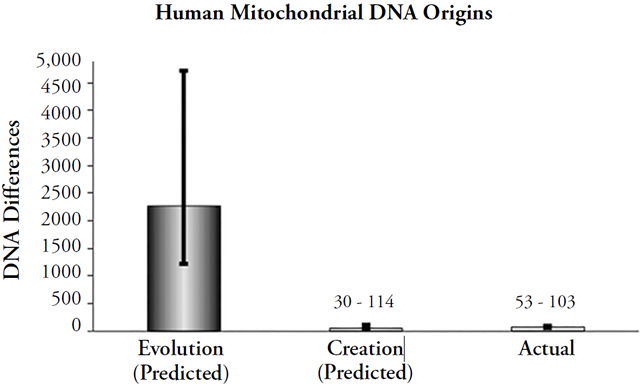
Specifically, we will assume for sake of argument that humans originated a long time ago (180,000 years ago under the evolutionary model) or recently (4,500 years ago…representing the end of the Flood). Then we will predict how many mtDNA differences should have accumulated in the timeframe specific to each model, after which we’ll compare these predictions to the actual number of differences in the current human population. Thus, by multiplying the measured mutation rate of mtDNA by 180,000 years or by 4,500 years, we can make testable predictions about the timescale of human origins.

Comparing these predictions to actual mtDNA differences at the global scale reveals a result that strongly contradicts the evolutionary timescale and confirms the biblical timescale.

Human Mitochondrial DNA Origins

After 180,000 years, human mtDNA would have accumulated over 2,000 DNA differences through the process of mutations. In just 4,500 years, humans would have accumulated only 30 to 114 mutations. Currently, in the most genetically diverse populations, about 78 differences exist on average, with a maximum difference of 120. Similar results hold true in animal species.

What does this matter?

Humans are a special creation of God as affirmed in Genesis. This means that whatever materials and processes God used, the results go beyond the natural. We need a real Adam and Eve if we are to make sense of the Bible and of life. People are both created (Genesis 1-2) and fallen (Genesis 3). They are worthy of the highest love and recipients of the greatest redemption.

For just as through the disobedience of the one man [Adam] the many were made sinners, so also through the obedience of the one man [Jesus] the many will be made righteous.

Romans 5:19

Because of this we can make sense of our origins and understand the source of our dignity, even people and groups violate that dignity so often. Blaise Pascal, in his Pensees, gives this insight:

Man’s greatness is so obvious that it can even be deduced from his wretchedness, for what is nature in animals we call wretchedness in man, thus recognizing that, if his nature is today like that of the animals, he must have fallen from some better state which was once his own.

Humanity is one family, one human race, giving everyone equal worth and dignity.

Modern genetics shows us that there is .1% difference genetically between people. Of this .1% difference, skin color, what is called “race,” makes up .01% of the human genetic makeup. This truly shows that race is only skin deep. The genetic differences hardly count for anything. Dr. Craig Venter, head of the Celera Genomics reveals, “Race is a social concept, not a scientific one.” Racial categories recognized by society are just not reflected on the genetic level. This is true at the biblical level, as well. Paul declares:

From one man he made all the nations, that they should inhabit the whole earth; and he marked out their appointed times in history and the boundaries of their lands.

Acts 17:26

There is only one race of people, the human race. We all have a common tie of dignity from God our Creator. In C. S. Lewis’ Chronicles of Narnia, Aslan told Prince Caspian, who was disheartened to learn that he was descended from pirates who found their way from our world to the world of Narnia.

Caspian: “I was wishing that I came from a more honourable lineage.”

Aslan: “You come of the Lord Adam and the Lady Eve. And that is both honour enough to erect the head of the poorest beggar, and shame enough to bow the shoulders of the greatest emperor on earth. Be content.”

This is reason enough to exalt our dignity and humble our ill-gotten arrogance at the same time.