

Were Adam and Eve historical people, the original parents of the human race as Genesis describes? This article will affirm this claim with a solid, YES. There has, of course, been serious allegation levelled against the truth of the Genesis story. One of the biggest comes from the modern science of genetics. Here are three:
- Allegation # 1: DNA reveals human beings share a common ancestry with primates like chimpanzees, orangutans, bonobos. Humanity is not a special creation but the result of common descent with other animals.
- Allegation # 2: The genetic diversity in the present human population requires a much larger gene pool than two people can provide from a recent history. Humanity had to arise from an existing population of no less than 10,000 people to account for existing genetic diversity.
- Allegation # 3: The process of DNA development within the human population would have taken hundreds of thousands of years.
What this article will do is seek to answer each of these allegations and further show that the Genesis account of Adam and Eve as our first parents from approximately six thousand years ago makes better sense of the current data. Further, we will see why a belief in the historical Adam and Eve gives all humanity an equal basis for dignity.
Common Design or Common Descent?
Ever since Darwin, it has been affirmed that primates represent humanity’s closest living relatives. Current evolutionary literature identifies the chimpanzee as our closest living biological relative. Because of the similarity of the DNA, it is claimed that this is evidence of a common descent. It is estimated that this ancestral line of humans from chimps broke off 3-13 million years ago. If you accept the premise that the difference between chimps and humans could have occurred through gradual changes (mutations) over 3-13 millions of years, that is still not enough time to explain the enormous genetic gap that exists between humans and chimpanzees.
One way to think of how genes are passed on is like the process of copying the text of a book. In the copying process errors are made. In the realm of genetics, DNA are the letters of the text, and the errors are called mutations. The corrupted copy (mutations) is then used for the next round of copying. Dr. Nathaniel Jeanson who holds a PhD in cell and developmental biology from Harvard University, further clarifies, “The DNA in our cells is, in essence, a chemical instruction manual for building and maintaining our anatomy and physiology from conception to death…[which] carries biological meaning. In total, the DNA in our cells is billions of letters long, six billion to be more precise. This is a very large biological “book.”
Jeanson goes on to explain:
When DNA is copied in sperm and egg cells prior to conception, the copying process is imperfect. The rate of copying mistakes (called mutations) has been measured in both humans and chimpanzees, and the rates are fairly similar. About 60 mutations happen each generation. Using rounded numbers, if the human and chimpanzee lineages split 3–13 million years ago, and if the years from one generation to the next are about 20 years, then 150,000–650,000 generations have passed since the two species last shared a common ancestor. In each lineage, about 60 DNA mutations happen in each of those hundreds of thousands of generations leading to an expectation that the DNA of humans and the DNA of chimpanzees should differ by about 18–80 million DNA letters.
The actual difference is much larger. There are actually about 400 million (400,000,000) DNA letters of variation which is at least a 12 % difference. This level of variance creates an enormous and unbridgeable genetic chasm between the two species. Here are just some of the differences on the physical level:
- Humans are about 38% taller.
- Humans are 80% heavier.
- Humans live 50% longer.
- Humans have brains that are about 400% larger.
- Humans can’t interbreed with chimps.
- Humans can’t interchange body parts with chimps.
It stands to reason that if God is the original Designer than there would be common materials used in the designing: materials as DNA, carbohydrates, fats, and protein, when making various animal kinds. Design is different than descent. Genesis 2:7 appears to imply this when establishing that “God formed a man from the dust of the ground…” God did not establish the primates as close cousins but rather as animals in which we are to provide care and stewardship. (Genesis 2:20)
A Population or a Pair?
Population: For many years there was no way through science to know how small or large the human population was like at the dawn of mankind. Fossils and historical records regarding this time give very few clues. Only with the advent of modern genetics have scientists been able to more directly explore this question. Here is how. Through genome sequencing, we know that there are about 3-5 million DNA letter differences which exist among the average human. This is about 0.1% of the total human DNA sequence. From an evolutionary point-of-view, 60 mutations per generation from two originating parents can’t produce this much diversity among humans in just 6,000 years. So, it is reasoned that the genetic diversity had to come from a population of at least 10,000 people. Our human ancestors would have come from this genetic pool, thus allowing for the 3-5 million DNA variations seen today.
Pair: So, how could the genetic variations spring from two people nearly 6,000 years ago? Let’s assume the biblical account of two supernaturally created people, who did not have any genetic differences between due to mutations and, of course, the XX (female) and XY (male) chromosomes, specifying gender. If Adam and Eve decided to fulfill God’s command to “be fruitful and multiply and fill the earth” (Genesis 1:28), they would have passed on two identical DNA sequences to their offspring. Adam and Eve would have basically produced copies of themselves — not somewhat modified versions of themselves we are used to seeing in our own children, but identical copies. Being completely identical this would make them clones. In this scenario, the human race would be populated with clones. This is not acceptable, of course.
Rather, God could have created Adam and Eve with built in recessive or latent genetic differences from the start. (e.g., skin color, eye color) Think of it this way, all of us possess 6 billion letters of DNA in our cells. 3 billion of these come from mom and 3 billion from dad. This is a constant going back to every generation starting with Adam and Eve. They would have had the same cellular arrangement — two versions of 3 billion letters totaling 6 billion, and Eve would have had two versions of 3 billion totaling 6 billion. Before the Fall and after the Fall, the two different copies of Adam and Eve’s DNA would have been reshuffled through recombination.
Again Jeanson explains:
This would make each offspring unique and lead to diversity within the human race. After the Fall, mutations (perhaps at a rate of 60 mutations per generation) would have occurred and added to the genetic diversity in their children, and leading to the production of diverse offspring (in contrast to cloning). Calculations within the parameters of this model match the worldwide DNA diversity that we observe today.
Ancient or Recent?
Is it possible to measure the DNA changes which have occurred through time and calculate how long humans have been in existence? The transmission of 60 DNA mutations from parent to offspring should enable us to mark the passage of one generation to another. However, knowing how much time has passed requires knowing when the clock — whether mechanical or biological — actually started ticking. Most DNA differences may not represent mutations at all; they may have been supernaturally created in Adam and Eve from the start — e.g., Adam and Eve would have been created with genetic differences. Thus, when we’re evaluating the billions of DNA letters in our cells and trying to determine when the differences began arising, it’s as if we were asked how long a clock has been ticking.
The vast majority of DNA letters in our cells do not lend themselves to clear tracking because they are combined with the mother and father. There is, however, a tiny section of DNA about 16,500 letters long called mitochondria (mtDNA) which comes only from the mother. This is a powerhouse DNA which turns food into energy. This DNA is found in both males and females, but only females pass it on to their offspring. Because of this, even evolutionary scientists agree that the current mtDNA differences among modern humans are traceable to a single woman in the past, whom they label “Mitochondrial Eve.” But is this “Eve” traceable back to a woman who was part of a larger population of 10,000 people 180,000 years ago? Or is this the biblical Eve from 6,000 years ago?
To use mtDNA as a clock, the mutation rate can be measured based on either the evolutionary timescale or on an earlier timescale fitting with the Genesis account. Again Jeanson explains this process:
Specifically, we will assume for sake of argument that humans originated a long time ago (180,000 years ago under the evolutionary model) or recently (4,500 years ago…representing the end of the Flood). Then we will predict how many mtDNA differences should have accumulated in the timeframe specific to each model, after which we’ll compare these predictions to the actual number of differences in the current human population. Thus, by multiplying the measured mutation rate of mtDNA by 180,000 years or by 4,500 years, we can make testable predictions about the timescale of human origins.
Comparing these predictions to actual mtDNA differences at the global scale reveals a result that strongly contradicts the evolutionary timescale and confirms the biblical timescale.
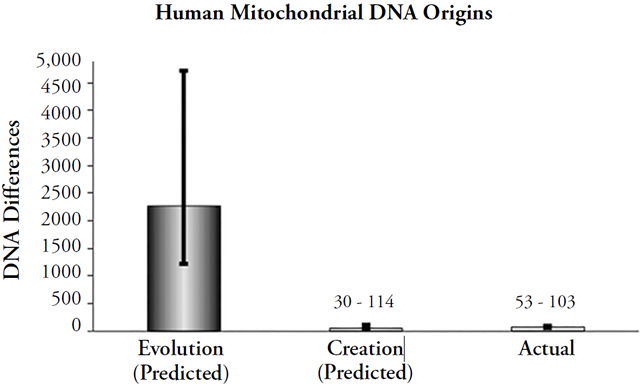
After 180,000 years, human mtDNA would have accumulated over 2,000 DNA differences through the process of mutations. In just 4,500 years, humans would have accumulated only 30 to 114 mutations. Currently, in the most genetically diverse populations, about 78 differences exist on average, with a maximum difference of 120. Similar results hold true in animal species.
What does this matter?
Humans are a special creation of God as affirmed in Genesis. This means that whatever materials and processes God used, the results go beyond the natural. We need a real Adam and Eve if we are to make sense of the Bible and of life. People are both created (Genesis 1-2) and fallen (Genesis 3). They are worthy of the highest love and recipients of the greatest redemption.
For just as through the disobedience of the one man [Adam] the many were made sinners, so also through the obedience of the one man [Jesus] the many will be made righteous.
Romans 5:19
Because of this we can make sense of our origins and understand the source of our dignity, even people and groups violate that dignity so often. Blaise Pascal, in his Pensees, gives this insight:
Man’s greatness is so obvious that it can even be deduced from his wretchedness, for what is nature in animals we call wretchedness in man, thus recognizing that, if his nature is today like that of the animals, he must have fallen from some better state which was once his own.
Humanity is one family, one human race, giving everyone equal worth and dignity.
Modern genetics shows us that there is .1% difference genetically between people. Of this .1% difference, skin color, what is called “race,” makes up .01% of the human genetic makeup. This truly shows that race is only skin deep. The genetic differences hardly count for anything. Dr. Craig Venter, head of the Celera Genomics reveals, “Race is a social concept, not a scientific one.” Racial categories recognized by society are just not reflected on the genetic level. This is true at the biblical level, as well. Paul declares:
From one man he made all the nations, that they should inhabit the whole earth; and he marked out their appointed times in history and the boundaries of their lands.
Acts 17:26
There is only one race of people, the human race. We all have a common tie of dignity from God our Creator. In C. S. Lewis’ Chronicles of Narnia, Aslan told Prince Caspian, who was disheartened to learn that he was descended from pirates who found their way from our world to the world of Narnia.
Caspian: “I was wishing that I came from a more honourable lineage.”
Aslan: “You come of the Lord Adam and the Lady Eve. And that is both honour enough to erect the head of the poorest beggar, and shame enough to bow the shoulders of the greatest emperor on earth. Be content.”
This is reason enough to exalt our dignity and humble our ill-gotten arrogance at the same time.
 Story of Grace
Dear Anthony
A wonderful article, thank you so much. I say there is no such thing as racial differences as we are all one race, the human race descended from Adam and Eve. It took we a while to see through the deception of Satan and his cronies (I am a bit slow), but I got there in the end.
Evolutionary theory is a case of smoke and mirrors, a house of cards waiting to fall.
Kind regards
Baldmichael Theresoluteprotector’sson
Please excuse the nom-de-plume, this is as much for fun as a riddle for people to solve if they wish.
LikeLike
Thank you for your comment and input. Greatly appreciated.
LikeLiked by 1 person
Dear Anthony;
I really enjoyed this article as I do all your articles and videos. Thank you for your witness, your prayers and your dedication to our Lord and Savior.
LikeLike
Anne,
Thank you for your comment and encouragement. I have appreciated your thoughtfulness during our wonderful times together.
LikeLike