

“He makes nations great, and destroys them; he enlarges nations, and disperses them.”
Job 12:23
Every culture and nation has a rise and fall or at least a decline. The Bible declares this pattern to be an act of God. Yet, this act is not arbitrary, for within this pattern of rising and falling, there are virtues within each nation that cause them to rise and the vices which cause them to fall. This is illustrated profoundly in the story of the Amorites: a people group who ascended through the power of strength and freedom, but descended because over time they idolized these qualities above all else, sacrificing the vitality of which their future depended–their children.
God told Abraham (c.2000 B.C.) that his descendants entry into the Promise Land would be linked to the timing of the sin of the Amorites reaching its “full measure,” who were at that time an ascendant power.
13Then the Lord said to him, “Know for certain that for four hundred years your descendants will be strangers in a country not their own and that they will be enslaved and mistreated there. 14But I will punish the nation they serve as slaves, and afterward they will come out with great possessions. 15You, however, will go to your ancestors in peace and be buried at a good old age. 16In the fourth generation your descendants will come back here, for the sin of the Amorites has not yet reached its full measure.”
Genesis 15:13-16
This article will contend that this sin of the Amorites is referencing the results of a sin which plagues societies today: the preservation of freedom at the sacrifice of children and the legacy of the future.
The Strength of the Amorites
Strength and Flexibility
The Amorites positively introduced new economic and social freedoms which allowed for many significant economic developments and even the free movement of Abraham. From the time of the Flood (c. 2500 B.C.), they descended from Canaan (grandson of Noah) which means they were grouped together under the title, Canaanites.
Canaan was the father of Sidon his firstborn, and of the Hittites, Jebusites, Amorites, Girgashites,
Genesis 10:15-16
The Amorites began to arrive in the territory to the west of the Euphrates (around Sumer on the map below), modern Syria. There was no actual invasion, but rather for a period of five hundred years they drifted down into southern Mesopotamia, integrating into Sumerian civilization where they lived in enclaves.
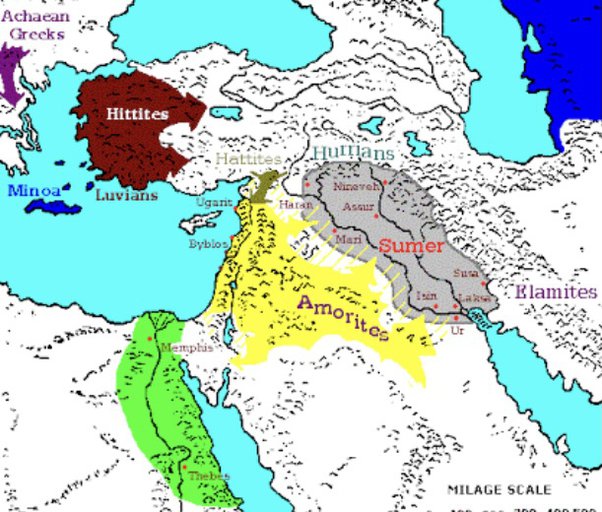
The fall of Sumerian civilization, around 2000 BC left a vacuum that lasted for about a century. Conflict and chaos in the Sumerian state were eventually overcome as the Amorites began to rise in power and importance and they were in a strong position to pick up the pieces. They expanded and became dominant for about 400 years. At the time of Abraham some of the Amorites lived in Hazazon (Genesis 14:7), a large active oasis on the western shore of the Dead Sea. When the Exodus (c. 1446 BC) came about they ruled much of Canaan and Jordan.
As Israel tried to enter the Promised Land, they were chased out by the Amorites:
44The Amorites who lived in those hills came out against you; they chased you like a swarm of bees and beat you down from Seir all the way to Hormah. 45You came back and wept before the Lord, but he paid no attention to your weeping and turned a deaf ear to you. 46And so you stayed in Kadesh many days—all the time you spent there.
Deuteronomy 1:44-46
This means that the Amorite power center was the Transjordan, but they were still west of the Dead Sea during the time of the Exodus. On the other hand, Judges 1:34-36 says they banished the tribe of Dan into the mountains and they lived in the Valleys.
34The Amorites confined the Danites to the hill country, not allowing them to come down into the plain. 35And the Amorites were determined also to hold out in Mount Heres, Aijalon and Shaalbim, but when the power of the tribes of Joseph increased, they too were pressed into forced labor. 36The boundary of the Amorites was from Scorpion Pass [ascent of Akrabbim] to Sela and beyond.
Judges 1:34-36

From this record, it shows they were physically powerful and socially agile and could maneuver and fit into many different places. This strength and flexibility set them apart giving them unique skills for adaptation and conquest. This was a new advance in humanity learning the power of its human potential.
Freedom
Given their strength and flexibility, the Amorites also created a new society of free subjects able to farm their own lands and conduct business as they saw fit. They founded many of the basic concepts of early mathematics, developing multiplication which aided in mercantile and sales transactions. They also had literary development which led to the creation of the Code of Hammurabi, as a series of laws which emphasized the pursuit of justice, especially in relation to commerce. This set a precedent for later law codes. As they took over as rulers, the Amorites became entrepreneurial leaders who freed much of their civilization to own land and cultivate it for profit.
Abraham
Ezekiel 16:3 says that Terah, the father of Abraham, was an Amorite. Genesis 11:31 says they went from Ur to Haran on their way to Canaan.
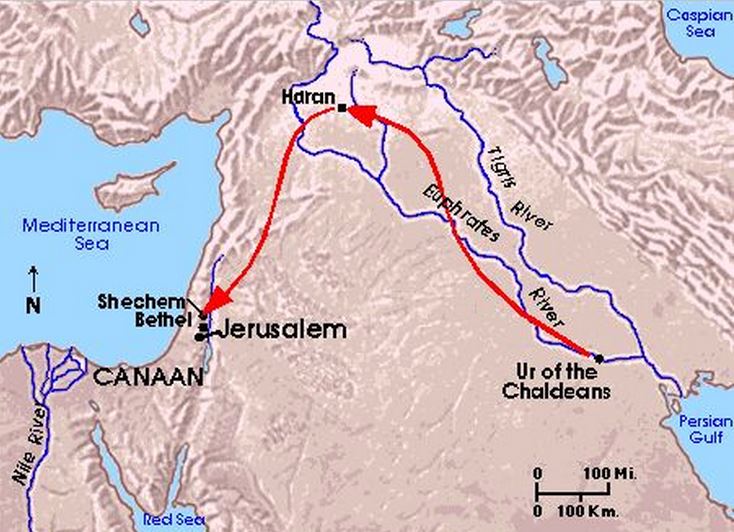
A. L. Oppenheimer, of the University of Chicago, adds, “There seem to have been few periods in the history of the region [Mesopotamia] when . . .a private person could move [herds] around freely.” The historical record and the biblical account appear to overlap nicely with what we know regarding the migrations of the Amorites and the travel of Abraham.
Power & Prosperity at any Cost
So, what was the “sin of the Amorites” which would lead to their decline? R. A. Stewart Macalister (1870 –1950) was an Irish archaeologist who studied historic areas where the Amorites were inhabitants. He looked particularly in the high places (elevated pieces of ground where sacrifices were made to pagan gods) of Gezer, which is where the Amorites would have dwelled. He documented his findings of child sacrifice. He associated his findings with biblical record of the “sin of the Amorites”(Genesis 15:16) in his publication “Bible side-lights from the mound of Gezer.” He observed the evidence of human sacrifice on a barbaric scale. Among other things, he found the remains of burnt babies who were burnt in cultic ritual. This mirrored the warnings given by Moses:
You must not worship the Lord your God in their way, because in worshiping their gods, they do all kinds of detestable things the Lord hates. They even burn their sons and daughters in the fire as sacrifices to their gods.
Deuteronomy 12:31
The Reason for Child Sacrifice
At the heart of child sacrifice is the perverse desire for power. The idea was that the more important and pure the sacrifice, the more it would satisfy the gods and provide favor and power to those making the sacrifice. This was true in the time of the Amorites, and it is still the justification for many of the ways children are sacrificed today.
Cultic
Child offerings are literally done in parts of Africa today. Dennis Kilma describes the reason for the practice in Uganda:
Through child sacrifice, many Africans believe they can secure wealth and happiness. Thus child sacrifice today is about much more than religion. Through it, and the mediation of the spirits, many Africans believe they can secure wealth and happiness. It’s a means to an end: the purer the sacrifice the more influential its power; the greater one’s desire the greater the sacrifice needs to be. Because political or material gain is not cheap in the African spirit world. While animal blood sacrifices can achieve much, many hold that a child’s blood is unparalleled in its effect.
Clinical (Abortion)
The fundamental justification for abortion is increased freedom. This is why politically it is called pro-choice. According to one study the main reason has to do with financial freedom or financial ability. Ultimately, the carrying, delivery and raising of a child presents a major limitation on human mobility and financial advancement. Pregnancy often interferes with future opportunities. The sacrifice of children in the womb is the price that must be paid for our dreams to be lived out.
The Result
Society devalues the worth of life. When a human being’s right to live is based upon someone else’s evaluation of their worth, then life is severely cheapened in value. It is a dangerous place when we can determine who is disposable or sacrificial based off of what we judge as valuable. Our value as humans comes from our being made in the image of God. Human beings do not get to define their own existence and meaning. That is something which is given to us by our Creator.
“No society that permits the active or passive killing of people because they are unwanted can long survive. No society that defines away personhood has any claim to knowing right from wrong. Whose personhood will the government define away next?”
Andrew Napolitano
This cheapening of life reduces the strength of society leading to decline.
Society declines in quality of life. As life is devalued, then society loses the compass of its direction and source of its moral strength. One of the greatest dangers facing us today is depopulation. For the first time in America’s history, we are trending toward a decreasing population as the number of births is not replacing the death rate. The results of this will be an unbearable burden of the younger generations unable to care for the older generations, either through financial resources or human labor. Further, there is a loss of economic growth and influence in the world. A hallmark of American growth and confidence has been an expanding population. Eliminating a population through abortion destroys a population that will work and pay taxes and imposes a serious economic loss. This has already been happening in Europe over the last three decades. Social scientists Nicholas Eberstadt writes why:
Back in the 1980s, after most of Western Europe had gone sub-replacement, two Flemish demographers diagnosed what they identified… The symptoms of this new demographic order included rising cohabitation and serial partnerships in the place of marriage, increasing childlessness, declining family size for those who did bear children, and a shift to more or less permanent sub-replacement fertility. In their diagnosis, this fundamental social change was driven by a transformation of values…In their assessment, the new demography of Europe was powered by a quest for “self-actualization,” for “personal autonomy.” Old family forms and fertility patterns did not square terribly well with these new and widely accepted personal imperatives, and so they gave way.
The reasons for these population changes are one centered on the promise of freedom: “self-actualization” and “personal autonomy.” A declining population is a sure signal of a society’s loss of confidence in the future and decline. There is a sacrificing of the vitality of the future in the effort to hang on to freedom in the present. The Amorites killed their babies because they wanted to maintain their power and dominance. We kill babies because we want a better life. The only difference between us and the Amorites is that they sacrificed children to their gods, while we sacrifice them to ourselves.
 Story of Grace