

The Phoenicians were an ancient civilization located in modern-day Lebanon, north of Israel, which are credited with achievements fundamental to the advance of God’s purposes in the world. They were the first to conquer the seas and develop a complex network of maritime trade in North Africa, Spain, Italy, and Greece. They invented glass, a luxury purple dye (which was worth three times the value of gold); but their most significant accomplishment was the development of the alphabet and the widespread use of papyrus, which became indispensable for the formation of the Bible and the spread of literacy. In this article we will look at the remarkable way God protected and used this very tiny group of people to have an outsized influence.
Who Were the Phoenicians?
In Genesis 10 we learn the origins of the Phoenicians with Sidon, whose was father was Canaan.
Canaan was the father of Sidon his firstborn, and of the Hittites, Jebusites, Amorites, Girgashites, Hivites, Arkites, Sinites, Arvadites, Zemarites and Hamathites. Later the Canaanite clans scattered and the borders of Canaan reached from Sidon toward Gerar as far as Gaza, and then toward Sodom, Gomorrah…
Genesis 10:15-18
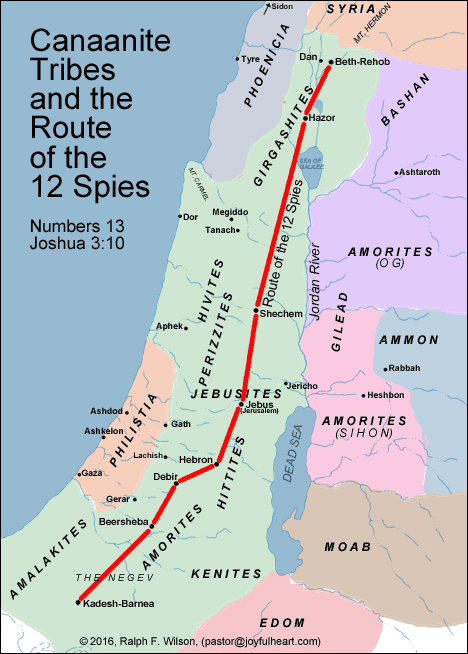
Sidon, one of the key cities of the Phoenicians along with Tyre and Byblos, was apparently named after the first born of Canaan, according to the passage above. The Phoenicians never ruled as one nation, but rather identified as a common culture or people. In fact, they never called themselves Phoenicians. This name was given to them by the Greeks with whom they traded. The root word for “Phoenician” is the Greek phoinikē, meaning “red,” which could refer to the luxury dye produced in the region. Though it was clear that the Phoenicians were Canaanites and their cities were in the borders of Israel, the Jews did not attempt to conquer them when they invaded. Joshua 11:8 describes the Israelites chasing Canaanite armies “all the way to Greater Sidon.”
So Joshua and his whole army came against them suddenly at the Waters of Merom and attacked them, and the Lord gave them into the hand of Israel. They defeated them and pursued them all the way to Greater Sidon, to Misrephoth Maim, and to the Valley of Mizpah on the east, until no survivors were left.
Joshua 11:7-8
This stopping at Greater Sidon can be seen as an act of God’s grace as we will see later.
About four hundred years later, during the reign of David (ca.1000 BC), he expanded Israel’s frontiers to include Philistia, Ammon, Edom, and the Syrians; but there was one region that David did not touch–just like his predecessor Joshua–Phoenicia. Far from going to war, David and the Phoenicians formed a strong alliance which led to King Hiram of Tyre providing cedarwood, carpenters and masons to build David’s palace.
Now Hiram king of Tyre sent envoys to David, along with cedar logs and carpenters and stonemasons, and they built a palace for David.
2 Samuel 5:11
The friendship between Israel and Phoenicia continued after David’s death. 1 Kings 5 shows that King Hiram sent a delegation to congratulate King Solomon on his coronation. We also know that Solomon hired the Tyrians to send cedarwood for construction of the temple in Jerusalem.
Solomon sent this message to Hiram king of Tyre: “Send me cedar logs as you did for my father David when you sent him cedar to build a palace to live in. Now I am about to build a temple for the Name of the Lord my God and to dedicate it to him…“
2 Chronicles 2:3-4
The reigns of David and Solomon represent the pinnacle of Israelite-Phoenician relations. Following the death of these two kings, relations between their peoples remained cordial until the time of the dispersion of Jerusalem in 586 B.C. by the Babylonians.
Why God Spared the Phoenicians
The Gift of Writing
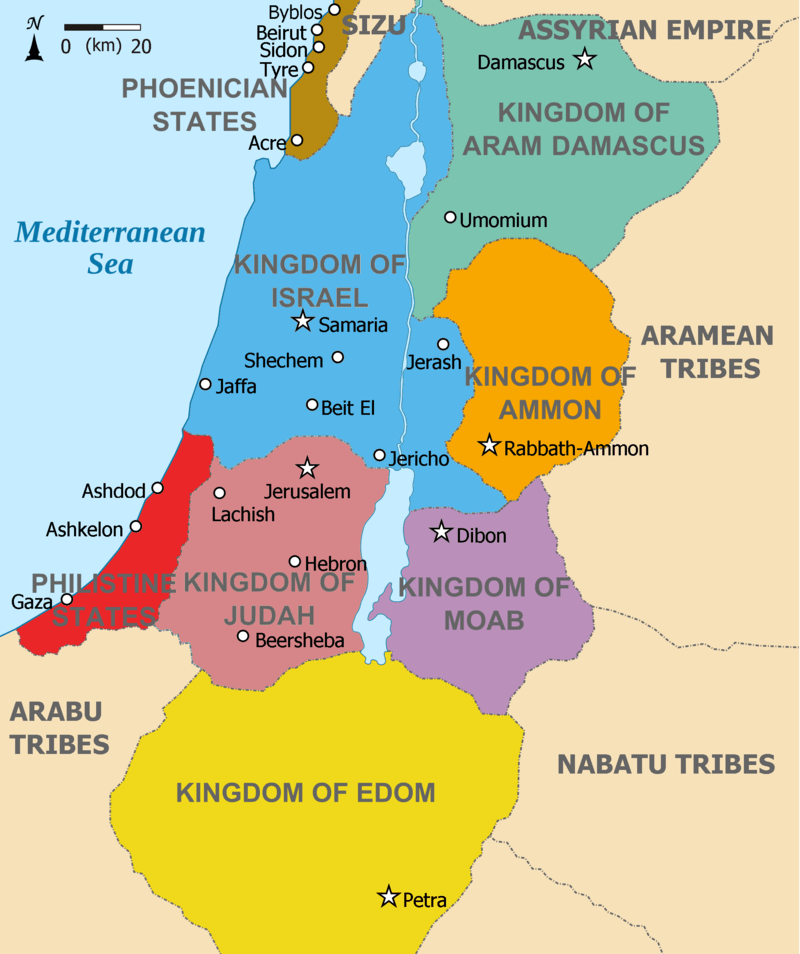
Before the Israelites entered the Canaanite territories, the Phoenicians emerged as a people group about 1800 BC. They occupied a narrow strip of coast because stronger kingdoms surrounded them which forced them to become urban and seafaring merchants. This was necessary for survival because of cedar forests to the east and inhospitable territory to the north and south. Their only option for economic survival was to exploit the sea to the west. They became the first world class ship builders and mariners, who engaged in trade in North Africa, Southern Europe and the coastal Levant (modern Israel and Lebanon). This was aided by the abundant cedar trees which grew so close to home that were especially prized for boat building. These cedar trees were highly durable, easy to shape, and resistant to deterioration in seawater. A remarkably preserved 2,000-year-old vessel was found submerged in the Sea of Galilee was made partially from these cedars. Because of the high volume of trade, their business dealings required an increasing number of contracts, record keeping, and documentation. They needed a way to write and transmit information with greater efficiency and found it necessary to utilize and develop a 22 letter alphabet.1
The Phoenician 22 letter alphabet represented a major advance over pictograph writing, where pictures communicate ideas or objects as in hieroglyphs and cuneiform. Pictograph writing could have up to 700 symbols, and only a very few (often religious priests) could effectively understand and utilize it. This meant that the vast majority of people were illiterate without any possibility of reading or writing limiting the flow of information. With the invention and spread of the alphabet, ordinary people, such as traders, could learn to read and write by memorizing a small number of symbols which represented sounds. This meant a far larger percentage of the population could transmit information that was recorded. This increased literacy revolutionized many aspects of life. Among those who were part of this revolution were the Jews because their Hebrew language (which the Old Testament was written in) came from this Phoenician alphabet.
The Origins of the Bible
During 330-64 BC, Byblos became famous as a center for importing and exporting papyrus, a plant grown along the Nile River of Egypt. This papyrus was formed into an early form of paper which was easier to write on. Because papyrus was one of the key articles of trade, the Greeks took the name of the city of Byblos as their word for book (biblos) which we get our name for Bible. In the fifth century A.D., Greek Church Fathers used the word “biblios” to refer to the sixty-six books of the Bible. The English word “Bible” is derived from the Greek name of the city and means “the (papyrus) book”.
Lessons
God has worked out his plan for all nations. Without the Phoenicians the Jews would not have had the Hebrew language for which the Old Testament is written. Without the Phoenicians the Jews would not have had the resources for building the Temple. Through Israel God’s distinctive plan of salvation was given to the nations, but the nations have had the privilege to contribute to that plan.
God advances his plan for the blessing of the world. Through the Phoenicians our world took the next steps toward freedom in realizing the potential of its God ordained image and destiny. Here are some of the ways:
- The world became more connected through trade which allowed for the expansion of knowledge.
- Literacy spread.
- The seeds of democracy were sown as some of Phoenician territories would later become Greek city states.
- There were advances in architecture as even the temple would be influenced by Phoenician design.
End Note
1It is important to know that a Semitic people living in Egypt may have invented the alphabet, but the Phoenicians developed it and caused it to have widespread use in the Mediterranean world.)


 Story of Grace