
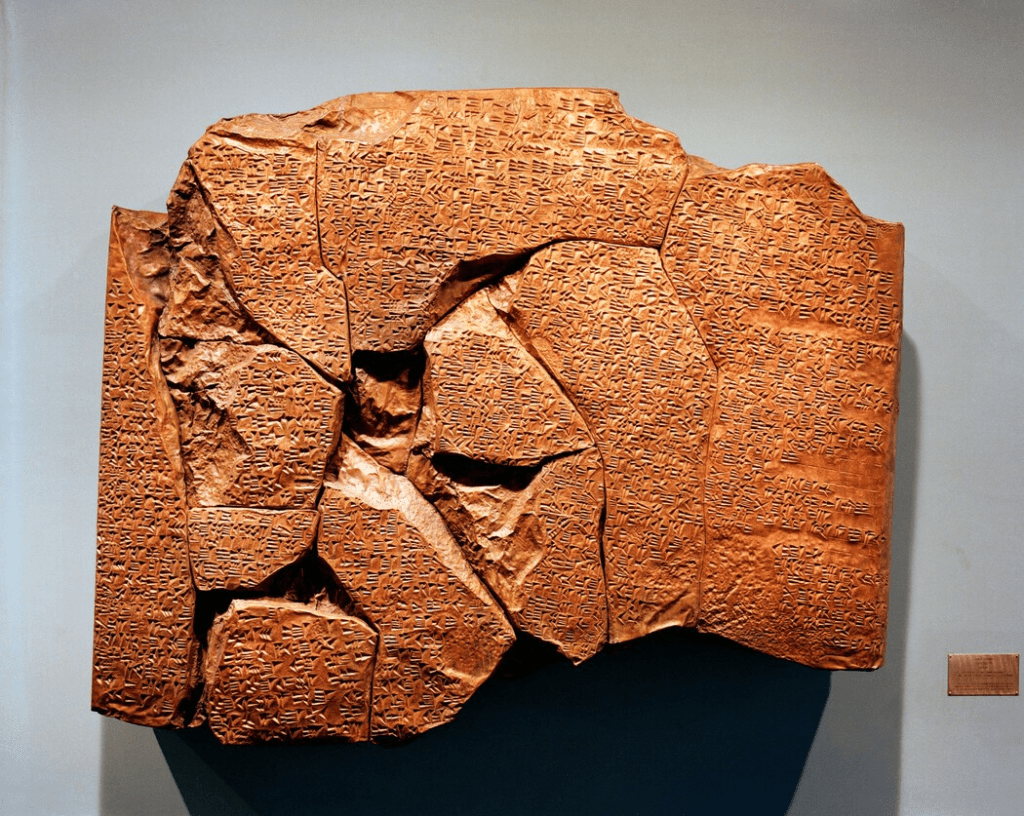
Hittites at the United Nations
Dominant from the period of approximately 1600 to 1200 B.C., the Hittites were masters of making stronger weapons, conducting trade, and entering into diplomatic negotiations. Because of their strategic location between Europe and Asia, they became a vital hub for trade routes which allowed them to accumulate wealth and expand their influence. They established extensive trade networks with neighboring regions trading textiles, metals, livestock, and agricultural products. Through their extensive trade they became exceptional in their diplomatic skills and became the first civilization to establish formal treaties with other nations ensuring increased cooperation. In fact, it was the Hittites which developed the first known international treaty of which there is currently a copy hanging on the wall of the United Nations.
From the form which these treaties took, God (Yahweh) would use the Hittite treaty as a model of the covenant he made with Israel through Moses and Joshua. In this article we will see how God used the Hittites to develop greater connections and cooperation among the nations advancing his trinitarian likeness of unity (one God) and cooperation among the diversity (three persons) of nations.
Founding Of the Hittite Kingdom

In Genesis 10, Noah’s grandson Canaan is described as the father of the Hittites. (Genesis 10:15) Beyond Genesis’ brief description of their origin, the Hittites as a group migrated west to Anatolia (modern Turkey) sometime around 2000 BC. Their start as a nation is dated to 1680 BC and is credited to Hattusili I. They eventually extended their territory toward Syria and the Levant (modern coastal Lebanon). The Bible records the Israelites having many contacts with the Hittites as apparently scattered groups lived throughout the Promised Land. Examples range from Hebron (Genesis 23:1-3), Beer-sheba (Genesis 26:33-34), the Hill Country (Numbers 13:29), Bethel (Judges 1:23-26), and Jerusalem (Ezekiel 16:3). These interactions included Abraham buying a grave to bury Sarah from the Hittites, Esau marrying two Hittites, king David lusted after Bath-sheba, the wife of Uriah the Hittite, who David caused to be killed (2 Samuel 11:3); and Solomon who married Hittite women (1 Kings 11:1). When Joshua was preparing to enter the land of Canaan after the death of Moses, the Lord promised Joshua that Israel’s territory would include all the land of the Hittites:
Your territory will extend from the desert to Lebanon, and from the great river, the Euphrates—all the Hittite country—to the Mediterranean Sea in the west.
Joshua 1:4
This reference to the Hittite country refers to that which was in the boundaries of Canaan as opposed to Anatolia.
Diplomacy and Treaties
The Hittites most enduring contribution was in the areas of diplomacy and formation of treaties which played a crucial role in civilization’s development and influence. Because they were very active in to conduct treaties and alliances with neighboring states, they became pioneers in international diplomacy. This came into play when Egypt and the Hittites originated the first known international peace treaty. This was born out of a rivalry between the Egyptians and Hittites over control of the Levant. Both saw this region as vital to their security and economic well-being. In 1274 BC the Hittite army under Muwatalli II confronted the forces of Ramses II at the border town of Kadesh. Their armies were roughly the same size, but Rameses had been misled into thinking that Muwatalli was far off and was therefore caught completely off guard. Hittites caught the Egyptians in an ambush just as they were setting camp and managed to scatter one of the Egyptian divisions. Believing themselves victorious, the Hittites began to loot the Egyptian camp. However, as Egyptian reinforcements arrived, they were able to drive them off and inflict great casualties.
After the Battle of Kadesh both the Egyptian and Hittitian sides decided to end the hostilities. Ramses II and Hattusili III came to realize that it was no longer worth the rising number of casualties when neither could substantially gain an advantage. The best course forward was the path of peace. The Hittites and Egyptians then entered into a new relationship of peaceful and cooperative relations in which they shared their knowledge and experiences. This was an innovation! The Hittites taught the Egyptians how to make superior weapons and tools while the Egyptians shared their own knowledge of agriculture with the Hittites. The two nations continued a mutually beneficial relationship until the fall of the Hittite Empire 1200 BC. The Hittite’s facility in treaty making made this peace agreement possible.
Hittite Treaties and Israel’s Covenant
Between 1906 and 1912, thousands of Hittite tablets and fragments were discovered in central Turkey (formerly Anatolia). In 1955, G. E. Mendenhall, a biblical scholar who taught at the University of Michigan, effectively made the case that the covenant of Moses and Joshua seem to have been similar in form to the Hittite treaties of the fourteenth-thirteenth centuries BC. This pattern is seen most clearly in the structure of the book of Deuteronomy but can also be discerned in Joshua 24 and Exodus 20. These parallels include:
- preamble of the covenant in which the Great King identifies himself
- historical prologue in which the Great King tells what he has done
- stipulations of the covenant in which the nation binds itself in accepting the demands of the covenant
- preservation of the covenant
- public reading of the covenant
- list of witnesses
- blessings and curses of the covenant
| preamble of the covenant in which the Great King identifies himself | Deuteronomy 1:1–5 | Joshua 24:2 | Exodus 20:1 |
| historical prologue in which the Great King tells what he has done | Deuteronomy 1:6–3:29 | Joshua 24:3–13 | Exodus 20:2 |
| stipulations of the covenant in which the nation binds itself in accepting the demands of the covenant | Deuteronomy 4:1–11:32 | Joshua 24:14-15 | Exodus 20:3–17 |
| preservation of the covenant & public reading of the covenant | Deuteronomy 12:1–26:19 | Joshua 24:16–25 | |
| list of witnesses | Deuteronomy 27:1–26 | Joshua 24:26 | Exodus 25:16; 34:1 |
| blessings and curses of the covenant | Deuteronomy 28:1–68 | Joshua 24:27 |
So What?
Dating the Covenant of Moses: The historical connection of the Hittite treaties and the Old Testament is significance because this provides further evidence to date the story of Moses and the Hebrews in the fifteenth century BC. (The exodus from Egypt occurred in 1446 BC.) This adds to the mounting evidence for the historicity of the Exodus in distinction from those who argued that the covenant of Moses was not invented until the eighth century BC. With the work of G.E. Mendenhall, we now know that these covenants were already in existence during the tradition date of the Exodus.
Theological Clarity of Grace: The nature of the Hittite treaty helps reinforce our understanding of grace. The covenant is not a contract, but rather a binding relationship. A contract establishes a limited and partial agreement between two parties, but a covenant is a lasting relationship forged from the deepest bonds of trust and fidelity. Lets look at the covenant of Joshua an example:
Preamble of the Covenant
Joshua said to all the people, “This is what the Lord, the God of Israel, says: ‘Long ago your ancestors, including Terah the father of Abraham and Nahor, lived beyond the Euphrates River and worshiped other gods.
Joshua 24:2
Accomplishments of the King
But I took your father Abraham from the land beyond the Euphrates and led him throughout Canaan and gave him many descendants. I gave him Isaac, and to Isaac I gave Jacob and Esau. I assigned the hill country of Seir to Esau, but Jacob and his family went down to Egypt. “‘Then I sent Moses and Aaron, and I afflicted the Egyptians by what I did there, and I brought you out. When I brought your people out of Egypt, you came to the sea, and the Egyptians pursued them with chariots and horsemen as far as the Red Sea. But they cried to the Lord for help, and he put darkness between you and the Egyptians; he brought the sea over them and covered them. You saw with your own eyes what I did to the Egyptians. Then you lived in the wilderness for a long time. “‘I brought you to the land of the Amorites who lived east of the Jordan. They fought against you, but I gave them into your hands. I destroyed them from before you, and you took possession of their land. When Balak son of Zippor, the king of Moab, prepared to fight against Israel, he sent for Balaam son of Beor to put a curse on you. But I would not listen to Balaam, so he blessed you again and again, and I delivered you out of his hand. “‘Then you crossed the Jordan and came to Jericho. The citizens of Jericho fought against you, as did also the Amorites, Perizzites, Canaanites, Hittites, Girgashites, Hivites and Jebusites, but I gave them into your hands. I sent the hornet ahead of you, which drove them out before you—also the two Amorite kings. You did not do it with your own sword and bow. So I gave you a land on which you did not toil and cities you did not build; and you live in them and eat from vineyards and olive groves that you did not plant.’
Joshua 24:3-13
The Covenant Stipulations
“Now fear the Lord and serve him with all faithfulness. Throw away the gods your ancestors worshiped beyond the Euphrates River and in Egypt, and serve the Lord. But if serving the Lord seems undesirable to you, then choose for yourselves this day whom you will serve, whether the gods your ancestors served beyond the Euphrates, or the gods of the Amorites, in whose land you are living. But as for me and my household, we will serve the Lord.”
Joshua 24:14-15
Preservation and Public Reading of the Covenant
Then the people answered, “Far be it from us to forsake the Lord to serve other gods! It was the Lord our God himself who brought us and our parents up out of Egypt, from that land of slavery, and performed those great signs before our eyes. He protected us on our entire journey and among all the nations through which we traveled. And the Lord drove out before us all the nations, including the Amorites, who lived in the land. We too will serve the Lord, because he is our God.” Joshua said to the people, “You are not able to serve the Lord. He is a holy God; he is a jealous God. He will not forgive your rebellion and your sins. If you forsake the Lord and serve foreign gods, he will turn and bring disaster on you and make an end of you, after he has been good to you.” But the people said to Joshua, “No! We will serve the Lord.” Then Joshua said, “You are witnesses against yourselves that you have chosen to serve the Lord.” “Yes, we are witnesses,” they replied. “Now then,” said Joshua, “throw away the foreign gods that are among you and yield your hearts to the Lord, the God of Israel.” And the people said to Joshua, “We will serve the Lord our God and obey him.” On that day Joshua made a covenant for the people, and there at Shechem he reaffirmed for them decrees and laws.
Joshua 24:16-23
Binding Witness
And Joshua recorded these things in the Book of the Law of God. Then he took a large stone and set it up there under the oak near the holy place of the Lord.
Joshua 24:26
Blessings and Curses (implied)
“See!” he said to all the people. “This stone will be a witness against us. It has heard all the words the Lord has said to us. It will be a witness against you if you are untrue to your God.”
Joshua 24:27
International Cooperation: As the story of God’s grace advances, the nations are learning that they can take further steps in agreement and cooperation and live in peace, at least temporarily. In their diversity they can experience an increased unity. This further reflects the diversity and unity in the Trinity, three-in-one…the advance of his Story of Grace among the world.
 Story of Grace