

In God’s unfolding Story of Grace we see a Persian king, Cyrus the Great, who inaugurated the first universal declaration of human rights which afforded religious and cultural tolerance over a plurality of nations. This is significant in that God further advanced the shaping of society to be modelled after his image as Trinity, one with social unity (like one God) that respects personal rights (like three persons). The goal of God is to have everything ultimately conform to his image. Cyrus represents a major step forward in God’s work through history to bring the world toward this outcome. Cyrus demonstrates two major truths:
- God is the one who is writing the world’s Story, even through pagans, who do not worship or follow him.
- God’s is writing this Story through the intertwining of creational (general) history and salvation (redemptive) history. Both necessarily work together.
In this article, we will see that Cyrus demonstrates the sovereign outworking of God’s plan where salvation and creational history work together in the first establishment of human rights.
A Pagan Messiah?
Cyrus is a king mentioned more than 30 times in the Bible. He reigned over Persia (modern day Iran) between 539—530 BC. He stands out in the Bible because it was under his rule that the Jews were first allowed to return to Israel after 70 years of captivity. (Ezra 1:1-8, 2 Chronicles 36:23) In relation to this, Cyrus is declared by the prophet Isaiah, as the Lord’s (YHWH’s) anointed or messiah.
This is what the Lord says to his anointed,
to Cyrus, whose right hand I take hold of
to subdue nations before him
and to strip kings of their armor,
to open doors before him
so that gates will not be shut…Isaiah 45:1
The word “anointed” in Hebrew is roughly transliterated into English as meshiach or messiah. In its earliest form it meant to anoint with oil in order to set apart a person for a special task, as in the priest. As the term came to be used in a more expanded sense, to anoint became related to a divine call and empowerment to advance God’s purposes on the earth. Many people are anointed in the Old Testament, and many are referred to as “anointed one,” but only a special group is designated “YHWH’s messiah,” as Cyrus is in Isaiah 45:1. The term “his anointed” and its equivalents are reserved for the kings in Israel. (Psalm 2:2, 132:10) Here it refers to a Persian monarch who does not acknowledge God.
It is surprising that God places his anointing on a pagan king, but another outstanding feature of this description is that it is a prophecy which Isaiah declared 200 years before Cyrus became king and for that matter was either born or named. This prophecy is directly preceded by a denunciation of the “false prophets” and “diviners”:
24“This is what the Lord says—
your Redeemer, who formed you in the womb: I am the Lord,
the Maker of all things,
who stretches out the heavens,
who spreads out the earth by myself,
25 who foils the signs of false prophets
and makes fools of diviners,
who overthrows the learning of the wise
and turns it into nonsense, 26 who carries out the words of his servants
and fulfills the predictions of his messengers, who says of Jerusalem, ‘It shall be inhabited,’
of the towns of Judah, ‘They shall be rebuilt,’
and of their ruins, ‘I will restore them,’
27 who says to the watery deep, ‘Be dry,
and I will dry up your streams,’ 28 who says of Cyrus, ‘He is my shepherd and will accomplish all that I please…Isaiah 44:24-28
So, nearly 200 years before Cyrus reigned, Isaiah (through the inspiration of the Holy Spirit), predicts the very name of the king–Cyrus (44:28)–who will shepherd the rebuilding and restoration of Jerusalem. (44:26) This true prophecy is in absolute contrast to the false prophets, diviners, and wise. (44:25) The scope of this is the Maker of all things, who stretches out the heavens, who spreads out the earth by myself… (44:24) When God blesses Israel, all of the nations of the earth are in view for blessing, as well, as was originally promised to Abraham. (Genesis 12:1-3) In chapter 45 we see in detail a remarkable prophecy:
1“This is what the Lord says to his anointed,
to Cyrus, whose right hand I take hold of
to subdue nations before him
and to strip kings of their armor,
to open doors before him
so that gates will not be shut:
2 I will go before you
and will level the mountains;
I will break down gates of bronze
and cut through bars of iron.
3 I will give you hidden treasures,
riches stored in secret places,
so that you may know that I am the Lord,
the God of Israel, who summons you by name.Isaiah 45:1-3
In Isaiah 45:1 God spoke directly to Cyrus by name. According to the ancient Jewish historian Josephus, “These things Cyrus knew from reading the book of prophecy which Isaiah had left behind two hundred and ten years earlier.” (Josephus, Antiquities XI, 5) Cyrus would be led by the hand of God and subdue nations before him. The Greek historian Xenophon cataloged the nations the Persian King overthrew:
Cyrus subdued…the Syrians, Assyrians, Arabians, Cappadocians, Phrygians, the Lydians, Carians, Phoenicians, Babylonians, the Bactrians, Indians, Cilicians, Sacians, Paphloagonians, Maryandines, and many other nations. He also had a dominion over the Asiatics, Greeks, Cyprians, Egyptians.
Herodotus, another Greek historian, records: “He vanquished whatever country soever he invaded.” Below is a map, provided by Ralph Wilson, demonstrating the 2 million square miles of territory of his conquest. This encompasses most of modern-day Iran, parts of Turkey, Iraq, Afghanistan, Pakistan, and Egypt.

God goes on to announce to Cyrus:
I will give you hidden treasures,
riches stored in secret places…
Isaiah 45:3
The Roman historian Pliny verifies these words: “When Cyrus conquered Asia, he found thirty-four thousand pounds weight of gold, besides golden vessels and articles in gold.” Isaiah continues, through the voice of the Lord, that God does it through his own graciousness alone:
4 For the sake of Jacob my servant,
of Israel my chosen,
I summon you by name
and bestow on you a title of honor,
though you do not acknowledge me.
5 I am the Lord, and there is no other;
apart from me there is no God.
I will strengthen you,
though you have not acknowledged me,
6 so that from the rising of the sun
to the place of its setting
people may know there is none besides me.
I am the Lord, and there is no other.Isaiah 45:4-6
God is magnified in the unfolding of his Story of Grace at work in the world. He blesses and guides the world even though he is not immediately acknowledged. Through his work in the world, it is evident that people experience his gracious hand of blessing. God is sovereign (completely guiding) over all of this:
I form the light and create darkness,
I bring prosperity and create disaster;
I, the Lord, do all these things.Isaiah 45:7
God is moving the events and people of this planet toward his righteous plan to spring up new life, reflecting his image:
“You heavens above, rain down my righteousness;
let the clouds shower it down.
Let the earth open wide,
let salvation spring up,
let righteousness flourish with it;
I, the Lord, have created it.Isaiah 45:8
The First Universal Declaration of Human Rights
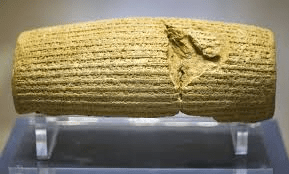
The call and raising up of Cyrus brought first and foremost the Jews back from captivity from Babylon to Jerusalem. (Ezra 1:1-8) This advanced God’s work of salvation and redemption, leading ultimately to Jesus Christ coming into the world. But his rule was also to cause salvation to spring up and righteousness to flourish with it. At the creational level, Cyrus’ reign brought an unprecedented advance of human rights for that time. The record of this is found today in what is known as the Cyrus Cylinder. The Cyrus Cylinder is a barrel-shaped cylinder of baked clay measuring 8.9 inches in length by 3.9 inches at its maximum diameter. It was created in several stages around a cone-shaped core of clay. This ancient record has been recognized as the first charter or declaration of human rights.
The Cyrus Cylinder, etched in Akkadian cuneiform script, describes the conquest of Babylon and King Cyrus’s intention to allow freedom of worship to communities displaced by the defeated Babylonian ruler, Nabonidus. In it is seen Cyrus’ respecting the languages, religions, and cultures of all the lands to which he laid claim. He believed that different faiths should co-exist. Cyrus also considered all nations and peoples to be equal in terms of their rights. Below are some statements from the Cyrus Cylinder:
[23] I took up my lordly abode in the royal palace amidst rejoicing and happiness. Marduk, the great lord, /established as his fate\ for me a magnanimous heart of one who loves Babylon, and I daily attended to his worship.
[24] My vast army marched into Babylon in peace; I did not permit anyone to frighten the people of [Sumer] /and\ Akkad.
[25] I sought the welfare of the city of Babylon and all its sacred centers.
[26] I relieved their weariness and freed them from their service.
[28] and in peace, before him, we mov[ed] around in friendship. [By his] exalted [word], all the kings who sit upon thrones
[29] throughout the world, from the Upper Sea to the Lower Sea, who live in the districts far-off], the kings of the West, who dwell in tents, all of them,
[32] I returned the images of the gods, who had resided there,note to their places and I let them dwell in eternal abodes. I gathered all their inhabitants and returned to them their dwellings.
[33] In addition, at the command of Marduk, the great lord, I settled in their habitations, in pleasing abodes, the gods of Sumer and Akkad, whom Nabonidus, to the anger of the lord of the gods, had brought into Babylon.
As a result of his humane policies, Cyrus gained the support of his subjects, thus securing the integrity of his empire. It is now translated into all six official languages of the United Nations, and its provisions parallel the first four Articles of the Universal Declaration of Human Rights.
What Do We Learn?
God shows that his creational and redemptive purposes are intertwined. God uses a pagan king to bring deliverance to his people and reestablish them in their homeland. This displays that God’s salvation purposes specific to redemption, and his purposes of creation are intertwined. This means that followers of Christ should work to discern the intersection of both.
God used Cyrus to advance the dignity of human rights. From Persia, the idea of human rights spread to Greece and eventually Rome. There, the concept of “natural law” arose, in observation of the fact that people tended to follow certain unwritten laws in the course of life. This has laid such foundational concepts which are later displayed in in the Magna Carta (1215), the US Constitution (1787), and the US Bill of Rights (1791).
 Story of Grace