

So rarely has the consequential unfolding of history been so on the line as the Battle of Salamis (480 B.C.). On this battle held the fate and destiny of Western Civilization itself. On the one side is the massive Persian military under Xerxes with an army considered the largest ever assembled-2,641,000 fighting men, according to Herodotus. Humorously he tells us that when “Xerxes armies drank the whole river ran dry.” The mass of this army is not surprising given that the Persian Empire, the largest to have ever existed at the time, had 70 million inhabitants living within 1 million square miles. This colossal power was intent on crushing the often warring and fractious Greek city-states which had 2 million inhabitants bordered in 50,000 square miles. The Persians were affluent with nearly unlimited resources in contrasts to the Greeks who, by comparison, were poor. This supersedes by any measure a David and Goliath analogy. At stake in this confrontation is the furtherance of personal freedom toward self-determination (represented by Greece), and the authoritarian and absolute rule over the masses by a very few (represented by Persia). In this battle is the literal determination of whether people will be able to form more closely into the image of the Trinity, where there is a heightened empowerment to personal freedom leading to a greater communal unity.
David (Greece) vs. Goliath (Persia)
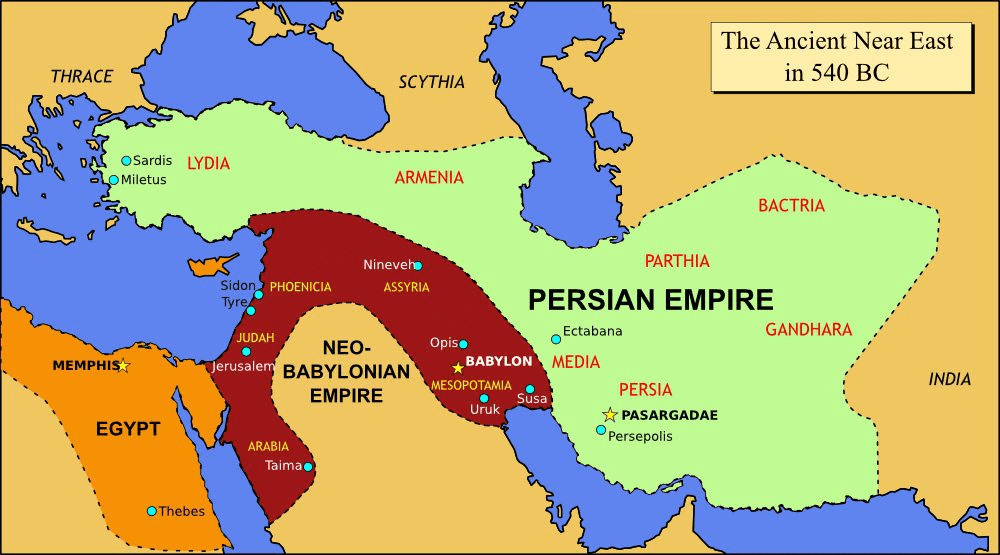
Cyrus the Great led the Persian Empire into its rapid expansion starting in 550 B.C. Before Cyrus, Persia was a small state under the control of the Medes (an ancient Iranian people). But as the map shows, Cyrus controlled most of modern day Iran, parts of Turkey and Mesopotamia by 540 B.C. This is all in one decade. Five kings and fifty years later, by 490 B.C., the Empire expands to more than 2 million square mile (as seen by the map below)–the largest the world has ever known.

Now with Xerxes (485-465 B.C.) in power, his aim is to expand their territory into Greece, which is at the furthest edge of their northeastern border. Xerxes father, Darius (522-486 B.C.) sought to conquer Greece in the Battle of Marathon (490 B.C.). This resulted in a major defeat for the Persians. Xerxes followed his father as monarch and inherited his father’s burden of expanding the Empire toward Greece. To accomplish what Darius had been unable to do, Xerxes inherited the largest and best equipped army at the time. With four years of preparation, in 480 B.C., he headed off to Greece with approximately 1 million men, along with an elite force of 10,000 warriors known as the immortals. It was here that Xerxes would conquer much of mainland Greece, even conquering and burning the great city of Athens, whose 10,000 men were no match for the invading horde. With victory over all of Greece assuredly in his grasps, Xerxes heads toward the isthmus of Salamis.
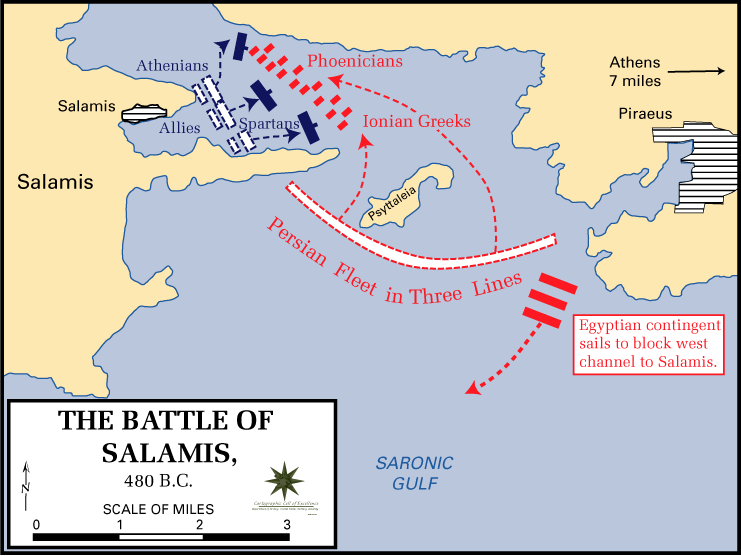
He is deceptively lured there by Themistocles. This ruse was led by the Greek general, Themistocles. From a young age he prepared himself for political life. He came from a family where governmental influence would not have been open to him. But under the new system of government, he was able to advance as he was motivated by a tremendous sense of ambition and guided by a charismatic personality and daring vision. He used his charm and gifting to ascend to the place of military general. The Greek form of democracy was the only place in the world which allowed a larger number of people like him to climb the social ladder. And it was now under threat of being crushed by Persia.
The Distinctions of East and West
Democracy had been in Greece since 510 B.C, which has been introduced to Athens through the reforms of Cleisthenes. At this point, democracy is about 30 years old. This spirit of democracy allowed for public deliberation by the citizens regarding policies which effected their lives. Further, they were allowed to be critical of their leaders. Property was more widely and freely held. There could be no execution without a proper trial. They had the ability to freely write and speak their opinions. These freedoms in Persia were unknown. The absolute rule of millions were in the hands of a very few. The king and his small court of relatives, which were “the eyes and ears” of the king, thrived through substantial collections of taxes and the vast ownership of estates. The largest farms in Greece were a hundred acres, but in Persia the farms were in the thousands. Criticism or oppositions of the king and his administration would certainly be met with a cruel death. When a nobleman asked Xerxes that his son be exempted from war, he had the nobleman’s son cut in half and required the father to walk between the severed pieces of his body. It is at this historical juncture that we see the formative development of the conflicts of East (Persia) versus West (Greece).

As the Battle of Salamis was to commence, it is nearly impossible to understand how impossible it was from the outmatched Greeks to win. The city of Athens has been abandoned and is going up in flames. There is no mainland to fight from in this area, so a land battle is an impossibility. The only option is a sea battle, yet its recently built fleet of 200 ships, of its 378, was unwilling to engage the enemy’s nearly 800 to 1,000 fighting vessels. (Herodotus and Aeschylus estimate that the Persian armada consisted of over a 1,000 ships with approximately 200,000 men.) A naval battle in the open sea would have led to a crushing defeat for the Greeks. So, Themistocles was convinced that the only hope of victory lay in the straights of Salamis where the superior numbers of the Persians would be less effective. Yet, he could not mobilize the military to confront the imperial giant because many of the commanders believed it to be a suicide mission.
To motivate the fearful leaders, Themistocles sent his slave, Sicinnus, to trick Xerxes into attacking the Greeks. Sicinnus delivered a message to Xerxes that said the Athenians were afraid and going to run away. The message also claimed that the Allied commanders were fighting among themselves. Xerxes believed the message and attacked the Greeks. With this attack, the fearful naval commanders were left with no choice but to defend themselves. Themistocles risky maneuver of trickery and deceit paid off. The Persians were defeated in the narrow straight of Salamis in the 12 hours of fighting. The more easily navigated triremes (Greek ships) were much more suited for this narrow warfare than the heavier ships of their enemies. The Persians were defeated with a loss of 200 ships and the Greeks with a loss of 40.
Legacy of Salamis
The Motivation of Freedom Is Advanced
The Greeks were able to fight and win because of freedom. Freedom created a greater morale and incentive to defeat the enemy. This was the understanding of Herodotus who commented:
As long as the Athenians were ruled by a despotic government, they had no greater success at war than any of their neighbors. Once the yoke was thrown off, they proved the finest fighters in the world.
After the victory at Salamis, Herodotus again tells us, that when the Persians attempted to mediate an agreement with the Athenians, they responded:
We know of ourselves that the power of the Persians is many times greater than ours. There is no need to taunt us with that. Nevertheless in our zeal for freedom we will defend ourselves to the best of our ability.
A year after the Salamis, Dirodorus tells us that the men in the Greek army were required to swear an oath beginning, “I shall fight to the death, and shall not count my life as more valuable than freedom.” Again, the same author records, that the Greeks dedicated a monument at the sanctuary of Dephi with the inscription, “The saviors of wide Greece set up this monument, having delivered their city-states from this loathsome slavery.”
As the Greeks were considering whether or not to continue in battle with the Persians, the leaders and citizens would engage in frenzied debate, disagreements and discussions. Herodotus characterized these constant deliberations as a “war of words,” and Diodorus described it as an “unrest of the masses.” This required the military’s generals and civic leaders to keep their thumb on the pulse of public opinion in relation to their decisions. In contrast to this, it was unthinkable for those in the Persian empire to express their opinions to Xerxes. This could very well lead to their death. The problem with this is that it shut out many good ideas, and blinded them to many mistakes and errors to avoid. In this major battle, freedom was confronted with a great test and came out the victor. The idea, meaning and reality of freedom was advanced.
The Power of Freedom is Advanced
Georg Hegel in his Philosophy of History reflects on the historic and momentous nature of the Battle of Salamis:
Oriental despotism—a world united under one lord and sovereign—on the one side, and separate states—insignificant in extent and resources, but animated by free individuality—on the other side, stood face to face. Never in history has the superiority of spiritual force over material bulk—and that of no contemptible amount—been made so gloriously manifest.”
It is of importance to remember that the idea of freedom was a couple of centuries old, and democracy itself was around three decades old. The practice of freedom was shared by only a few hundred thousand people in the backwaters of the Mediterranean. Had Salamis been lost by the Greeks it would have ended the eventual rise of Western civilization and its distinct institutions based on freedom altogether. Yet, now with Salamis won, the virus of freedom would be released and spread, and the strongest forces of oppression could not ultimately extinguish it.
The Meaning of Freedom Will Advance
It is not insignificant that when Christ came into the world, he was born at a time which had been greatly influenced by the Greeks.
Paul declares:
But when the fullness of time had come, God sent forth his Son, Christ came in the fullness of time.
Galatians 4:4
It was the Greek influence which allowed the apostles to have language and idea which could more clearly express the realities they experience with the revelation of Jesus and the expanding of the kingdom of God in the church. The New Testament was mainly written in Greek. Many ideas such as the logos (word), ecclesia (church/assembly), psuche (soul) express more of a Greek understanding. The early theology of the church would borrow heavily from Greek categories of thought.
God has ordered all of the nations of the world that they should come into the fullness of his purposes which are designed to advance the Story of Grace which is being written in the world.
26 From one man he made all the nations, that they should inhabit the whole earth; and he marked out their appointed times in history and the boundaries of their lands. 27 God did this so that they would seek him and perhaps reach out for him and find him, though he is not far from any one of us. 28 ‘For in him we live and move and have our being.
Acts 17:26-28
 Story of Grace