

Alexander the Great (356 BC – 323 BC) was a world historical force with “god-like” powers to shift the entire directions of nations and continents. In a period of 12 years he conquered the Persian Empire which spanned from Egypt to India and extended his conquests to cover approximately 2 million square miles. He achieved legendary victories in some of the most epic battles which displayed a tactical brilliance of extraordinary skill. As a result he spread the culture and language of the Greeks which would pave the way eventually for the Roman Empire and allow for the rapid advance of Christianity 300 years later. In this article and the next articles we will see how God, in His Story of Grace, used Alexander to expand civilization after the trinitarian image of bringing increased unity (the one) among the nations which carried with it the idea of individual freedom (the many). We will also see that Alexander’s record is tragically mixed.
In this article we will look at Alexander from the perspective of biblical prophecy in Daniel 8. We will understand that the large scale events of history and the world are under God’s hand to accomplish His Story of Grace.
Daniel’s Vision
Daniel received a prophecy regarding the overthrow of the Persian Empire and the advance of the Greek Empire around 553-554 B.C., approximately 200 years before it unfolded. The language is apocalyptic (which means to “unveil”). It opens up the curtain of what is seen so that we may peer beyond what we naturally see to understand bigger realities shaping world events. To do this it uses ideas and concepts we do understand to reveal concepts and ideas we do not as easily understand. Daniel is given the vision of a ram with two horns (representing Persia) and a goat with one horn between its eyes (representing Greece and the conquest of Alexander). The vision reads as follows:
1In the third year of King Belshazzar’s reign, I, Daniel, had a vision, after the one that had already appeared to me. 2 In my vision I saw myself in the citadel of Susa in the province of Elam; in the vision I was beside the Ulai Canal. 3 I looked up, and there before me was a ram with two horns, standing beside the canal, and the horns were long. One of the horns was longer than the other but grew up later. 4 I watched the ram as it charged toward the west and the north and the south. No animal could stand against it, and none could rescue from its power. It did as it pleased and became great.5 As I was thinking about this, suddenly a goat with a prominent horn between its eyes came from the west, crossing the whole earth without touching the ground. 6 It came toward the two-horned ram I had seen standing beside the canal and charged at it in great rage. 7 I saw it attack the ram furiously, striking the ram and shattering its two horns. The ram was powerless to stand against it; the goat knocked it to the ground and trampled on it, and none could rescue the ram from its power. 8 The goat became very great, but at the height of its power the large horn was broken off, and in its place four prominent horns grew up toward the four winds of heaven.
The vision is interpreted for Daniel by Gabriel the angel. The interpretation reads as follows:
15 While I, Daniel, was watching the vision and trying to understand it, there before me stood one who looked like a man. 16 And I heard a man’s voice from the Ulai calling, “Gabriel, tell this man the meaning of the vision.” 17 As he came near the place where I was standing, I was terrified and fell prostrate. “Son of man,” he said to me, “understand that the vision concerns the time of the end.” 18 While he was speaking to me, I was in a deep sleep, with my face to the ground. Then he touched me and raised me to my feet. 19 He said: “I am going to tell you what will happen later in the time of wrath, because the vision concerns the appointed time of the end. 20 The two-horned ram that you saw represents the kings of Media and Persia. 21 The shaggy goat is the king of Greece, and the large horn between its eyes is the first king.
These identifiers by Gabriel point to the fact that the Ram represents Media (elite rulers of Babylon) and Persia (who overtakes Media). There are, then, several ways this vision demonstrates the spiritual realities behind Alexander the Great and the advance of Greek culture.
Meaning # 1: Alexander’s Rapid Power
a goat with a prominent horn between its eyes came from the west, crossing the whole earth without touching the ground. (Daniel 8:5)
The Macedonians, from which Alexander came, were called “goat people.” Commentator Joseph Benson explains:
This is because, according to one report, their first king was commanded by the oracle to take the goats for his guides to empire. Afterward, seeing a herd of goats flying from a violent storm, he followed them to Edessa, and there fixed the seat of his empire, made the goats his ensigns, or standards, and called the city The Goats’ Town.

After 13 years he conquered an empire that stretched from the Balkans to northern India with his armies travelling some 20,000 miles. Through this he fought 20 major battles with no losses; he named 70 cities after himself, conquering an area spanning three continents covering approximately two million square miles.
Meaning # 2: Alexander’s Ruthless and Total Conquest
6 It came toward the two-horned ram I had seen standing beside the canal and charged at it in great rage. 7 I saw it attack the ram furiously, striking the ram and shattering its two horns. The ram was powerless to stand against it; the goat knocked it to the ground and trampled on it, and none could rescue the ram from its power. (Daniel 8:6-7)
When the vision describes “the goat knocked it to the ground and trampled in it,” this describes the ruthless and complete nature of the conquest over Persia. At the battle of Issus, Darius offered concessions of land for peace. Alexander wanted more than concessions; he wanted to be recognized as sole ruler of the Persian territories. Darius was unwilling, and so Alexander mercilessly crushed Persia. In the ensuing battle there are claims that the Greek army killed up to 100,000 in the battle. If this number is true, it would amounted to 200 to 300 men killed a minute for 8 hours. This one battle is illustrative of how this world conqueror brought a level of carnage and destruction which the world had never seen. Historical scholar of Greek antiquity, Victor Davis Hanson, estimates that his armies may, in all of their battles combined, have killed around 1,000,000.
Meaning # 3: Civil War and Division
The goat became very great, but at the height of its power the large horn was broken off, and in its place four prominent horns grew up toward the four winds of heaven. (Daniel 8:8)
At this great peak, Alexander’s life comes to a sudden end. This is represented in Daniel 8:8 as a “large horn was broken off.” How he died “at the height of his power,” with millions upon millions as his subjects, is uncertain. Some theories are infectious disease, poisoning, or alcoholism. The definitive cause(s) are not known. What is known is that he had no successor. This then led to an eruption of civil strife which led to the Wars of Diadochi (meaning successor). These wars lasted almost for half a century (roughly 322-275 BC) and involved multiple battles and alliances. The most prominent figures in the battles were Antigonus, Cassander, Ptolemy, and Seleucus. These are the four prominent horns in Daniel 8:8. That they grew up toward the four winds of heaven means they eventually carved out their own kingdoms in what became known as the Hellenistic period. (The word “Hellen” means Greek.) This division resulted in the formation of separate powerful and independent kingdoms:
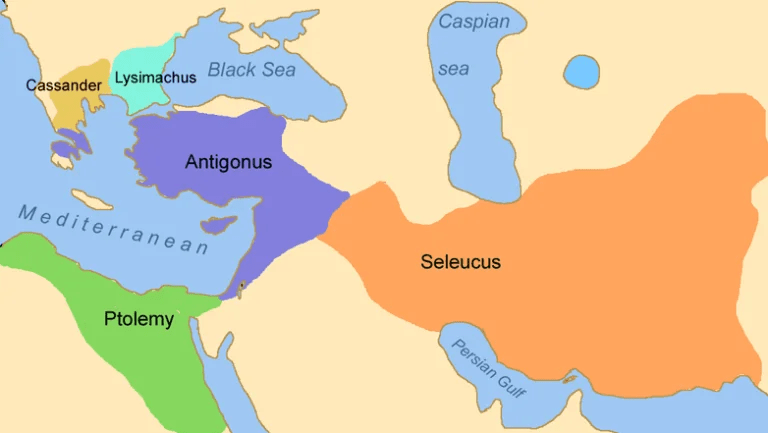
Ptolemaic Kingdom: Ptolemy established control over Egypt and its surrounding territories.
Seleucid Empire: Seleucus took control of the eastern regions, including Persia and Mesopotamia.
Antigonid Kingdom: Antigonus and later his descendants ruled over Macedonia and Greece.
Other: Lysimachus controlled part of Asia Minor and Cassander controlled part of Greece which Antigonus did not.
This is described in a later chapter of Daniel, as well:
3 Then a mighty king will arise, who will rule with great power and do as he pleases. 4 After he has arisen, his empire will be broken up and parceled out toward the four winds of heaven. It will not go to his descendants, nor will it have the power he exercised, because his empire will be uprooted and given to others. (Daniel 11:3-4)
A Monumental Shift in Civilization
We will look at the negative implications of Alexander’s conquests in a later article. Yet, the fact is that God used Alexander the Great to prepare the way for advancing His Story of Grace.
Greek Language: Because of Alexander the Great, the Greek language became the common or business language from Egypt to India. Each territory had its own native language, but each one learned to speak Greek. This allowed for rapid communication since the world was able to speak a common tongue. It is for this reason that over 300 years later after Alexander the 27 books of the New Testament was penned in Greek. Everyone could read this and have access to the New Testament letters.
Greek Culture: Not only was there the spread of Greek language, but there was also the spread of art, architecture, philosophy, and political ideas across a vast area. Greek culture did not replace existing cultures but blended with them. This was monumental because it was the first time in which there was a international blending of one culture into many different ones. A result of this is that in many ways Christianity became a blend of Jewish and Greek cultures. Because of the migration of Greek culture to the East, it would forever shape Christian thinking and practice. This is seen first and foremost in the doctrine of Logos (John 1:1) which would lead to our understanding of the Trinity, with the Son at the eternal Logos of the Father.
Other: The spread of Greek culture made possible by Alexander had impacts on political structures, art, architecture, travel, commerce, science and medicine. These would lay a foundation for the growth of what would become the Roman Empire.
Conclusion
What is most noteworthy was that Daniel prophesied the advance of Alexander and the spread of Hellenism. Daniel did not use the name (Alexander) or the term (Hellenism). This was beyond the scope of his prophesy. His purpose was not to focus on the seen realities but to address the unseen spiritual realities behind the seen ones. As Daniel write earlier in his book:
He changes times and seasons;
he deposes kings and raises up others.
He gives wisdom to the wise
and knowledge to the discerning. (Daniel 2:21)
 Story of Grace