What Was the First Bible Of the Church? (Isaiah 49:6)

As we discovered in the previous article, The Library of Alexandria played a crucial role in the creation of the Septuagint (LXX), the Greek translation of the Hebrew Bible. This is highly consequential because the New Testament authors quote it over 300 times. Further, it would become the main Bible (in regard to the Old Testament) of the early church for nearly its first 500 years. So, where did it come from? The Letter of Aristeas reports that Ptolemy II requested that a translation be made of the Hebrew Bible for the Alexandrian Library. He supposedly sent 72 Jewish scholars to Alexandria to carry out the translation. (Septuagint is Latin for 70. It is often abbreviated in Roman numerals as LXX.) Genesis through Deuteronomy was translated around 280 BC.  The other sections of the Old Testament would be translated later at various times and places and by various people. Eventually it became the standard Greek version of the Old Testament for the early Christian and Jewish communities alike. 

It is hard to overstate the importance of the Septuagint for the spread of God’s Story of Grace. It was a substantial leap forward toward the promise below where God declares to the Jewish people:

I will also make you a light for the Gentiles,
    that my salvation may reach to the ends of the earth.

Isaiah 49:6

In this article, we will lay out three key ways the LXX (Septuagint) was central to the advance of God’s Story of Grace, and then we will look at what it means for how we understand and read the Bible today.

Three Big Influences of the Septuagint

The LXX made the Old Testament accessible to the world.

After the dispersion of Israel under the Assyrians (722 BC) and later Judah by the Babylonians (597 BC), the majority of Jews remained outside of Israel (even after the return in 538 BC) in lands they were taken captive. Because of this, most Jews lost the ability to read or speak Hebrew (the original language of the Old Testament) within a couple of generations. Of the dispersed Jews the largest and most influential population was in Alexandria, Egypt. Out of this great city came the LXX. As copies of it spread, this allowed for their scriptures to be read wherever they were dispersed since every country in the known world of the Jews spoke Greek because of the influence of Alexander the Great. While the Septuagint was initially used by Jews, it came to be read by a much larger population of gentiles, especially those who were converts to Christianity.

The LXX demonstrated that God is missional.

The very Word of God (The Bible) became translatable without losing its force, meaning or power. This was the first large scale translation of God’s revelation demonstrating that God is eager to bring salvation and the knowledge of himself to the ends of the earth. God’s desire from the very beginning has been for his message to be communicated to the nations as revealed in the original promise to Abraham:

“I will make you into a great nation,
    and I will bless you;
I will make your name great,
    and you will be a blessing.
I will bless those who bless you,
    and whoever curses you I will curse;
and all peoples on earth
    will be blessed through you.”
(Genesis 12:2-3)

From the Tower of Babel (Genesis 11), we know that God did not want to force the world into one language, but created a diversity of languages:

This is what the Lord Almighty says: “In those days ten people from all languages and nations will take firm hold of one Jew by the hem of his robe and say, ‘Let us go with you, because we have heard that God is with you.’” (Zechariah 8:23)

This anticipates a process of biblical translation which today has recorded the Hebrew Old Testament and the Greek New Testament into over 3,400 different languages.

The LXX shaped the theology of the New Testament.

In its use of the Greek, The LXX was able to bring out a greater depth of the messianic or New Covenant meaning latent in the Hebrew words of the Old Testament. This would help to shape the vocabulary and theology of the Christian faith. Below are six examples:

Example # 1: “Christ”

Jesus was born, who is called Christ.” (Matthew 1:16)

English Translation Greek Word Common Greek meaningSeptuagint Usage Influence On the New Testament
Christchristos (Gr. Χριστός)“to be rubbed on” (referring to oil or ointment) In Hebrew, “mashiach” (מָשִׁיחַ) means “anointed one”honorific title for Jesus “Christ” (“Messiah”)

The Hebrew word Mašíaḥ (מָשִׁיחַ) referred to individuals designated by God for specific roles, such as kings or priests, through anointing with oil. In the LXX, Mašíaḥ was consistently translated as Christos (χριστός), a Greek loanword derived from the verb χρίω (chrī́ō) which means “to anoint”.  This, then, became the honorific title for Jesus, the Christ (the anointed one).

Example # 2: “Sin Offering”

God did by sending his own Son in the likeness of sinful flesh to be a sin offering.” (Romans 8:3)

English Translation Greek Word Common Greek MeaningSeptuagint Usage Influence On the New Testament
sin offeringperi hamartias “concerning sin” or “for sin” technical term “sin offering,” for Heb. hatta’tJesus himself as the ultimate “sin offering”

Peri hamartias” (περί ἁμαρτία) is literally translated “concerning sin” or “for sin.” Because of the LXX it became the term used to translate hatta’t (חטאה) which means “sin offering.”

Example # 3: “Covenant”

“This is my blood of the covenant, which is poured out for many,” (Mark 14:24)

English Translation Greek Word Common Greek MeaningSeptuagint Usage Influence On the New Testament
covenantdiathēkē
“last will” (cf. synthēkē, “contract”)divine “covenant,” for Heb. berithdivine covenants

Diathēkē (διαθήκη) in its original Greek usage primarily referred to a last will or testament outlining the distribution of possessions after death. The LXX translators chose diathēkē to translate “berith”(ברית), meaning covenant, in the Hebrew Bible. A more common Greek word for “covenant” was suntheke. Diathēkē emphasizes the one sided (God’s side) of the covenant over suntheke which speaks to a mutual agreement.

Example # 4: “Propitiation”

“He is the propitiation for our sins, and not for ours only but also for the sins of the whole world.” (1 John 2:2)

English Translation Greek Word Common Greek MeaningSeptuagint Usage Influence On the New Testament
propitiation
hilastērion
“expiation” (of the gods)covering of the ark where atonement by blood is made, for Heb. kapporetJesus himself as the consummate “mercy seat” of propitiation

The LXX introduced the term hilastērion (ἱλαστήριον) to translate the Hebrew word kapporeth (כַּפֹּרֶת) which refers to the mercy seat (or lid) of the Ark of the Covenant. This term was understood in the Hellenistic Jewish world to refer to an object that brings atonement or reconciliation through propitiation (satisfying the justice of God). The LXX’s use of “hilastērion” helped solidify its connection to the concept of atonement and forgiveness.  

Example # 5: “Gospel”

“the gospel must first be preached to all nations” (Mark 13:10)

English Translation Greek Word Common Greek MeaningSeptuagint Usage Influence On the New Testament
gospel euangelizomaireport of “good news” from battlespiritual/ salvific “good news,” especially in Isaiah“proclaiming the gospel”

Euangelizomai (εὐαγγελίζομαι) was commonly used for reports of military victories. In the LXX, especially in Isaiah, it was applied to spiritual good news related to the saving work of God. This had a strong influence on the apostolic authors as they linked this word to the proclamation of Jesus’ victory.

Example # 6: “Lord”

“every tongue acknowledge that Jesus Christ is Lord(Philippians 2:11)

English Translation Greek Word Common Greek MeaningSeptuagint Usage Influence On the New Testament
Lord
kyrios
term of respect for anyone in authoritytranslation of “Lord” (both adonai and kyrios)title for “Lord” Jesus

The LXX significantly changed our understanding of the word “kyrios” (κύριος) by establishing it as a primary Greek equivalent for the Hebrew name for God (YHWH) and the title “Lord.” “Kyrios” originally meant “lord” or “master;” the LXX’s use solidified its association with the divine name and the concept of God’s sovereignty. 

Reading the Septuagint Today

1. The LXX has a real authority, but it is derivative.

Obviously, since the Greek translation of the Old Testament is quoted over 300 times in the New Testament, this shows it has great importance. But its authority is derived from the actual Hebrew manuscripts it translates. The inescapable logic is that the Hebrew text is primary since it is the one being translated. The original Hebrew documents written by the prophetic authors have primary or ultimate authority, what Jesus labelled as Moses, Prophets and the Psalms.

Everything must be fulfilled that is written about me in the Law of Moses, the Prophets and the Psalms. (Luke 24:44)

So, it is clear that the LXX is not a separate authority from the Hebrew Bible, but derives its authority as it reflects and correctly draws out the meanings of the original text.

2. The LXX shows the messianic movement of God’s Story In the New Testament.

As seen above, the LXX was able to take the Hebrew language and draw out the richer implications of the words which would serve as a vehicle for the language of the New Testament. Even before Jesus the Messiah came to this earth, the Story of God’s Grace was advancing forward toward the Savior as seen in the LXX. This is further seen in how the Greek translators, on occasion, subtly transform their Hebrew source in ways that give a more personal glimpse of the Messiah. Here are some selected examples:

Genesis 49:10

In Genesis 49: 10, Jacob’s blessing on Judah reads from the Hebrew:

The scepter will not depart from Judah,
 nor the ruler’s staff from between his feet,
until he to whom it belongs shall come and the obedience of the nations shall be his. (Genesis 49:10, NIV)

From the LXX it reads from the Greek:

A ruler shall not fail from Judah, nor a prince from his loins, until there come the things stored up for him; and he is the expectation of nations. (Genesis 49:10, LXX)

The Greek translator personifies the metaphor by substituting “ruler” for “scepter” and “prince” for “ruler’s staff.” This emphasis on the personal nature of the prophetic blessing sets the stage for other Jewish writings that interpret the prophecy with a messianic emphasis.

Isaiah 26:18

See, I lay a stone in Zion, a tested stone,
    a precious cornerstone for a sure foundation;
the one who relies on it
    will never be stricken with panic.
(Isaiah 28:16, NIV)

This is important passage for messianic trajectory. (see 1 Peter 2:6) This trajectory is aided with the Greek translation, which reads:

I lay for the foundations of Zion a costly stone, a choice, a corner-stone, a precious stone, for its foundations; and he that believes on him  shall by no means be ashamed. (Isaiah 28:16, LXX)

The Greek, as can be seen, adds the object of faith: “he that believes on him.” This personifies the stone as an object of faith, which— combined with the importance of Zion (Jerusalem) in the Old Testament— suggests that the translator understands the “stone” as a messianic metaphor.

Psalm 72:17

Development of the preexistence of the Messiah can be seen more clearly in the Greek translation, while the Hebrew Bible is less clear on this matter. Here are two Old Greek examples which suggest that the idea was developing within Judaism. First, Psalm 72, which is a hymn of praise to a messianic king, states in the Hebrew in v.17:

May his name endure forever;
    may it continue as long as the sun.
(Psalm 72:17, NIV)

The Greek, however, renders the second clause, “May his name endure prior to the sun.” This “prior to the sun” points in a temporal sense to preexistence.

Conclusion

As Paul writes in Galatians 4:4, when the fullness of time had come, God sent forth his Son, there was much that needed to occur before Jesus could come to this earth. One of the key developments in this unfolding Story of Grace was translation of the Septuagint.

The Most Important Intellectual Event Ever, The Library of Alexandria (Habakkuk 2:14)

Representation of the Alexandrian Library

A major advance in God’s Story of Grace was The Library of Alexandria. It was the the most important event of intellectual history of the ancient world and maybe for time immemorial. The results of this library’s influence have echoed loudly throughout history, and its sounds are continuing to be heard. This is a central reason for why Greek language and Greek culture spread throughout the Western world allowing for the spread of science, classical literature, democracy and most importantly the Bible and ultimately the Christian faith. Because of this library, it facilitated the declaration of the prophet Habakkuk, which he declared in the midst of his lament:

For the earth will be filled with the knowledge of the glory of the LORD as the waters cover the sea.

Habakkuk 2:4

In this article we will explore what this great library did to shape the world to more reflect the trinitarian reality of increase unity (the oneness of the Trinity) across nations with the greater freedom (the unique persons of the Trinity) with individual thought, personal agency and representative democracy.

The Significance of the Alexandrian Library

Founded in the early 3rd century BC, it attracted the best thinkers, researchers, and scientists from all over the world. In addition, it housed the world’s greatest body of knowledge with a collection of as many as 500,000 scrolls (ancient books) which included works of religion, literature, history, law, math, and science. Because of this, there were significant advances in:

  • Scientific & Mathematical Understanding. Scholars who made significant and lasting contributions in these areas include Euclid in mathematics , Archimedes in physics, Galen in medicine, and Eratosthenes in astronomy, to name a few.
  • Literary Preservation. Many great and lasting texts of literature were preserved which may have otherwise been lost. Among them were the works of Homer, Sophocles, Plato and Aristotle.
  • Cultural Interaction: The library attracted the greatest minds from across the world, fostering a vibrant exchange and cross-pollination of ideas.
  • Biblical Knowledge. The most important contribution of the Library of Alexandria was the the Greek translation of the Hebrew scriptures (Old Testament) known as the Septuagint. It was here that Jewish scholars verses in Greek began the translation of their sacred writings. This ultimately allowed for the worldwide spread of the Bible and ultimately Christianity.

Why Alexandria Egypt?

location of the port city of Alexandria

Alexander the Great entered Egypt in 332 BC where he was welcomed by the Egyptians as a liberator from the oppression of Persian rule. He embraced Egypt as his own respecting Egyptian culture and religion, even adopting some Egyptian titles and practices.  In his embrace of Egypt, he founded the city of Alexandria. Strategically located along the mouth of the Nile, it was positioned to become a major center of Hellenism (the movement to spread Greek culture and ideas) and trade as it was easily accessible to other nations by sea.  Alexander established a Greek government to control the administration of Egypt.  Greek influence was further reinforced by the settlement of Alexander’s veterans throughout Egypt, who formed a privileged aristocracy (ruling elite) that gradually assimilated with the Egyptians. 

After Alexander’s death, his general Ptolemy took control of Egypt and established a dynasty which ruled Egypt for nearly three centuries. As was hoped, the city of Alexandria emerged as a center of Hellenism which spread Greek learning and culture.  Its location was not only great for international trade and commerce, but cultural engagement among nations. Further, Egypt was a major producer of papyrus (this is where we get the word “paper”) which was the primary writing material of the time, ensuring a readily available supply for the library’s growing collection for the scribes who worked tirelessly to copy manuscripts. These factors made it ideal for a library of international repute. Ptolemy was a man of intelligence and iron will. He placed many scholars on his payroll.

Alexandria’s Most Notable Influences

Euclid the Mathematician

Euclid, known as the “father of geometry,” lived in Alexandria during the time of Ptolemy I, who reigned over Egypt from 323 to 285 BC, and is thought to have been among the library’s first scholars. Here he wrote his influential Elements which laid the foundations for mathematical reasoning and geometry as we know it even today. The logical structure and rigorous proofs in Elements set a standard for mathematical reasoning. This became the standard textbook for mathematical education in the ancient world, the Islamic world, and in Europe until almost the present time. Newton’s Principia, which marked the beginning of modern physics, took Euclid’s work as its intellectual model.

Archimedes the Engineer

Archimedes Screw

Archimedes, a prominent figure in physics and mathematics, is especially known for his contributions to the science of matter, including the principle of buoyancy and the “Archimedes screw” which was used to transport water from a lower to a higher level. This is still commonly used today in water treatment plants, irrigation systems, and even for generating hydroelectric power. He also made significant contributions to mathematics, including calculating the area and volume of geometric shapes and approximating the value of pi. He is also famous for his work on levers and pulleys and inventions of various machines. He was so absorbed in his intellectual pursuits, it is said that he would frequently forget to eat or bathe. 

Galen the Physician

Galen, a renowned physician, surgeon, and philosopher, studied in Alexandria and drew inspiration from the library there, which housed knowledge about anatomy and physiology. Galen made significant advances in medicine by advocating for anatomical studies through dissection (mainly performed on animals), demonstrating that arteries carry blood not air (a concept that had been taught for 400 years). Galen strongly believed in the importance of anatomy as the foundation of medical knowledge. He made important observations about the nervous system, including functions of the spinal nerves. He was the first physician to use the pulse as a sign of illness.  Galen’s work contributed to the improvement of surgical skills. His writings and theories dominated medical thought for over 1,500 years, and his influence remains significant in the history of medicine. 

Eratosthenes the Astronomer

An armillary sphere is an instrument that demonstrates the movement of the planets.

Eratosthenes, an astronomer and mathematician, made significant advances in the study of the stars and the planets. He astoundingly provided an accurate calculation of the earth’s circumference and axial tilt, and is credited with creating the armillary sphere, an early astronomical device.  He developed a system of longitude and latitude and made a map of the known world. He is credited with coining the term “geography”. He created the Sieve of Eratosthenes, a method for finding prime numbers. 

Preserved the Heritage of Literature

The library housed a vast collection of scrolls and papyri, including works by prominent figures making it a store house of knowledge. This is where many of the great texts from Greece, Persia, Mesopotamia and other places were kept in safe keeping. With housing all of these ancient documents, this was the place where the science of textual criticism developed (the process of attempting to ascertain the original wording of a text). Harold Ellens summarizes the gift that the Alexandrian Library brought to us:

It stimulated an intensive editorial program that spawned the development of critical editions, textual exegesis [interpretation of texts] and such basic research tools as dictionaries, concordances and encyclopedias. The library in fact developed into a huge research institution comparable to a modern university—containing a center for the collection of books, a museum for the preservation of scientific artifacts, residences and workrooms for scholars, lecture halls and a refectory.

The Biggest Contributions to Advance God’s Story

The Septuagint

As already reported, The Septuagint is the Greek translation of the Hebrew Bible (Old Testament). The word Septuagint means “70” in Latin and refers to the 70 translators of the first five books of the Old Testament. The rest of the Old Testament would be translated in subsequent years. Its great significance comes from two facts:

  1. The Septuagint translation of the Old Testament is quoted by the New Testament writers more than 300 times. (This is much more frequent than quotations of the original Hebrew Old Testament.) Approximately 7% of the New Testament consists of Septuagint quotes.
  2. For several centuries it was the Bible of Christians in regard to their reading and study of the Old Testament. As the large majority of gentiles did not read or speak Hebrew, the Septuagint made scripture accessible to God-fearing gentiles (gentiles who practiced Judaism) and the early church.

The Septuagint would not have been translated had it not been for the resources provided at the Alexandrian Library. By the fact that this work was part of the Christian Bible for several centuries and makes up 7% of the New Testament, it would appear to give strong evidence that the formation of the Alexandrian Library was part of God’s Story of Grace to advance his plan in the world.

The Alexandrian Text of the New Testament

The Library of Alexandria, with its nearly 500,000 books, had a strong tradition of copying. As works were collected, scribes–those who copied manuscripts–would diligently reproduce the works. Their work was crucial in preserving and disseminating these works. It was out of this scribal discipline that key manuscripts of the New Testament have been delivered to us.

As Christianity spread to Alexandria, Egypt as early as 49 AD, letters now consisting of the New Testament were brought to the Alexandrian church. Christians trained in the scribal discipline copied these letters so they could be more widely read. It is from Alexandria that we have around 30 New Testament manuscripts, either in part or whole. These 30 copies make up only a very small percentage of all the ancient manuscripts we have of the New Testament, but Alexandria gives us our oldest texts, one of which dates back to 125 AD of a portion of the Gospel of John.

Conclusion

As Zechariah proclaimed of the Messiah:

He will proclaim peace to the nations.
    His rule will extend from sea to sea
    and from the River to the ends of the earth.
(Zechariah 9:10)

The founding of the Library of Alexandria was one more step in God’s Story of Grace to proclaim peace to the nations!

Two Triumphal Entries: Alexander the Great and Jesus the Messiah (Zechariah 9:1-10)

It is the distinct reality that in God’s Story of Grace, God uses even the wicked for his overall purposes and plans. Scripture testifies to this in many places.

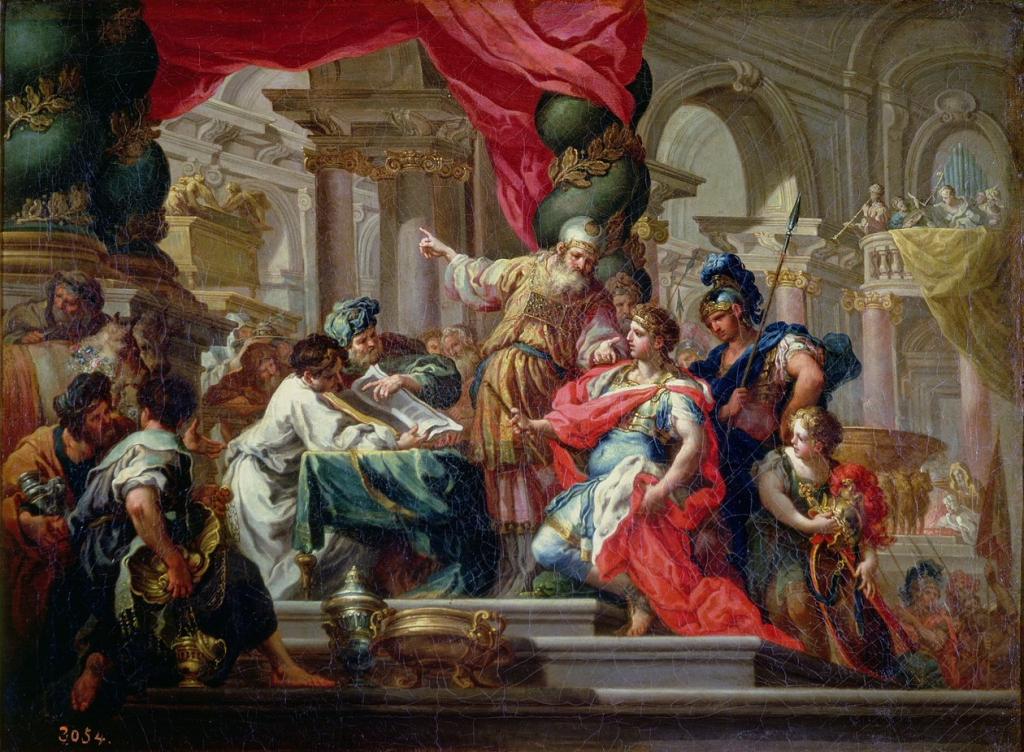
Alexander the Great in the Temple by
Sebastiano Conca (1680-1761) 

Human defiance only enhances your glory, for you use it as a weapon.”

Psalm 76:10

In this article, we will see four prophecies (these four cover a one year period) where the prophet hydroplanes over four mountain peak events where we see God uses Alexander the Great as an agent of judgement against the pride and wickedness of different regions which were near Jerusalem. Then we will see how the ambitious conqueror, instead of conquering the holy city of Jerusalem, acknowledges the God of Israel and makes sacrifices to him. This shows in a dramatic and definitive way how God is Lord even over those who oppose him. We will see how God uses evil to overturn evil and prepare the way for the Triumphal Entry of Christ to advance His Story of Grace. What will become clear is that the destructive force of Alexander’s army tears down obstinate forms of evil and opens up the way for the grace of the Messiah, Jesus Christ, to come into the world at the proper time.

An Invader From the North (Zechariah 9:1-8)

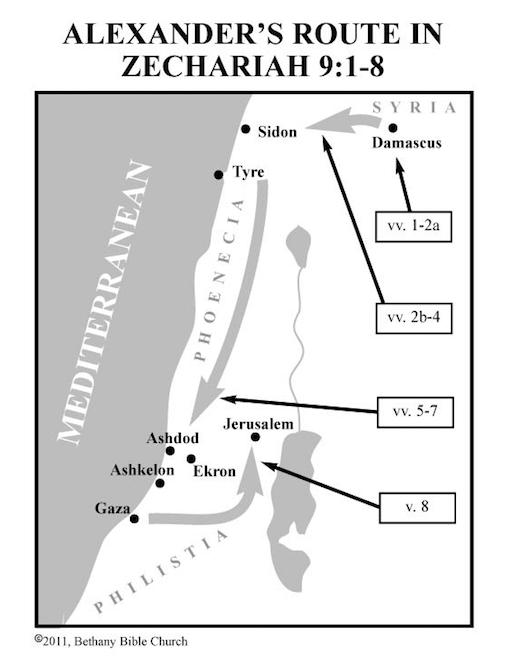
In the previous article we saw how Daniel 8:1-8 foretold about the rapid conquest of Alexander the Great’s military machine to overtake 200 million square miles of territory over three continents in thirteen years. This prophecy occurred nearly 300 years before Alexander’s time. Then emerges Zechariah, who spoke the Word of God soon after Daniel’s death, from 520 to 518 BC, and forecasted with precision a one year portion (ca. 333-332 B.C.) of Alexander’s 13 year conquest. Like Daniel, he did this with stunning accuracy a few centuries before the actual events unfolded. This is seen through the subduing of three regions along the Mediterranean Sea and then a miracle at Jerusalem.

Syria Invaded

1A prophecy:

The word of the Lord is against the land of Hadrak and will come to rest on Damascus— for the eyes of all people and all the tribes of Israel are on the Lord—

In Zechariah’s time no one would have dreamed that the Greeks could ever constitute a significantly powerful military force which would bolt through the world. In retrospect that is what is depicted in Zechariah 9. The prophecy deals with the punishment that God would visit on various city-states down the Mediterranean coast. It commences after Alexander marched into Syria in 333 BC and defeated the Persian army at the battle of Issus. It is here that the prophecy picks up with Alexander’s conquest into Damascus and will proceed southward. The prophet begins by pointing out in v.1 that God has sovereign power over Hadrach (either an ancient area or city in Syria) near Damascus. This is the only place where Hadrach is mentioned in the Old Testament, though it is mentioned in Assyrian cuneiform tablets. Hadrach may represent the far and obscure reaches of the world. What is shown through this subjugation is that “all people” will acknowledge God’s reign in the world.

Phoenicia Invaded

and on Hamath too, which borders on it, and on Tyre and Sidon,  though they are very skillful. Tyre has built herself a stronghold; she has heaped up silver like dust, and gold like the dirt of the streets. But the Lord will take away her possessions
 and destroy her power on the sea,
 and she will be consumed by fire.

In v.2 Hamath is a city to the far north of Syria. The prophet moves over to the area of Phoenicia and references the coastal cities of Tyre and Sidon. In v.3 Tyre is singled out for special attention because of its tremendous wealth, power and security which has “silver like dust, and gold like the dirt of the streets.” Not only did Tyre have great wealth, but it was known for its cunning shrewdness in business and politics. It was a city which was a model of human perfection in many ways. This brought to the leaders of the city a great arrogance. Ezekiel describes the king of Tyre as being filled with an enormous pride at an anti-Christ level, mistaking themselves for God. Ezekiel points out that Tyre was filled with pride claiming, “I am a god:”

1The word of the Lord came to me:  “Son of man, say to the ruler of Tyre, ‘This is what the Sovereign Lord says:

“‘In the pride of your heart
    you say, “I am a god;
I sit on the throne of a god
    in the heart of the seas.”
But you are a mere mortal and not a god,
    though you think you are as wise as a god.
Are you wiser than Daniel?
    Is no secret hidden from you?
By your wisdom and understanding
    you have gained wealth for yourself
and amassed gold and silver
    in your treasuries.
By your great skill in trading
    you have increased your wealth,
and because of your wealth
    your heart has grown proud.

As a result of this swelling arrogance, judgement is coming:

“‘Therefore this is what the Sovereign Lord says:

“‘Because you think you are wise,
    as wise as a god,
I am going to bring foreigners against you,
    the most ruthless of nations;
they will draw their swords against your beauty and wisdom
    and pierce your shining splendor.
They will bring you down to the pit,
    and you will die a violent death
    in the heart of the seas.
Will you then say, “I am a god,”
    in the presence of those who kill you?
You will be but a mortal, not a god,
    in the hands of those who slay you.
10 You will die the death of the uncircumcised
    at the hands of foreigners.

The destruction at the hands of foreigners came in several waves. The Babylonians besieged it for thirteen years from 586 to 573 BC. Cyrus the Great of Persia surrounded it in 539 BC. In both of these cases, though the main land became ravaged, Tyre was ultimately not subdued because it had an island isolated from the mainland. This island was highly fortified and had access to the other countries of the Mediterranean for its supplies. With its great wealth it could sustain itself under siege for years. Though the mainland was taken by conquerors, it remained for Alexander to finally destroy its island fortification. He did this by taking the rubble from the mainland of Tyre and making a causeway to the island. In seven months it was totally destroyed vindicating Ezekiel and Zechariah’s predictions.

Philistia Invaded

Ashkelon will see it and fear;
    Gaza will writhe in agony,
    and Ekron too, for her hope will wither.
Gaza will lose her king
    and Ashkelon will be deserted.
A mongrel people will occupy Ashdod,
    and I will put an end to the pride of the Philistines.
I will take the blood from their mouths,
    the forbidden food from between their teeth.
Those who are left will belong to our God
    and become a clan in Judah,
    and Ekron will be like the Jebusites.

Four of five cities of the Philistines are mentioned in vs.5-7. (Gath is the only one not mentioned.) Zechariah predicts that this tribe of people will lose its ethnic identity as a mongrel people will occupy Ashdod. Ekron will be like the Jebusites meaning Ekron will be overtaken like the Jebusites had been, when King David invaded, and it become a mixed race of people. The Greek armies subdued this area after their conquest of the Phoenicians.

Israel Spared (The Miracle!)

The next major city for the ambitious general to overrun was the Hebrew capital of Jerusalem only forty miles to the east of Philistia. This was only logical and was ripe for taking by the unquenchable appetite for conquest of the Greek army. This did not happen because Zechariah declared that Jerusalem would be given divine protection. In v.8 God declares:

But I will encamp at my temple
    to guard it against marauding forces.
Never again will an oppressor overrun my people,
    for now I am keeping watch.

Alexander, while still at the siege of Tyre, sent a letter to the Jews demanding their loyalty. They had previously pledged themselves to Darius the Mede, but when they saw that he was defeated by the Greeks at the Battle of Issus, they changed their minds. Josephus (37–100 AD) details how this prophecy was carried out:

.. [Alexander] gave his hand to the high priest and, with the Jews running beside him, entered the city. Then he went up to the temple, where he sacrificed to God under the direction of the high priest, and showed due honour to the priests and to the high priest himself. And, when the book of Daniel was shown to him, in which he had declared that one of the Greeks would destroy the empire of the Persians, he believed himself to be the one indicated; and in his joy he dismissed the multitude for the time being, but on the following day he summoned them again and told them to ask for any gifts which they might desire …

Not only did he not assault the city, and he also allowed them to practice the laws of their forefathers. Many of the Jews joined Alexander’s army and accompanied him in his mission of conquest.

What Can We Conclude From Josephus’ Account?

  1. First, in describing Alexander’s Mediterranean conquests, Zechariah declared that Jerusalem would not be taken.
  2. Second, there is no logical reason why Jerusalem should not have been captured. It was a very wealthy city when compared to some of the others which had just been overrun.
  3. Third, for some seemingly inexplicable reason, Alexander spared the city and became friendly towards the Jews.
  4. Fourth, in view of the prophecies, it is most logical to conclude that God was providentially directing the activities of the Greek ruler.

The Real Triumphal Entry

Zechariah will go on to prophesy of another conqueror in 9:9-10:

9Rejoice greatly, Daughter Zion!
    Shout, Daughter Jerusalem!
See, your king comes to you,
    righteous and victorious,
lowly and riding on a donkey,
    on a colt, the foal of a donkey.
10 I will take away the chariots from Ephraim
    and the warhorses from Jerusalem,
    and the battle bow will be broken.
He will proclaim peace to the nations.
    His rule will extend from sea to sea
    and from the River to the ends of the earth.

This is a prediction of Jesus Christ coming into Jerusalem on a donkey on His Triumphal Entry the week before his crucifixion. (Matthew 21:1-11, Mark 11:1-11, Luke 19:28-44 and John 12:12-19).  Alexander weakened the cities around Jerusalem and strengthened Jerusalem to protect and preserve the coming of the Messiah whose rule will extend from sea to sea and from the River to the ends of the earth. This is incredible evidence of God’s sovereign and providential order over history.

Alexander and Jesus Compared (Christ and Anti-Christ)

Jesus had a triumphal entry into Jerusalem Alexander had a triumphal entry into Jerusalem
Jesus is God.Alexander claimed to be God.
Jesus died for multiplied millions.Alexander killed multiplied thousands.
Jesus died in his early 30’s.Alexander died in his early 30’s.
Jesus rose from the dead and reigns forever. Alexander reigned briefly.

God in His Story of Grace would even use the pride and wickedness of Alexander to pave the way for the triumph of Jesus Christ. God uses even human defiance as a weapon to accomplish his purposes to advance His Story of Grace.