
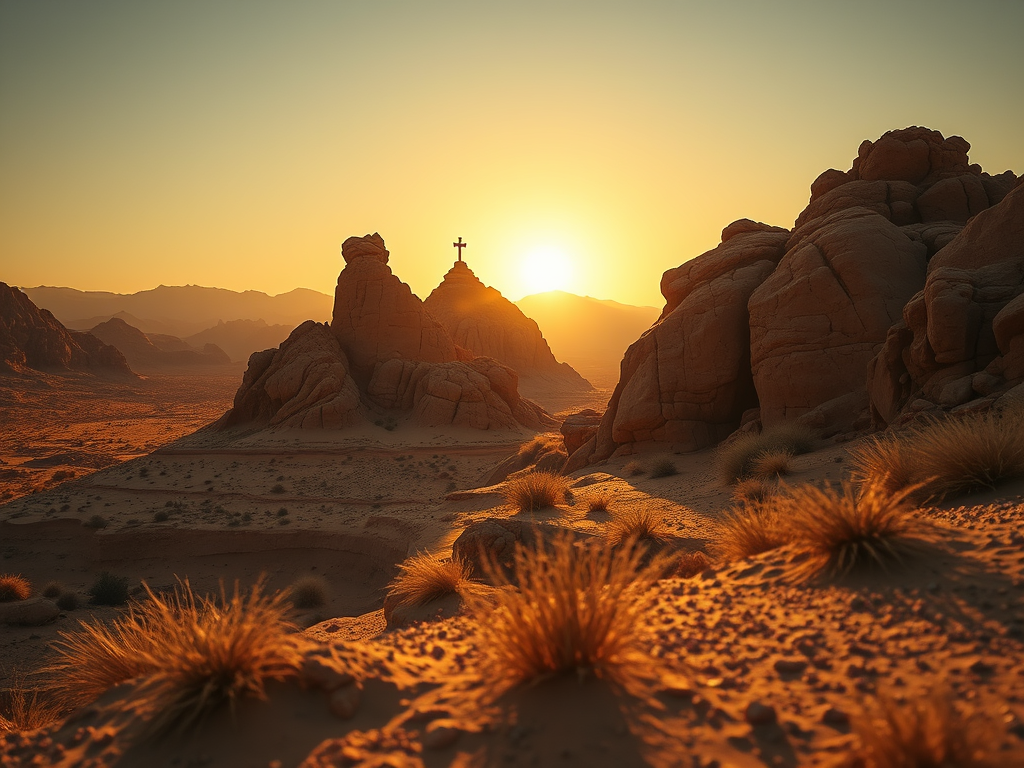
In a movement starting in the middle of the third century, the deserts of Egypt, Palestine, Arabia and Persia were increasingly populated by a rare breed of men. They have come to be called the Desert Fathers. By the early fourth century as Christianity would become popular and accustomed to greater ease, these men would serve as a prophetic witness to the church, injecting the leaven of discipleship and biblical truth into a church which found it increasingly easy to compromise. The Desert Fathers were men who were unable to passively drift along by following the tenets and values of larger society. They chose to live separated lives forged by seeking God with a singular focus in a scorching and barren landscape. In the biblical tradition of men like Moses, David, Elijah, John the Baptist and Paul, they left the noise of urban life and sought after God.
“Then Jesus was led by the Spirit into the wilderness to be tempted by the devil.”
Matthew 4:1
Though strange to many, their role was indispensable to the continued unfolding of God’s Story of Grace. By their extreme example, they would call the church away from coasting into social complacency to embrace a robust calling to discipleship after Jesus. In so doing, they halted the church from descending into an indistinguishable mass of herd conformity to embrace the mutual and self-giving life of the Trinity.
In this article we will look at the movement of the Desert Fathers, particularly Anthony the Great (251–356), and examine how they were vital to the ongoing growth and development of God’s Story of Grace. They did this through calling the church to personal and doctrinal purity and providing crucial points of guidance to the larger society.
Origins Of the Desert Fathers
The rise of the Desert Fathers began as a spontaneous movement around key locations where Christianity was spreading. No one explanation can spell out this unusual phenomenon except a yearning certain men (in some cases women) had to pursue a higher level of discipleship with Christ. Being stripped of all self-reliance in the hot barrenness of the desert environment, their ears could be sharply tuned to the voice of God. Skip Moen describes the mindset of the Desert Fathers as men who understood, “Heaven on earth is not found in opulent surroundings. It is found in stinky mangers, hostile wastelands, the edges of humanity and the places no one wants to be.“
In this yearning, they were motivated to follow certain scriptural precedents.
Precedent # 1: Singleness
Paul spoke of the gift or calling of celibacy to the Corinthians:
32 I would like you to be free from concern. An unmarried man is concerned about the Lord’s affairs—how he can please the Lord. 33 But a married man is concerned about the affairs of this world—how he can please his wife— 34 and his interests are divided. (1 Corinthians 7:32-34)
Eventually the movement of these hermits would evolve into a monastic movement with communities of monks. The original meaning of the word monk is “single.” These were men of an undivided, single and solitary focus.
Precedent # 2: Poverty
Another important strand in Desert Fathers goes back to the instructions which Jesus gave to the seventy-two missionaries to take no provision for the journey as they went:
Do not take a purse or bag or sandals… (Luke 10:4)
Like these early adventurers for Jesus’ kingdom, the Desert Fathers were pioneers, with nothing to go on but the examples of the biblical saints and the call of the mission they were to fulfill. Their call to poverty compelled them to innovate a new life and create a new culture in the desert.
Precedent # 3: Cross Bearing
Jesus said to his disciples, “Whoever wants to be my disciple must deny themselves and take up their cross and follow me.” (Matthew 16:24)
These men lived lives of extreme discipline and self-denial. In some cases, it was too extreme. But these extremes may have been necessary to be a witness against the church’s increasing embrace of the world.
Precedent # 4: Preparation for Martyrdom
The primary Greek word for “witness” (Acts 1:8) in the Bible is μάρτυς (martus) from which we get the word martyr. Overtime as believers increasingly faced death for Christ, this came to be seen as a witness to the gospel. As the threat of martyrdom receded, the extreme life of discipline and renunciation came to be seen as a kind of substitute for martyrdom.
Anthony the Great
The most famous of the Desert Fathers is Anthony the Great.1 Born in 251 in Egypt, Anthony had a radical conversion at age sixteen when he heard a sermon taken from the words of Jesus in Matthew 19:21:
If you want to be perfect, go, sell your possessions and give to the poor, and you will have treasure in heaven. Then come, follow me.
In 285, as a young man, Anthony withdrew from civilization and ventured into the desert, giving away everything he owned. At first he lived in a desert region about 60 miles west of Alexandria. Later he moved to more distant locations in a search for the solitude he needed to center his attention more intensely on prayer and further disentangle himself from evil. According Athanasius, his biographer, the spiritual trials that Anthony endured over the ensuing decades prepared him for the remarkable movement that drew thousands into the barren wilderness. In Anthony, many found a leader who had faced his own demons and found a vision for a life deeper and richer than anything that even the best of the Roman Empire had to offer.2
Influence
They protected the church’s emerging doctrine of the Trinity.
In 325 the Council of Nicaea affirmed that Jesus Christ is true God of true God, begotten not made, of one essence with the Father. When Emperor Constantine, the sponsor of the Nicaean Council died, the new imperial regimes opposed those adhering this affirmation. Athanasius, Bishop of Alexandria, carried the torch to defend this truth, while it was being severely opposed. With his life under continuous threat and having to hide from his home in Alexandria for seventeen years, Anthony was for him a key source of support, protection and courage. In the sandy outskirts, Athanasius was able to escape while under the protection of Anthony and the other desert hermits. At one point, according to Athanasius, Anthony traveled to Alexandria and “denounced the Arians [those denying the deity of Christ], saying that their heresy was the last of all and a forerunner of Antichrist.” The Christian historian Sozomen (400-450) wrote that, “The monks were prepared to subject their necks to the sword rather than to swerve from the Nicene doctrines.” Had it not been for the protection of these Desert Fathers, the defenders of the Nicene doctrine would have been arrested and eventually killed. This would have spelled a probable end for biblical orthodox truth.3
They protected civilization.
Overtime the Desert Fathers built gathered communities known as monasteries which played a decisive role in the West as oases of civilization in a world descending into barbarism. Eventually, these monks protected civilization by preserving knowledge through copying manuscripts, which saved classical and religious texts from being lost. They preserved and systematically copied two main categories of essential texts: religious works that formed the foundation of Christian faith and a significant body of classical Greco-Roman literature. Most importantly was the preservation of the Bible. The most notable surviving example includes the 4th-century Codex Sinaiticus, found at St. Catherine’s Monastery. This is the old known copy of the entire Bible. Monks copied important philosophical works from ancient Greece and Rome, including the writings of Aristotle and Plato. In the Middle Ages, some of these Greco-Roman works were reinterpreted through a Christian lens.
They mediated conflicts in society.
By the third and fourth centuries certain Desert Fathers acquired considerable power precisely because of their position outside society. Their renunciation of sex, marriage, and property lifted them out of kinship and property networks. This, combined with their reputation for total devotion to God, favorably positioned them to be “third party” mediators and arbiters from quarreling villagers to powerful political leaders. Their radical independence enabled them to intervene with great authority even in public affairs.4
Conclusion
The Desert Fathers, though extreme to many, in fact served a vital role for the preservation and advance of God’s Story of Grace. In once sense, their separation was to preserve the reality of what radical discipleship could look like to a church that would move toward greater complacency and comfort. These desert hermits would separate from society becoming an example and inspiration of reformation movements in doctrine and spiritual life for centuries to come. This would allow society to form along the two tracts: increasing scale and growth of social structures of the state (the one) and the radical call of discipleship (the many).5 The Trappist Monk, Thomas Merton, summarizes their importance and spiritual brilliance toward the larger society:
They were men who did not believe in letting themselves be passively guided and ruled by a decadent state, and who believed that there was a way of getting along without slavish dependence on accepted, conventional values. But they did not intend to place themselves above society. They did not reject society with proud contempt, as if they were superior to other men.
As stated earlier, in so doing, they halted the church (and the world) from descending into mass conformity so that humanity, in the development of history, could embrace the mutual and self-giving life of the Trinity.
___________________________________________________________________________
- The first Desert Father was Paul of Thebes, also known as St. Paul the First Hermit. He is traditionally regarded as the earliest Christian hermit, living in the Theban desert in Egypt. A biography written by St. Jerome recounts his life of solitude, prayer, and reliance on divine provision.
- In Alexandria, the theologian Origen (who lived in the early third century) had taught new converts about Christianity and amazed them with his renunciations, including sleeping on the floor, going barefoot, extreme fasting, and abstaining completely from wine. Origen did not invent the idea that one must pursue purity of heart in order to understand the deeper spiritual meanings of Scripture. But his teaching ministry at Alexandria in the early third century gave this idea a deep and longstanding influence in the church. It was from the church at Alexandria that Christianity’s first ascetics went out to the Egyptian desert, taking with them the great teacher’s deep insights into the reading of the Bible and the quest for holiness.
- The Desert Fathers appeared to be a remnant given by God to preserve Christian truth affirming the promise of Jesus that the gates of hell would not prevail. (Matthew 16:18)
- For example, a Desert Father by the name of Apollo more than once resolved conflicts over land boundaries between pagan and Christian visitors. In another instance, he converted a group of pagan priests, discipled them, and turned them over to the local parishes. Another example is John of Lycopolis, counseled Emperor Theodosius, as well as generals, tribunes, and wives of military officers.
- The great developments have occurred in history when ideas which were developed or preserved in the margins of society take root in society. Such examples would be representative democracy, the Protestant Reformation, universal education.
 Story of Grace