
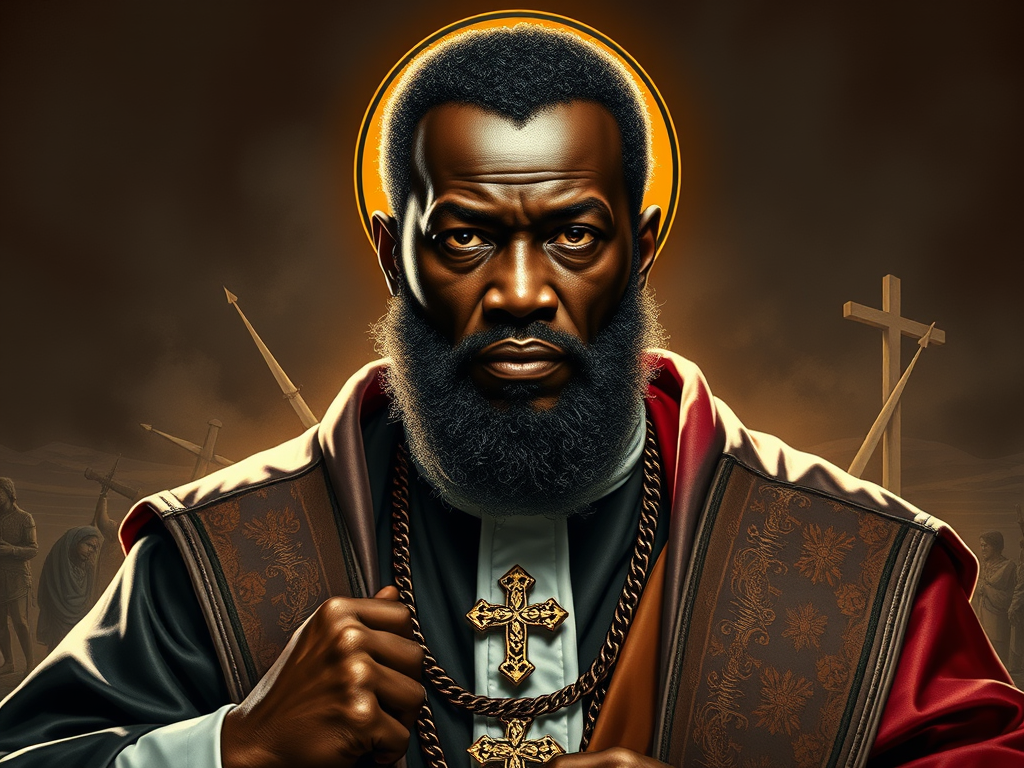
Athanasius was a larger-than-life figure living in a momentous time. Shortly before his death in 373, he wrote to a friend with a simple plea: “Let what was confessed by the Fathers of Nicaea prevail.” Upon his shoulders was carried the flame of vital Christian truth which the darkness of error and heresy was trying to choke. Just over a decade after the Council of Nicaea affirmed that Jesus Christ is very God of very God, the weeds of Arianism (denying the full co-equality in nature of the Son with the Father) were overtaking the garden of the church. Called by his enemies, “the black dwarf,”1 Athanasius exercised extreme courage on behalf of the gospel. For nearly half a century he carried the torch of truth while undergoing five exiles from his home, numerous accusations and murderous plots, all backed by the imperial power of Rome. For this reason he has been honored by Gregory of Nazianzus with the title: “pillar of the Church.” His contributions to the ongoing Story of God’s Grace are wide-ranging,2 but his singular importance is centered on his defense of the full equality and unity of the Son with the Father against the overwhelming onslaught of the Arian heresy.
In this article, we will see how this one man bore the significant weight of faithful doctrine for the whole of the church. In God’s Story of Grace perhaps no person had been more important since the apostles to advance the image of God in the world. It was he who defended the the deity of Christ and protected the biblical boundaries so the church could more fully define the Trinity.3
Defender of Orthodoxy
Athanasius was born in the city of Alexandria sometime in the 290s. The city was a culturally vital city for the Roman Empire. It had intellectual leaders from paganism, Judaism, and Christianity—all drawn to the city’s philosophical schools and the fabled Alexandrian Library. He entered the service of the bishop of Alexandria and was discipled in theology and pastoral skills. During the time of his apprenticeship, the church was rocked by a controversy started by Arius, a deacon of the influential church of Alexandria in Egypt.4 Arius denied that Christ was fully God, arguing that only the Father was truly God, and the Son was created.
Despite the fact that the Nicene Creed was affirmed by an overwhelming majority at the Council of Nicaea, the Arians wormed their way back into positions of power and engineered the dismissal of key leaders who supported the Nicene Creed. Athanasius was one of them. The Arians leveled a series of charges against him. For example, he was accused of having arranged the murder of a Melitian bishop, Arsenius. Athanasius had to go to Tyre to appear before the emperor Constantine to refute this charge. Upon entering the room, Athanasius first made sure that his accusers knew what Arsenius looked like. To their surprise, the “murdered” man was then produced, alive and well, for he had been discovered hiding in the city of Tyre itself. This would be the first major volley he would endure through a lifetime of attacks.
“On The Incarnation”
Against the backdrop of the Arian heresy; Athanasius argued for Christianity’s distinctive claim that God, who is the origin of all things, entered human history as a man, to bring redemption to all things. He needed to counter the more neatly packaged story presented by Arius. This heresy was gaining ground because the message of the Incarnation (fully divinity taking on humanity), as one writer comments, “seemed messy and arbitrary to some, and manifestly unfitting, or even blasphemous, to others.” Athanasius, in response to this perception, mounts a series of arguments to convince his readers that the Incarnation was fitting, and that the death of Christ, both as to fact and to manner, was neither arbitrary nor unreasonable. At fewer than a hundred pages, On The Incarnation develops into a comprehensive understanding of the role and person of Jesus. It begins by detailing the continuity of Christ’s purpose in creation and redemption.
Continuity
To show that the Incarnation is not some strange and alien idea added to scripture, he begins his masterpiece by paralleling creation and redemption around the centrality of the very logos (Word) of John:
1In the beginning was the Word, and the Word was with God, and the Word was God. 2 He was with God in the beginning. 3 Through him all things were made; without him nothing was made that has been made. (John 1:1-3)
The Word became flesh and made his dwelling among us. We have seen his glory, the glory of the one and only Son, who came from the Father, full of grace and truth. (John 1:14)
Athanasius explains: “There is…no inconsistency between creation and salvation; for the One Father has employed the same Agent for both works, effecting the salvation of the world through the same Word Who made it in the beginning.” This, then, is not a change, but it is a manifestation in human form of who God has eternally been.
Corruption
After the Word created humanity, sin irreversibly and irreparably marred humanity. There is nothing that humanity can do to cure the disease of sin which had so irreparably sickened the human condition. As Athanasius spells it out:
Nor does repentance recall men from what is according to their nature; all that it does is to make them cease from sinning. Had it been a case of a trespass only, and not of a subsequent corruption, repentance would have been well enough; but when once transgression had begun men came under the power of the corruption proper to their nature and were bereft of the grace which belonged to them as creatures in the Image of God.
The Father could not bear to let death have mastery over his handiwork bringing it to nothing. His response was to “renew His image in mankind, so that through it men might once more come to know Him.” This was done by Christ coming to earth to take the form of a human.
Cure
The why behind the Incarnation is love. Christ was, according to Athanasius:
“…manifested in a human body for this reason only, out of the love and goodness of His Father, for the salvation of men….it was our sorry case that caused the Word to come down, our transgression that called out His love for us, so that He made haste to help us and to appear among us. It is we who were the cause of His taking human form, and for our salvation that in His great love He was both born and manifested in a human body.
What was needed then? The Word of God, who at the beginning made all out of nothing. Only he could restore the corruptible to incorruption, while maintaining the justice of the Father towards us. Again, Athanasius explains:
What, then, was God to do? What else could He possibly do, being God, but renew His Image in mankind, so that through it men might once more come to know Him? And how could this be done save by the coming of the very Image Himself, our Saviour Jesus Christ? Men could not have done it, for they are only made after the Image; nor could angels have done it, for they are not the images of God. The Word of God came in His own Person, because it was He alone, the Image of the Father, Who could recreate man made after the Image.
The Incarnation then appears as the solution to this dilemma, for by taking on human nature God healed it of the corruption and injury which sin had produced in it. “[T]hrough this union of the immortal Son of God with our human nature, all men were clothed with incorruption in the promise of the resurrection.” The great defender of Christ provides this analogy to help his readers wrap their minds around this:
It is like when a great king enters a city and stays in one of the houses there. The city is held in high regard by others, and its enemies no longer attack it, all because of the king’s residence in a single house there. So it is with the Monarch of all. He has come to our realm, and made his home in one body among his fellow people. As a consequence, the whole conspiracy of the enemy against mankind is beaten off, and the corruption of death which previously overcame them is finished. The human race would have gone to ruin, if the Lord and Savior of all, the Son of God, had not come among us to meet the end of death.
The beauty of this is that God did not create the world and hold it at an insurmountable distance, but he bridged the distance uniting himself completely with the world. By taking human nature into himself in a particularly intimate way, he healed it and even re-created it, thereby carrying on the creative activity that he always exercises with respect to the world in general, and our nature in particular.5
For the Lord touched all parts of creation, and freed and undeceived them all from every deceit.
Athanasius
Death
Having taken a body like ours, because we were all under the penalty of death he gave his body up to death in our place. Only death could stop the plague of corruption, the Word took a mortal body, so that all who become united with him might receive his immortality. As Paul declares:
3 For what the law was powerless to do because it was weakened by the flesh, God did by sending his own Son in the likeness of sinful flesh to be a sin offering. And so he condemned sin in the flesh, 4 in order that the righteous requirement of the law might be fully met in us… (Romans 8:3-4)
The Word knew that death was the only way that humanity could be saved from corruption, and yet it was impossible for the Word to suffer death, being immortal and Son of the Father. Therefore, he took on a body capable of death, so that this body, being joined to the Word who is above all, might be worthy to die in the place of all; and being inhabited by that Word, remain incorruptible, stopping our own corruptibility from then on by the grace of the resurrection. By offering up this body to death, as a pure sacrifice, he instantly took death away from all people.6 The great author provides another analogy:
When a king founds a city, if it is attacked by bandits from the carelessness of its citizens, he certainly does not neglect it, but avenges and reclaims it, for the sake of his own honor. How much more did God the Word of the all-good Father refuse to let humans, his work, go to corruption. He blotted out their death by the offering of his own body, and corrected their neglect by his own teaching, restoring all that was theirs by his own power.
In destroying the corruption of sinfulness, as Mako A. Nagasawa expresses it, “God’s love within each human being…could be received as love and not as torment, since our self-centeredness would resist and resent the call of God to be as other-centered as he is.”
All of this is summarized in the words of the inspired apostle:
God made him who had no sin to be sin for us, so that in him we might become the righteousness of God. (2 Corinthians 5:21)
Athanasius’ Lasting Influence
Athanasius anchored Christian truth in the logic and consistency of revelation. To the Arians the Incarnation of God in Jesus was not logical. Arius was driven more by Greek reasoning and imported that reasoning onto scripture. He was not alone in this problem. Many in the Christian movement were tempted to prioritize philosophical speculation and human reasoning in relation to God’s Word. Athanasius’ work is a masterpiece because he demonstrates the superior clarity of scriptural revelation to be a better guide for philosophy and reasoning. He places the majestic revelation in Christ as witnessed in the scriptures to its commanding perch over all human systems of philosophy. Because of this, Athanasius is often referred to as the Father of Orthodoxy.7
Athanasius captures the beauty of God’s Story. Through Christ, the Word made flesh, God re-shapes and re-makes our story. In sending Jesus as the Incarnate Son of God, we know the very heart and intention of this remaking is grace. David Bentley Hart eloquently describes it as follows:
“It is because Christ’s life effects a narrative reversal, which unwinds the story of sin and death and reinaugurates the story that God tells from before the foundation of the world – the story of the creation he wills, freely, in his eternal counsels – that Christ’s life effects [the] restoration in creation’s goodness…that created being is redeemed in him.”
We see a story of where the Triune God takes the human story and redeems it into his personal and loving being. In this story we see God taking on the sin of the world and continuing to shape human history after the image of the Trinity. As Paul declares God’s universal reconciliation in Jesus:
19 For God was pleased to have all his fullness dwell in him, 20 and through him to reconcile to himself all things, whether things on earth or things in heaven, by making peace through his blood, shed on the cross. (Colossians 1:19-20)
Athanasius serves as an example of God’s remnant grace. As the heresy of Arianism was taking over the church, God preserved one man to be the point of the spear to fight the fight against overwhelming odds of darkness which were overtaking the church. When informed that the whole world was against Athanasius regarding his view of Christ’s full divinity, he replied, “Then I am against the world.” The life and work of Athanasius is a testament to the truth that “the gates of hell will not prevail.” (Matthew 16:18)
_____________________________________________________________
- Athanasius, from Egypt, is a historical testimony of the prominence and influence African Christianity had from its beginning. Such figures also include Augustine, Tertullian, Cyprian, and Origen,
- He wrote the first treatise defending the full deity of the Holy Spirit in 358–359. His close friend Serapion of Thmuis, a town in the Nile Delta, told him about the Binitarianism of certain individuals in his church who confessed Christ as fully God but argued that the Holy Spirit was to be included among the angelic beings. Athanasius’s three letters to Serapion were the first of a number of important defenses of the Spirit’s deity written over the next thirty-five years or so. Athanasius’s biography of the Egyptian monk Anthony, written not long after the monk’s death in 356, was a “bestseller” in Christian antiquity and played a key role in the conversion of Augustine of Hippo in 386. Among the things that Athanasius related about Anthony was his phenomenal memorization of the entire Bible. It is most likely the case that Athanasius had also memorized most of the Scriptures. Athanasius’s Easter Letter of 367 contains the first known list of the books of the New Testament that corresponds exactly to the modern listing of the New Testament canon. Along with the Old Testament, Athanasius declared such books to be the “fountains of salvation, that they who thirst may be satisfied with the living words they contain. In these alone is proclaimed the doctrine of godliness.”
- It was at the Council of Constantinople that the deity of the Holy Spirit was fully defined for the church.
- Athanasius and Arius were arch-enemies from the same church.
- Athanasius gives further reasoning for the nature of the Incarnation: For this reason He did not offer the sacrifice on behalf of all immediately He came, for if He had surrendered His body to death and then raised it again at once He would have ceased to be an object of our senses. Instead of that, He stayed in His body and let Himself be seen in it, doing acts and giving signs which showed Him to be not only man, but also God the Word.
- For Athanasius, the problem was the corruption and decay within human nature itself, not a juridical imbalance that required appeasement through Christ’s punishment such as a penal substitution view of atonement: There are some other possible objections that must be answered. Some might urge that, even granting the necessity of a public death for subsequent belief in the resurrection, it would surely have been better for Him to have arranged an honourable death for Himself, and so to have avoided the ignominy of the cross. But even this would have given ground for suspicion that His power over death was limited to the particular kind of death which He chose for Himself; and that again would furnish excuse for disbelieving the resurrection. Death came to His body, therefore, not from Himself but from enemy action, in order that the Saviour might utterly abolish death in whatever form they offered it to Him. A generous wrestler, virile and strong, does not himself choose his antagonists, lest it should be thought that of some of them he is afraid. Rather, he lets the spectators choose them, and that all the more if these are hostile, so that he may overthrow whomsoever they match against him and thus vindicate his superior strength. Even so was it with Christ. He, the Life of all, our Lord and Saviour, did not arrange the manner of his own death lest He should seem to be afraid of some other kind.
- The word “orthodox” literally means “right teaching” or “right belief,” stemming from the ancient Greek words orthos (right, correct) and doxa (teaching, opinion, or glory/worship). In a broader sense, it signifies conforming to established, correct standards of doctrine used to distinguish authentic Christian teachings from heretical ones.
 Story of Grace