
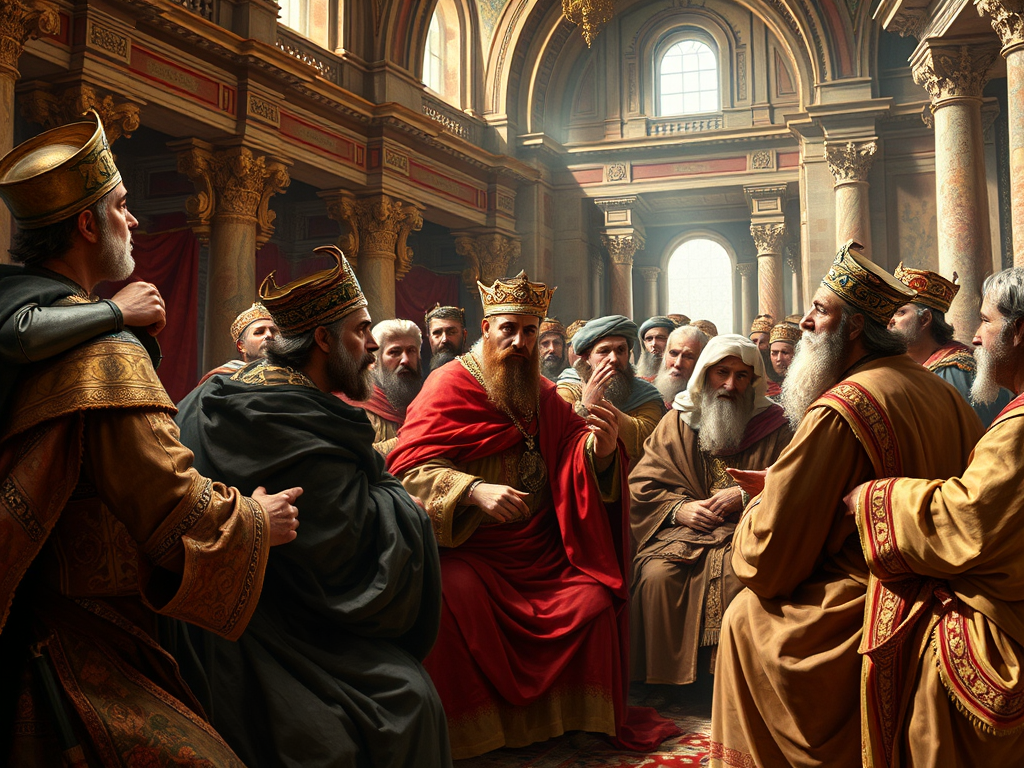
Emperor Theodosius, who lived from 347–395, was a man with a singular ambition: to unite the Roman Empire not just politically, but spiritually, under the banner of Nicene Christianity.1 Upon ascending the throne in 379 AD, he sought to consolidate the church under the affirmation of the Nicene Creed. Theodosius assembled 150 bishops in 381 AD to settle the Arian controversy, which had put the very doctrine of the Trinity at risk.2 As the great emperor entered the hall, the air was not one of harmony, but of simmering tension. He saw men like Gregory of Nazianzus, a brilliant but frail theologian, who bore the weight of biblical truth with a heavy heart. He saw Meletius of Antioch, a powerful figure, who had been a source of division.3 He observed the Macedonian bishops, who arrived late in protest, their faces defiant, ready to challenge his very authority. Theodosius’s first act was not to decree, but to observe. He listened to the arguments, the impassioned speeches, and the subtle maneuvers of both sides of this momentous debate. This was not a battlefield to be won with swords, but a spiritual arena where the mind and the soul held sway.
In this article we will see how this second great council of the church further articulated and universally affirmed the doctrine of Trinity. This would provide a further basis for the advance of God’s Story of Grace where God’s image of a mutual and self-giving love to expand and be lived out on the earth. Further, as Rome would begin to fracture, the Church would become the new unifying center of civilization which would allow God’s image, reflected in the Trinity, to further transform civilization. Theodosius was the emperor who would, after Constantine, lay the ground work to make this possible.
The First Council of Constantinople
The Council of Constantinople was led by Miletus. When he died unexpectedly, Gregory of Nazianzus, who was recently installed as the bishop of Constantinople, was elected to preside. He spoke with fiery eloquence, defending the divinity of the Holy Spirit, in full equality with the Father and the Son. This had been an aspect of the Nicene Creed which was not addressed and still stirred fervent debate. But old rivalries ran deep. Gregory’s authority was challenged by a cabal of bishops who refused to be commanded by a theological rival. Exhausted and disheartened by the infighting, Gregory resigned. To replace Gregory, the council quickly installed Nectarius, a Roman official, who quickly became baptized in order to be the new bishop of Constantinople. Though lacking Gregory’s theological clout, Nectarius was a symbol of imperial favor and political stability.
In the end, it became clear that the work of the bishops was not to create a new document, but to expand upon the one formulated at Nicaea decades earlier. They condemned Arianism, but their most significant work was the clear articulation of the Holy Spirit’s divinity. The bishops, in need of a cohesive faith, arrived at a new consensus. The Constantinopolitan Creed, as it came to be known, was not merely a decree from an emperor but a statement of faith articulated by the Church itself. When the council concluded, Theodosius knew he had achieved his goal: the further strengthening and unification of the Church.
Major Outcomes
The divinity of the Holy Spirit is affirmed forever securing belief in the Trinity. In the original Nicene Creed of 325 reads:
We believe in one God, the Father almighty, Maker of heaven and earth,
and of all things visible and invisible.
And in one Lord Jesus Christ, the Son of God, the only-begotten,
begotten of the Father before all ages.
Light of Light, true God of true God, begotten not made,
of one essence with the Father by whom all things were made;
who for us men and for our salvation, came down from heaven,
and was incarnate of the Holy Spirit and the Virgin Mary
and became man.
And He was crucified for us under Pontus Pilate,
and suffered, and was buried.
And the third day He rose again, according to the Scriptures;
and ascended into heaven, and sits at the right hand of the Father;
and He shall come again with glory to judge the living and the dead;
whose Kingdom shall have no end.
And in the Holy Spirit.
Following the Second Ecumenical Council in Constantinople in 381, the Creed was further
supplemented with the following:
And we believe in the Holy Spirit, the Lord, the Giver of Life,
Who proceeds from the Father; who with the Father and the Son
together is worshipped and glorified; who spoke by the prophets.
In one Holy, Catholic,4 and Apostolic Church.
I acknowledge one baptism for the remission of sins.
I look for the resurrection of the dead, and the life
of the world to come.
Amen.
Theodosius expanded the unity of the Roman Empire with a deepening Christian commitments. This was vital as the Roman Empire would come under increasing attack from German tribes like the Visigoths, Ostrogoths, and Vandals, as well as the Huns. This ultimately created a domino effect of invasions and migrations as the political structure of Rome began to disintegrate, with the last emperor deposed in 479. It was Theodosius who consolidated the empire under the Council of Constantinople and would further push efforts to expand Christian reforms and policies that had begun under Constantine.5 Ironically, his reforms would provide a basis for Christianity to organically spread as the barbarian tribes came into contact with Rome. They converted to Christ, in part, because paganism had been forced into increasing decline.
The reign of Theodosius was not perfect by any measure. But in the expansion of God’s Story of Grace, his reforms and leadership led to the further realization of Revelation 11:15:
“The kingdom of the world has become
the kingdom of our Lord and of his Messiah,
and he will reign for ever and ever.”
______________________________________________________________________________
- Nicene Christianity affirmed the Council of Nicaea’s declaration that Jesus Christ was “very God of very God,” meaning that he was co-substantial (of the same substance) with the Father, “begotten and not made.” This was distinct against Arianism which promoted the idea that Jesus Christ was a created being, less in than the Father.
- The council did formally use the term Trinity, the council’s work was built upon the Council of Nicaea (325 AD), and together they confirmed the divinity of the Son and added the divinity of the Holy Spirit to the creed, affirming the Trinitarian view that is central to Christian orthodoxy today.
- He served as the first president of the council but died shortly after the proceedings began. Meletius of Antioch (Greek: Μελέτιος, Meletios) was a Christian patriarch from Antioch from 360 until his death in 381. He was opposed by a rival bishop named Paulinus II and his ministry was dominated by the division and argument, usually called the Meletian schism. As a result, he was exiled from Antioch in 361–362, 365–366 and 371–378.
- The term “Catholic” mean universal church and is not limited to the Roman Catholic Church. In fact, this creed and council favored the leaders and churches at Constantinople over the leaders and churches of Rome.
- In some cases his reforms were too harsh against pagans, but in making the Empire more Christian, it provided an environment for missions and Christian philanthropy to spread.

 Story of Grace