Augustine’s Confessions: The Birth Of the Inner World (Romans 13:13-14)

Augustine’s Confessions did not influence the world with a single, thunderous strike, but through a gentle and persistent introspection that poured into the soul of Western civilization. His work could be viewed as the birth of the soul’s inner world, inviting readers to embark on their own journeys of self-discovery, which are created through God’s ongoing Story of Grace. His act of writing, which blended personal reflection on his own life with profound theological and philosophical questions, created a new form of self-examination that had never before been seen. With candid honesty, Augustine laid bare his struggles, doubts, and spiritual awakenings. The penning of this work created space, allowing others to find solace in his vulnerabilities. As the movement of Christianity was becoming bigger and wider in scope in the Roman world, at the same time it became smaller and more personalized through the writing of this groundbreaking work.

In this article, we will discuss the lasting effects of the Confessions and how it expanded our understanding of the soul, revealing important psychological insights and spiritual discoveries. As we explore Augustine’s self-examination, we will see how the Confessions not only changed individual lives but also affected the larger conversation about the meaning of God’s Story of Grace working through history.

The Journey of Augustine

The birth of the inner world

Augustine began writing Confessions around the age of 43 in 397 AD. This was not from a place of comfort but of reckoning. Hunched over a parchment, the nib of his pen scratching in the silence, he recounts his life from childhood to his conversion to Christianity. Putting aside his academic and scholarly leaning, this work is primarily the unburdening, solitary prayer addressed to God. It begins with his most famous words:

We are a mere particle in your creation, and yet you stir our hearts, so that in praising you, we find our joy. You have made us for yourself, Lord, and our hearts are restless until they rest in you.

The narrative is not a typical autobiography; instead, it is a reflective journey through his sins and struggles, a theological exploration of themes like memory, time, and creation, and an examination of his relationship with God. It offers an unprecedented glimpse into the complexities of the human psyche.

Grace and Redemption

His ability to confront the sin and brokenness of his inner life so honestly is made possible in light of Christ’s inexhaustible grace and redemption. In one memorable section, he remembered the theft of pears as a boy, a trivial sin on the surface, but a festering wound in his memory. He wrote not only of the act but of the joy he found in the forbidden nature of it—the sheer, perverse pleasure of destruction for its own sake. The shame of that small, forgotten crime burned as brightly now as it had decades ago, a signpost to the deeper, restless sickness of his soul. He details this memory as follows:

My troublemaking friends and I often stayed out late, playing games in the streets until long after dark. One night, when the games had ended, we crept out to a pear tree near my family’s vineyard. The fruit wasn’t especially appealing or tasty, but that didn’t matter to us. We shook the tree violently, laughing as we robbed it of its fruit. We gathered pears by the armful, not to eat, but to throw to the pigs. We hardly even tasted them. It wasn’t the pears we wanted; we just wanted to do something wrong, something forbidden, something we enjoyed precisely because it was despised.

He recalled the intoxicating intellectual pride of his youth, the way he had dismissed the simple wisdom of Scripture for the elegant, but empty, prose of the great Greek and Latin writers. The memory of it felt like a betrayal. He recalled the face of his mother, Monica, whose prayers had followed him like a shadow across continents, a thread of light he had tried so hard to sever. Her love was a grace he could not outrun, and now, as he wrote, he remembered the presence of her prayers following his long journey home.

The story moved toward Milan and the sermons of Bishop Ambrose, whose voice had taught Augustine to listen for the deeper truths of the biblical texts. Here he describes his encounters with the great Christian leader:

So, off I went to Milan. And that’s where I met Ambrose, the bishop. He was already known far and wide, beloved as a good man and a faithful servant of you, Lord. His eloquent sermons were like a feast for your people, giving them the nourishment of your wheat, the joy of your oil, and the sober intoxication of your wine. I didn’t know it at the time, but you were the one leading me to him, so that through him, I might be led to you. Ambrose welcomed me like a father—kind, warm, and gracious from the moment I arrived.

Conversion

The narrative reaches the famous garden scene. As he senses God coming closer to his life, he is all the more wrestling with his divided will, torn between a longing for worldly pleasure and a call to a higher life. He had heard a child’s voice chanting repeatedly, “Take up and read.” The words had driven him to the letters of the Apostle Paul, and the passage he had fixed his eyes upon struck him like a thunderclap:

Let us behave decently, as in the daytime, not in carousing and drunkenness, not in sexual immorality and debauchery, not in dissension and jealousy. Rather, clothe yourselves with the Lord Jesus Christ, and do not think about how to gratify the desires of the flesh. (Romans 13:13-14)

Recalling the impact from this reading, Augustine recounts:

My eyes landed on these words: “Not in carousing and drunkenness, not in sexual immorality and debauchery, not in dissension and jealousy. Rather, clothe yourselves with the Lord Jesus Christ, and do not think about how to gratify the desires of the flesh.” Those were the only words I read. They were all I needed. The moment I reached the end of that sentence, it felt as if a bright light suddenly snapped on inside my heart, sweeping away every shadow of doubt. I slipped a marker into the book and closed it. My heart, once storm-tossed, was now completely still.

The story of his life was only the beginning. The last chapters were an exploration of the great mysteries he now understood: the nature of time and memory, the meaning of Genesis, and the uncreated goodness of God. His mind, once a labyrinth of prideful philosophy, was now a vessel for God’s truth. He wrote for the many who would one day read it, but primarily, he wrote for God. With every word, he became less the great orator and more the small, repentant man, finding peace in the bittersweet medicine of truth. He had entered his story in his own words, and by the end, he had discovered himself within God’s Story of Grace.

The Impact of the Confessions

God’s grace moves dynamically, healing the brokenness of history. In this creative narrative, the Confessions reveals that grace is not an abstract concept, but a dynamic, historical force. Augustine wasn’t just recounting history; he was discerning its meaning. His life became a microcosm (a small example of a larger reality) of human history itself. In his own story of wandering and return, he saw the grand narrative of humanity’s journey away from and back to God. His personal conversion was not a singular event, but a participation in the greater story of redemption, showing how grace works within the fabric of time.

This is seen in the shame he once felt for his concubine and their son, Adeodatus, born out of wedlock, but now transformed by a new kind of love, a human affection now ordered by the divine grace.

My son, Adeodatus, was with us as well. He was born of my sin, and yet, Lord, you had crafted him so wonderfully. He wasn’t even fifteen, but his mind was sharper than many seasoned men. That brilliance didn’t come from me. Every good thing in him was a gift from you, the Creator who alone can take what is broken and make it whole. All I had given that boy was my sin in his conception; everything else came from your grace. You raised him in your ways, not me. You filled his young heart with a love for your discipline. And for these gifts, I thank you.

A new awareness emerged of the soul’s innermost, personal dimension. Augustine’s story demonstrates that history is not just unfolding on the wider world stage shaping events, but the drama of divine grace that is shaping and redeeming individuals, and through them, the wider world. The book’s profound legacy is that it taught the world to look inward, to see the human soul not as a static entity but as a dynamic landscape of memory, will, and grace. God is equally at work in the grand, sweeping moments of history and in the small, personal ones: in a mother’s persistent prayers, in a book found in a garden, in the quiet realization that the heart is restless until it rests in God. In Augustine, the vastness of the one trinitarian God is seen equally in the simplicity of his personal distinctions.
How Christians Built the First Hospitals (Matthew 25:40)

depiction of a hospital

In the 4th century, a kind bishop named Basil of Caesarea started a major change by creating the first real hospital, which turned informal care for the sick and poor into organized medical help. This important institution not only changed healthcare by providing systematic support but also set the stage for future hospitals, focusing on human dignity and well-being. Originally called the Basiliad (after Basil), it introduced a structured way of healthcare, allowing a variety of medical practices and granting everyone, regardless of their status, access to quality care. As a result, the Basiliad became a lasting example for hospitals today, shaping healthcare practices and inspiring future medical professionals to support those in need while promoting a broader sense of social responsibility in the community.

In this article, we shall explore how the visionary leadership of Basil not only addressed the immediate health concerns of the afflicted but also established an enduring ethic of social responsibility and communal care that echoes through history. His innovative approaches and compassionate initiatives created a network of support, fostering a sense of unity among the community members. In this context, God’s Story of Grace progressed by reintegrating the sick individuals into the well-being of the wider community. Healing came to be seen not merely as a person’s physical restoration but also as a profound social reconnection, further establishing within society the trinitarian image (Father, Son and Holy Spirit) of mutual interdependence and self-giving love.

The Dawn of an Institution: The Basiliad

Long before Basil, medical care was often limited to private homes for the wealthy or temples that excluded the terminally ill. This changed with Basil, a well-educated man and devout Christian, who was moved by the teachings of Jesus to serve the most vulnerable in society. In 369 AD, during a time of severe regional famine, he established a massive complex just outside Caesarea in Cappadocia (modern-day Turkey). He had already established soup kitchens, but he envisioned something greater: a massive complex, a “city outside the city,” dedicated to organized, compassionate care. It was his friend and fellow theologian, Gregory Nazianzus, who would call this revolutionary institution the Basiliad, after its inventor.

This wasn’t just a clinic; it was a “new city” of mercy. The Basiliad included:

  • Inpatient facilities: Wards specifically designed for the sick, the aged, and orphans, where patients receive comprehensive care and attention “around the clock.”
  • Professional medical care: A dedicated staff of physicians and nurses provided systematic treatment. Basil himself, defying social norms, bandaged the wounds of lepers, a deeply marginalized group at the time.
  • Holistic services: The complex also offered trade schools to teach occupants useful occupations, lodging for weary travelers, and spiritual care, aiming to heal the whole person—body, mind, and soul.
  • Charitable mission: Crucially, all care was provided for free, funded by church donations and challenging the self-interest prevalent in Roman society.

A Legacy Takes Root

Basil’s efforts were a radical departure from the norm and prompted a major shift in the understanding of social responsibility. He also played a key role in convincing Christians that medical science was a gift from God, not a pagan practice, thereby encouraging the integration of medical knowledge and Christian charity. Here is an excerpt from his work, Long Rules (Question 55), that captures this sentiment:

Each of the arts is God’s gift to us, remedying the deficiencies of nature… The same is true, also, of the medical art. Inasmuch as our body is susceptible to various hurts… the medical art has been vouchsafed to us by God, who directs our whole life, as a model for the cure of the soul, to guide us in the removal of what is superfluous and in the addition of what is lacking.

Basil saw medicine as one of many God-given natural means—like agriculture and weaving—intended to comfort and care for the body in a fallen world, not an act of human pride or a rejection of divine providence. 

Following his death in 379 A.D., the impact of the Basiliad was immediate and widespread.

  • Rapid Expansion: Within a century, inspired by Basil’s model, similar Christian hospitals became commonplace throughout the Byzantine world and the wider Roman Empire, significantly improving healthcare access for the less fortunate.1
  • Monastic Influence: Monasteries became centers of healing, with monks and nuns offering medical care and shelter, further embedding the hospital concept within the fabric of society.
  • Formalization of Care: Religious orders, such as the Knights Hospitaller2, later formalized this commitment, establishing hospitals across Europe and the Holy Land.

The spirit of the Basiliad, with its revolutionary combination of professional medicine, organized charity, and inpatient facilities for all, regardless of wealth, established the fundamental principles that guide modern hospitals today.

The Lasting Influence of Compassion

The Basiliad brought together the “voluntary poor” (monastics) and the “involuntary poor” (those in need) in a new kind of community that embodied Trinitarian principles of self-giving love and interdependence. This was seen in three ways:

It fostered an inclusive community. The complex included a hospital with professional staff who were dedicated to providing exceptional care to all patients, a home for the aged that offered warmth and companionship, an orphanage where the children received not just shelter but also love and education, a trade school that equipped individuals with valuable skills for their future, and guesthouses for travelers that provided comfortable accommodations and a welcoming atmosphere. This diversity of functions and residents living in close proximity mirrored the dynamic, ordered relationship of the Persons of the Trinity, illustrating how different roles and identities can coexist harmoniously while contributing to the greater good of the whole community.

It offered dignity to all. In an era where the sick, especially lepers, were outcasts, Basil personally embraced and cared for them, seeing the image of God in every suffering person. This radical affirmation of human dignity challenged the prevailing social hierarchy and emphasized the equal value of all people, just as all persons of the Trinity are of equal divinity and power.

It demonstrated love as action: The “New City” was centered around a magnificent church and focused on “love for humanity” (philanthropia). The entire structure was a physical manifestation of Christian charity, a social revolution that sought to make societal interaction reflect the harmonious, life-giving communion of the Trinity itself.

Final Thought

In essence, Basil, who was a great proponent and defender of the Trinity, put the doctrine into a concrete social blueprint, demonstrating that the nature of God as a communion of persons demands a human society characterized by communion, mutuality, and compassionate service to all members. Basil was used by God to make the words of Jesus an expanded reality:

Truly I tell you, whatever you did for one of the least of these brothers
and sisters of mine, you did for me.

Matthew 25:40

_________________________________________________________________________

  1. Around a century after St. Basil’s founding (c. 469 CE), hospitals inspired by his work began to spread throughout both the Eastern and Western Roman Empires. Examples of growth: The Eastern Roman Empire, under Emperor Justinian, saw the establishment of approximately 35 hospitals in Constantinople alone. Religious orders: The founding of dedicated religious orders, such as the Knights Hospitalers of Saint John, contributed to the growth of hospitals by formalizing the care of pilgrims and the sick.
  2. The order was originally a monastic and charitable one, providing care for the sick and poor, especially Christian pilgrims in the Holy Land. 

For this day the ancient slavery is ended, the devil confounded, the demons take to flight, the power of death is broken, paradise is unlocked, the curse is taken away, sin is removed from us, error is driven out, truth has been brought back… Because God is now on earth, and man in heaven; on every side, all things commingle.

John Chrysostom (Nativity Sermon in 386 AD)

The Roots of Christmas: From Sun Worship to Son Worship (Malachi 4:2)  

depiction of an early Christmas

In deep winter, as nights grew longest, ancient Europeans found comfort in fire, feasting, and rituals. These gatherings were often wild celebrations meant to fight off darkness and welcome the sun’s return. For instance, in Scandinavia, the Norse celebrated Yule for twelve nights starting at the winter solstice, burning huge logs and believing each spark would bring new life in spring. In German forests, people feared the god Odin, who flew through the night sky to decide fates, causing many to stay indoors. Meanwhile, in the Roman Empire, the mid-December Saturnalia festival turned strict social order into chaos, with work halting and open gambling. The festivities peaked on December 25th, celebrating the “Unconquered Sun” (Sol Invictus), symbolizing the sun’s rebirth as days grew longer.

These rituals began to change in the fourth century as Christianity grew. The celebration of Christmas replaced old pagan practices. This shift brought new values and beliefs, as the birth of Christ added meaning and hope to a time once filled with fear and superstition. Communities in Rome, Norse areas, and beyond began to celebrate with joy, focusing on the compassion and hope from Jesus’s birth, transforming old rituals that were linked to darkness and despair.

In this article, we will see how the darkness of the winter solstice (the longest night of the year, marking the Earth’s maximum tilt away from the sun) and rituals were a divine foreshadowing of Jesus Christ and the Nativity story of Christmas. The deep winter rituals were designed by God to create within the nations the ache of a longing for light and hope that is found in Jesus Christ, a brightness and warmth that never fades.

Where December 25th Really Comes From

Pagan Origins of December 25th

Ancient solstice rituals predate Christianity by millennia, as evidenced by monuments like Newgrange and Stonehenge, which align with the sun’s position during the solstice and archaeological findings of associated feasts. As Christianity grew within the Roman Empire, it encountered established winter festivals, notably the ancient Roman Saturnalia, a multi-day feast honoring the god Saturn. The cultural landscape shifted further in 274 AD when Emperor Aurelian established the festival of Dies Natalis Solis Invicti (Birthday of the Unconquered Sun) on December 25th, an effort to unify the empire by linking the winter solstice with the return of light.

Christian Origins of December 25th

The tradition of celebrating Jesus’s birth on December 25th originated with early Christian writers like Hippolytus of Rome around 204 AD, predating the pagan Sol Invictus festival.1 While initially a minor practice, the first official celebration in Rome occurred in 336 AD, as noted in the Chronography of 354.2 This date was chosen to coincide with and co-opt existing pagan festivals like Saturnalia. Instead of suppressing these traditions, the Church integrated and redeemed them, shifting the focus from pagan deities to Christ as the “light of the world.”3

Redeeming Solstice into Christmas

Animal and potential human sacrifices: Ancient Romans and others offered blood sacrifices, such as pigs, to their gods (like Saturn) to win favor for the new year. The Christmas narrative replaced the need for such sacrifices with the sacrifice of Christ, the “Lamb of God.”

Rampant drunkenness and social reversal: The Roman festival of Saturnalia, in particular, was marked by excessive drinking, gambling (normally forbidden), and a temporary reversal of social hierarchies. This led to what some contemporaries, like Seneca, viewed as excessive hedonism (the pursuit of pleasure) and public disorder. Christmas replaced this raucous and sometimes chaotic atmosphere with a more joyous, family-focused, and spiritual celebration of the Nativity.

Pagan idol worship: Many traditions involved honoring pagan deities, such as using little figurines of gods as gifts or displaying them on household altars. These practices were replaced by devotion to Jesus Christ and the use of Christian imagery, such as the Nativity scene (which some scholars trace back to the Roman figurine tradition).

Belief in evil spirits: Pagans in northern Europe used decorations like evergreens, holly, and lights (bonfires) to ward off evil spirits during the darkest time of the year. The Christian faith replaced this fear of spirits and reliance on magic with the message of Christ as the “Light of the World,” whose birth signaled the triumph of light over darkness and spiritual salvation.

Pagan TraditionPagan MeaningChristian (Christmas) Redemptive Equivalent
Date of CelebrationWinter solstice, “rebirth” of the sun (Sol Invictus)Birth of Jesus, the “Light of the World”
Evergreen Trees/WreathsSymbol of eternal life and fertilitySymbol of everlasting life with Christ
Feasting and MerrimentCelebrating the end of harvest and survivalA celebratory feast for the Nativity
Gift-GivingRoman Saturnalia tradition for good luck/bountiful harvestCommemorating the gifts of the Magi; linked to St. Nicholas
Wassailing/CarolingAnglo-Saxon tradition to wish “good health” and banish spiritsSinging spiritual songs to celebrate the birth of Jesus

How God Prepared Humanity for Christmas

God’s Story of Grace transformed the darkness of the winter solstice rituals with Christmas, interpreting the natural phenomenon of light’s return as a divine foreshadowing of Jesus Christ, the “Light of the World.” (John 8:12) Early church leaders found profound theological symbolism in this alignment, viewing it as God’s preparation of the world for the birth of His Son.5

The World Awaits the Light

Long before Jesus was born, people recognized the cycles of nature. The winter solstice was important in the ancient world. As we have seen, the various cultures celebrated mid-winter festivals, like the Roman Saturnalia, to honor the rebirth of the sun and the hope for longer, warmer days. These celebrations reflected humanity’s desire for light to overcome darkness, which the church believed was fulfilled in the messianic promise of Malachi 4:2:

 But for you who revere my name, the sun of righteousness will rise with healing in its rays. (Malachi 4:2)  

God’s Symbolic Timing

While the exact date of Jesus’ birth is not recorded in the Bible, early Christians in the 4th century began formally celebrating it on December 25th in Rome, a tradition that had existed before Emperor Aurelius established the date for Sol Invictus. This was not a random choice but a thoughtful alignment with the existing mid-winter symbolism. The early Church saw the natural “light of the world” as a powerful, God-ordained metaphor for the spiritual “true light”:

The true light that gives light to everyone was coming into the world. (John 1:9 )

Providential Timing

  • Triumph over Darkness: Just as the physical sun begins to grow in strength and duration after the solstice, the birth of Christ marked the moment God’s light began to overcome the spiritual darkness of sin and death.
  • A New Era: The “unconquered sun” became a powerful symbol for Christ, the true “Unconquered King,” whose victory over death was the ultimate source of hope and renewal.
  • Fulfillment of Prophecy: Early Christians believed that God had orchestrated the natural world and human traditions to point toward this moment, preparing the hearts and minds of people to recognize Jesus as the fulfillment of their deepest longings for a Savior.

The Enduring Story

God used the universal human experience of winter’s darkness and the subsequent return of light to provide a seasonal “prelude” to the message of salvation. This is why December 25th has taken on such importance. The Church transformed the date’s existing significance, imbuing it with a new, profound meaning: the celebration of God becoming human, bringing eternal light and hope to the world.6 The date stands as a testament to this theological understanding, where natural cycles point to a divine reality.

His coming did not abolish the solstice; it redeemed it. The raw, untutored ache of humanity was met in the person of Christ. The bonfires, once a pagan prayer, became lights throughout the houses—each flame a silent testament to the trueLight of the World, who had stepped into their very real darkness. The focus shifted from appeasing unseen forces to celebrating the pure, unmerited grace of a God who gives Himself away. The desire of the nations (Haggai 2:7) was fulfilled. The old shadows fled, replaced by the steady, unquenchable radiance of a Savior who is the end of all our searching and the fulfillment of all our hope.

________________________________________________

  1. Hippolytus did not choose the date to co-opt a pagan festival; rather, he arrived at it through theological and calendrical calculations based on the belief that Jesus’s conception and crucifixion occurred on the same date. Hippolytus, and others like Tertullian, posited that Jesus was conceived on the vernal equinox, which the Romans observed on March 25. Counting nine months forward from March 25 leads precisely to December 25 for his birth. This was part of a belief in “integral age,” where a significant person died on the anniversary of their conception or birth, ensuring a perfect, whole number of years for their life.
  2. The Chronography of 354 is an illuminated Roman manuscript, compiled in 354 AD for a wealthy Christian named Valentinus, that functions as a historical almanac or calendar. 
  3. Christmas as a celebration was introduced in the Eastern Roman Empire at Constantinople in 379 AD and Antioch around 380 AD. It would later go to Egypt by 432 AD, and England by the end of the sixth century and eventually making its way to the northern European countries as Christianity spread.
  4. Ancient civilizations had observed solstice rituals throughout time and around the world. Celts: Celebrated the summer solstice with bonfires to honor the sun god and ensure fertility and prosperity. Egyptians: Celebrated both summer and winter solstices, with some rituals honoring the goddess Isis and the birth of the sun god. Hopi: Their winter solstice celebration, Soyal, involves ceremonies and rituals that have been passed down through generations and are rooted in ancient traditions. Mayans: Integrated solstice observations into their calendars and religious practices. 
  5. Early Christian writers such as St. Ambrose and the author of the text De solstitia et aequinoctia conceptionis et nativitatis Domini nostri Iesu Christi et Iohannis Baptistae (a fourth-century work) saw the coincidence of Jesus’s birth on December 25 (the Roman date for the winter solstice) as a providential sign and a powerful metaphor for Christ as the “Sun of Righteousness” bringing light to the world. Ambrose described Christ as the true sun who outshone the pagan gods of the old order. Augustine also noted the coincidence of the date but focused on the divine symbolism rather than calendrical engineering: “That day, Christmas, is called the birthday of the Lord on which the Wisdom of God manifested himself as a speechless Child and the Word of God wordlessly uttered the sound of a human voice”. He also referred to Christ as the one “who made this day” (the day of the sun). The De solstitia (On the Solstice) Text (4th Century AD): This text explicitly argues for the winter solstice as the appropriate day for Christ’s birth, using scriptural symbolism (Malachi 4:2, the “Sun of Righteousness”): “But for you who fear my name, the Sun of righteousness shall arise with healing in its wings”.
  6. It is helpful to remember that Jesus celebrated traditions outside of the Old Testament revelation. For instance, Mordecai created the Purim festival without an explicit command from God. And the festival Jesus attended in John 10:22 was the non-biblical Chanukkah, established by Judas Maccabaeus. Wherever the amazing events of the nativity and the astonishing humility of Christ are taught accurately, Christmas observance is has enriched the life of the followers of Jesus for centuries.

Previous article: From Living Room to Sanctuary: How the Church Building Reshaped Christianity

From Living Room to Sanctuary: How the Church Building Reshaped Christianity

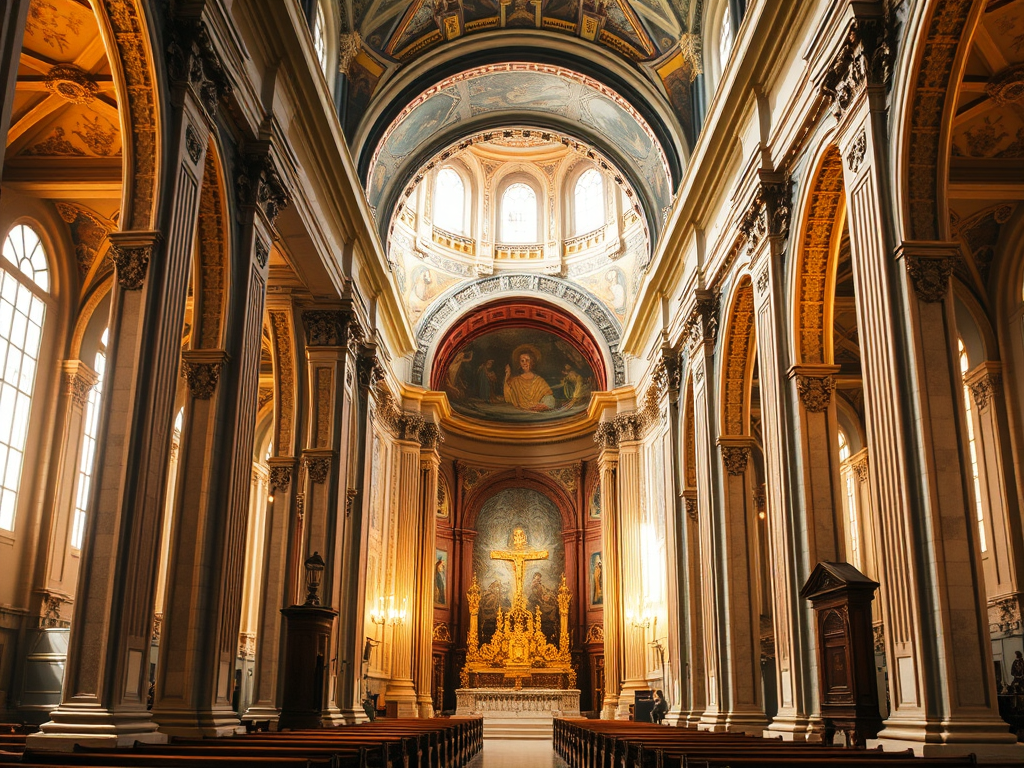
image of a basilica

Christian worship and gatherings evolved significantly, transitioning from intimate gatherings in private residences to the grand construction of public basilicas. This transformation marked a pivotal shift, as private, hidden worship transformed into a visible, public act that resonated deeply within the community. As congregations grew not only in size but also in significance, these impressive structures became essential gathering places, serving as focal points for the faithful and reflecting the multifaceted nature of their beliefs. They encapsulated not just the faith of individuals but also the collective aspirations and cultural identity of society as a whole. This new repurposing of Roman architecture played a crucial role in accelerating a new reality for communities, advancing God’s Story of Grace. They fostered an environment that brought together a new sacred space of joining personal dignity, which was reinforced by communal identity—concepts that would prove foundational to Western social thought. This laid the groundwork for future social and cultural developments that would evolve throughout the centuries.

In this article, we will examine how the basilica as a new place of gathering advanced God’s Story of Grace, forming the image of the trinity in society, which built a new understanding and experience that was both personal (the many) and communal (the one).

From Private Persecution to Public Legitimacy

House Church at Dura-Europos (3rd century)

In the Roman Empire’s first three centuries, the emerging Christian community gathered for worship in private homes, a necessity due to periods of persecution and the need for discreet assembly. This was a testament to their unwavering belief and resilience as followers of Jesus. These informal, intimate spaces fostered a sense of close fellowship, centered around shared meals (the agape feast), instruction, and discipleship. Early Christian meetings were humble affairs. Believers assembled in the homes of wealthier members like Lydia or Prisca and Aquila, as noted in Paul’s letter (1 Corinthians 16:9). The architecture was entirely domestic, with rooms adapted for prayer, baptisms (often in a modified courtyard or a separate room), and communal worship. The house at Dura-Europos in Syria is a famous archaeological example, showing a simple residential structure modified into a meeting place.1 This “house church” model was a necessity during a time when Christians were often a marginalized group and could not build public places of worship.

Roman Basilica

The narrative shifts dramatically in 313 AD, when Emperor Constantine issued the Edict of Milan, which granted Christianity legal status and full tolerance within the Roman Empire. This act not only ended official persecution but also thrust the Church into public prominence. Christianity moved from the shadows of persecution into the light of imperial favor. The faith exploded in popularity, attracting masses of new converts, and the modest house churches could no longer accommodate the growing congregations. The newly public Church needed a new architectural form. Christian leaders, with imperial patronage, chose to adapt the Roman basilica, which was a public multi-purpose building used for law courts, markets, and public assemblies. This was chosen over the pagan temples for several reasons:

  • Capacity: The large, rectangular, open interior could house an entire congregation for communal worship, which pagan temples (designed for only a few priests inside who offered sacrifices) could not. The vast, open interior of the basilica, designed to hold large crowds, was perfect for accommodating growing congregations.
  • Association: Unlike pagan temples, which were deeply rooted in the traditional Roman religious practices, the basilica had no strong ties to these customs, allowing the Church to effectively distance itself from polytheism and create a new identity that resonated with its distinct Christ-centered beliefs and practices.
  • Dignity: As an official Roman public building, the basilica form already commanded respect and authority, bringing a greater degree of respect to a once marginalized faith. By establishing basilicas as public buildings, Christians moved from the shadows of persecution into the light, becoming central landmarks in cities that reinforced Christianity’s growing prominence and role in civic life.

They did not just adopt the building; they baptized it. They saw the potential of the basilica’s vast, open interior, perfect for large numbers of the faithful to gather and hear the Word.

From Cultural Resistance to Public Influence

The story of the church moving from homes and even underground dwellings (catacombs) to basilicas is one of Christianity transforming the culture by its missional movement. This transition marked a pivotal moment in history, signifying not just a physical change in location but also a profound shift in how Christianity engaged with the broader world. This physical adoption had profound and immediate consequences for Western civilization and God’s work in the world:

The Architecture of Community

By adopting the basilica, the church established a communal space as the core of its physical expression, ensuring that worship could be accessible to all members of the community. Unlike the mystery cults or pagan rituals that often took place in private or exclusive temples, Christian worship in the basilica was public and inclusive, inviting individuals from all walks of life to participate in the sacred rites. The architectural choice of the basilica not only provided a grand and welcoming environment but also symbolized the openness and universality of the Christian faith. This design encouraged greater interaction among congregants, fostering a sense of belonging and connection within the community.

The Enduring Framework of Western Law

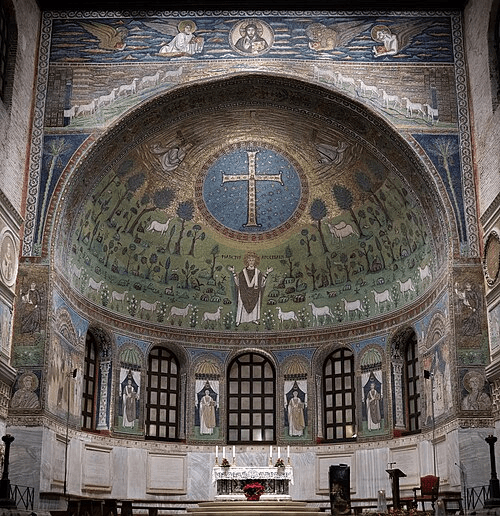
Early Christian Apse (arch)

The shift from the magistrate’s judgment seat to the bishop’s teaching chair was a seismic transfer of authority. The basilica was the physical embodiment of Roman law. When the Western Roman Empire crumbled and the legions retreated, the only organized authority that remained was the Church. The legal and administrative framework that had once been dispensed from the secular apse (arch) was now administered from the spiritual one. The Church adopted Roman legal principles, canon law, and administrative organization, all housed within the familiar basilica structure. This ensured the survival of Roman legal thought as the empire crumbled under the foot of barbarian invasion. The very concept of a structured, institutional body of law—a cornerstone of Western governance—endured because its physical home was preserved and repurposed by the Church.

The Birth of the Public Square

The Christian basilica created a new kind of gathering place: a structured space for moral instruction, reflection, and community gathering. This became the model for countless public institutions throughout Western history, from town halls to university lecture halls. It established the idea of a dedicated, formal civic space that was not just for commerce or military assembly, but for the higher purpose of social and moral cohesion. Today, when you walk into a modern courthouse, a state capitol building, or a university hall with its central aisle and raised platform, you are walking through the architectural ghost of the Roman basilica.

What Happened to House Churches?

House churches continued into the fourth and fifth centuries, even as larger, dedicated church buildings became more common after Christianity was legalized. While formal structures like basilicas emerged, many Christians continued to meet in homes. The shift from house churches to dedicated buildings was a gradual one. In many cases, existing private homes were remodeled for Christian worship, sometimes incorporating features like baptismal baths. Even with new, large churches being built, it was not always practical or desirable for all Christians to gather in one place. Smaller, more intimate house church settings remained important for many communities. In some regions, Christians continued to meet in homes due to ongoing persecution or simply because it was more accessible or preferred than using a large, public building.

Conclusion

The decision made by early Christian leaders—to utilize the remnants of the empire for the construction of their places of worship—accomplished more than merely providing a sanctuary for the church. It preserved the principles of structured law, defined the essence of communal gathering spaces, and significantly influenced the physical and philosophical landscape of the West. This development represented a progression in God’s Story of Grace by integrating a new space to cultivate the Trinitarian image within society, emphasizing personal dignity alongside communal identity.

____________________________________________________________________

  1. The Dura-Europos house church was a private home in the ancient city of Dura-Europos (modern-day Syria) that was converted into a Christian meeting place around 240 AD. It is significant as one of the earliest known Christian assembly buildings, featuring well-preserved frescoes, particularly in the baptistery, that depict biblical scenes like the Good Shepherd and the Healing of the Paralytic. The conversion involved architectural changes, such as removing walls to create a larger meeting hall and adding a baptistery with a font, which made it suitable for Christian worship while remaining discreet. 
  2. The basilica—from the Greek basilike, meaning “royal”—was a symbol of that power. It was the civic heart of every Roman town: a spacious, rectangular hall with a raised apse at one end, where a magistrate sat in judgment, administering justice and collecting taxes. It also featured high central ceilings with clerestory windows for light.
  3. Ancient mystery cults often conducted their core rituals in private, exclusive temples or designated sacred spaces, distinct from the public, state-sponsored religious ceremonies. The very term “mystery” (from the Greek myein, to shut one’s eyes or lips) refers to the secrecy surrounding their rites. Only individuals who had undergone a special initiation process (mystai) were permitted to participate, and they took vows of secrecy, often under penalty of death for revealing the details. Mithraea: The cult of Mithras, popular among Roman soldiers, conducted its rituals in small, windowless, often underground temples called mithraea. These were the architectural “antithesis” of open public temples. Sanctuaries and Shrines: Major cults like the Eleusinian Mysteries had dedicated sanctuaries where secret ceremonies took place in a central, restricted hall (the Telesterion). Private Settings: Beyond formal temples, some rites, like those of Bacchic groups, were held in private voluntary organizations (thiasoi), sometimes in remote locations like mountains, to engage in ecstatic worship away from public view. 

Previous article: The Latin Vulgate: How Jerome’s Bible Defined a Millennium of European Culture

The Latin Vulgate: How Jerome’s Bible Defined a Millennium of European Culture

depiction of Jerome

The year is 382, and Rome is in turmoil. The old empire is crumbling, and with it, the authority of its once-unassailable institutions. In the midst of this chaos, a brilliant and notoriously cantankerous scholar named Jerome was commissioned by Bishop Damasus to create a standardized Latin translation of the Bible. As Christianity spread through the western part of the Roman Empire: North Africa and Spain, then to Italy, Gaul (modern-day France), and Germany, there was a growing need for Latin versions of the Bible for those who did not understand the Septuagint (the Greek translation of the Old Testament) or the Greek letters of the New Testament. Initial Latin translations were made independently by various individuals and churches, without central authority. A patchwork of different regional versions was filled with inconsistencies and errors. The church needed a unified text, one that could be held as authoritative and authentic for the millions now impacted by the Christian message.

Map Demonstrating the Need for a Latin Translation of the Bible

It would be Jerome’s translation of the Bible that would advance the march of God’s Story of Grace in ways that can hardly be calculated. But its strongest contribution was to provide a common language, theology, and story to unify the western nations, many of whom were escaping barbarism and paganism to follow Christ. In this article, we will trace the journey to the translation of the Latin Vulgate and its impact on civilization. It took a fractured Europe and brought it together under the authority of God’s Word.

The Call to Translate

Jerome, a Roman-educated scholar, became seriously ill in Antioch in 375 AD. A powerful vision during his illness led him to abandon his worldly ambitions and embrace life as a desert monk to follow Jesus Christ. Following in the ways of the desert fathers, he entered into the life of a monk around 373 AD, about five years before he was commissioned by Bishop Damasus. Living in a desert cell in very austere conditions outside of Antioch in the Syrian desert, he disciplined himself to learn Hebrew and engage in scriptural study to know God better. Without realizing it, this would prepare him for his monumental translation work to which he would be called.1 As Damasus approached him, he left the area of Antioch and settled in Bethlehem, eventually immersing himself more deeply in the study of Hebrew and Aramaic to translate the Old Testament directly from its original sources—a radical act for his time.2 While his contemporaries favored translating the Old Testament from the Greek Septuagint because they believed it was inspired and authoritative, Jerome’s approach was rooted in his conviction that going back ad fontes (“to the sources”) was the only way to achieve a truly accurate and sound translation.

For more than two decades, Jerome labored in his Bethlehem monastery, dedicating himself to his work. By 405 A.D., he produced a polished and accessible translation in the “vulgar” (common language) Latin of the day, more commonly titled The Latin Vulgate. This translation would be widely comprehensible to millions. The Vulgate was more than just a new translation; it was a cultural and spiritual linchpin to hold Western civilization together for a millennium.

A Thousand Years of Influence

The Vulgate became a force for unity: With the collapse of the Western Roman Empire, the Church became a unifying force across a fractured continent. This unity would have been impossible without a common book. The Vulgate empowered the Church by providing a single, authoritative scripture that stabilized language, stories, doctrine, and worship practices. Kings and emperors, such as Charlemagne, relied on the Vulgate to unify their realms under a common Christian worldview. Even the Protestant Reformers, though knowing Greek and Hebrew, would commonly quote the Vulgate.

The Vulgate became formative for the development of theology: The Latin translation shaped the theological language of Western Europe for centuries. Jerome’s translation would give rise to many other translations including the first English translation of the Bible from John Wycliffe and his followers around 1382. The Gutenberg Bible, one of the first books ever printed, was a copy of the Vulgate, ensuring its continued dominance into the modern era. Even the King James translators consulted the Vulgate.3 In addition, the Latin terms Jerome used shifted the understanding, or at least the way they were read, of some of the key Greek terms in the New Testament. The Latin terms Jerome used in translating the Greek, in some cases, took on a more legal, governmental and military shift.4 This would have an enduring influence on theological development.

Conclusion

The work of Jerome was central for unifying the western countries of Europe around a common theme of God’s revelation in Christ through the Old and New Testaments. As Christianity spread throughout Europe, this Bible created a common theology, language and unifying story for which civilization could be brought and held together as the Roman Empire fell apart. Within the scriptures itself, we see this is the desire of God for the nations:

I will bless those who bless you,
    and whoever curses you I will curse;
and all peoples on earth
    will be blessed through you. (Genesis 12:3)

Now there were staying in Jerusalem God-fearing Jews from every nation under heaven. (Acts 2:5)

After this I looked, and there before me was a great multitude that no one could count, from every nation, tribe, people and language, standing before the throne and before the Lamb. (Revelation 7:9)

Though this reality will not be fully attained until the return of the Savior to the earth, through the Latin Vulgate, the world would become more trinitarian as the MANY different nations would become more unified as ONE around the Story of Grace.

_________________________________________________________________

  1. Before being approached by Pope Damasus, Jerome was motivated to study Hebrew by a desire for penance and a need to overcome temptations during his life as a desert hermit. This was combined with a passion for precise biblical scholarship and a growing conviction that translations of the Old Testament should be based on the original Hebrew texts. 
  2. Translating the Old Testament from the Hebrew was a radical act at Jerome’s time because the church primarily used the Greek Septuagint translation, and many Christians considered it divinely inspired. Jerome’s decision to base his translation on the Hebrew Bible was controversial because it challenged the authority of the Septuagint, seemed to connect Christianity too closely to its Jewish roots, and was seen by some as an insult to the Greek-speaking East of the church.
  3. By the time of the Protestant Reformation (1517), the very success of the Vulgate had ironically made it inaccessible to the average person. Latin had evolved from the common spoken language of the Roman Empire into a scholarly and ecclesiastical language, no longer understood by the average person. 
  4. Below is a comparison chart of some of the key theological shifts in terms.
Original Greek Word Vulgate Latin TranslationMeaning Shift and Doctrinal Impact
metanoiapaenitentiaMetanoia means “a change of mind” or “repentance” in Greek. Jerome translated it as paenitentia, which comes from the Latin verb paenitere, meaning “to cause to regret or repent” or “to perform an act of penitence”. This translation led to a shift from an internal change of heart to the external, ritualistic actions of the sacrament of penance in Latin theology.
kecharitōmenēgratia plenaIn Luke 1:28, the angel’s greeting to Mary, kecharitōmenē, means “highly favored one” or “having been graced”. Jerome rendered it as gratia plena, “full of grace”. This change, though subtle, emphasized the Catholic doctrine that Mary was filled with grace in a unique, permanent sense, rather than simply being the recipient of a divine favor.
ethnosgentilisThe Greek word ethnos simply means “nation” or “people group” without any negative connotation. Jerome’s choice of gentilis for “Gentile” carried a more negative meaning, sometimes implying “foreigner” or “heathen” in Latin. This introduced a subtle racial and religious hierarchy that was not present in the original Greek.
logosverbumLogos is a rich Greek word encompassing ideas of “word,” “reason,” and “divine meaning”. The Vulgate’s translation as verbum captured the idea of “word” but lost some of the philosophical depth of the Greek, which had been influenced by Stoic and Platonic thought. This flattened the concept to a more literal, spoken word.
mysterionsacramentumThe Greek mysterion means “a secret rite” or “revealed secret”. By translating it as sacramentum, Jerome applied a term that had existing legal and military connotations in Latin, related to an oath of allegiance. The new word helped define the Christian sacraments as sacred oaths or rituals.

Previous article: The Ascending Church: A Theodosius and the Council of Constantinople

Next article: From Living Room to Sanctuary: How the Church Building Reshaped Christianity

The Ascending Church: A Theodosius and the Council of Constantinople

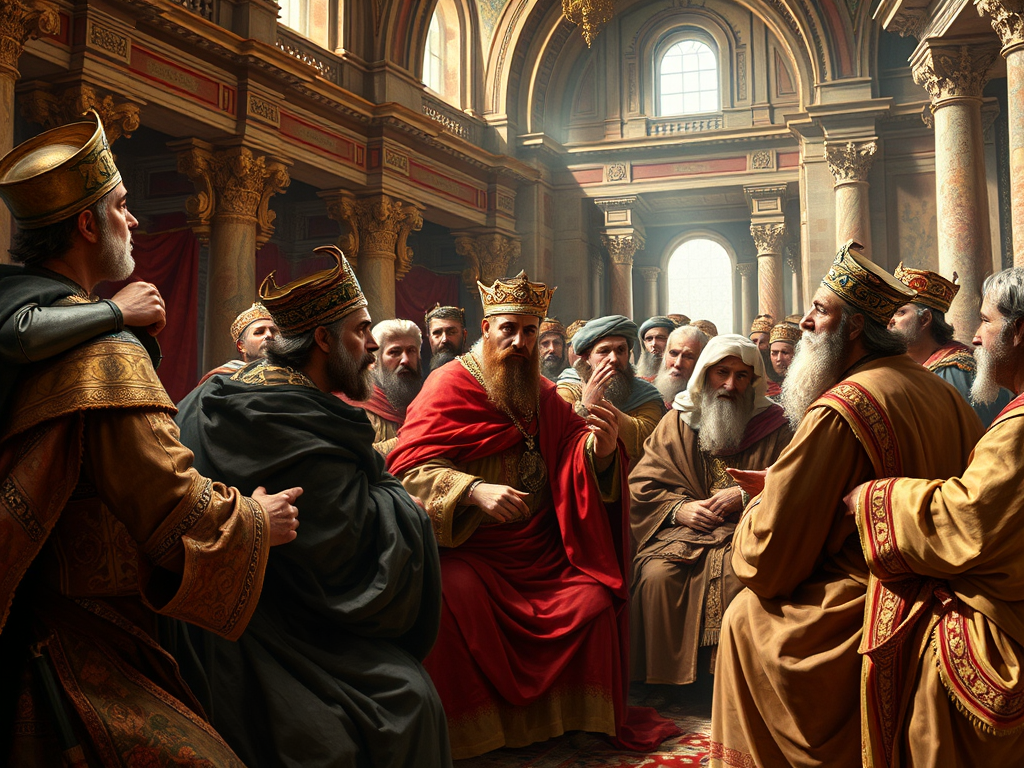
depiction of the Council of Constantinople

Emperor Theodosius, who lived from 347–395, was a man with a singular ambition: to unite the Roman Empire not just politically, but spiritually, under the banner of Nicene Christianity.1 Upon ascending the throne in 379 AD, he sought to consolidate the church under the affirmation of the Nicene Creed.  Theodosius assembled 150 bishops in 381 AD to settle the Arian controversy, which had put the very doctrine of the Trinity at risk.2 As the great emperor entered the hall, the air was not one of harmony, but of simmering tension. He saw men like Gregory of Nazianzus, a brilliant but frail theologian, who bore the weight of biblical truth with a heavy heart. He saw Meletius of Antioch, a powerful figure, who had been a source of division.3 He observed the Macedonian bishops, who arrived late in protest, their faces defiant, ready to challenge his very authority. Theodosius’s first act was not to decree, but to observe. He listened to the arguments, the impassioned speeches, and the subtle maneuvers of both sides of this momentous debate. This was not a battlefield to be won with swords, but a spiritual arena where the mind and the soul held sway.

In this article we will see how this second great council of the church further articulated and universally affirmed the doctrine of Trinity. This would provide a further basis for the advance of God’s Story of Grace where God’s image of a mutual and self-giving love to expand and be lived out on the earth. Further, as Rome would begin to fracture, the Church would become the new unifying center of civilization which would allow God’s image, reflected in the Trinity, to further transform civilization. Theodosius was the emperor who would, after Constantine, lay the ground work to make this possible.

The First Council of Constantinople

The Council of Constantinople was led by Miletus. When he died unexpectedly, Gregory of Nazianzus, who was recently installed as the bishop of Constantinople, was elected to preside. He spoke with fiery eloquence, defending the divinity of the Holy Spirit, in full equality with the Father and the Son. This had been an aspect of the Nicene Creed which was not addressed and still stirred fervent debate. But old rivalries ran deep. Gregory’s authority was challenged by a cabal of bishops who refused to be commanded by a theological rival. Exhausted and disheartened by the infighting, Gregory resigned. To replace Gregory, the council quickly installed Nectarius, a Roman official, who quickly became baptized in order to be the new bishop of Constantinople. Though lacking Gregory’s theological clout, Nectarius was a symbol of imperial favor and political stability.

In the end, it became clear that the work of the bishops was not to create a new document, but to expand upon the one formulated at Nicaea decades earlier. They condemned Arianism, but their most significant work was the clear articulation of the Holy Spirit’s divinity. The bishops, in need of a cohesive faith, arrived at a new consensus. The Constantinopolitan Creed, as it came to be known, was not merely a decree from an emperor but a statement of faith articulated by the Church itself. When the council concluded, Theodosius knew he had achieved his goal: the further strengthening and unification of the Church.

Major Outcomes

The divinity of the Holy Spirit is affirmed forever securing belief in the Trinity. In the original Nicene Creed of 325 reads:

We believe in one God, the Father almighty, Maker of heaven and earth,
and of all things visible and invisible.
And in one Lord Jesus Christ, the Son of God, the only-begotten,
begotten of the Father before all ages.
Light of Light, true God of true God, begotten not made,
of one essence with the Father by whom all things were made;
who for us men and for our salvation, came down from heaven,
and was incarnate of the Holy Spirit and the Virgin Mary
and became man.
And He was crucified for us under Pontus Pilate,
and suffered, and was buried.
And the third day He rose again, according to the Scriptures;
and ascended into heaven, and sits at the right hand of the Father;
and He shall come again with glory to judge the living and the dead;
whose Kingdom shall have no end.
And in the Holy Spirit.

Following the Second Ecumenical Council in Constantinople in 381, the Creed was further
supplemented with the following:

And we believe in the Holy Spirit, the Lord, the Giver of Life,
Who proceeds from the Father; who with the Father and the Son
together is worshipped and glorified; who spoke by the prophets.
In one Holy, Catholic,4 and Apostolic Church.
I acknowledge one baptism for the remission of sins.
I look for the resurrection of the dead, and the life
of the world to come.
Amen.

Theodosius expanded the unity of the Roman Empire with a deepening Christian commitments. This was vital as the Roman Empire would come under increasing attack from German tribes like the Visigoths, Ostrogoths, and Vandals, as well as the Huns. This ultimately created a domino effect of invasions and migrations as the political structure of Rome began to disintegrate, with the last emperor deposed in 479. It was Theodosius who consolidated the empire under the Council of Constantinople and would further push efforts to expand Christian reforms and policies that had begun under Constantine.5 Ironically, his reforms would provide a basis for Christianity to organically spread as the barbarian tribes came into contact with Rome. They converted to Christ, in part, because paganism had been forced into increasing decline.

The reign of Theodosius was not perfect by any measure. But in the expansion of God’s Story of Grace, his reforms and leadership led to the further realization of Revelation 11:15:

“The kingdom of the world has become
    the kingdom of our Lord and of his Messiah,
    and he will reign for ever and ever.”

______________________________________________________________________________

  1. Nicene Christianity affirmed the Council of Nicaea’s declaration that Jesus Christ was “very God of very God,” meaning that he was co-substantial (of the same substance) with the Father, “begotten and not made.” This was distinct against Arianism which promoted the idea that Jesus Christ was a created being, less in than the Father.
  2. The council did formally use the term Trinity, the council’s work was built upon the Council of Nicaea (325 AD), and together they confirmed the divinity of the Son and added the divinity of the Holy Spirit to the creed, affirming the Trinitarian view that is central to Christian orthodoxy today. 
  3. He served as the first president of the council but died shortly after the proceedings began. Meletius of Antioch (Greek: Μελέτιος, Meletios) was a Christian patriarch from Antioch from 360 until his death in 381. He was opposed by a rival bishop named Paulinus II and his ministry was dominated by the division and argument, usually called the Meletian schism. As a result, he was exiled from Antioch in 361–362, 365–366 and 371–378.
  4. The term “Catholic” mean universal church and is not limited to the Roman Catholic Church. In fact, this creed and council favored the leaders and churches at Constantinople over the leaders and churches of Rome.
  5. In some cases his reforms were too harsh against pagans, but in making the Empire more Christian, it provided an environment for missions and Christian philanthropy to spread.

Ambrose’s Struggle: Balancing Submission and Resistance to Government (Romans 13:1-7)

depiction of Ambrose and Constantine

In 390 A.D., when Emperor Theodosius ordered the massacre of approximately 7,000 citizens in the city of Thessalonica, this set off a clash with Bishop Ambrose of Milan. This confrontation offers a profound challenge to a superficial reading of Romans 13:1–7, where Paul famously commands submission to governing authorities. Ambrose’s resolute defiance of the emperor illustrates a critical theological distinction: that the state’s authority, though divinely instituted, is not absolute and is subordinate to God’s moral law. The conflict over the massacre at Thessalonica forged a powerful precedent in the history of church and state, demonstrating that Christians have a duty to resist and rebuke state power when it oversteps its moral and spiritual bounds.

In this article, we will address where those categories overlap. In God’s Story of Grace, the church has now come to a new place of authority and prominence to further reshape the world in the trinitarian image: increased unity and diversity. In this article, we will understand the influence of the church in relation to the state.

The Biblical Basis for State Authority

Paul wrote to the early church living in the very center of authority in the Roman Empire. This provides one of the most significant biblical passages on the Christian relationship to the state. Here is how Paul addresses this topic:

1Let everyone be subject to the governing authorities, for there is no authority except that which God has established. The authorities that exist have been established by God. Consequently, whoever rebels against the authority is rebelling against what God has instituted, and those who do so will bring judgment on themselves. For rulers hold no terror for those who do right, but for those who do wrong. Do you want to be free from fear of the one in authority? Then do what is right and you will be commended. For the one in authority is God’s servant for your good. But if you do wrong, be afraid, for rulers do not bear the sword for no reason. They are God’s servants, agents of wrath to bring punishment on the wrongdoer. Therefore, it is necessary to submit to the authorities, not only because of possible punishment but also as a matter of conscience.This is also why you pay taxes, for the authorities are God’s servants, who give their full time to governing. Give to everyone what you owe them: If you owe taxes, pay taxes; if revenue, then revenue; if respect, then respect; if honor, then honor.

Let’s look at a basic breakdown of this passage:

Principle # 1: The state has a divine origin.

“Let everyone be subject to the governing authorities, for there is no authority except that which God has established” (Romans 13:1).

Paul grounds the state’s legitimacy in God’s providence, meaning that the institution of government is part of God’s plan for order in the world.

Principle # 2: The state bears authority as a servant of God.

“For rulers hold no terror for those who do right, but for those who do wrong… For he is God’s servant to do you good” (Romans 13:3–5).

The state’s purpose is to maintain civil order, restrain evil through punishment, and create an environment where the righteous can flourish. In this way, they are servants of God.

Principle # 3: The state is to be submitted to and honored as God’s servants.

Therefore, it is necessary to submit to the authorities, not only because of possible punishment but also as a matter of conscience. (Romans 13:5).

Paul asks Christians to obey the state not merely out of fear of retribution but out of a deeper moral commitment to God, who established the state. This includes fulfilling civic duties like paying taxes.

This is also why you pay taxes, for the authorities are God’s servants, who give their full time to governing. Give to everyone what you owe them: If you owe taxes, pay taxes; if revenue, then revenue; if respect, then respect; if honor, then honor. (Romans 13:6–7)

These principles are solid for any age. But how this is applied to the church in the middle of the first century and the church at the end of the fourth century was considerably different. Before Constantine, the relationship between church and state was one of persecution, where Christianity was an illegal and often persecuted religion, with the state viewing it as a threat. After Constantine, the relationship transformed from persecution to tolerance and eventual state support, with the emperor becoming a key patron of the church, which gained political influence and began to intertwine with the state, a process that eventually led to Christianity becoming the official state religion.

Before and After Constantine

Before Constantine

  • Persecution: Christians were a persecuted minority, and the Roman state viewed Christianity as a threat to its traditional pagan order.
  • Illegal status: Christianity was an illegal religion for much of this period.
  • Lack of state support: The church did not receive state funding or special privileges and had to operate independently. 

After Constantine

  • State patronage: Constantine ended the persecution of Christians and, through the Edict of Milan in 313 CE, granted Christianity legal toleration. 
  • Increased power and influence: The church gained significant political power, temporal wealth, and influence it had never possessed before. 
  • Official religion: The relationship evolved to the point where, within a century, Christianity became the official religion of the empire. 
  • Instrument of unification: Emperors increasingly relied on the church as a tool to help unify the empire, especially as its unity and authority began to crumble. 

The Clash Over the Thessalonica Massacre

When Bishop Ambrose learned of the atrocity at Thessalonica, he was appalled by the emperor’s indiscriminate slaughter. This act moved beyond the state’s God-given role as a minister of justice and became a horrific miscarriage of it. Ambrose did not respond with political rebellion or armed force. Instead, he employed the most powerful spiritual weapon of his office: excommunication.

He wrote a letter of rebuke and correction to the emperor. Theodosius ignored Ambrose’s letter and showed up at the church doors. The historian Sozomen described this encounter:

When he drew near the gates of the edifice, he was met by Ambrose, the bishop of the city, who took hold of him by his purple robe, and said to him, in the presence of the multitude, ‘Stand back! A man defiled by sin, and with hands imbrued in blood unjustly shed, is not worthy, without repentance, to enter within these sacred precincts, or partake of the holy mysteries.’ The emperor, struck with admiration at the boldness of the bishop, began to reflect on his own conduct, and, with much contrition, retraced his steps. It appears that it was for these and other acts of cruelty that Ambrose rebuked the emperor, forbade him to enter the church, and excommunicated him.

Theodosius, recognizing the gravity of his sin and the spiritual authority of the bishop, eventually submitted. The historian Sozomen, again, explains his response:

Theodosius publicly confessed his sin in the church, and during the time set apart for penance, refrained from wearing his imperial ornaments, according to the usage of mourners. He also enacted a law prohibiting the officers entrusted with the execution of the imperial mandates, from inflicting the punishment of death till thirty days after the mandate had been issued, in order that the wrath of the emperor might have time to be appeased, and that room might be made for the exercise of mercy and repentance.

As a result, he enacted a law requiring a 30-day waiting period between a death sentence and its execution to prevent future impulsive acts of violence.

Before Constantine, the church and state were in conflict, with Christianity being illegal and regularly persecuted, as the state saw it as a threat. After Constantine, this changed to tolerance and support, with the emperor becoming an important supporter of the church, which gained political power and began to connect with the state, ultimately leading to Christianity being declared the official state religion.

Reconciling Submission and Resistance

Ambrose’s actions were not a rejection of Romans 13 but a consistent honoring of it. It is important to keep in mind that Ambrose did in no way seek to overthrow the emperor but rather to hold him accountable to the higher moral authority of God. The conflict reveals several critical principles for reconciling submission and resistance:

Principle # 1: The state has a divine origin. Ambrose understood that the state has its ultimate authority to God and answers to God. As such, that authority is accountable to God who is its source and even judge.

Principle # 2: The state has authority as a servant of God. While the state has legitimate authority over the civil order as a servant of God; the church has prophetic authority to call out the state when it steps beyond its service.

Principle # 3: The state, as servants of God, is to be submitted to and honored. The key here is that the state is to be obeyed “as God’s servants.” The massacre at Thessalonica was an act of gross injustice. He has every justification as a leader of the church, who had the emperor’s ear, to confront this. Ambrose’s resistance was spiritual. He did not raise an army but instead used the moral and spiritual power of the church.

Conclusion

In essence, Ambrose’s resistance was not a rebellion against authority but a protest against the abuse of authority. His actions illustrate that the Christian duty of submission outlined in Romans 13 is not a passive acceptance of all state actions but a call to active, conscience-based engagement. When the state acts outside its divine mandate to uphold justice and order, a Christian, and particularly a church leader, when properly positioned, has the duty to challenge and rebuke it for the sake of a higher purposes of God’s Story of Grace, at work in the world.

Ambrose and the Courage to Resist the State (Ephesians 1:22)

depiction of Ambrose

On rare occasions, leaders arise in history who possess the vision and capability to effectively address several significant problems at once, often leaving a lasting impact on their societies. In the late fourth century, that exceptional leader was Ambrose of Milan, Italy (340-397 AD). As Bishop of Milan, he was not only a powerful orator but also a devoted theologian whose influence reached far beyond his time. Substantial challenges were confronting the movement of God’s Story of Grace, including political strife, theological disputes, and moral decline in the church, which Ambrose navigated with remarkable skill. He actively worked to bridge the gap between church and state, advocating for Christian values while confronting the powerful rulers of his day, thereby shaping the early Christian church’s influence within the Roman Empire.

  • The church was divided and weakened by the heresy of Arianism.
  • The power and authority of state rulers over the church had become way too great.
  • There were no larger voices to shape a biblical understanding to address the great shifts of the changing times.

All of these factors combined, placed the church at a place of increased impotency. In Ambrose, an unlikely and reluctant bishop in northern Italy, these problems would find a decisive answer. In God’s Story of Grace, he would arise to the occasion and weave together several loose threads into a unified knot. Further, he would ascend to a place of influence–not from his own choosing or ambition–to showcase the supremacy of Christ in the world:

God has put all things under the authority of Christ and has made him head over all things for the benefit of the church. (Ephesians 1:22)

In this article we will see how the life of Ambrose, in his spiritual authority, restrained the most powerful state in the world, showing the supremacy of Christ for his church over all things.

Life of Ambrose

Summoned to Lead

Ambrose, born in 340 AD, was the son of a government official in Trier, a city in present-day Germany. Following in his father’s footsteps he trained as a lawyer to prepare himself for a life of service as a government official. By his early 30s, he was already governor of Milan, a city in northern Italy. Milan had taken over Rome as the place of imperial rule due to the emergence of barbarian invaders threatening the capital city. When the bishop of Milan died in 374 AD, Ambrose expected trouble. Tension between the Nicene (those holding to the divinity of Jesus) and Arian (those holding to Jesus being less than divinity) parties were very sharp. Conflict arose over whether the new bishop would be Arian or Nicene. 

As it was coming time to choose a bishop, crowds surged into the streets, some shouting they wanted an Arian bishop, while others demanded a Nicene replacement. The animosities were potentially boiling to a riot. As regional governor, it was Ambrose’s responsibility to oversee the election. He pleaded with the crowd to keep the peace. He was not publicly identified with either party. As he addressed the riotous crowds, the people were enthralled with his speaking ability. Combined with his existing popularity, the crowd began to shout, “Ambrose for bishop!” The pleas grew more insistent: “Ambrose for bishop! Ambrose for bishop!”

The two major problems with this appeal is that Ambrose had no desire to be bishop; further, he had not even been baptized.  After strongly resisting the call to spiritual leadership over Milan, he finally consented to the will of the citizens. Within eight days, Ambrose was baptized and ordained bishop of Milan. As a leader he was both wise and humble enough to know how much he had to learn. When he became bishop, he gave away his wealth and found teachers in theology to help him learn what he needed to know to effectively shepherd and guide as bishop. He eventually became one of the most learned men of his time.  His influence would be felt for centuries.

Overcoming the Power of Arianism

Upon attaining the role of bishop, he was not publicly aligned with either Nicene or Arian views. This worked to his favor because both parties believed that they had obtained a mutually acceptable candidate in Ambrose. As he grew in spiritual leadership and applied his education to the interpretation and exposition of scripture; he acquired a profoundly biblical and Nicene understanding of the faith. It would be this doctrine that he zealously defended in the face of Arian opposition not only against Arian bishops but from the imperial power of the Rome. Emperor Valentinian II, who was Arian, attempted to have one of the three major churches in Milan under the control of the Arians for their use. Ambrose refused. The conflict culminated in a stand-off between imperial and church authority. Ambrose and his supporters barricaded themselves inside the church successfully resisting the efforts of Valentinian.

During the confrontation Ambrose set forth an important principle that would have ramifications for Church-state relations for centuries: “The emperor is in the church, not above it.” In 381, the same year as the Council of Constantinople, Ambrose presided over the Council of Aquileia in the West. This council deposed several Arian bishops, solidifying support for Nicene and biblical belief in his own realm.

“The emperor is in the church, not above it.” 

Ambrose of Milan

Overcoming the Pride of Rome

Ambrose’s triumph over a politically powerful Arianism was followed by a more thorny confrontation with another imperial authority who arose to the throne in 380, Theodosius. Not long after he became emperor, Theodosius declared Nicene Christianity the official belief of the entire Roman Empire. Yet Ambrose’s principle of the emperor being “in the church, not above it” would face an even greater test with this new ruler. This happened when Theodosius ordered the massacre of some 7,000 people in Thessalonica after a local riot that claimed the lives of several imperial officers. Ambrose, as the emperor’s bishop, ordered him to do public penance. In a carefully worded but firm letter, he chided the emperor, likening his action to King David’s murder of Uriah the Hittite:

Bear it, then, with patience, O Emperor, if it be said to you: You have done that which was spoken of to King David by the prophet. For if you listen obediently to this, and say, “I have sinned against the Lord,” if you repeat those words of the royal prophet: “O come let us worship and fall down before Him, and mourn before the Lord our God, Who made us,” it shall be said to you also: “Since you repent, the Lord puts away your sin, and you shall not die.”

Theodosius complied with this directive and publicly repented and decreed that, going forward, any time he sentenced someone to death, there should be a waiting period of a month before the sentence was carried out. This way he would not act in haste. 

Ambrose’s Legacy

Ambrose was used in God’s Story of Grace to place the church on a footing of moral authority in order that Christianity and the gospel could give spiritual guidance to the larger development of civilization. He did this by bravely and effectively resisting two emperors, demonstrating a remarkable blend of spiritual fortitude and diplomatic skill, and placing the church at its proper place of authority. This courageous stance was not merely an act of defiance but a profound assertion that would allow the church to become a moral compass and conscience of the state, particularly as western Rome began a gradual process of disintegration marked by political turmoil and societal upheaval. In this context, the church would rise to take the lead as the unifying energy of civilization, fostering a sense of community and shared purpose among disparate groups. As God is shaping the world after his trinitarian image, Ambrose’s stance and resistance would create greater humility in the state (after the one God), prompting rulers to recognize the limits of their power. This acknowledgment would allow greater freedom and creativity for society (after the distinctive persons), encouraging a flourishing of culture, art, and thought, rooted in Christian values. Ambrose’s enduring influence would echo through history, reminding future generations of the vital interplay between faith and governance in the pursuit of a just and equitable society.

This would also pave the way for the contributions of Ambrose’s greatest disciple, Augustine. It would be Augustine who would provide a monumental understanding of the role and limits of the state in relation to church, especially in his magisterial writing, The City of God. It would be through the leadership of Ambrose, and to a much greater extent, Augustine, that the church and society would find a way to understand its place, as the Rome of the West would become increasingly weakened by barbarian invasions it was not able to stop.

Why Constantine Was Good For Christianity (Hosea 6:6)

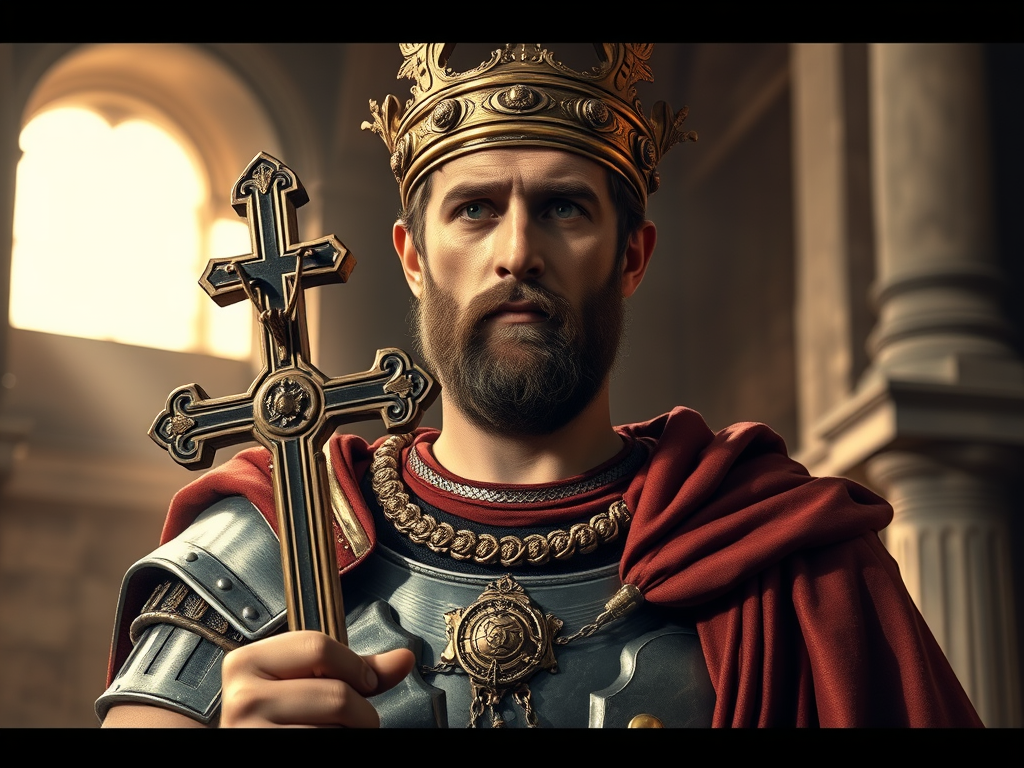
depiction of Constantine

Two rivals, Constantine and Maxentius, met in an earth-shaking confrontation at the Milvian Bridge, north of Rome, over the Tiber River. Maxentius held Rome in his iron grip. As Constantine descended from the north, this brilliant general marched his smaller, battle-hardened army toward Rome. The day before the final battle, Constantine was filled with a familiar anxiety. At midday, his gaze drifted upward, away from the turmoil of his camp. There, he saw a cross of light above the sun itself, with the Greek words “Ἐν Τούτῳ Νίκα” (“In this sign, conquer”) emblazoned upon it. Later that night, another vision came to him in a dream. Christ appeared, bearing the same cross, and commanded Constantine to make this symbol his standard in battle. The symbol was the Chi-Rho, an elegant monogram formed from the first two Greek letters of “Christ.” The next day, he ordered his soldiers to paint the sacred monogram on their shields. Within hours, the two armies clashed fiercely on the plain north of Rome. Constantine’s cavalry, emblazoned with the Chi-Rho, charged with a ferocity that Maxentius’s larger army could not match. It was a decisive victory. After his victory at the Milvian Bridge, what Constantine did next—or did not do—would begin to echo through the ages. The rules of the triumph required Constantine to enter the Roman capital and offer the sacrifice of an animal to Jupiter; Constantine refused. This was because he attributed his win to the Christian God.

Constantine became the first Roman emperor to embrace and then promote Christianity. To some, this royal acceptance is what led to a corruption and decline of biblical Christianity for the centuries ahead. The worldly priorities of state power overtook the founding mission to make disciples given by Jesus (Matthew 28:19). so it is claimed. But what if Constantine had not become favorable to Christianity? Would the church have been stronger as a persecuted and minority faith? The answer is probably not. From the angle of God’s Story of Grace, Constantine was part of a kairos (“fullness of time moment”) that brought a pivotal change: he shifted the dominant religious theme of Rome from the pervasively practiced pagan blood sacrifice to a civic acknowledgment of the completed blood sacrifice of Christ. For all of Constantine’s alleged blessings and flaws, this exchange brought a pivotal shift in Western civilization.

In this article, the claim will be made that the effects of the atonement of Christ, which began to be embraced by the Roman Empire, liberated society from the fear of appeasing angry and volatile deities to providing increasing mercy to increase compassion in society. This would be a turning point for the widespread improvement of civilization reflecting the mutual and self-giving love of the Trinity.

Bloody Rome

The core of Rome’s existence was built on sacrifice. These frequently included animal offerings like rams and ox; but also human slaughter through gladiatorial games, strangling prisoners at the temple, burying prisoners of war alive, among others atrocities. Sacrifices were central to establishing favor with the deities in order to appease them for transgressions or demonstrate devotion to gain their favor. Another way this sacrificial devotion was expressed was the killing of Christians. This occurred at its greatest extent from 303 to 311, just before Constantine ascended to the throne in 312. Diocletian became emperor in 284. In 299, he participated in a sacrifice to seek the favor of the Roman Empire, while in the city of Antioch, that proved alarming. When the liver of a slaughtered animal was examined, the pagan priest said it showed unfavorable signs. For Diocletian this was very disturbing. The very peace of Rome was at stake. Theologian Peter Leithart describes what happens next:

The presiding diviner investigated and concluded that “profane persons” had interrupted the rites, and attention focused on Christians in Diocletian’s court who had made the sign of the cross to ward off demons during the proceedings. Diocletian was outraged and demanded that all members of his court offer sacrifice, a test designed to weed out Christians. Soldiers were required to sacrifice or leave the sacred Roman army. At least at the heart of the empire, in the court and in the army, sacrifices would continue without being polluted by Christians. At the heart of the empire, where it really mattered, gods and men would remain in communion.

Still the problem was not solved. Leithart continues:

Several years after the failed sacrifice, Diocletian was back in Antioch when a Christian deacon, Romanus, burst in on another imperial sacrifice loudly denouncing the worship of demons. Diocletian ordered that his tongue be cut out and sentenced him to prison, where he was executed, but the emperor knew something more needed to be done. Wintering in Nicomedia the following year, Diocletian consulted with his Caesar Galerius about the problem. “Arrogant and ambitious” and a “fanatical pagan,” Galerius urged Diocletian to issue a general order against the Christians.

The Chi Rho Symbol

Diocletian was charged with guarding the frontiers of the empire and maintaining the sacredness of Rome. It was his solemn duty to expel any pollution that might infect it and bring down the wrath of the gods. Christianity was spreading, and Christians were everywhere. From Diocletian’s point of view, Rome could only be saved by a massive sacrifice of Christian blood. What started out in 303 as an arrest and violence against Christian leaders turned into a bloodshed in the most widespread, long lasting and severe persecution which the church had ever faced under the hammer of Rome. The beginning of the end would finally occur at the battle at the Milvian Bridge in 312 and one year later the blood sacrifice of Christians ended in 313 when Constantine issued the Edict of Milan. This gave Christians legal status to practice their faith.

This was the beginning of a series of reforms which would baptize the Roman Empire in a Christian direction away from paganism. He prohibited his provincial governors from offering sacrifices at official functions, thus opening up civil offices to Christians. Eusebius, the ancient historian, claimed Constantine passed a law around 324 that “was intended to restrain the idolatrous abominations which in times past had been practiced in every city and country; and it provided that no one should erect images, or practice divination and other false and foolish arts, or offer sacrifices in any way.” In 325, he issued an edict against the gladiatorial games declaring that “bloody spectacles are not suitable for civil ease and domestic quiet.” Constantine himself fought imperial wars, but his victories were not celebrated as the honor-wars to the gods of previous emperors had done.

With Constantine, the Roman Empire became officially an empire without sacrifice or at least a bloody sacrifice. It still had acknowledgement of sacrifice, but it was the sacrifice provided once and for all by Jesus Christ. The implications had earth-quaking significance. Again, Peter Leithart explains:

Every city is sacrificial, but Constantine eliminated sacrifice in his own city and welcomed a different sacrificial city into Rome. For a fourth-century Roman, eliminating sacrifice from the city was as much as to say, “My city is no longer a city.” For a fourth-century Roman, acknowledging the church’s bloodless sacrifice as the sacrifice was as much as to say, “The church is the true city here.” When Constantine began to end sacrifice, he began to end Rome as he knew it, for he initiated the end of Rome’s sacrificial lifeblood and established that Rome’s life now depended on its adherence to another civic center, the church.

Because Rome couldn’t acknowledge the ultimate and final sacrifice for humanity, it was not free to exercise mercy. Above all God desires from his people “mercy not sacrifice.” (Hosea 6:6)

Pagan Sacrifice to the Sacrifice of Christ

The state became more compassionate. Because the sacrifice of Christ was accomplished “once and for all,” Rome no longer needed to be consumed with the brutal work of appeasing bloodthirsty entities. Rather, it could promote compassion and mercy as expressed through the message of the church. This would, in turn, bring the promotion of more just laws.

  • Crucifixion was abolished.
  • Funding for the poor, orphans, and widows was introduced.
  • The practice of infanticide through exposing unwanted babies was made illegal. Care for unwanted children was provided for from the public treasury.
  • More humane policies toward slaves was put in place.  
  • Branding on the faces of criminals was made illegal. 
  • Prison reform was inaugurated requiring that prisoners be given daylight and fresh air instead of being kept in total darkness. 
  • Gladiator games were banned. 
  • Women were given more rights in regard to their children.
  • A day of rest was put in place , thereby reordering the life of society to make space for Christian worship.1

The mission of the church expanded. The Constantinian revolution created space for Christianity to shape the new society that was being constructed away from paganism. The church put forward a new idea of a separate community within society. No longer did the state control the ultimate meaning of life. The church was a gathered community within the state that brought in God’s Story of Grace in Jesus Christ. The result was a great flowering of Christian expression in art, architecture, law, theology, philosophy, and spiritual literature. None of this was imposed by the state but came as a natural outgrowth of the dynamic movement of Christianity. The number of disciples would mount across the empire. Historian Robert Louis Wilken describes the church’s growth:

The transformation that took place within the empire would be replicated again and again as Christianity spread beyond Rome’s boundaries into northern Europe, among the Franks and the Germans, the British and the Irish, the Scandinavians and the Poles, the Lithuanians and the Bulgars, the Ukrainians and the Russians, into Asia among the Armenians and Georgians, and into Africa among the Nubians and Ethiopians. For all these peoples conversion to Christianity meant a change of public practice in law, in architecture, in calendar, in marriage customs, in political institutions, in social mores, in burial practices, and much more.

Statistically, it would be at the time of Constantine that Christianity would experience an exponential growth.2

Conclusion

In Constantine, God’s Story of Grace would advance primarily with the cross triumphing over paganism, and compassion beginning to overtake the Roman jaws of power. The Christian ethic of human value would advance as a widespread value in Western culture. It would be from this place that the boundaries of Christian mission and influence would be expanded. For the first time, the organic movement of the church would intersect with the force of Roman power, and a new phase of the image of the Trinity would be born into the world. All the parts of Rome (the many) would become more unified as a larger body (the one) under the sign of the cross.3

_______________________________________________________________

  1. Though Constantine would have a revolutionary influence, he did not usher in a “golden age” of Christianity. Over the next decades after Constantine, Christianity would face a battle against Arianism to affirm the deity of Christ as affirmed in the Council of Nicaea. Often those like Athanasius, who affirmed the Nicaean Creed were severely persecuted.
  2. Rodney Stark has provided these stats on the growth of Christianity in the first four centuries: 7,500 Christians by the end of the first century (0.02% of sixty million people); 40,000 Christians by 150 AD (0.07%); 200,000 by 200 AD (0.35%); 2 million by 250 AD (2%)6 million by 300 AD (10%); 34 million by 350 AD (57%)
  3. Under Constantine, the church held its first ecumenical council, which affirmed the doctrine of the deity of Christ at the Nicaean Council in 325.