

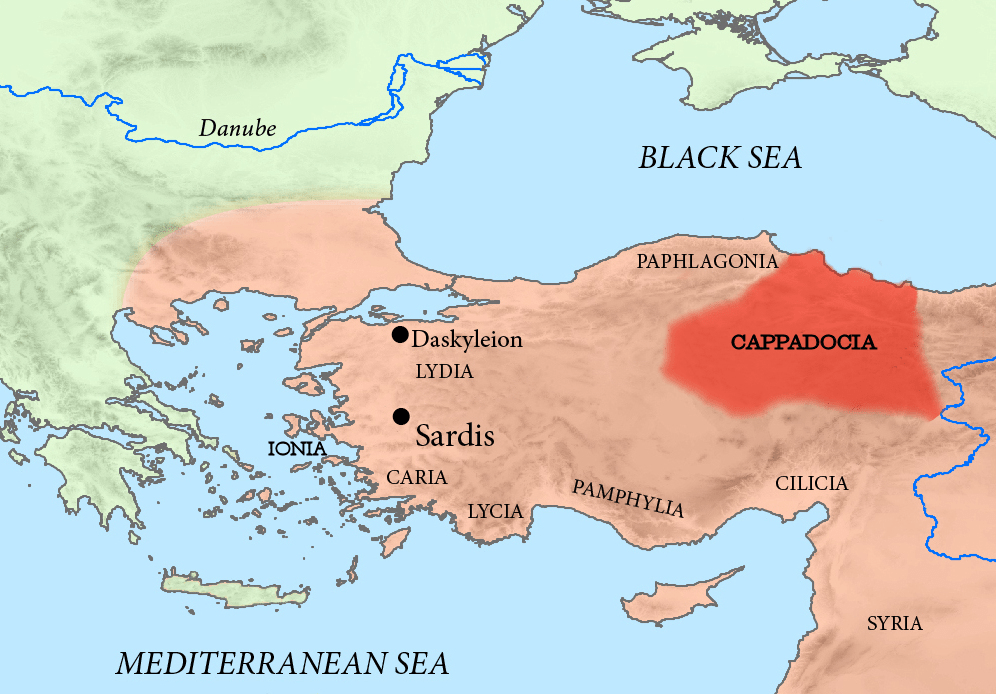
A golden age of biblical exploration and theological development occurred in the fourth century with a band of Christian leaders known as the Cappadocian Fathers: Basil of Caesarea, Gregory of Nyssa, and Gregory of Nazianzus. Their stories and their theological contributions are intertwined. They lived full and adventurous lives as not only theologians but as leaders of the church. But their most important contribution to God’s Story of Grace was solidifying Trinitarian truth for all time–the bedrock of Orthodoxy.1 From the area of Cappadocia (an area of modern Turkey), these three men refined our understanding of the biblical revelation of the meaning of God as Father, Son and Holy Spirit. Their work helped to establish the formula of one God existing in three persons. (one ousia=essence in three hypostasis=person).
In this article we will look at the distinctive contribution of each man to the doctrine of the Trinity and then look at the big implications of this doctrine in the shaping of God’s Story in the world.
Trinitarian Theologians
All three were born after the First Council of Nicaea (325) and so entered into the life of the church in the midst of its aftereffects. The Council of Nicaea did not cease opposition to those upholding the truth it affirmed, namely: Jesus is fully God equal to the Father, very God of very God. On the contrary, in many ways opposition increased. Followers of Arius continued to press a reduced view of the Son claiming that the Son is created, and thus less, than the Father. In fact, by the time the Cappadocian Fathers were on the scene, the new level of attack by the Arians was to claim that the Holy Spirit is a created being, as well.2 The opposition theologically created persecution politically. Arianism, for the next half a century, was backed by the emperors after Constantine– three of them being Constantine’s sons. The bishops who held to Arianism were able to hold seats of influence and power in the church. Because of this the three Cappadocians Fathers experienced serious and sustained resistance and harassment. Nonetheless, their arguments for the deity of Jesus and the Holy Spirit would prevail, and their theological and biblical insights for understanding how God exists as one God in three persons would forever be the standard clarification of biblical revelation. This would be later affirmed at the Council of Constantinople (381).
Cappadocian Fathers
Basil of Caesarea 330-379 (ousia and hypostasis)
To counter heresies like Arianism, Basil emphasized the distinction between the terms ousia (Greek word for essence) and hypostasis (Greek word for person). These words had been used synonymously; Basil was the first to make a distinction.3 In 377 a man named Amphilochius wrote to Basil and asked him to explain the distinction between ousia and hypostasis. Basil responded with the following:
The distinction between essence [ousia] and hypostasis is the same as that between the general and the particular; as, for instance, between [humanity] and the particular [man]. Therefore, concerning the divinity, we confess one essence [ousia]…; but the hypostasis, on the other hand, is particularizing, in order that our conception of Father, Son and Holy Spirit may be unconfused and clear.

Basil’s analysis is helpful as it utilizes a distinction with which we are all familiar. We all know the difference between describing a person as a human being (one who is a member of the human race) and identifying him as a distinct individual (e.g., Bob Smith). But the analogy should not be pushed too far.4 They are distinguished not by their substance but how they exist to and with one another.
Gregory of Nazianzus 330–391 (homousia of the Holy Spirit)
He significantly extended the case for the full divinity of the Holy Spirit, affirming his co-eternal and co-equal status with the Father and the Son. He did this by directly linking the Spirit’s redemptive actions to his divine nature, arguing that only God could perform God-level tasks like sanctification and rebirth which brings the believer into the likeness of God. His argument is that the Holy Spirit is homoousia (of the same essence) with the Father and the Son. To deny the Spirit’s divine essence, he reasoned, would undermine the Trinity and the economy of salvation leading to an incomplete or imperfect Godhead. In salvation and sanctification, the Holy Spirit makes believers “like God.” If the Holy Spirit were a created being–indwelling believers–they would be filled with a creature, who could not make them like divinity. Gregory declared, “If he has the same rank as I have, how can he make me God, how can he link me with deity?” But the Holy Spirit is able to make us like God since he is God.
In this respect, The Holy Spirit causes believers to participate in the very life and reality of the Trinity and makes that very life known and experienced to the Christian. He writes forcefully on this point in his Fifth Theological Oration making several key points. I will break his statements down into four categories:
Category 1: The Holy Spirit is joined with Christ in every step of his ministry.
Look at the facts: Christ is born, the Spirit is his forerunner; Christ is baptized, the Spirit bears him witness; Christ is tempted, the Spirit leads him up; Christ performs miracles, the Spirit accompanies him; Christ ascends, the Spirit fills his place. Is there any significant function belonging to God, which the Spirit does not perform?
Category 2: The Holy Spirit is given exalted titles.
Is there any title belonging to God, which cannot apply to him…He is called “Spirit of God,” “Spirit of Christ,” “Mind of Christ,” “Spirit of the Lord,” and “Lord” absolutely; “Spirit of Adoption,” “of Truth,” “of Freedom”; “Spirit of Wisdom,” “Understanding,” “Counsel,” “Might,” “Knowledge,” “True Religion” and of “The Fear of God.”
Category 3: This Spirit of God fills and sustains the universe.
The Spirit indeed effects all these things, filling the universe with his being, sustaining the universe. His being “fills the world,” his power is beyond the world’s capacity to contain it. It is his nature, not his given function, to be good, to be righteous and to be in command. He is the subject, not the object, of hallowing, apportioning, participating, filling, sustaining; we share in him and he shares in nothing.
Category 4: The Holy Spirit performs all the actions as the Father.
All that God actively performs, he performs. Divided in fiery tongues, he distributes graces, makes Apostles, prophets, evangelists, pastors, and teachers. He is “intelligent, manifold, clear, distinct, irresistible, unpolluted”—or in other words, he is utterly wise, his operations are multifarious, he clarifies all things distinctly, his authority is absolute and he is free from mutability. He is “all-powerful, overseeing all and penetrating through all spirits that are intelligent and pure and most subtle”—meaning, I think, angelic powers as well as prophets and Apostles. He penetrates them simultaneously, though they are distributed in various places; which shows that he is not tied down by spatial limitations.
Gregory of Nyssa 335–394 (distinction but not separation of the hypostasis)
Gregory of Nyssa’s key contribution to this effort was defining the complete unity of the Trinity relating and functioning within the distinctive ways of Father, Son and Holy Spirit. He explained that every divine action from creation to the governance of the universe is a single motion that proceeds in one direction with all persons of the Trinity. Within the unified motion of God there are distinctions of person but not separation.5 In this way he was able to highlight the relational interaction and dynamic of the personhood of the Father, Son and Holy Spirit. For this reason he worked to more clearly define the working order or sequencing6 of the Trinity as seen in the scriptures:
The Son Proceeds From the Father
14 The Word became flesh and made his dwelling among us. We have seen his glory, the glory of the one and only Son, who came from the Father, full of grace and truth…18 No one has ever seen God, but the one and only Son, who is himself God and is in closest relationship with the Father, has made him known. (John 1:14, 18)
…yet for us there is but one God, the Father, from whom all things came and for whom we live; and there is but one Lord, Jesus Christ, through whom all things came and through whom we live. (1 Corinthians 8:6)
9 For in Christ all the fullness of the Deity lives in bodily form… (Colossians 2:9)
The Holy Spirit proceeds from the Son and the Father
16 And I will ask the Father, and he will give you another advocate to help you and be with you forever— 17 the Spirit of truth. (John 14:16-17)
But the Advocate, the Holy Spirit, whom the Father will send in my name, will teach you all things and will remind you of everything I have said to you. (John 14:26)
“When the Advocate comes, whom I will send to you from the Father—the Spirit of truth who goes out from the Father—he will testify about me. (John 15:26)
Unless I go away, the Advocate will not come to you; but if I go, I will send him to you. (John 16:7)
32 God has raised this Jesus to life, and we are all witnesses of it. 33 Exalted to the right hand of God, he has received from the Father the promised Holy Spirit and has poured out what you now see and hear. (Acts 2:32-33)
The Holy Spirit glorified the Father and the Son
13 But when he, the Spirit of truth, comes, he will guide you into all the truth. He will not speak on his own; he will speak only what he hears, and he will tell you what is yet to come. 14 He will glorify me because it is from me that he will receive what he will make known to you. 15 All that belongs to the Father is mine. That is why I said the Spirit will receive from me what he will make known to you.” (John 16)
It is clear from these scriptures that the three divine persons know and love each other. In this love, they are in communion with each other, and freely act together in their common will and purpose.
What Does This Mean?
The Trinity is revealed and understood through history. God continues to make himself known more fully in the relational progress of history. It is only through the outworking of the human experience that we are able to experience, understand and appreciate God’s Story of Grace. What is the reason for this? Finite humans can only perceive the infinite God gradually and can only worship relationally–in real experience. As Gregory Nazianzus wrote in his Fifth Oration: You see how light shines on us bit by bit, you see in the doctrine of God an order, which we had better observe, neither revealing it suddenly nor concealing it to the last. To reveal it suddenly would be clumsy… For God to reveal too much at one time would have created confusion rather than revelation. This is why history itself is the progression of gradual and relational experience, and God makes himself known this way.
The Trinity is the direction and shape of history. God’s decisive acts of creation and redemption are unfolding through the entire scope of history reclaiming and transforming everything to participate in the likeness of the Trinity. It is a movement toward a mutual and self-giving love, a balance of respect for the one (hypostasis) and many (ousia). This makes it fitting that the doctrine and understanding of the Trinity would itself be progressively hammered out and defined in a historical process. It is also fitting that the foundational ecumenical creeds of Nicaea and Constantinople are anchored to these most central and beautiful truths about God–one essence (ousia) in three persons (hypostasis).
____________________________________________________________________________
- In ancient Greek, the word “ortho-” means straight or correct. The word “doxa” means judgment or belief. Orthodoxy basically means correct belief which is in the spirit of Jude 1:3: I felt compelled to write and urge you to contend for the faith that was once for all entrusted to God’s holy people.
- While some anti-Nicenes continued to object to Nicaea, many who wanted to ecclesiastically fall in line with the Nicene decision and its implicit support by Constantine shifted their arguments against the full divinity of the Son to a denial of the full divinity of the Holy Spirit. This was their way of straddling the fence in the controversy.
- Hypostasis brings together the two words: ὑπό (hupo), meaning “under” or “beneath,” and στάσις (stásis), meaning “a standing” or “position.” This is an excellent words for the personal distinctions of the Father, Son and Holy Spirit underneath or existing in the one essence of God.
- As we have seen, Basil is insistent that the divine substance is incomprehensible. “We do not know what God is in his essence, what kind of being he is, because ultimately he is not a kind of being at all.”
- There are several scriptures which witness to this relational unity: 16 As soon as Jesus was baptized, he went up out of the water. At that moment heaven was opened, and he saw the Spirit of God descending like a dove and alighting on him. 17 And a voice from heaven said, “This is my Son, whom I love; with him I am well pleased.” (Matthew 3:16-17); For it is we who are the circumcision, we who serve God by his Spirit, who boast in Christ Jesus, and who put no confidence in the flesh (Philippians 3:3); 4 There are different kinds of gifts, but the same Spirit distributes them. 5 There are different kinds of service, but the same Lord. 6 There are different kinds of working, but in all of them and in everyone it is the same God at work. (1 Corinthians 12:4-6); who have been chosen according to the foreknowledge of God the Father, through the sanctifying work of the Spirit, to be obedient to Jesus Christ and sprinkled with his blood (1 Peter 1:2).
- Gregory defined this ordering or sequencing by the Greek word (táxis) means “order,” “arrangement,” or “rank.” The word comes from the verb tássein (“to arrange” or “to set in order”) and originally described military formations before being applied to other contexts, such as the movement of organisms in response to stimuli.











 Story of Grace