Socrates: Bringing Heaven to Earth

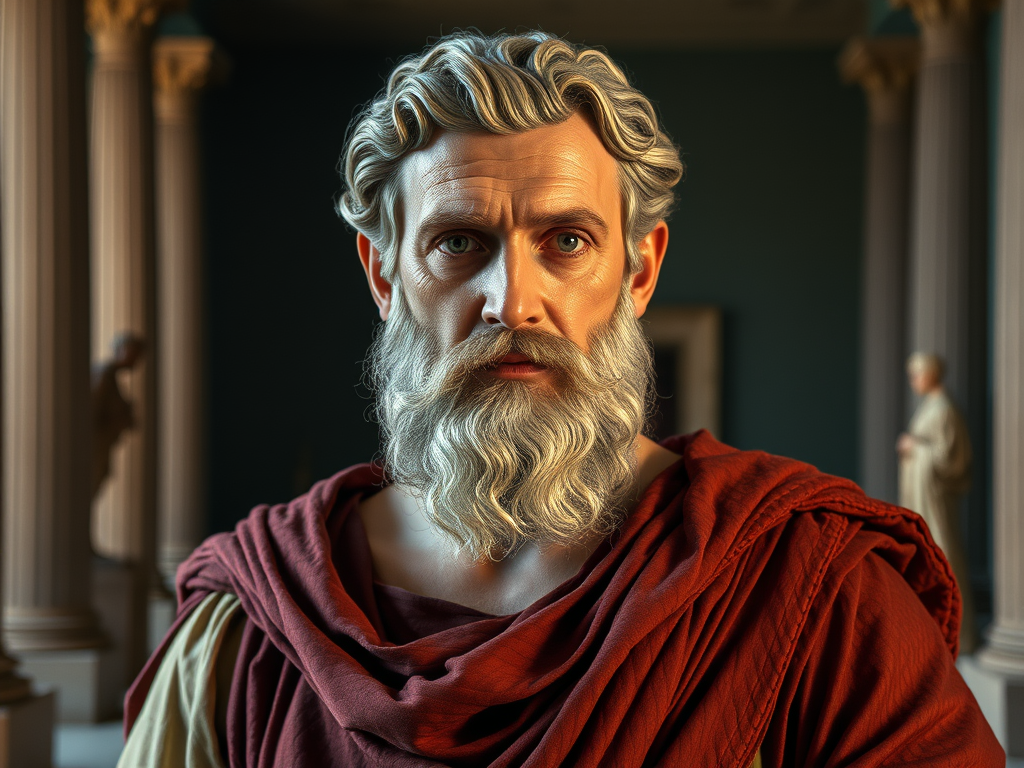
depiction of Socrates

Even among world historical figures, Socrates would be uncommon. His life was marked by an irony which brought together opposing qualities. He rarely travelled beyond Athens, yet his influence has been felt throughout the world. Though he was often invited to lavish dinner parties, he lived on a very simple diet. Possessing a towering intellectual capacity, he was more at home with everyday people. Though he wrote down none of his teachings, we possess about 35 of his dialogs. Some aspects of his life remain unclear, but what doesn’t is that his influence is impossible to overestimate. His crowning achievement in advancing God’s Story of Grace is that he took philosophy (the pursuit of wisdom) and brought it into reach for everyday people and everyday life to improve the quality of how they–even we–live. He did this because it was, as he believed, his calling from God. In so doing, he made the well-lived life something which was more possible for everyone to attain.

In this article, we will look at Socrates impact at the time he lived and how his influence moved the world further in God’s plan.

Who Was Socrates?

His Life

He lived from 469–399 B.C. He lived his whole life in Athens, other than when he travelled in the military. At its height his native city had a population of around 180,000 is 430 B.C. By his death it was reduced to about 100,000 due, in part, to ongoing war with Sparta. As a man of Athens he fought bravely in the wars with the Spartans. His friend Alcibiades said that Socrates saved his life when he was wounded by standing over him and warding off enemy attack. He was reported to be fierce in battle. There is, also, some evidence he may have been a stone mason since his father was. But his primary calling and life’s work was that he became a prophet to the Athenian people. He founded no academy like his pupil Plato. He never sought out a public platform, but instead he chose to live very simply with few clothes, meager food and basic shelter–even rejecting the gift of land which was offered to him. He felt the call of God (as he understood God) to call men to examine the meaning and purpose of their lives. Historian Paul Johnson states that he “compared himself to a gadfly, stinging the Athenian horse of state…out of its complacency and comatose inertia.” He engaged in discussions with all kinds of people concerning topics like friendship, justice, courage, citizenship, etc. He believed his most important contribution to Athenian society was to call people to virtue for only with virtuous people can a society flourish.

His Death

Overtime he became a well-known public figure. This increasing attention was not always positive. The playwright Aristophanes made a satirical and mocking drama titled The Clouds which portrayed Socrates as a money greedy corruptor of youth. This play had a negative impact on his reputation with some of the Athenian public. He remained unangered, responding: “If the criticism is just, I must try to reform myself. If it is untrue, it doesn’t matter.” Eventually jealous political forces had him arrested and convicted of presenting “different gods” and “corrupting the youth.” After being tried in a kangaroo court he was sentenced to be executed. He is famously remembered for his calm and magnanimous embrace of death, speaking to his friends about the virtuous and good life until his very last day.

What Set Socrates Apart?

He was led by God. He rejected the myth centered polytheism (belief in many gods) of his day. Like Heraclitus, he did not really criticize or show contempt for the traditional gods of the Greek world, but he did not reverence or follow them; further he called people to think beyond them. He appears to have been a monotheist who believed there is only one God. For this Athenian teacher, belief in God was not an abstract idea but a strongly felt reality. He once said, “Athenians, I cherish and you. But I shall obey God rather than you.” On another occasion he professed, “To practice philosophy has been indicated to me by God…” He felt this through such means as dreams, prophecies and other means.

His belief in divinity was also in sharp distinction to one of his sharpest debating partners, Protagoras, who gave the famous adage: “Man is the measure of all things.” As a materialist, Protagoras taught materialism which is the belief that there is nothing more than physical reality. Socrates rejected this because of his own experience as well as his belief that our deeper moral commitments require a deeper resource or basis than merely ourselves.

He believed all humans possessed an immaterial soul. He taught that the body needed to be guided by the soul. The idea of the soul was not new, but after Socrates’ the concept of the soul would be forever changed. Before the great thinker, the soul had been viewed as a ghostlike and shadowy substance which eventually gets banished to a murky existence of hades after the death of the body. After Socrates the soul was seen as the core of human intelligence, meaning and morality. With a proper philosophical understanding and training in wisdom the soul can guide one’s life to virtue and a well-lived existence. With his examination of the soul and the inner life of man, he would open the way eventually to the study of psychology.

He held to and promoted moral absolutes. For example, it was exceptional that he advocated that retaliation or revenge is always wrong. He instructed an early version of “turn the other cheek.” In Greece it was largely thought that a just man is one who does good to his friends and harm to his enemies. Socrates would have none of this. In Plato’s Republic, Socrates is quoted saying: “A just man is one who does good to his friends, certainly, but also does good to those who have harmed him, thereby seeking to convert an enemy into friend.”

He lived among the common men. At this time, Athenian Greece was singular in the world because a craftsman might become a general, a wrestler a philosopher, a poet could found a colony. Though there was an aristocracy, the man of common means could still excel. Paul Johnson asserted that just as Winston Churchill perfectly reflected the spirit of Great Britain, Socrates perfectly reflected the democratic spirit of ancient Athens. He got along with all kinds of people from different classes and backgrounds, highest to lowest. He had a genuine curiosity in people. This interest he showed made people feel important, and it helped to strengthen the democratic character of the city.

Socrates Advance of God’s Story

depiction of Paul at the Aereogapus

Socrates brought the LOGOS (WORD) closer to men. In Acts 17, some 450 years after Socrates, Paul stood at the Areogapus (meeting place for political councils in Athens), the very place Socrates often deliberated. It was there that Greek philosophers wanted Paul to make a public case for his “strange ideas” (Acts 17:20) for which he was advocating. Paul, then, gives a masterclass in building a missional communication bridge with a different culture. In his introduction, one can see hints of his drawing upon Socrates’ influence as he references “an unknown god.”

22 Paul then stood up in the meeting of the Areopagus and said: “People of Athens! I see that in every way you are very religious. 23 For as I walked around and looked carefully at your objects of worship, I even found an altar with this inscription: to an unknown god. So you are ignorant of the very thing you worship—and this is what I am going to proclaim to you.

Acts 17:22-23

Athens worshiped many gods, but Socrates did not. Athenians accepted their religious traditions, often without question. Socrates did not. He advocated a god that was not known. Perhaps it was this “unknown god” of Acts 17 Paul proclaims. Perhaps this is the LOGOS which was first proclaimed by Heraclitus, nearly 100 years before Socrates, and would eventually be declared by the apostle John, when he declared Jesus to be the Word (LOGOS) in John 1:1. As I wrote in a previous article:

LOGOS, which means Word or Speech, communicates the idea that we see indirectly an intelligible rationality behind the universe. It does so in the fact that words, whether heard through the ear (speech) or seen through the eye (writing), shows the evidence of an intentional and intelligible presence, even when we do not see a person present. This evidence of intentionality and intelligence, logically, points to a personal being behind all of this–God. Though this creative and personal being is not directly seen, his speech is. In the midst of the chaos of the world, there is behind all of it an ordered logic (e.g., math and science) and appearance of a creative purpose (e.g., love and justice). The Bible affirms this in both the Old and New Testaments.

This is seen in the Old Testament.

The heavens declare the glory of God;
    the skies proclaim the work of his hands.
Day after day they pour forth speech;
    night after night they reveal knowledge.
They have no speech, they use no words;
    no sound is heard from them. (Psalm 19:1-3)

Of those outside the Hebrew world, Socrates appeared to grasp this better than anyone before him and made this reality more accessible to the Greek and gentile world.

Socrates made a life of purposeful moral living more accessible to the common man. He is famous for saying, “The unexamined life is not worth living.” The ancient philosopher modeled how everyday men could think through moral questions and issues to live a more wise and virtuous life. Perhaps the Roman statemen Cicero best summed up the great sage’s contribution to the world historical development best:

“Socrates was the first to call philosophy down from the heavens and to place it in cities, and even to introduce it into homes and compel it to inquire about
life and standards and goods and evils.”

Cicero

For this, we can have much gratitude to Socrates for bringing the truths given by heaven more closely to us on the earth.

The Birth of the World’s Most Important Idea: LOGOS

The emergence of philosophy comes from an obscure philosopher from Ephesus named Heraclitus (540-480 B.C.). As the first philosopher of the West, he gave society, its most foundational and important concept: LOGOS (Word). Little is known about his life, and what we have of his writings exists in 129 fragments (brief proverbs, teachings and statements). He was an alone and solitary figure who did not have much use for the masses. As such, he was not a fan of popular democracy which made decisions based off of the will of the majority. Yet, this solitary figure was the first to coin and inspire a concept which would grow to become the most important idea in Western Civilization and more importantly Christian revelation and theology: the Greek term LOGOS which means WORD.

It was this concept of the LOGOS which would become a central organizing idea for understanding and developing science, mathematics, and psychology. Yet, of even greater importance, the concept of LOGOS became a key basis to formulate the understanding of a unified and transcendent God for the gentiles and later an organizing basis for understanding Jesus Christ and the Trinity. Of the 129 fragments of Heraclitus, 3 of them reference the LOGOS directly (Fragments 1, 2 & 50). In addition, other parts of the fragments provide clues as to the philosopher’s thinking. We will look at the three fragments where the LOGOS is directly mentioned; then we will look at other statements of the fragments which provide additional meaning to LOGOS. Finally, we will examine how, in God’s Story of Grace, the LOGOS concept provided a framework to advance human understanding of science, psychology, mathematics and theology.

Heraclitus and the LOGOS

For Heraclitus, the LOGOS was the underlying reality which brings order through all of the changes to the cosmos.

Fragment # 1

Though this Word is true evermore, yet men are as unable to understand it when they hear it for the first time as before they have heard it at all. For, though all things come to pass in accordance with this Word, men seem as if they had no experience of them, when they make trial of words and deeds such as I set forth, dividing each thing according to its kind and showing how it is what it is. But other men know not what they are doing when awake, even as they forget what they do in sleep. (Fragment 1)

Depiction of Heraclitus

Though a somewhat obscure statement, Heraclitus communicates three principles about the LOGOS:

  1. The Word (LOGOS) is always true (true evermore).
  2. The Word (LOGOS) brings all thing to pass, and is before all things (all things come to pass in accordance).
  3. Men barely comprehend and are largely blind to the Word (LOGOS) even though it is the basis of all existence.

Fragment # 2

Though the logos is common, the many live as if they had a wisdom of their own. (Fragment 2)

In this fragment there are two principles which stand in support of what is already observed in Fragment # 1.

  1. The Word (LOGOS) is not only “ever true” (Fragment 1), but it appears to be ever present (logos is common).
  2. Most do not comprehend it or are willfully blind to it because they live as if “they had a wisdom of their own.”

Though the term LOGOS is not used in Fragment 72, Heraclitus gives additional meaning to what we see in Fragment 2.

Most are at odds with that with which they most constantly associate — the account which governs the universe — and … what they meet with every day seems foreign to them. (Fragment 72)

Fragment # 50

 It is wise to hearken, not to me, but to my Word, and to confess that all things are one. (Fragment 50)

Heraclitus, in Fragment 50, appears to see himself as one who expressed the Word (LOGOS). He sees his task as expressing the truth and wisdom of the LOGOS. There are at least two supporting principles that can be seen in this fragment.

  1. The Word (LOGOS) is accessible to people (hearken…to my Word).
  2. The Word (LOGOS) is the unifying reality in and under everything which exists (all things are one).

Summary

A summary of his thinking on the LOGOS would be as follows:

  • Truth # 1: LOGOS is the creative reality by which everything exists and which everything is sustained.
  • Truth # 2: Men do not perceive its reality and often remain in a foolish blindness.
  • Truth # 3: The task of the philosopher is to lead men to live by the LOGOS.

Additional Concepts of LOGOS

Fire

Depiction of Artemis

These shreds of statements may not seem significant. Keep in mind, however, that this is the very first effort for anyone to systematically express that there is a larger unifying reality behind all that is seen. As Heraclitus is relating to his audience, he references common realities as symbols of LOGOS. One of those is fire. German philosopher Martin Heidegger sees that the ancient teacher of wisdom connects LOGOS to fire because the prominent goddess in Ephesus was Artemis–THE LIGHT-BEARER. Artemis was sometimes depicted as one who carries a torch of light in both hands. Five hundred years later it is seen that Artemis was still the chief deity of the city because when Paul was in Ephesus (the very same city of Heraclitus), he caused an uproar as his preaching of Christ posed a threat. This is reported for us in Acts as Demetrius the silversmith, who made silver shrines of Artemis, leads the city in a revolt against Paul (see Acts 19:26-27).

Martin Heidegger interprets Heraclitus’ use of fire as symbolic of how the LOGOS brings light and clarity, revealing what is concealed. In Fragment 30, the sage uses this symbol of Artemis’ fire as a way of showing that the light Artemis is bearing is the LOGOS. This relativizes Artemis with the goal of pointing people to focus on the LOGOS.

This world, which is the same for all, no one of gods or men has made. But it always was, is, and will be: an ever-living Fire… (Fragment 30)

In Fragment 66, the philosopher indicates that the fire (LOGOS) brings judgement to everything. All that is not in alignment with its order experiences a type of correction.

Fire in its advance will judge and convict all things. (Fragment 66)

Soul

In addition, the Greek thinker advances the idea of the soul. He sees the immaterial soul as greater than what anything in this world can fill. The implication is that the soul is closer to its purpose and meaning in the LOGOS than in the physical world.

You will not find the boundaries of soul by travelling in any direction, so deep is the measure of it. (Fragment 45)

The idea that the soul is not meant primarily for this world, and even finds this world to be destructive to it, is expressed in Fragment 85. We see the soul will fight with desire and pay a cost for it.

It is hard to fight with one’s heart’s desire. Whatever it wishes to get, it purchases at the cost of soul. (Fragment 85)

To this is added the idea that the soul increases the influence of the LOGOS in the world in Fragment 115.

To the soul, belongs the self-multiplying Logos. (Fragment 115)

There is much more we can share in regard to Heraclitus and his understanding of the LOGOS. Another idea to explore, but goes beyond the scope of this article is the idea of the reality of LOGOS realized through the tension of opposites. That can be discussed another time.

Let’s end this article by posing several question and providing answers.

Questions and Answers

Question # 1: What difference did this understanding of the LOGOS make in Western Civilization? In the Greek influenced world (like Ephesus), there was no ordered religion which provided a unified way of thinking. There was simply chaos of the gods. It was often the case that different cities had different understandings of the same gods. This was a significant cause which kept the city-states independent from each other. With the introduction of LOGOS, the idea was now advanced that there was a reality beyond what is seen that holds everything together. The LOGOS would become the source of a more unified and systematic understanding of reality beyond the appearance of disorder and chaos. This would eventually provide a framework for advancing science (an ordered understanding of nature), psychology (an ordered understanding of the soul), mathematics (an ordered understanding of structure) and most importantly theology (an ordered and unified understanding of God).

Question # 2: Why was the term LOGOS used to express this reality? LOGOS, which means Word or Speech, communicates the idea that we see indirectly an intelligible rationality behind the universe. It does so in the fact that words, whether heard through the ear (speech) or seen through the eye (writing), shows the evidence of an intentional and intelligible presence, even when we do not see a person present. This evidence of intentionality and intelligence, logically, points to a personal being behind all of this–God. Though this creative and personal being is not directly seen, his speech is. In the midst of the chaos of the world, there is behind all of it an ordered logic (e.g., math and science) and appearance of a creative purpose (e.g., love and justice). The Bible affirms this in both the Old and New Testaments.

Old Testament

The heavens declare the glory of God;
    the skies proclaim the work of his hands.
Day after day they pour forth speech;
    night after night they reveal knowledge.
They have no speech, they use no words;
    no sound is heard from them. (Psalm 19:1-3)

New Testament

20 For since the creation of the world God’s invisible qualities—his eternal power and divine nature—have been clearly seen, being understood from what has been made… (Romans 8:20)

Question # 3: How does the LOGOS relate to Christ? The gospel of John begins with describing Jesus as the LOGOS.

In the beginning was the Word (LOGOS), and the Word (LOGOS) was with God, and the Word (LOGOS) was God. (John 1:1)

John’s equating of Jesus with the LOGOS was extremely important for the development of how Jesus was revealed and came to be understood in relation to the Father and the Holy Spirit as Trinity. Because Jesus is the LOGOS (The Word of God the Father), that means that the Father and the Son are inseparable. As the LOGOS, Jesus is like the speech of God the Father who created the whole universe. Bruce Hillman adds insight, “When God spoke the universe into creation, it was the Logos that proceeded from his ‘mouth,’ a Word.” This means that the Word was God. There was no time that the Word (the speech/thought) of God did not exist. Hillman goes on to explain:

And when the Logos took on flesh and lived among us, he did not cease being God’s Logos and, therefore, still eternally God. Before the incarnation, the Logos did not have a body, ;but for our sake became man.’ Thus, in his incarnation, the Logos became Jesus, the God-Man. The Logos makes salvation possible because it merges God and Man in the incarnation of Jesus Christ.

“When God spoke the universe into creation, it was the Logos that proceeded from
his ‘mouth,’ a Word.”

Bruce Hillman

Summary

Nearly 500 years before Christ, God had been working through the Greeks to birth a fundamental concept that would clarify not only our understanding of the world, but it would provide the framework and language for the depth of our understanding of Jesus Christ and the Trinity. This was through an obscure philosopher known by the name of Heraclitus.

Greek Tragedy and the Sustaining of Democracy

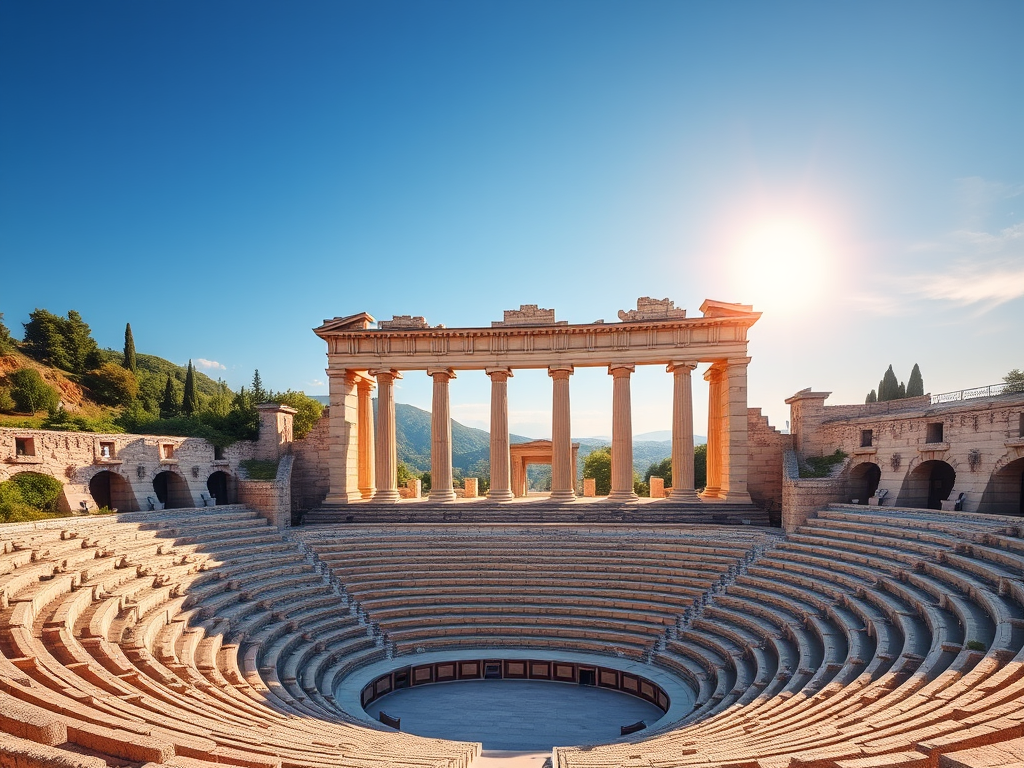
A Greek Theater

In the emerging democracy of Greece of the fifth century B.C., a newly created art form of theater helped to cultivate attitudes and foster education which advanced a democratic spirit: “a government of the people, by the people and for the people.” Democracy requires a lot of hard work. The simple idea of “one person, one vote,” is hardly sufficient. If citizens who have that vote are not correctly taught or informed how to think about the larger issues related to matters they are voting on, then it will be misdirected. Furthermore, when dissent or differing viewpoints of fellow citizens are not respected, then democracy will descend into a division of the many (majority opinion) against the few (minority opinion), sometimes leading to mob action–or more extreme–civil war. For the newly birthed democratic revolution in Greece–which had no other country to serve as an example–it was vital that there would be a venue in popular culture to both educate in matters related to the state and encourage toleration of differing views. The avenue which developed was the theater where plays known as tragedies were performed. It was in this setting that as many as twenty thousand people would gather in an amphitheater, and the stories of playwrights would be acted out.

In this article we will examine how the theater with its tragedies helped to sustain the spirit and practice of democracy in ancient Greece. This art form deepened the Story of Grace in which God matured humanity to become more like the Trinity where personal dialog and mutual understanding were increased in order to maintain a life-giving unity.

The Birth of Tragedy

Theater and the Promotion of Democracy

Here are four ways that Greek tragedies helped to promote and nurture democracy:

An Image of Aeschylus, the Greek Tragedy Writer

The first theaters with plays were produced and performed in Athens. These plays were known as tragedies because they emphasized the inevitability of a heroic downfall because of the fragility of human limits and moral error (pride, anger, lust, etc.). Emerging in the wake of Athens’ democratic revolution, people could identify with these plays because Greece had arisen from tremendous amounts of conflict and loss. Further, (like today) they could take comfort that their heroes were all too human like they were. These plays demonstrated anew the fragile balance between order and chaos which grew from the aftermath of the democratic revolution. So popular were these tragedies that over a thousand were produced in the fifth century B.C. Today we only possess some thirty of them which were composed by three authors: Sopholocles, Euripides and (who) The Greek experience was critical because they founded democracy at a time when it had never existed.

Four Ways Greek Theater Cultivated Democracy

  1. Plays nurtured a common civic culture. The outdoor amphitheaters in ancient Greek city-states were places citizens would gather together from different classes and backgrounds as equals. They sat next to each other and participated in the same grand experience. In this setting social walls were broken down, and they came together as one people. For democracy to work the citizens must acknowledge that other citizens are our equals and are entitled to an equal say. This view point is not natural and has to be nurtured in order to be maintained.
  2. Plays encouraged citizens to engage in deeper conversations. After watching plays, citizens would often have more in-depth conversations about moral and political issues which impacted all people. If democracy was to function well, citizens must do a lot of thinking and talking about moral issues related to their political life. As storytellers and as political philosophers, the tragedians educated theater audiences in vital issues. They structured their plots around conflicts of law and justice, mortal men and divine gods, male and female, family and the state, the insiders and outcasts. This exposed the audience to the issues which impact the real nature of debate, dialog and disagreement which occur within democracy.
  3. Plays modeled dialogue. With their often-used rapid form of question-and-answer dialogue to explore issues, plays showed how conversations needed to take place. To learn this skill was essential to the deliberation which was required in democracy. It modeled for them, in certain instances (like Aeschylus’ Oresteia), how to embrace civility in difference and dissent, creating a more open society.
  4. Plays challenged ideas which threatened democracy. For example, in Sophocles’ famous tragedy Antigone, revolves around the question of political supremacy. Pericles, the great Athenian democratic ruler, initiated new policies which elevated political allegiance to the state above all else, including above the allegiances owed to individuals and to one’s family. The all important theme of the power of the state in relation to the individual and family is undertaken. In the Suppliants by Aeschylus, tells the story of fifty fictional women, having fled their homeland of Egypt, pleaded for asylum in a Greek city-state. These suppliants were outsiders in every sense of the word. Yet as women, and as foreigners, they were determined to be treated with state protection and dignity in a land where such a fundamental right was denied to foreigners. (This is an ever relevant discussion in many parts of the world today.) Prometheus Bound concerns the role of the limits of human advancement; Oedipus Rex relates to the power of authority and the fall pride brings, just to name a few. All of these topics, among others, were (and still are) urgently important to think about when it comes participation in the life of the state as a responsible citizen.

The Enduring Legacy

Tragedy is still alive for the very reason that it relates to the challenges of our human condition. We are a mix of heroic action and mortal deceit. We attain great heights of achievement only to be toppled by inevitable flaws. This is why today film with tragic themes like The God Father, Titanic, Breaking Bad or Batman are so popular. There are two ways that God advanced his Story of Grace through theater.

In Greek tragedy, humanity more clearly sees its need for grace. The work of God’s grace to mature humanity through the millenniums has been remarkable given humanity’s tragic fallenness. Only God’s grace could overcome the level of brokenness which sin has brought. But this maturing has been a work of grace, in which God’s power guided by love, is progressively overcoming humanity’s sin and depth of brokenness. God, in his grace, has led humanity to such discoveries as language (Babel), navigation (Phoenicians), science (Medes), and now democracy (Greeks). As Paul wonderfully declares:

“But where sin increased, God’s grace increased even more.”

Romans 5:20

Greek tragedy showed the inevitability of sin. For the Greeks, this was their power of the law to show humanity of his need to be delivered from the tragic implications of human selfishness. Yet, the tragic nature of tragedy is just that, it provides no answers to the broken human condition. This deliverance will be ultimately discovered in the life and death and resurrection of Christ.

In Greek tragedy, humanity sees more of the value and viewpoints of others. This creates more of a spirit of toleration. As the audience watched the plays, they experienced a deep sense of pathos (Greek word for suffering) which stirred emotions for the plays character such as sorrow, joy, elation, fear. These made the stories engaging and relatable. These emotions which were wedded to moral lessons helped the Greeks to think and to feel in greater moral categories. Aristotle wrote that this was very healthy for a community. In this new art form, the dynamic and interchangeable love within the Trinity is more fully realized at a larger scale. This identification with one another is more fully reflected in the life of the Trinity which is mirrored in the church. Paul expressed it as follows:

If one part suffers, every part suffers with it; if one part is honored,
every part rejoices with it.

1 Corinthians 12:26

Salamis and the Miraculous Battle For Freedom

So rarely has the consequential unfolding of history been so on the line as the Battle of Salamis (480 B.C.). On this battle held the fate and destiny of Western Civilization itself. On the one side is the massive Persian military under Xerxes with an army considered the largest ever assembled-2,641,000 fighting men, according to Herodotus. Humorously he tells us that when “Xerxes armies drank the whole river ran dry.” The mass of this army is not surprising given that the Persian Empire, the largest to have ever existed at the time, had 70 million inhabitants living within 1 million square miles. This colossal power was intent on crushing the often warring and fractious Greek city-states which had 2 million inhabitants bordered in 50,000 square miles. The Persians were affluent with nearly unlimited resources in contrasts to the Greeks who, by comparison, were poor. This supersedes by any measure a David and Goliath analogy. At stake in this confrontation is the furtherance of personal freedom toward self-determination (represented by Greece), and the authoritarian and absolute rule over the masses by a very few (represented by Persia). In this battle is the literal determination of whether people will be able to form more closely into the image of the Trinity, where there is a heightened empowerment to personal freedom leading to a greater communal unity.

David (Greece) vs. Goliath (Persia)

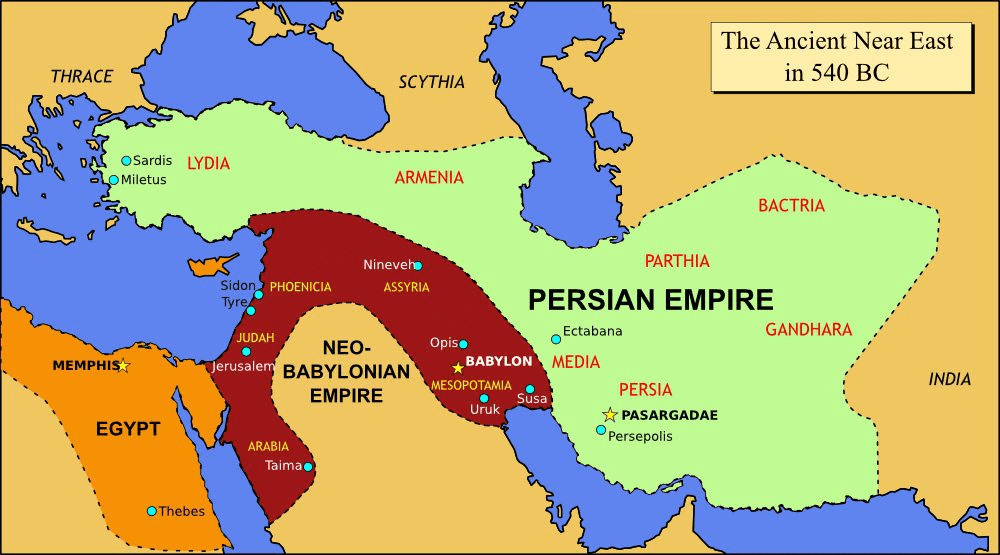
Cyrus the Great led the Persian Empire into its rapid expansion starting in 550 B.C. Before Cyrus, Persia was a small state under the control of the Medes (an ancient Iranian people). But as the map shows, Cyrus controlled most of modern day Iran, parts of Turkey and Mesopotamia by 540 B.C. This is all in one decade. Five kings and fifty years later, by 490 B.C., the Empire expands to more than 2 million square mile (as seen by the map below)–the largest the world has ever known.

Now with Xerxes (485-465 B.C.) in power, his aim is to expand their territory into Greece, which is at the furthest edge of their northeastern border. Xerxes father, Darius (522-486 B.C.) sought to conquer Greece in the Battle of Marathon (490 B.C.). This resulted in a major defeat for the Persians. Xerxes followed his father as monarch and inherited his father’s burden of expanding the Empire toward Greece. To accomplish what Darius had been unable to do, Xerxes inherited the largest and best equipped army at the time. With four years of preparation, in 480 B.C., he headed off to Greece with approximately 1 million men, along with an elite force of 10,000 warriors known as the immortals. It was here that Xerxes would conquer much of mainland Greece, even conquering and burning the great city of Athens, whose 10,000 men were no match for the invading horde. With victory over all of Greece assuredly in his grasps, Xerxes heads toward the isthmus of Salamis.

He is deceptively lured there by Themistocles. This ruse was led by the Greek general, Themistocles. From a young age he prepared himself for political life. He came from a family where governmental influence would not have been open to him. But under the new system of government, he was able to advance as he was motivated by a tremendous sense of ambition and guided by a charismatic personality and daring vision. He used his charm and gifting to ascend to the place of military general. The Greek form of democracy was the only place in the world which allowed a larger number of people like him to climb the social ladder. And it was now under threat of being crushed by Persia.

The Distinctions of East and West

Democracy had been in Greece since 510 B.C, which has been introduced to Athens through the reforms of Cleisthenes. At this point, democracy is about 30 years old. This spirit of democracy allowed for public deliberation by the citizens regarding policies which effected their lives. Further, they were allowed to be critical of their leaders. Property was more widely and freely held. There could be no execution without a proper trial. They had the ability to freely write and speak their opinions. These freedoms in Persia were unknown. The absolute rule of millions were in the hands of a very few. The king and his small court of relatives, which were “the eyes and ears” of the king, thrived through substantial collections of taxes and the vast ownership of estates. The largest farms in Greece were a hundred acres, but in Persia the farms were in the thousands. Criticism or oppositions of the king and his administration would certainly be met with a cruel death. When a nobleman asked Xerxes that his son be exempted from war, he had the nobleman’s son cut in half and required the father to walk between the severed pieces of his body. It is at this historical juncture that we see the formative development of the conflicts of East (Persia) versus West (Greece).

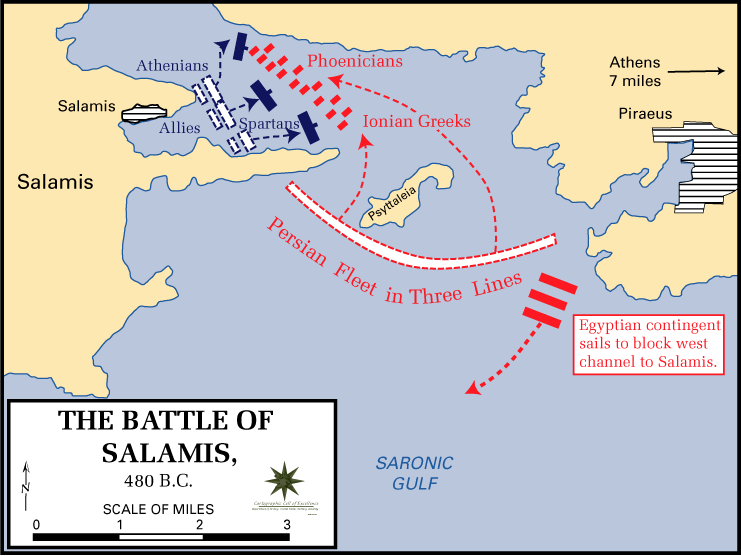
The Persian fleet (in red) entered from the east (right) and confronted the Greek fleet (in blue) within the confines of the strait.

As the Battle of Salamis was to commence, it is nearly impossible to understand how impossible it was from the outmatched Greeks to win. The city of Athens has been abandoned and is going up in flames. There is no mainland to fight from in this area, so a land battle is an impossibility. The only option is a sea battle, yet its recently built fleet of 200 ships, of its 378, was unwilling to engage the enemy’s nearly 800 to 1,000 fighting vessels. (Herodotus and Aeschylus estimate that the Persian armada consisted of over a 1,000 ships with approximately 200,000 men.) A naval battle in the open sea would have led to a crushing defeat for the Greeks. So, Themistocles was convinced that the only hope of victory lay in the straights of Salamis where the superior numbers of the Persians would be less effective. Yet, he could not mobilize the military to confront the imperial giant because many of the commanders believed it to be a suicide mission.

To motivate the fearful leaders, Themistocles sent his slave, Sicinnus, to trick Xerxes into attacking the Greeks. Sicinnus delivered a message to Xerxes that said the Athenians were afraid and going to run away. The message also claimed that the Allied commanders were fighting among themselves. Xerxes believed the message and attacked the Greeks. With this attack, the fearful naval commanders were left with no choice but to defend themselves. Themistocles risky maneuver of trickery and deceit paid off. The Persians were defeated in the narrow straight of Salamis in the 12 hours of fighting. The more easily navigated triremes (Greek ships) were much more suited for this narrow warfare than the heavier ships of their enemies. The Persians were defeated with a loss of 200 ships and the Greeks with a loss of 40.

Legacy of Salamis

The Motivation of Freedom Is Advanced

The Greeks were able to fight and win because of freedom. Freedom created a greater morale and incentive to defeat the enemy. This was the understanding of Herodotus who commented:

As long as the Athenians were ruled by a despotic government, they had no greater success at war than any of their neighbors. Once the yoke was thrown off, they proved the finest fighters in the world.

After the victory at Salamis, Herodotus again tells us, that when the Persians attempted to mediate an agreement with the Athenians, they responded:

We know of ourselves that the power of the Persians is many times greater than ours. There is no need to taunt us with that. Nevertheless in our zeal for freedom we will defend ourselves to the best of our ability. 

A year after the Salamis, Dirodorus tells us that the men in the Greek army were required to swear an oath beginning, “I shall fight to the death, and shall not count my life as more valuable than freedom.” Again, the same author records, that the Greeks dedicated a monument at the sanctuary of Dephi with the inscription, “The saviors of wide Greece set up this monument, having delivered their city-states from this loathsome slavery.”

As the Greeks were considering whether or not to continue in battle with the Persians, the leaders and citizens would engage in frenzied debate, disagreements and discussions. Herodotus characterized these constant deliberations as a “war of words,” and Diodorus described it as an “unrest of the masses.” This required the military’s generals and civic leaders to keep their thumb on the pulse of public opinion in relation to their decisions. In contrast to this, it was unthinkable for those in the Persian empire to express their opinions to Xerxes. This could very well lead to their death. The problem with this is that it shut out many good ideas, and blinded them to many mistakes and errors to avoid. In this major battle, freedom was confronted with a great test and came out the victor. The idea, meaning and reality of freedom was advanced.

The Power of Freedom is Advanced

Georg Hegel in his Philosophy of History reflects on the historic and momentous nature of the Battle of Salamis:

Oriental despotism—a world united under one lord and sovereign—on the one side, and separate states—insignificant in extent and resources, but animated by free individuality—on the other side, stood face to face. Never in history has the superiority of spiritual force over material bulk—and that of no contemptible amount—been made so gloriously manifest.”

It is of importance to remember that the idea of freedom was a couple of centuries old, and democracy itself was around three decades old. The practice of freedom was shared by only a few hundred thousand people in the backwaters of the Mediterranean. Had Salamis been lost by the Greeks it would have ended the eventual rise of Western civilization and its distinct institutions based on freedom altogether. Yet, now with Salamis won, the virus of freedom would be released and spread, and the strongest forces of oppression could not ultimately extinguish it.

The Meaning of Freedom Will Advance

It is not insignificant that when Christ came into the world, he was born at a time which had been greatly influenced by the Greeks.

Paul declares:

But when the fullness of time had come, God sent forth his Son, Christ came in the fullness of time.

Galatians 4:4

It was the Greek influence which allowed the apostles to have language and idea which could more clearly express the realities they experience with the revelation of Jesus and the expanding of the kingdom of God in the church. The New Testament was mainly written in Greek. Many ideas such as the logos (word), ecclesia (church/assembly), psuche (soul) express more of a Greek understanding. The early theology of the church would borrow heavily from Greek categories of thought.

God has ordered all of the nations of the world that they should come into the fullness of his purposes which are designed to advance the Story of Grace which is being written in the world.

26 From one man he made all the nations, that they should inhabit the whole earth; and he marked out their appointed times in history and the boundaries of their lands. 27 God did this so that they would seek him and perhaps reach out for him and find him, though he is not far from any one of us. 28 ‘For in him we live and move and have our being.

Acts 17:26-28

Cleisthenes And Democracy From the Athens

Photo by Element5 Digital on Pexels.com

In 508 B.C. the city state of Athens was in an uproar. The common people turned on their ruling elite because of the oppression and tyranny they had been experiencing. What sets this time apart from all that had gone before is that this was the very first uprising where the common people successfully overthrew their rulers. This action was unprecedented and would pave the way for the governmental democracy–“a government of the people and for the people.” But this was not accomplished through mob action. It would require a highly skilled and wise design to make this work. As this overthrow was taking place, the skill and leadership of Athenian nobleman, Cleisthenes, would be called upon. He would become a central figure in the development of democratic ideas and practices.

In this article, we will see how in God’s Story of Grace, divine providence continues to shape humanity toward increased freedom and dignity after the image of God in the Trinity (the balance of unity and diversity-the three in one). In another current of divine movement, God’s sovereignly works to introduce democracy from the West.        

Why Democracy in Greece?  

Geography

What were the conditions which allowed democracy to develop in Greece and Athens (which became the dominant city) in particular? One major factor was the geography of Greece. As a country it is comparable in size to Alabama in the U.S. or England in Europe. Yet, the landscape is riveted with approximately 300 mountains which separated the many city-states such as Athens, Sparta, Corinth, Thebes and Delphi. This made it very difficult for one king or monarch (like Cyrus of Persia) to rule the entire territory. This landscape naturally fostered a greater degree of local independence and fierce identity among each urban territory. This setting uniquely provided fertile ground for people to adopt and be governed by self-rule.

Olympic Games

Another important factor which allowed for democracy to germinate and grow in Greece was the Olympic games. Once every four years men gathered to compete in athletic skills. The competitions had been founded 200 years prior to the founding of democracy. What made these games stand a part was that they were open to all so that anyone could compete and win. These were also very popular with as many as 40,000 Greeks gathered to watch the sporting events. This environment created the idea of meritocracy where all could participate and be involved.  

Economic Growth 

Farming of olives prospered in Athens because of the amount of olive trees there. Economically olives provided oil, soap, and lubricants which became in increasing demand. The ancient Mediterranean had the greatest market place around the world providing an economy for Athens to flourish in the sale of olives and olive-based products. This caused Athens to economically prosper. In addition, Athens produced exceptional pottery. Though potters were the lowest of the low in society, pottery became of staple of the kitchen and transportation. The potters were very competitive wanting to outdo each other. This led to the capacity for extraordinary achievement among those considered to be in the lower class. It was for this reason that Athens was ripe to discover democracy among the city-states of Greece.

The Historical Cycle of Tyranny

In this background of a rising meritocracy and wealth of the Athenian population, the common people experienced increased discontent with their rulers. The common people were no longer content to be subjugated at the hands of their rulers. They demanded more of a voice in their civic affairs and were no longer content to be subjected to the ups and downs caused by the good and bad rulers of their city-states. Good rulers provided relief by way of tax reform, fair trials, debt relief during times of poor harvests, etc. Others provided hardship by increased taxation, harsher laws, land confiscation, abuse of rights, etc. People experienced the cycle of ups and downs that came from good and bad rulers, though mainly bad. During the year 508 B.C. the people of Athens were ready for the cycle to come to an end. They revolted, overthrowing their rulers. To guide them in constructing a government which gave agency to the people, they turned to Cleisthenes.

Cleisthenes and Democracy

Cleisthenes

Cleisthenes was born around 570 B.C. He was from his earliest days an aristocrat, an elite person separated from the common people.  Aristocrats controlled everything and held power against everyone else. For example, the center of Athens was the Council of the Areopagus, which consisted of rulers called Archons. Nine archons were chosen each year by lot among the elite and wealthy classes. This ensured that the office of Archon perpetuated aristocratic rule. Sometimes good men would become an Archon and exercise positive reforms. One such ruler was a man named Solon who influenced the adoption of many laws which helped the poor: expanded citizenship, reforming weights and measures, forgiving debts of slaves, etc. The challenge which always occurred was that there were eventual problems of tyranny wiping out the reforms of the good rulers. So, whether the rulers were good or bad, the people were powerless in the cycles of ups and downs.

This brings us to 508 B.C. After the end of another tyranny, two factions competed for power to reshape the government of Athens. One was led by Isagoras, whom Aristotle calls a “friend of the tyrants.” The other was led by Cleisthenes who sought to befriend the lower classes. Isagoras won a victory by getting himself chosen as Archon in 508 B.C. In their rivalry, Isagoras called on the Spartan king Cleomenes to help him evict Cleisthenes from the city. When the Spartans occupied the city and tried to disband the government and expel all opposition, the Athenians rose up against them and those allied with Isagoras and drove them out. This was the very first time in history where the people stood against their leaders and overthrew them. With the overthrow of Isagoras and those allied with him, Cleisthenes was free to impose his reforms. This marks the beginning of classical Athenian democracy which fundamentally redefined how the people of Athens saw themselves in relation to each other and to the state.

For Cleisthenes the task was given to create a government which could escape from the pointless cycle of violence and tyranny. He must now give people a say in their future. He could not put in a tyrant or Aristocrats. He had people meet at the Acropolis. Rich and poor alike could address their fellow citizens. Government was not decided by the sword or class but by persuasion and voting. To accomplish this, it required several innovations:

  • Cleisthenes help to foster a common political identity. He managed to convince the Athenians to adopt their city-name into their own. So, where formerly an Athenian man would have identified himself as “Demochares, son of Demosthenes;” after Cleisthenes’ reforms he would have been more likely to identify himself as “Demochares from Athens.” Using identification with the city name de-emphasized any connection (or lack thereof) to the old aristocratic families and emphasized his place in the new political community.
  • Each city had a “demarch,” like a mayor, who was in charge of its most important functions: keeping track of new citizens. As young men came of age, the demarch kept track of all citizens from the city eligible to participate in the Assembly, and selecting citizens from the city each year to serve on the Council.
  • He arranged the central and most populous part of Greece into regions where representatives would meet as a council. This helped citizens to take an interest and be concerned beyond regional issues. This caused people to work together beyond their own families and tribes.

All of these reforms constituted a remarkable re-shaping of Athenian society along new lines. Old associations, by region or according to families, were broken. Citizenship and the ability to enjoy the rights of citizens were in the hands of immediate neighbors, but the governing of Athens was in the hands of the Athenian people as a whole, organized across boundaries of territory and clan. The new order was sealed as citizens adopted their city-names into their own names.

Through the work of Cleisthenes, God’s Story of Grace makes a remarkable step forward in bringing the ordered unity of the whole with the greater personal dignity of the many.

Cyrus and the Advance of Human Rights

Photo by Sora Shimazaki on Pexels.com

In God’s unfolding Story of Grace we see a Persian king, Cyrus the Great, who inaugurated the first universal declaration of human rights which afforded religious and cultural tolerance over a plurality of nations. This is significant in that God further advanced the shaping of society to be modelled after his image as Trinity, one with social unity (like one God) that respects personal rights (like three persons). The goal of God is to have everything ultimately conform to his image. Cyrus represents a major step forward in God’s work through history to bring the world toward this outcome. Cyrus demonstrates two major truths:

  1. God is the one who is writing the world’s Story, even through pagans, who do not worship or follow him.
  2. God’s is writing this Story through the intertwining of creational (general) history and salvation (redemptive) history. Both necessarily work together.

In this article, we will see that Cyrus demonstrates the sovereign outworking of God’s plan where salvation and creational history work together in the first establishment of human rights.

A Pagan Messiah?

Cyrus is a king mentioned more than 30 times in the Bible. He reigned over Persia (modern day Iran) between 539—530 BC. He stands out in the Bible because it was under his rule that the Jews were first allowed to return to Israel after 70 years of captivity. (Ezra 1:1-8, 2 Chronicles 36:23) In relation to this, Cyrus is declared by the prophet Isaiah, as the Lord’s (YHWH’s) anointed or messiah.

This is what the Lord says to his anointed,
    to Cyrus, whose right hand I take hold of
to subdue nations before him
    and to strip kings of their armor,
to open doors before him
    so that gates will not be shut

Isaiah 45:1

The word “anointed” in Hebrew is roughly transliterated into English as meshiach or messiah. In its earliest form it meant to anoint with oil in order to set apart a person for a special task, as in the priest. As the term came to be used in a more expanded sense, to anoint became related to a divine call and empowerment to advance God’s purposes on the earth. Many people are anointed in the Old Testament, and many are referred to as “anointed one,” but only a special group is designated “YHWH’s messiah,” as Cyrus is in Isaiah 45:1. The term “his anointed” and its equivalents are reserved for the kings in Israel. (Psalm 2:2, 132:10) Here it refers to a Persian monarch who does not acknowledge God.

It is surprising that God places his anointing on a pagan king, but another outstanding feature of this description is that it is a prophecy which Isaiah declared 200 years before Cyrus became king and for that matter was either born or named. This prophecy is directly preceded by a denunciation of the “false prophets” and “diviners”:

24“This is what the Lord says—
    your Redeemer, who formed you in the womb: I am the Lord,
    the Maker of all things,
    who stretches out the heavens,
    who spreads out the earth by myself,
25 who foils the signs of false prophets
    and makes fools of diviners,
who overthrows the learning of the wise
    and turns it into nonsense, 26 who carries out the words of his servants
    and fulfills the predictions of his messengers, who says of Jerusalem, ‘It shall be inhabited,’
    of the towns of Judah, ‘They shall be rebuilt,’
    and of their ruins, ‘I will restore them,’
27 who says to the watery deep, ‘Be dry,
    and I will dry up your streams,’ 28 who says of Cyrus, ‘He is my shepherd and will accomplish all that I please

Isaiah 44:24-28

So, nearly 200 years before Cyrus reigned, Isaiah (through the inspiration of the Holy Spirit), predicts the very name of the king–Cyrus (44:28)–who will shepherd the rebuilding and restoration of Jerusalem. (44:26) This true prophecy is in absolute contrast to the false prophets, diviners, and wise. (44:25) The scope of this is the Maker of all things, who stretches out the heavens, who spreads out the earth by myself (44:24) When God blesses Israel, all of the nations of the earth are in view for blessing, as well, as was originally promised to Abraham. (Genesis 12:1-3) In chapter 45 we see in detail a remarkable prophecy:

1“This is what the Lord says to his anointed,
    to Cyrus, whose right hand I take hold of
to subdue nations before him
    and to strip kings of their armor,
to open doors before him
    so that gates will not be shut:

I will go before you
    and will level the mountains;
I will break down gates of bronze
    and cut through bars of iron.
I will give you hidden treasures,
    riches stored in secret places,
so that you may know that I am the Lord,
    the God of Israel, who summons you by name.

Isaiah 45:1-3

In Isaiah 45:1 God spoke directly to Cyrus by name. According to the ancient Jewish historian Josephus, “These things Cyrus knew from reading the book of prophecy which Isaiah had left behind two hundred and ten years earlier.” (Josephus, Antiquities XI, 5) Cyrus would be led by the hand of God and subdue nations before him. The Greek historian Xenophon cataloged the nations the Persian King overthrew:

Cyrus subdued…the Syrians, Assyrians, Arabians, Cappadocians, Phrygians, the Lydians, Carians, Phoenicians, Babylonians, the Bactrians, Indians, Cilicians, Sacians, Paphloagonians, Maryandines, and many other nations. He also had a dominion over the Asiatics, Greeks, Cyprians, Egyptians.

Herodotus, another Greek historian, records: “He vanquished whatever country soever he invaded.” Below is a map, provided by Ralph Wilson, demonstrating the 2 million square miles of territory of his conquest. This encompasses most of modern-day Iran, parts of Turkey, Iraq, Afghanistan, Pakistan, and Egypt.  

God goes on to announce to Cyrus:

 I will give you hidden treasures,
    riches stored in secret places

    Isaiah 45:3

The Roman historian Pliny verifies these words: “When Cyrus conquered Asia, he found thirty-four thousand pounds weight of gold, besides golden vessels and articles in gold.” Isaiah continues, through the voice of the Lord, that God does it through his own graciousness alone:

For the sake of Jacob my servant,
    of Israel my chosen,

I summon you by name
    and bestow on you a title of honor,
    though you do not acknowledge me.
I am the Lord, and there is no other;
    apart from me there is no God.
I will strengthen you,
    though you have not acknowledged me,
so that from the rising of the sun
    to the place of its setting

people may know there is none besides me.
    I am the Lord, and there is no other.

Isaiah 45:4-6

God is magnified in the unfolding of his Story of Grace at work in the world. He blesses and guides the world even though he is not immediately acknowledged. Through his work in the world, it is evident that people experience his gracious hand of blessing. God is sovereign (completely guiding) over all of this:

 I form the light and create darkness,
    I bring prosperity and create disaster;
    I, the Lord, do all these things.

Isaiah 45:7

God is moving the events and people of this planet toward his righteous plan to spring up new life, reflecting his image:

“You heavens above, rain down my righteousness;
    let the clouds shower it down.
Let the earth open wide,
    let salvation spring up,
let righteousness flourish with it;
    I, the Lord, have created it.

Isaiah 45:8

The First Universal Declaration of Human Rights

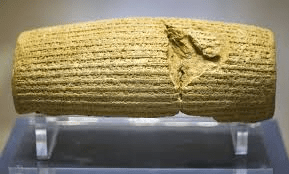
The Cyrus Cylinder

The call and raising up of Cyrus brought first and foremost the Jews back from captivity from Babylon to Jerusalem. (Ezra 1:1-8) This advanced God’s work of salvation and redemption, leading ultimately to Jesus Christ coming into the world. But his rule was also to cause salvation to spring up and righteousness to flourish with it. At the creational level, Cyrus’ reign brought an unprecedented advance of human rights for that time. The record of this is found today in what is known as the Cyrus Cylinder. The Cyrus Cylinder is a barrel-shaped cylinder of baked clay measuring 8.9 inches in length by 3.9 inches at its maximum diameter. It was created in several stages around a cone-shaped core of clay. This ancient record has been recognized as the first charter or declaration of human rights.

The Cyrus Cylinder, etched in Akkadian cuneiform script, describes the conquest of Babylon and King Cyrus’s intention to allow freedom of worship to communities displaced by the defeated Babylonian ruler, Nabonidus. In it is seen Cyrus’ respecting the languages, religions, and cultures of all the lands to which he laid claim. He believed that different faiths should co-exist. Cyrus also considered all nations and peoples to be equal in terms of their rights. Below are some statements from the Cyrus Cylinder:

[23] I took up my lordly abode in the royal palace amidst rejoicing and happiness. Marduk, the great lord, /established as his fate\ for me a magnanimous heart of one who loves Babylon, and I daily attended to his worship.

[24] My vast army marched into Babylon in peace; I did not permit anyone to frighten the people of [Sumer] /and\ Akkad.

[25] I sought the welfare of the city of Babylon and all its sacred centers.

[26] I relieved their weariness and freed them from their service.

[28] and in peace, before him, we mov[ed] around in friendship. [By his] exalted [word], all the kings who sit upon thrones

[29] throughout the world, from the Upper Sea to the Lower Sea, who live in the districts far-off], the kings of the West, who dwell in tents, all of them,

[32] I returned the images of the gods, who had resided there,note to their places and I let them dwell in eternal abodes. I gathered all their inhabitants and returned to them their dwellings.

[33] In addition, at the command of Marduk, the great lord, I settled in their habitations, in pleasing abodes, the gods of Sumer and Akkad, whom Nabonidus, to the anger of the lord of the gods, had brought into Babylon.

As a result of his humane policies, Cyrus gained the support of his subjects, thus securing the integrity of his empire. It is now translated into all six official languages of the United Nations, and its provisions parallel the first four Articles of the Universal Declaration of Human Rights.

What Do We Learn?

God shows that his creational and redemptive purposes are intertwined. God uses a pagan king to bring deliverance to his people and reestablish them in their homeland. This displays that God’s salvation purposes specific to redemption, and his purposes of creation are intertwined. This means that followers of Christ should work to discern the intersection of both.

God used Cyrus to advance the dignity of human rights. From Persia, the idea of human rights spread to Greece and eventually Rome. There, the concept of “natural law” arose, in observation of the fact that people tended to follow certain unwritten laws in the course of life. This has laid such foundational concepts which are later displayed in in the Magna Carta (1215), the US Constitution (1787), and the US Bill of Rights (1791).

Chaldeans and the Seven-Day Week

Photo by Bich Tran on Pexels.com

A group of people known as the Chaldeans advanced major steps forward in the progression of math, science, and astronomy. They discovered the Pythagorean theorem long before the Greeks. They also used the sexagesimal (base 60) place-value number system, which provided the practice of dividing a circle into 360 degrees, and an hour into 60 minutes. They were able to predict with surprising accuracy eclipses and planetary movements. But their most significant cultural achievement was that they solidified the use of the time cycle of the seven-day week, even providing the basis for the names to the days which we use today: Sunday, Monday, etc. The seven-day week is used all around the world. In almost every nation and civilization on the planet people live out their lives to the rhythm of the week. In God’s Story of Grace this emerged as a triumph of taking the creational pattern of Genesis (God creating the world in seven days) and emerging it into the larger civilizational pattern.

1Thus the heavens and the earth were completed in all their vast array.By the seventh day God had finished the work he had been doing; so on the seventh day he rested from all his work. Then God blessed the seventh day and made it holy, because on it he rested from all the work of creating that he had done. (Genesis 2:1-3)

In this article, we want to look at how God established through the Chaldeans the foundations of the seven-day week and examine how that was a cultural triumph to assist in the flourishing of humanity.

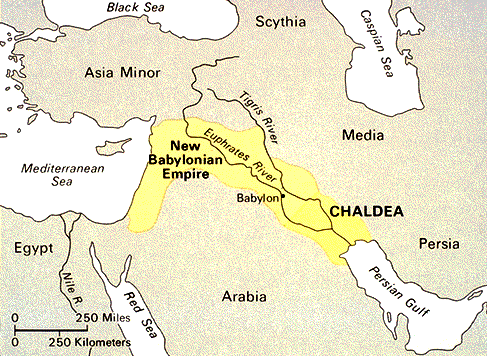
Who were the Chaldeans?

The Chaldeans were people who lived in southern Babylon. This is the southern part of Iraq today. It was thought to be an area of about 400 miles long and 100 miles wide among the Tigris and Euphrates Rivers. The Chaldeans are mentioned multiple times in the Bible. For example, Genesis 11:28 speaks of Abraham’s father Terah, who lived in “Ur of the Chaldeans.” Genesis 15:7 declares:

I am the Lord, who brought you out of Ur of the Chaldeans to give you this land to take possession of it.

The Origins of Sunday Through Monday

From approximately the 900’s to the 500’s B.C., the Chaldeans kept detailed records of the movement of the stars. Through patience and painstaking observation and without the benefits of instruments, they could predict such astronomical features as meteorological changes, the appearance of comets, the eclipses of the Sun and the Moon. In fact, the word “Chaldean” became synonymous with “astronomer.” Much of their devotion to studying the stars and planets was fueled by their devotion to astrology. Astrology is the pagan belief that the movement of the stars and planets have an effect on people’s earthly affairs.

An example of the belief comes from Enuma Anu Enlil which is a major series of 68 or 70 tablets that have been found which deal with ancient Babylonian astrology. Here is an example of an ancient report made by observing the moon:

If the moon becomes visible on the first day of the month: reliable speech; the land will be happy.

If the day reaches its normal length: a reign of long days.

If the moon at its appearance wears a crown: the king will reach the highest rank.

The Chaldeans believed that the earth was effected by seven key celestial bodies: Sun, Moon, Mars, Venus, Mercury, Saturn, and Jupiter. With their belief that the position of these seven “planets” effects the activities on the earth, they named the seven days of the week after them. Each day of the seven-day cycle was devoted to acknowledging the influence of each heavenly body:

  • Sunday – Day devoted to the sun
  • Monday – Day for the moon
  • Tuesday – Tyr or Tiw was the Norse god of war – the planet Mars
  • Wednesday – from the Norse god, Odin, also known as Woden or Wotan – Mercury
  • Thursday – Thor’s day, connected to the planet Jupiter
  • Friday – from Norse goddess, Frigga – Venus
  • Saturday – Roman, “dies saturni” – Saturn

This pattern of the weekly cycle would later be further developed and popularized through the Greeks and Romans and ultimately have its farthest reach by the spread of Christianity, which took the seven-day week, and reinforced its importance with biblical authority. Though the Chaldeans were the first society to begin to popularize a seven-day week, its origins go back to creation, as we have seen. The Bible teaches that God, himself, established the seven-day cycle by his own creative power. The world was destined to be governed by the seven-day week as humanity was given the charge to fill the earth and subdue it. (Genesis 1:28)

Rooted in Nature?

Biological Clock

What makes the eventual triumph of the seven-day week incredible is that other calendar units are determined by cycles existing in nature. A day is defined by the time it takes the earth to rotate once on its axis. A month is determined by the approximate time of the new moon cycles. A year is the time it takes the earth to complete one orbit around the sun. However, a week has no such natural basis, so it has been thought. But the emerging science of chronobiology which studies the interactions of biology with the rhythms of time has demonstrated that the seven-day cycle is embedded in our genes. This is not only in humans but animals and plants, as well. According to The Secrets Our Body Clocks Reveal by Susan Perry and Jim Dawson, the blood pressure cycle, coping hormone cycles, immune responses to infections, production of blood and urine chemicals, and even the heartbeat operate on a seven-day pattern.

Societal Health

Over the last few centuries, it has also been discovered that the seven-day week maximizes societal health. This can be seen by looking at cultures which have operated with weeks shorter or longer than seven days. There are some few cultures that have operated on a week of only three or four days. There were isolated pockets in the Democratic Republic of the Congo where the people operated in “weeks” of only three or four days. In African Cultural Astronomy, author Jarita C. Holbrook discusses the Igbo people of Nigeria, pointing out that they function on a four-day week. The same is true for other isolated cultures around the world. In 1929 the Soviet Union implemented the five-day week, no weekends. It was a disastrous 11 year experiment ending in 1941.

On the other side, experiments done with weeks longer than seven days, experience harmful consequences, as well. In 1793, just after the French Revolution, France adopted a 10-day week.

Jeremiah Jacques writes:

The revolutionaries made the move in an effort to simultaneously de-Christianize the country and increase its productivity. But productivity did not increase. According to R. R. Palmer’s The World of the French Revolution, France only kept the 10-day week around for 12 years because of its extremely disappointing results. During these years, French society saw a stark increase in injuries, exhaustion, illness, and work animals that collapsed and died at astounding rates. These people were attempting to operate on a rhythm unnatural to the design of their bodies, and the results were disastrous. Other societies have conducted similar week-extension experiments, but, like the French, they all reverted back to the seven-day model within a short time.

Conclusion

As Jesus declares:

The Sabbath was made for man, not man for the Sabbath.

Mark 2:27

The week and Sabbath was made for man, and mankind functions at its best when operating on a seven-day cycle. Not only is the command to rest on the seventh day, but also to work on the first six days. More or less than this, and penalties are inevitable.

The Hittites and the First Peace Treaty

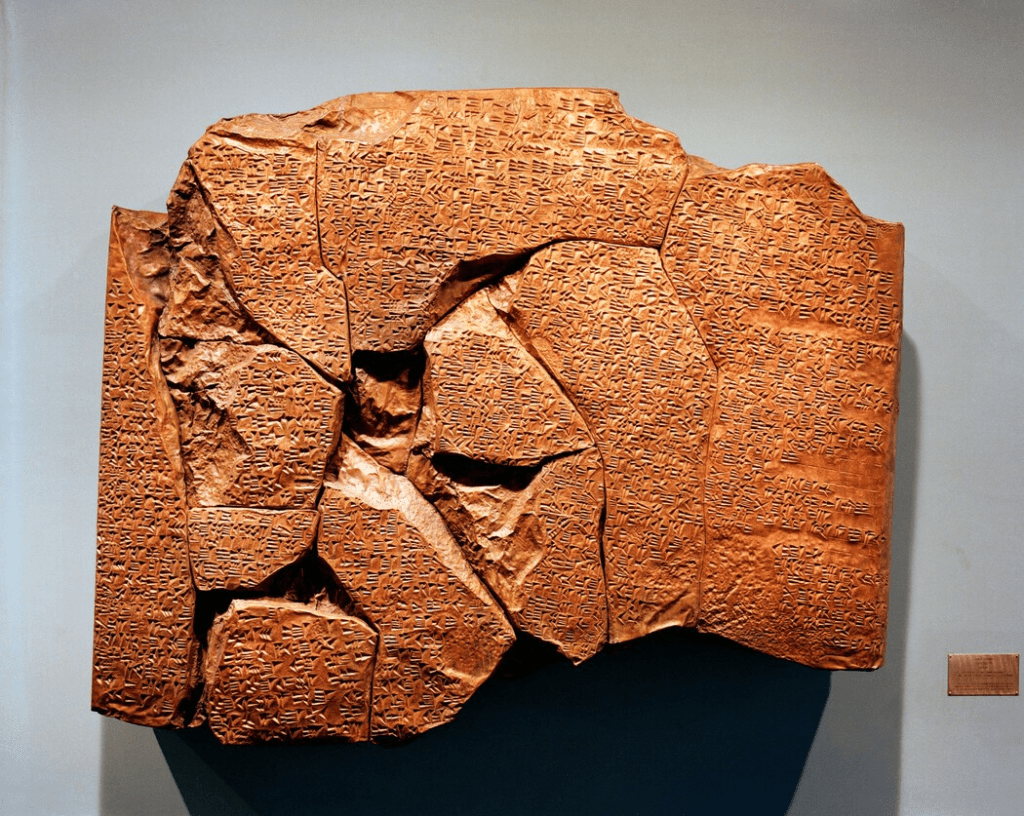
Kadesh Peace Treaty Between Egypt and the
Hittites at the United Nations

Dominant from the period of approximately 1600 to 1200 B.C., the Hittites were masters of making stronger weapons, conducting trade, and entering into diplomatic negotiations. Because of their strategic location between Europe and Asia, they became a vital hub for trade routes which allowed them to accumulate wealth and expand their influence. They established extensive trade networks with neighboring regions trading textiles, metals, livestock, and agricultural products. Through their extensive trade they became exceptional in their diplomatic skills and became the first civilization to establish formal treaties with other nations ensuring increased cooperation. In fact, it was the Hittites which developed the first known international treaty of which there is currently a copy hanging on the wall of the United Nations.

From the form which these treaties took, God (Yahweh) would use the Hittite treaty as a model of the covenant he made with Israel through Moses and Joshua. In this article we will see how God used the Hittites to develop greater connections and cooperation among the nations advancing his trinitarian likeness of unity (one God) and cooperation among the diversity (three persons) of nations.

Founding Of the Hittite Kingdom

Hittites Empire in 1300 B.C.

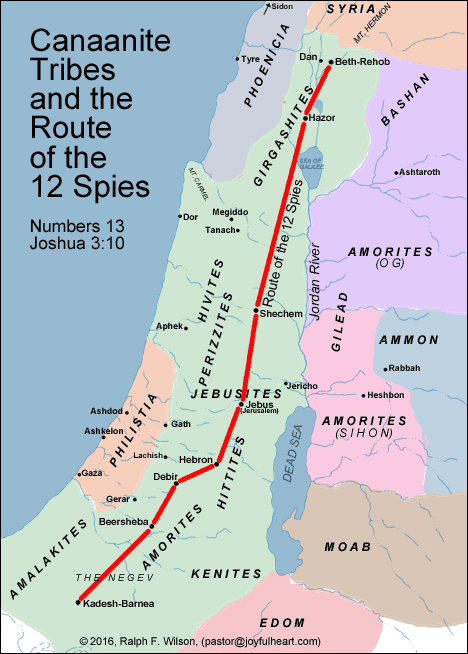
In Genesis 10, Noah’s grandson Canaan is described as the father of the Hittites. (Genesis 10:15) Beyond Genesis’ brief description of their origin, the Hittites as a group migrated west to Anatolia (modern Turkey) sometime around 2000 BC. Their start as a nation is dated to 1680 BC and is credited to Hattusili I. They eventually extended their territory toward Syria and the Levant (modern coastal Lebanon). The Bible records the Israelites having many contacts with the Hittites as apparently scattered groups lived throughout the Promised Land. Examples range from Hebron (Genesis 23:1-3), Beer-sheba (Genesis 26:33-34), the Hill Country (Numbers 13:29), Bethel (Judges 1:23-26), and Jerusalem (Ezekiel 16:3). These interactions included Abraham buying a grave to bury Sarah from the Hittites, Esau marrying two Hittites, king David lusted after Bath-sheba, the wife of Uriah the Hittite, who David caused to be killed (2 Samuel 11:3); and Solomon who married Hittite women (1 Kings 11:1). When Joshua was preparing to enter the land of Canaan after the death of Moses, the Lord promised Joshua that Israel’s territory would include all the land of the Hittites:

Your territory will extend from the desert to Lebanon, and from the great river, the Euphrates—all the Hittite country—to the Mediterranean Sea in the west. 

Joshua 1:4

This reference to the Hittite country refers to that which was in the boundaries of Canaan as opposed to Anatolia.

Diplomacy and Treaties

The Hittites most enduring contribution was in the areas of diplomacy and formation of treaties which played a crucial role in civilization’s development and influence. Because they were very active in to conduct treaties and alliances with neighboring states, they became pioneers in international diplomacy. This came into play when Egypt and the Hittites originated the first known international peace treaty. This was born out of a rivalry between the Egyptians and Hittites over control of the Levant. Both saw this region as vital to their security and economic well-being. In 1274 BC the Hittite army under Muwatalli II confronted the forces of Ramses II at the border town of Kadesh. Their armies were roughly the same size, but Rameses had been misled into thinking that Muwatalli was far off and was therefore caught completely off guard. Hittites caught the Egyptians in an ambush just as they were setting camp and managed to scatter one of the Egyptian divisions. Believing themselves victorious, the Hittites began to loot the Egyptian camp. However, as Egyptian reinforcements arrived, they were able to drive them off and inflict great casualties.

After the Battle of Kadesh both the Egyptian and Hittitian sides decided to end the hostilities. Ramses II and Hattusili III came to realize that it was no longer worth the rising number of casualties when neither could substantially gain an advantage. The best course forward was the path of peace. The Hittites and Egyptians then entered into a new relationship of peaceful and cooperative relations in which they shared their knowledge and experiences. This was an innovation! The Hittites taught the Egyptians how to make superior weapons and tools while the Egyptians shared their own knowledge of agriculture with the Hittites. The two nations continued a mutually beneficial relationship until the fall of the Hittite Empire 1200 BC. The Hittite’s facility in treaty making made this peace agreement possible.

Hittite Treaties and Israel’s Covenant

Between 1906 and 1912, thousands of Hittite tablets and fragments were discovered in central Turkey (formerly Anatolia). In 1955, G. E. Mendenhall, a biblical scholar who taught at the University of Michigan, effectively made the case that the covenant of Moses and Joshua seem to have been similar in form to the Hittite treaties of the fourteenth-thirteenth centuries BC. This pattern is seen most clearly in the structure of the book of Deuteronomy but can also be discerned in Joshua 24 and Exodus 20. These parallels include:

  • preamble of the covenant in which the Great King identifies himself
  • historical prologue in which the Great King tells what he has done
  • stipulations of the covenant in which the nation binds itself in accepting the demands of the covenant
  • preservation of the covenant
  • public reading of the covenant
  • list of witnesses
  • blessings and curses of the covenant
preamble of the covenant in which the Great King identifies himselfDeuteronomy 1:1–5 Joshua 24:2Exodus 20:1 
historical prologue in which the Great King tells what he has doneDeuteronomy 1:6–3:29 Joshua 24:3–13 Exodus 20:2 
stipulations of the covenant in which the nation binds itself in accepting the demands of the covenantDeuteronomy 4:1–11:32 Joshua 24:14-15 Exodus 20:3–17 
preservation of the covenant & public reading of the covenantDeuteronomy 12:1–26:19 Joshua 24:16–25   
list of witnesses
Deuteronomy 27:1–26 Joshua 24:26Exodus 25:16; 34:1 
blessings and curses of the covenantDeuteronomy 28:1–68  Joshua 24:27   
parallels of the Hittite and biblical covenants

So What?

Dating the Covenant of Moses: The historical connection of the Hittite treaties and the Old Testament is significance because this provides further evidence to date the story of Moses and the Hebrews in the fifteenth century BC. (The exodus from Egypt occurred in 1446 BC.) This adds to the mounting evidence for the historicity of the Exodus in distinction from those who argued that the covenant of Moses was not invented until the eighth century BC. With the work of G.E. Mendenhall, we now know that these covenants were already in existence during the tradition date of the Exodus.

Theological Clarity of Grace: The nature of the Hittite treaty helps reinforce our understanding of grace. The covenant is not a contract, but rather a binding relationship. A contract establishes a limited and partial agreement between two parties, but a covenant is a lasting relationship forged from the deepest bonds of trust and fidelity. Lets look at the covenant of Joshua an example:

Preamble of the Covenant

Joshua said to all the people, “This is what the Lord, the God of Israel, says: ‘Long ago your ancestors, including Terah the father of Abraham and Nahor, lived beyond the Euphrates River and worshiped other gods.

Joshua 24:2

Accomplishments of the King

But I took your father Abraham from the land beyond the Euphrates and led him throughout Canaan and gave him many descendants. I gave him Isaac, and to Isaac I gave Jacob and Esau. I assigned the hill country of Seir to Esau, but Jacob and his family went down to Egypt. “‘Then I sent Moses and Aaron, and I afflicted the Egyptians by what I did there, and I brought you out. When I brought your people out of Egypt, you came to the sea, and the Egyptians pursued them with chariots and horsemen as far as the Red Sea. But they cried to the Lord for help, and he put darkness between you and the Egyptians; he brought the sea over them and covered them. You saw with your own eyes what I did to the Egyptians. Then you lived in the wilderness for a long time. “‘I brought you to the land of the Amorites who lived east of the Jordan. They fought against you, but I gave them into your hands. I destroyed them from before you, and you took possession of their land.  When Balak son of Zippor, the king of Moab, prepared to fight against Israel, he sent for Balaam son of Beor to put a curse on you.  But I would not listen to Balaam, so he blessed you again and again, and I delivered you out of his hand. “‘Then you crossed the Jordan and came to Jericho. The citizens of Jericho fought against you, as did also the Amorites, Perizzites, Canaanites, Hittites, Girgashites, Hivites and Jebusites, but I gave them into your hands.  I sent the hornet ahead of you, which drove them out before you—also the two Amorite kings. You did not do it with your own sword and bow.  So I gave you a land on which you did not toil and cities you did not build; and you live in them and eat from vineyards and olive groves that you did not plant.’

Joshua 24:3-13

The Covenant Stipulations

 “Now fear the Lord and serve him with all faithfulness. Throw away the gods your ancestors worshiped beyond the Euphrates River and in Egypt, and serve the Lord.  But if serving the Lord seems undesirable to you, then choose for yourselves this day whom you will serve, whether the gods your ancestors served beyond the Euphrates, or the gods of the Amorites, in whose land you are living. But as for me and my household, we will serve the Lord.”

Joshua 24:14-15

Preservation and Public Reading of the Covenant

 Then the people answered, “Far be it from us to forsake the Lord to serve other gods!  It was the Lord our God himself who brought us and our parents up out of Egypt, from that land of slavery, and performed those great signs before our eyes. He protected us on our entire journey and among all the nations through which we traveled.  And the Lord drove out before us all the nations, including the Amorites, who lived in the land. We too will serve the Lord, because he is our God.” Joshua said to the people, “You are not able to serve the Lord. He is a holy God; he is a jealous God. He will not forgive your rebellion and your sins.  If you forsake the Lord and serve foreign gods, he will turn and bring disaster on you and make an end of you, after he has been good to you.” But the people said to Joshua, “No! We will serve the Lord.” Then Joshua said, “You are witnesses against yourselves that you have chosen to serve the Lord.” “Yes, we are witnesses,” they replied. “Now then,” said Joshua, “throw away the foreign gods that are among you and yield your hearts to the Lord, the God of Israel.” And the people said to Joshua, “We will serve the Lord our God and obey him.” On that day Joshua made a covenant for the people, and there at Shechem he reaffirmed for them decrees and laws. 

Joshua 24:16-23

Binding Witness

And Joshua recorded these things in the Book of the Law of God. Then he took a large stone and set it up there under the oak near the holy place of the Lord.

Joshua 24:26

 Blessings and Curses (implied)

“See!” he said to all the people. “This stone will be a witness against us. It has heard all the words the Lord has said to us. It will be a witness against you if you are untrue to your God.”

Joshua 24:27

International Cooperation: As the story of God’s grace advances, the nations are learning that they can take further steps in agreement and cooperation and live in peace, at least temporarily. In their diversity they can experience an increased unity. This further reflects the diversity and unity in the Trinity, three-in-one…the advance of his Story of Grace among the world.

The Phoenicians and the Origins Of Writing and the Bible

Photo by cottonbro studio on Pexels.com

The Phoenicians were an ancient civilization located in modern-day Lebanon, north of Israel, which are credited with achievements fundamental to the advance of God’s purposes in the world. They were the first to conquer the seas and develop a complex network of maritime trade in North Africa, Spain, Italy, and Greece. They invented glass, a luxury purple dye (which was worth three times the value of gold); but their most significant accomplishment was the development of the alphabet and the widespread use of papyrus, which became indispensable for the formation of the Bible and the spread of literacy. In this article we will look at the remarkable way God protected and used this very tiny group of people to have an outsized influence.

Who Were the Phoenicians?

In Genesis 10 we learn the origins of the Phoenicians with Sidon, whose was father was Canaan.

Canaan was the father of Sidon his firstborn, and of the Hittites, Jebusites, Amorites, Girgashites, Hivites, Arkites, Sinites, Arvadites, Zemarites and Hamathites. Later the Canaanite clans scattered and the borders of Canaan reached from Sidon toward Gerar as far as Gaza, and then toward Sodom, Gomorrah…

Genesis 10:15-18

Sidon, one of the key cities of the Phoenicians along with Tyre and Byblos, was apparently named after the first born of Canaan, according to the passage above. The Phoenicians never ruled as one nation, but rather identified as a common culture or people. In fact, they never called themselves Phoenicians. This name was given to them by the Greeks with whom they traded. The root word for “Phoenician” is the Greek phoinikē, meaning “red,” which could refer to the luxury dye produced in the region. Though it was clear that the Phoenicians were Canaanites and their cities were in the borders of Israel, the Jews did not attempt to conquer them when they invaded. Joshua 11:8 describes the Israelites chasing Canaanite armies “all the way to Greater Sidon.”

So Joshua and his whole army came against them suddenly at the Waters of Merom and attacked them, and the Lord gave them into the hand of Israel. They defeated them and pursued them all the way to Greater Sidon, to Misrephoth Maim, and to the Valley of Mizpah on the east, until no survivors were left.

Joshua 11:7-8

This stopping at Greater Sidon can be seen as an act of God’s grace as we will see later.

About four hundred years later, during the reign of David (ca.1000 BC), he expanded Israel’s frontiers to include Philistia, Ammon, Edom, and the Syrians; but there was one region that David did not touch–just like his predecessor Joshua–Phoenicia. Far from going to war, David and the Phoenicians formed a strong alliance which led to King Hiram of Tyre providing cedarwood, carpenters and masons to build David’s palace.

Now Hiram king of Tyre sent envoys to David, along with cedar logs and carpenters and stonemasons, and they built a palace for David. 

2 Samuel 5:11

The friendship between Israel and Phoenicia continued after David’s death. 1 Kings 5 shows that King Hiram sent a delegation to congratulate King Solomon on his coronation. We also know that Solomon hired the Tyrians to send cedarwood for construction of the temple in Jerusalem.

Solomon sent this message to Hiram king of Tyre: “Send me cedar logs as you did for my father David when you sent him cedar to build a palace to live in.  Now I am about to build a temple for the Name of the Lord my God and to dedicate it to him…

2 Chronicles 2:3-4

The reigns of David and Solomon represent the pinnacle of Israelite-Phoenician relations. Following the death of these two kings, relations between their peoples remained cordial until the time of the dispersion of Jerusalem in 586 B.C. by the Babylonians.

Why God Spared the Phoenicians

The Gift of Writing

Before the Israelites entered the Canaanite territories, the Phoenicians emerged as a people group about 1800 BC. They occupied a narrow strip of coast because stronger kingdoms surrounded them which forced them to become urban and seafaring merchants. This was necessary for survival because of cedar forests to the east and inhospitable territory to the north and south. Their only option for economic survival was to exploit the sea to the west. They became the first world class ship builders and mariners, who engaged in trade in North Africa, Southern Europe and the coastal Levant (modern Israel and Lebanon). This was aided by the abundant cedar trees which grew so close to home that were especially prized for boat building. These cedar trees were highly durable, easy to shape, and resistant to deterioration in seawater. A remarkably preserved 2,000-year-old vessel was found submerged in the Sea of Galilee was made partially from these cedars. Because of the high volume of trade, their business dealings required an increasing number of contracts, record keeping, and documentation. They needed a way to write and transmit information with greater efficiency and found it necessary to utilize and develop a 22 letter alphabet.1

The Phoenician 22 letter alphabet represented a major advance over pictograph writing, where pictures communicate ideas or objects as in hieroglyphs and cuneiform. Pictograph writing could have up to 700 symbols, and only a very few (often religious priests) could effectively understand and utilize it. This meant that the vast majority of people were illiterate without any possibility of reading or writing limiting the flow of information. With the invention and spread of the alphabet, ordinary people, such as traders, could learn to read and write by memorizing a small number of symbols which represented sounds. This meant a far larger percentage of the population could transmit information that was recorded. This increased literacy revolutionized many aspects of life. Among those who were part of this revolution were the Jews because their Hebrew language (which the Old Testament was written in) came from this Phoenician alphabet.

The Origins of the Bible

During 330-64 BC, Byblos became famous as a center for importing and exporting papyrus, a plant grown along the Nile River of Egypt. This papyrus was formed into an early form of paper which was easier to write on. Because papyrus was one of the key articles of trade, the Greeks took the name of the city of Byblos as their word for book (biblos) which we get our name for Bible. In the fifth century A.D., Greek Church Fathers used the word “biblios” to refer to the sixty-six books of the Bible. The English word “Bible” is derived from the Greek name of the city and means “the (papyrus) book”.

Lessons

God has worked out his plan for all nations. Without the Phoenicians the Jews would not have had the Hebrew language for which the Old Testament is written. Without the Phoenicians the Jews would not have had the resources for building the Temple. Through Israel God’s distinctive plan of salvation was given to the nations, but the nations have had the privilege to contribute to that plan.

God advances his plan for the blessing of the world. Through the Phoenicians our world took the next steps toward freedom in realizing the potential of its God ordained image and destiny. Here are some of the ways:

  • The world became more connected through trade which allowed for the expansion of knowledge.
  • Literacy spread.
  • The seeds of democracy were sown as some of Phoenician territories would later become Greek city states.
  • There were advances in architecture as even the temple would be influenced by Phoenician design.

End Note

1It is important to know that a Semitic people living in Egypt may have invented the alphabet, but the Phoenicians developed it and caused it to have widespread use in the Mediterranean world.)

Did God Command Genocide?

The modern era is filled with examples of genocide, the effort to wipe out an entire people group. There are Armenia, Cambodia, Sudan, Rwanda and Darfur. These are tragedies which are worthy of our sorrow and grief. And yet, some ask if the God of the Bible is really any better when He commanded the Israelites to wipe out all the Canaanites.

However, in the cities of the nations the Lord your God is giving you as an inheritance, do not leave alive anything that breathes.  Completely destroy them—the Hittites, Amorites, Canaanites, Perizzites, Hivites and Jebusites—as the Lord your God has commanded you. 

Deuteronomy 20:16-17

How do we understand God’s commandment to “completely destroy?” How could this be remotely compatible with the God who is loving and compassionate to all people? Admittedly, this is a challenging issue and question. To understand, it is necessary to frame this command in four perspectives.

Perspective # 1: The Canaanites had persisted in centuries of unthinkable acts of evil.

The Canaanite culture had a high degree of depravity and barbarism. The foremost act of depravity was infant sacrifice. Harvard Old Testament scholar and archaeologist, G. Earnest Wright explains, “Worship of these gods [Canaanite gods] carried with it some of the most demoralizing practices then in existence. Among them were child sacrifice, a practice long since discarded in Egypt and Babylonia…” Old Testament scholar Gordon Wenham writes, “Molech [a Canaanite god] sacrifices were offered especially in con­nection with vows and solemn promises, and children were sacrificed as the harshest and most binding pledge of the sanctity of a promise.”

The scriptural testimony affirms this:

Do not give any of your children to be sacrificed to Molek, for you must not profane the name of your God. I am the Lord… Do not defile yourselves in any of these ways, because this is how the nations that I am going to drive out before you became defiled. Even the land was defiled; so I punished it for its sin, and the land vomited out its inhabitants. But you must keep my decrees and my laws. The native-born and the foreigners residing among you must not do any of these detestable things, for all these things were done by the people who lived in the land before you, and the land became defiled.

Leviticus 18:21, 24-27

You must not worship the Lord your God in their way, because in worshiping their gods, they do all kinds of detestable things the Lord hates. They even burn their sons and daughters in the fire as sacrifices to their gods.

Deuteronomy 12:31

When you enter the land the Lord your God is giving you, do not learn to imitate the detestable ways of the nations there.  Let no one be found among you who sacrifices their son or daughter in the fire… Anyone who does these things is detestable to the Lord; because of these same detestable practices the Lord your God will drive out those nations before you. You must be blameless before the Lord your God.

Deuteronomy 18:9-10, 12-13

Apologist Clay Jones explains how children were sacrificed to Molech:

Molech was a Canaanite underworld deity represented as an upright, bull-headed idol with human body in whose belly a fire was stoked and in whose outstretched arms a child was placed that would be burned to death…. And it was not just infants; children as old as four were sacrificed….A bronze image of Kronos was set up among them, stretching out its cupped hands above a bronze cauldron, which would burn the child. As the flame burning the child surrounded the body, the limbs would shrivel up and the mouth would appear to grin as if laughing, until it was shrunk enough to slip into the cauldron.

In Canaan there were, also, rampant acts of incest, rape and bestiality.

Perspective # 2: The judgment was not an ethnic cleaning but an ethical cleansing.

Referencing this as a genocide is inaccurate on several levels. At the most basic of them is that the term “genocide” is a compound word consisting of the words “race” (gene) and “killing” (cide). But this was not an ethnic cleansing in any way. First, the Canaanites and Israelites were closely related. Jonathan Laden, writing for the Biblical Archaeological Society, explains this intriguing discovery:

After examining the DNA of 93 bodies recovered from archaeological sites around the southern Levant, the land of Canaan in the Bible, researchers have concluded that modern populations of the region are descendants of the ancient Canaanites. Most modern Jewish groups and the Arabic-speaking groups from the region show at least half of their ancestry as Canaanite.

Second, God warned that the exact same judgement would come upon the Jews if they engaged in the same practices as the Canaanites.

And if you defile the land, it will vomit you out as it vomited out the nations that were before you.

Leviticus 18:28

Third, God spared non-Israelites who turned to him. The rescue of Rahab and her family shows that this judgment was not an ethnic cleansing. Moreover, when the Israelites renewed their covenant with God, we read that foreigners and native-born (Canaanites) were there:

All the Israelites, with their elders, officials and judges, were standing on both sides of the ark of the covenant of the Lord, facing the Levitical priests who carried it. Both the foreigners living among them and the native-born were there. Half of the people stood in front of Mount Gerizim and half of them in front of Mount Ebal, as Moses the servant of the Lord had formerly commanded when he gave instructions to bless the people of Israel.

Joshua 8:33

It is clear that if a Canaanite turned to God they were spared.

Perspective # 3: The Canaanites rejected peace and wanted war.

God waits patiently for people to turn to him, and he is slow to anger. This is shown to be core to God’s character.

And he passed in front of Moses, proclaiming, “The Lord, the Lord, the compassionate and gracious God, slow to anger, abounding in love and faithfulness, maintaining love to thousands, and forgiving wickedness, rebellion and sin. Yet he does not leave the guilty unpunished; he punishes the children and their children for the sin of the parents to the third and fourth generation.”

Exodus 34:6-7

God’s patience and forgiveness is affirmed through the entirety of scripture. In fact, God allowed the Israelites to suffer greatly in slavery for 400 years so that the Canaanites could have an opportunity to change. He didn’t judge them immediately because the sins of the Canaanites did not reach the “full measure.” The full measure means they went beyond the point of no return.

Then the Lord said to him, “Know for certain that for four hundred years your descendants will be strangers in a country not their own and that they will be enslaved and mistreated there…In the fourth generation your descendants will come back here, for the sin of the Amorites has not yet reached its full measure.”

Genesis 15:13, 16

Before the Israelites entered Canaan, they had seen the destruction of Sodom and Gomorrah (Genesis 19:1-29) giving them clear evidence of what God can do. When the Hebrews were on the border of Canaan, the spies who were sent in heard this testimony from Rahab, showing there was an awareness of the power of God:

Before the spies lay down for the night, she went up on the roof  and said to them, “I know that the Lord has given you this land and that a great fear of you has fallen on us, so that all who live in this country are melting in fear because of you. We have heard how the Lord dried up the water of the Red Sea for you when you came out of Egypt, and what you did to Sihon and Og, the two kings of the Amorites east of the Jordan, whom you completely destroyed. When we heard of it, our hearts melted in fear and everyone’s courage failed because of you, for the Lord your God is God in heaven above and on the earth below.

Joshua 2:8-11

Before this, they had the ability to change, but at this point they were unwilling. Understanding the power of God, they refused to surrender.

Perspective # 4: Joshua didn’t engage in cruel and unusual practices.

This is the only offensive war that God ever commanded. All other wars in which Israel engaged were defensive. With that said there are three ways we can put this war in context.

Exaggerated Language: God’s command to “utterly destroy” is likely hyperbolic or exaggerated language. To utterly destroy means a comprehensive victory. Paul Copan uses the analogy of a modern sports fan saying that his team “slaughtered” or “killed” their opponents, which is not to be taken literally.

For example, Joshua 10:20 reads:

So Joshua and the Israelites defeated them completely, but a few survivors managed to reach their fortified cities. 

God warned the Israelites not to intermarry with the Canaanites. But why would God command this if all of the Canaanites were “utterly destroyed?”

But if you turn away and ally yourselves with the survivors of these nations that remain among you and if you intermarry with them and associate with them, then you may be sure that the Lord your God will no longer drive out these nations before you. 

Joshua 23:12-13

Surely these warnings would be useless unless the Canaanites were not utterly destroyed. This exaggerated language applies when it states that women and children are to be killed. There is not record of the destruction of women and children.

Removal not extermination: Some scholars point out that the goal was to drive out the Canaanites. If any fled, their lives would be spared; only those who remained would be killed. Notice the “drive them out” language:

Little by little I will drive them out before you, until you have increased enough to take possession of the land.

Exodus 23:30

As for all the inhabitants of the mountain regions from Lebanon to Misrephoth Maim, that is, all the Sidonians, I myself will drive them out before the Israelites. Be sure to allocate this land to Israel for an inheritance, as I have instructed you

Joshua 13:6

Theologian and philosopher, William Lane Craig clarifies:

The Canaanite tribal kingdoms which occupied the land were to be destroyed as nation states, not as individuals. The judgment of God upon these tribal groups, which had become so incredibly debauched by that time, is that they were being divested of their land. Canaan was being given over to Israel…If the Canaanite tribes, seeing the armies of Israel, had simply chosen to flee, no one would have been killed at all. There was no command to pursue and hunt down the Canaanite peoples.

Restricted fighting: Old Testament scholar Richard Hess argues that the killing in the book of Joshua was restricted to military battles which did not involve civilians. While the accounts of the conquest of Jericho and Ai appear to involve the defeat of a settled city full of civilians, Hess shows how each part of this description could be interpreted in other ways. There is no archaeological evidence of civilian populations at Jericho or Ai. Given what we know about Canaanite life in the Bronze Age, Jericho and Ai were military strongholds.

Conclusion

This was in NO WAY a genocide. That label is a gross misrepresentation. This war was conducted in such a way that gave the Canaanites every chance to turn or flee. It was a war of last resort. God has never commanded a war like this before or since. It was done for the purposes to stop the spread of horrible evils and advance salvation to the world.