Was God Evil For Killing Egypt’s First Born?

Photo by Bo Ponomari on Pexels.com

The charge is frequently levelled against God for wrong doing or evil because of the killing of Egypt’s first born at the Passover. The first born, it is alleged, were not in charge of the evils done in Egypt–Pharaoh was. The accusations continue claiming that the killing of the first born in Egypt makes God a killing vindictive hypocrite who commands us not to murder but turns around and does what He asks us not to do. This question is not just isolated to the Passover. It is related to a much broader issue: what authority does God have to take human life, even the lives of children rather than the perpetrators of the evil?

In this article we will contend that God was not vengeful or vindictive but displayed a higher passion for justice and overall love for humanity. To understand this we will look at the three frameworks of:

  • God’s Prerogatives
  • God’s Authority
  • God’s Omniscience

These three frameworks will be examined in light of the historical and cultural realities of Egypt and the Passover.

Can God Take Any Human Life?

Framework # 1: God has different prerogatives. It seems reasonable to hold God to the same standard of morality He holds us to. “Whatever we can’t do, God shouldn’t be allowed to do either,” we argue. But as the creator, sustainer and redeemer of humanity, God has different aims and objectives from us which shape His decisions and actions. Think about how the police have an authority to use force and coercion under certain circumstances which the every day citizen does not. God functions on an entirely different scope and scale of priorities than we do as humans. So, in governing the universe and carrying out His plan, God may rightfully choose to take life in which it would be wrong for humans to do.

Framework # 2: God has a different scope of authority. As humans we are only allowed to take the lives of other people in limited circumstances (self-defense, capital punishment, just war). Those circumstances are rare. Outside of justified circumstances we are robbing someone of a life that is not ours to take. Sometimes when people take life that they shouldn’t, they are accused of “playing God.” God does not “play God” when He takes life because He is the author and sustainer of life, and He is not robbing what is His in the first place.

See now that I myself am he!
    There is no god besides me.
I put to death and I bring to life,
    I have wounded and I will heal,
    and no one can deliver out of my hand.
(Deuteronomy 32:39)

Framework # 3: God has a higher level of knowledge. God is omniscient (He knows everything), so he knows when a group of people have become so wicked that it would be bad for them, and for their children, and for the rest of the world, to remain alive to keep sinning. This is a level of knowledge and understanding that only God has.

To understand how these three frameworks fit with the Passover, it is helpful to understand the 430 year history of slavery which the Jews experienced under Egypt until the Passover.

Putting the Passover In Perspective

The Jews, starting with Joseph and his brothers, are together in Egypt in 1887 B.C. After that generation passes, we are informed that the Jews would experience extreme oppression under the new pharaoh:

Then a new king, to whom Joseph meant nothing, came to power in Egypt.  “Look,” he said to his people, “the Israelites have become far too numerous for us. Come, we must deal shrewdly with them or they will become even more numerous and, if war breaks out, will join our enemies, fight against us and leave the country.” So they put slave masters over them to oppress them with forced labor, and they built Pithom and Rameses as store cities for Pharaoh. (Exodus 1:8-11)

The forced labor which is referred to in this passage is a means of population control, the kind of labor so brutal that it resulted in a thinning of the population through death. Exodus 1:14 describes the Egyptians working the Israelites “ruthlessly.” Nonetheless, the Jews increased in number through the power of God. This compelled pharaoh to resort to infanticide.

The king of Egypt said to the Hebrew midwives, whose names were Shiphrah and Puah,  “When you are helping the Hebrew women during childbirth on the delivery stool, if you see that the baby is a boy, kill him; but if it is a girl, let her live.” (Exodus 1:15-16)

Moses is born during this chilling time:

Now a man of the tribe of Levi married a Levite woman,  and she became pregnant and gave birth to a son. When she saw that he was a fine child, she hid him for three months.  But when she could hide him no longer, she got a papyrus basket for him and coated it with tar and pitch. Then she placed the child in it and put it among the reeds along the bank of the Nile.  His sister stood at a distance to see what would happen to him. (Exodus 2:1-4)

Moses will amazingly get picked up and raised by Pharaoh’s daughter, growing up in the King of Egypt’s family. About 115 years pass from the time of the new pharaoh, who did not know Joseph, to the time Moses was 40 years old. Look at the conditions of the Jews in Egypt.

One day, after Moses had grown up, he went out to where his own people were and watched them at their hard labor. He saw an Egyptian beating a Hebrew, one of his own people. Looking this way and that and seeing no one, he killed the Egyptian and hid him in the sand.  (Exodus 2:11-12)

Because of Moses’ intervention, Moses fell into trouble with Pharaoh, and he was forced to flee from Egypt and ran to Midian. By the time Moses returns to deliver Egypt, the Jews have been relentlessly suffering in Egypt for about 150 years…150 years, think of it!

During that long period, the king of Egypt died. The Israelites groaned in their slavery and cried out, and their cry for help because of their slavery went up to God. (Exodus 2:23)

The Number of Jews Killed

The killing off of Jews started before Moses was born and was in effect when he returned at 80 years of age. It would not be unreasonable to think that there were ongoing periods of infanticide through this time. In any year the killing of first born males would have resulted in the deaths of tens of thousands. After the Jews left Egypt, they counted the number of first born males. The total number of firstborn males a month old or more, listed by name, was 22,273. (Numbers 3:43) So, this number could be multiplied by four when you add the younger brothers. (Pharaoh went to kill all the males born, not just the first born.) Over a 150 year period, the death toll of infants and adults could be staggering, perhaps hundreds of thousands.

The Number of Egyptians Killed

It is very difficult to know the population of Egypt. An estimate given by archaeologist Karl Butzer calculated that the population of Egypt was around 2.5 to 3 million. The evidence of stelae and tombs from Dayr al-Madina shows that families with eight or ten children surviving into adulthood were not uncommon. This could place the population of first born males around 5,000. How do we arrive at this number?

  • Take 3,000,000 as the general Egyptian population ÷ 12 (number of people per family household) = 250,000 households.
  • Take 250,000 households x .08 (first born of each household) = 20,000.
  • Of these 20,000, it is likely that at least 3/4 could have become fathers and no longer qualified as first born. So, the number could be reasonably reduced to 5,000.

Though these numbers are unsure, it is sensible to understand that the loss of the Egyptian lives may have been as low as 3-5% (10,000) that of the Jews (hundreds of thousands).

Important Distinctions Between God and Egypt

God gave the Egyptians a way out ten different times. The Israelites were given zero ways out.
The death would have been at night while the first born were sleeping. The Israelite babies were thrown in the river to drown. The adults were killed in slave labor.
God’s action was a one-time event, which stopped the continuing killing by Pharaoh (and any further damages to his people)Pharaoh’s program went on for decades.
God’s action did not cause evil to occur in the Jewish hearts. Pharaoh’s program involved massive human agency–all Egyptians–with untold effects on the hearts of the Egyptians with state-sponsored hatred of the Hebrews.
God’s actions caused the loss of several thousand.Pharaoh’s program caused the loss of hundreds of thousands.

Questions

Couldn’t God have freed the Jews without such destruction to Egypt? The answer would be yes. But the reason for the destruction was not just to free the Jews, but to overturn an oppressive system of power and exploitation. The plagues of Egypt represented as seen by this chart:

Nile to bloodHapi (also called Apis), the bull god, god of the Nile; Isis, goddess of the Nile; Khnum, ram god, guardian of the Nile
FrogsHeqet, goddess of birth, with a frog head
GnatsSet, god of the desert storms
FliesRe, a sun god; Uatchit, possibly represented by the fly
Death of livestockHathor, goddess with a cow head; Apis, the bull god, symbol of fertility
BoilsSekhmet, goddess with power over disease; Sunu, the pestilence god; Isis, healing goddess
HailNut, the sky goddess; Osiris, god of the crops and fertility; Set, god of the desert storms
LocustsNut, the sky goddess; Osiris, god of the crops and fertility
DarknessRe, the sun god; Horus, a sun god; Nut, a sky goddess; Hathor, a sky goddess
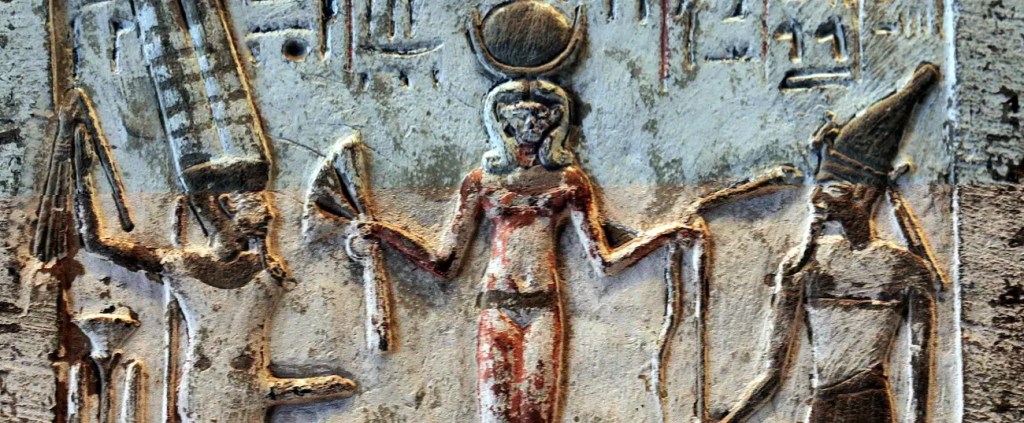
Death of firstbornMin, god of reproduction; Heqet, goddess who attended women at childbirth; Isis, goddess who protected children; Pharaoh’s firstborn son considered a god
https://zondervanacademic.com/blog/what-the-bible-tells-us-about-the-10-plagues-of-egypt

Through the ten plagues God was demonstrating His supremacy above the deities (which probably represented evil spirits) of Israel’s oppressors. What is of such critical importance is that through these judgements God is establishing the foundation of His supremacy as YHWH (Exodus 3:14). Referring to the tenth plague, God said:

“On that same night I will pass through Egypt and strike down every firstborn of both people and animals, and I will bring judgment on all the gods of Egypt. I am the Lord.” (Exodus 12:12)

This was all necessary for Israel to understand the supremacy and uniqueness of God and to destroy the foundations of an oppressive system.

Did God really need to kill the first born? Rabbi Ari Kahn provides this answer:

In order to fully understand this plague we must appreciate the hierarchy within Egyptian civilization. It was a society ruled by primogeniture [The first born]. The first-born had absolute power within the family unit. Pharaoh was the first-born of the first-born of the first-born. It was from this birthright that he exercised power. The attack against the first-born was therefore a powerful polemic against the entire culture of Egypt. The eldest ruled the younger siblings. This is why having slaves was so important to the Egyptians. This gave the lower classes someone else to control and dominate.

The evidence of the Exodus story indicates that it was only at this judgement of the first born that the Egyptians were willing to release the Hebrews, perhaps because that was their greatest source of cultural and religious pride.

Couldn’t God have just destroyed pharaoh and not the children? The challenge is that the corruption and oppression ran through society. It was passed down through different pharaohs. The king of Egypt during the Passover was different than the one who ordered the killing of the Hebrew males. (Exodus 2:23) All of society participated in the abuse and destruction of the Israelites. Pharaoh was the ultimate figurehead and representation of a systematic evil that ran through all of society.

Conclusion

Let’s look at the prerogatives, authority and knowledge of God in light of the Exodus story.

God’s prerogatives: God was establishing the foundation of His uniqueness and glory over all other “gods” and systems of oppression and evil.

God’s authority: The judgements of the Passover were all within the rights of God because of the overall good which He needs to accomplish and the establishment of justice on the earth.

God’s omniscience: God would have known the greater oppression which would have spread and come upon the earth if Egypt’s power had not been weakened with the judgement of the Passover.
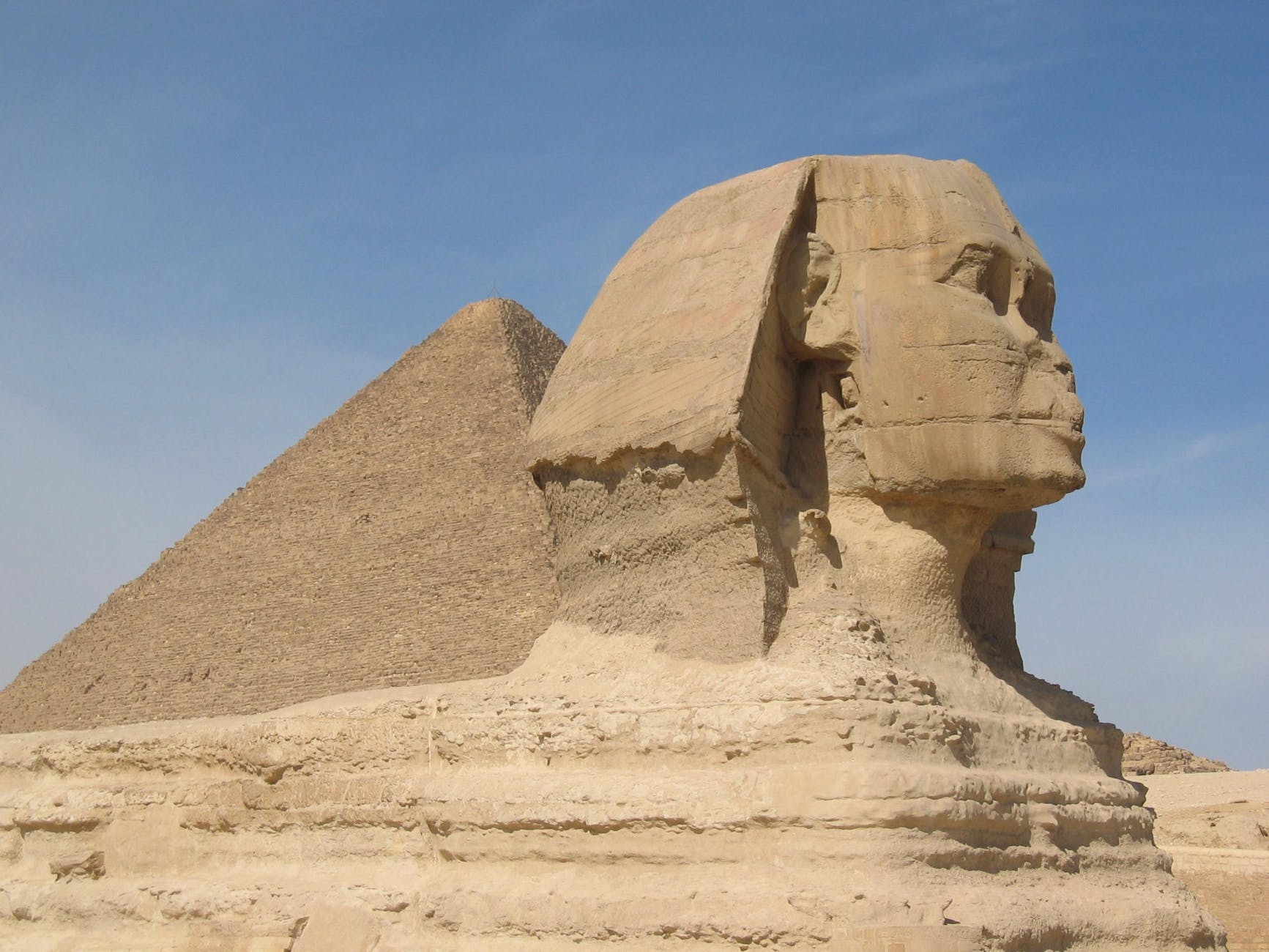
Egypt’s Greatest Gift

Photo by Pixabay on Pexels.com

Egypt holds a world of fascination. Along with Moses and the Exodus, such historical monuments as pyramids, mummies, King Tut, and The Great Sphynx inspire ongoing archaeological explorations and historical research. Of course these have inspired an Egyptomania leading to music, dances, movies, novels, and art designs. In addition, Egypt gave humanity one of the earliest forms of writing known as hieroglyphs, the 365 day solar calendar, papyrus sheets for writing, along with tooth paste to name just some of the innovations. Yet, the most important heritage which Egypt gave to the world was not something they invented, but something God had providentially formed over time–the nation state. Egypt was the first territory which unified tribes of people under one government and ruler. This nation state endured for 3,000 years. Before Egypt, most people were governed in collectives of smaller tribes and cities. Those which became powerful would conquer and rule over other cities and tribes for a period of time but then break apart. Egypt, for 3000 years, grouped together nearly 387,000 square miles of cities, tribes, and people groups under one centralized government.

Because of Egypt it was possible for the Hebrews, before they even became a nation, to understand how they were to form the nation of Israel, not just a loosely associated tribes, but on nation with set boundaries. This also created the foundation for other nations to form solid borders in which they would be protected under larger unified cultures in which people could more easily travel and ideas could more easily be transmitted. This is why Paul declared: to the Greeks

“From one man he made all the nations, that they should inhabit the whole earth; and he marked out their appointed times in history and the boundaries of their lands.”

Acts 17:26

Starting from the promise with Abraham in Genesis 12:1-3, we will trace the understanding and importance of the nation state and how the promise could only make sense through Egypt.

The Promise

In the originating promise of the Jewish people are all the seeds for understanding how Israel would form a nation distinct from simply a tribe or people group. The promise reads as follows:

1The Lord had said to Abram, “Go from your country (erets), your people and your father’s household to the land I will show you.

2“I will make you into a great nation (goy) ,
    and I will bless you;
I will make your name great,
    and you will be a blessing.
3I will bless those who bless you,
    and whoever curses you I will curse;
and all peoples
(mishpachah) on earth
    will be blessed through you.
(Genesis 12:1-3)

Here we see all of the distinctions which separate tribes, countries and nation states.

  • people“/mishpachah (v.3)–a group of people over a smaller territory unified together by a common ancestry and practices.
  • “country”/erets (v.1)–a group of people over a larger territory unified together by a common culture or identity without distinct boundaries.
  • nation”/goy (v.2)–a group of people over a larger territory unified together with distinct boundaries and a centralized government.

Egypt is the first territory to be transformed into a nation as defined above by the Hebrew word, “goy.” By the providence of God it would be Egypt that Abraham would travel to escape the famine which was in Canaan.

Now there was a famine in the land, and Abram went down to Egypt to live there for a while because the famine was severe.

Genesis 12:10

Basing his observations on archaeological records, Egyptologist James K. Hoffmeier, in his book, Israel in Egypt, writes:

Egypt was frequented by the peoples of the Levant [Canaan and its surrounding areas] , especially as a result of climatic problems that resulted in drought . . . from the end of… (2190 B.C. through…1550 B.C.). Even during the Empire Period, there are records of hunger and thirst driving people from Canaan and Sinai to Egypt for relief.

So, the Genesis account overlaps with the historical record provided by archaeology.

Eventually it would be in Egypt that the Hebrews would grow into a very sizable population according to Exodus 12:37. In time they would form into a nation state under King David which would reach to its peak of greatness in King Solomon. The forerunner of understanding what the descendants of Abraham would become as a nation (goy) was Egypt.

How Egypt Became a Nation State

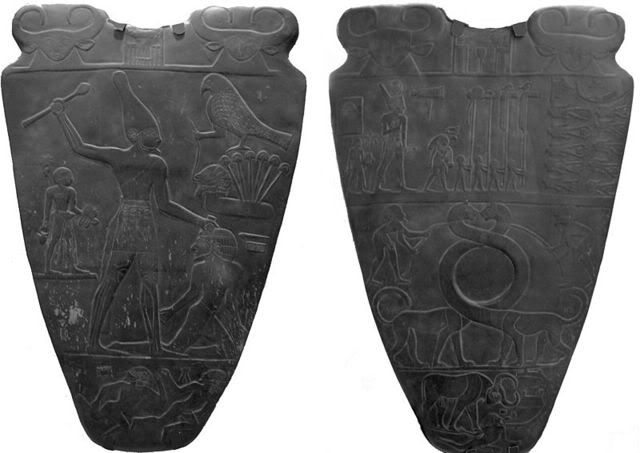
Narmer Palette
Two sides of a stone artifact showing
King Namer’s conquest

Beginning in about 4,000 B.C., Egypt existed in two kingdoms: Upper Egypt and Lower Egypt. These two kingdoms were ruled by different kings. Around 3100 B.C., Pharaoh Narmer brought the two kingdoms together through conquest (pictured in the image), creating a unified Egypt. Though he brought the two kingdoms together, there were geographical changes which occurred over the slow progress of centuries (Acts 17:26) making it possible for Egypt to develop and remain the first unified state.

Factor # 1: Changing Geography

In contrast to the 96% of desert we see in Egypt today, in ancient times the land consisted of marshy and rich environments where there were a variety of rich food resources. Fishing and hunting were abundant. This changed with the recess and stabilization of post-glacial sea levels which originated with the Flood. With the receding of water, the environment became less swampy which transformed into wider, more open, well-drained floodplains.

Factor # 2: Changing Food Source

As the environment changed, Egypt gradually became less rich in these food resources. Over time it would lose a significant amount of its primary food sources. Each succeeding generation would have had a slightly harder job of supporting itself. This would necessitate that the Egyptians shift toward farming. They kept pigs and grew more crops.

Factor # 3: Growing Food Surpluses

As Egyptians took up farming, a wealth of agricultural production developed that was at greater levels than any other area where farming had been practiced. This was because of the Nile River and its annual flooding provided a highly fertile soil which brought increasing surpluses of food. Large groups of people could be organized to carry out irrigation projects and to expand the agricultural wealth of a unified Egypt. The need to administer this surplus created the necessity for a unified state. Benjamin Pennington, professor of archaeology at University of Southampton, writes:

Early hieroglyphics from this time record transactions into and out of the state treasury, while the “capital” and royal court were set up at the obvious place—near modern-day Cairo—binding the agricultural powerhouse of the delta with the older centers of culture upstream.

The managing of these surpluses necessitated the need for a powerful centralized government. Eventually this centralized government made possible the construction of public monuments, such as the pyramids, and other cultural achievements. The geographical changes in Egypt not only helped stimulate farming production, but played a major role in the emergence of the first nation state. This was a major gift to the world.

How God Used Egypt As the First Nation State

As a nation state they were a source of refuge for God’s people.

  • Abraham fled to Egypt during famine (Genesis 12:10-20)
  • Jacob and his family fled to Egypt during famine (Genesis 46:1-34)
  • Joseph took Mary and Jesus to Egypt (Matthew 2:13-18)

Because of the resources of Egypt, it was a place of refuge for the Jewish patriarchs and Jesus.

As a nation state they were a model to other nations.

For Israel and the rest of the world, Egypt was an example of a people developing defined borders, a centralized administrative state, and a common unified culture. With the establishing of nation states, this allowed for the increased flow of information and travel for ideas to spread. For Israel, they could become one (goy) and not just distinct tribes or peoples (mishpachah) because they lived and grew inside of the first nation state.

Did the Exodus Really Occur?

Outside of Jesus, there is perhaps no more important figure than Moses. The three most influential religions in the world: Christianity, Judaism and Islam each claim Moses for a decisive role in their stories. He wrote the first five books of the Old Testament, delivered a slave people out of the most powerful nation of the ancient world, and bequeathed to the world a set of laws which has become foundational for the legislative codes of western civilization. Oddly, the figure of Moses and the pivotal events surrounding his prophetic work with the Exodus is often doubted as a real historical person connected to actual historical events. Yet, the archaeological record fits amazingly close with the Exodus account in the Bible.

For this article, I want to lay out key evidences which corroborates the Exodus account. They are as follows:

  • Evidence of an enslaved population of people like the Jews in Egypt before 1446 BC.
  • Evidence of a great Exodus after 1446 BC.
  • Evidence of Canaan being populated soon after 1446 BC.

Slavery

Evidence # 1: The Brooklyn Papyrus.

The Brooklyn Papyrus

The Brooklyn Papyrus was an Egyptian document with the names of 95 household servants of a noblewoman named Senebtisi. This papyrus dates to 1809–1743 BC. This is just after the time of Joseph. Several of these names have been identified as Hebrew. Some examples of these include:

Menahema, a feminine form of Menahem2 Kings 15:14
Ashera, a feminine form of Asher, the name of one of the sons of JacobGenesis 30:13
Shiphrah, the name of one of the Hebrew midwives prior to the ExodusExodus 1:15
Aqoba, feminine form of JacobGenesis 25:26
Ayyabum, the name of the patriarch JobJob 1:1
Sekera, which is a feminine name of IssakarGenesis 30:18
Dawidi-huat a compound name utilizing the name David1 Samuel 16:13
Sebtw, a name derived from the Hebrew word eseb meaning “herb”Deuteronomy 32:2
Hayah-wr another compound name composed of Eve and meaning “bright life”Genesis 3:20
Hy’b’rw, which appears to be an Egyptian transcription of HebrewGenesis 39:14
Semitic names in Brooklyn Papyrus

Archaeologist, Titus Kennedy, summarizes the importance of this papyrus: “This list is a clear attestation of Hebrew people living in Egypt prior to the Exodus, and it is an essential piece of evidence in the argument for an historical Exodus.”

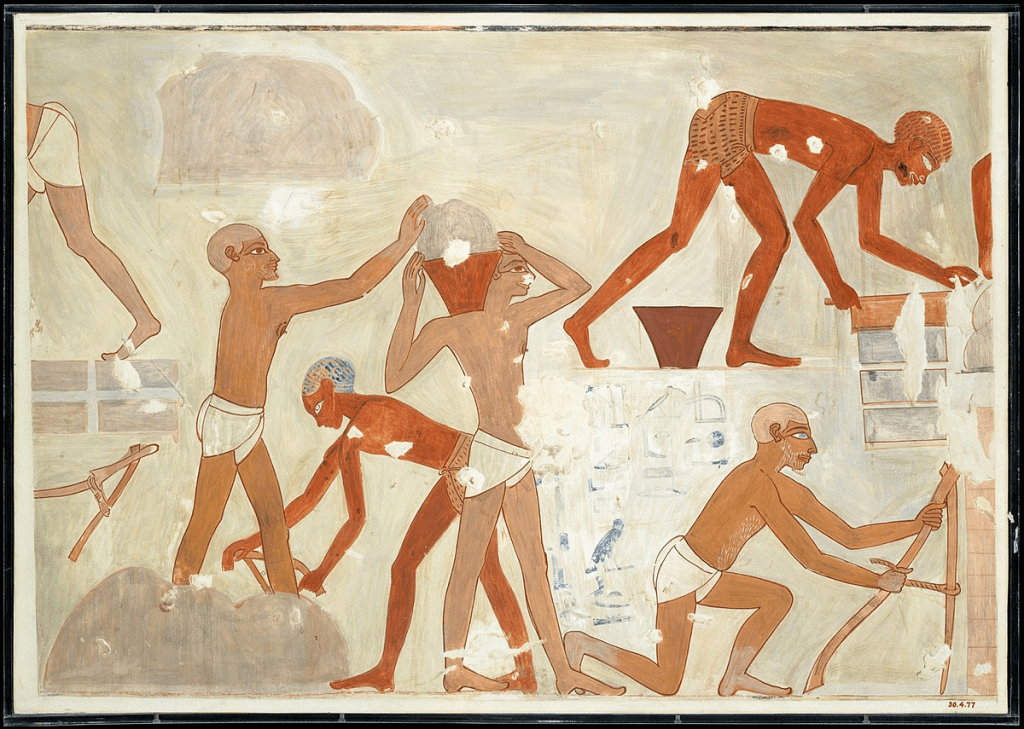
Evidence # 2: Egyptian Records of Slaves Making Bricks

Painting of Tomb of Rehkmire

According to Exodus 5:7-8, the Hebrew slaves were forced into making bricks. The biblical description of slaves making bricks is affirmed by a painting in the Tomb of Rehkmire (1470–1445 BC). Rehkmire was a high ranking official in Egypt under Thutmose III and Amenhotep II. (Amenhotep II is thought by many to be the pharaoh during the Exodus.) Slaves are seen mixing mud and water, packing the mixed mud in brick molds, and leaving the bricks to dry in the sun. The Egyptian officials oversee the work with a rod.

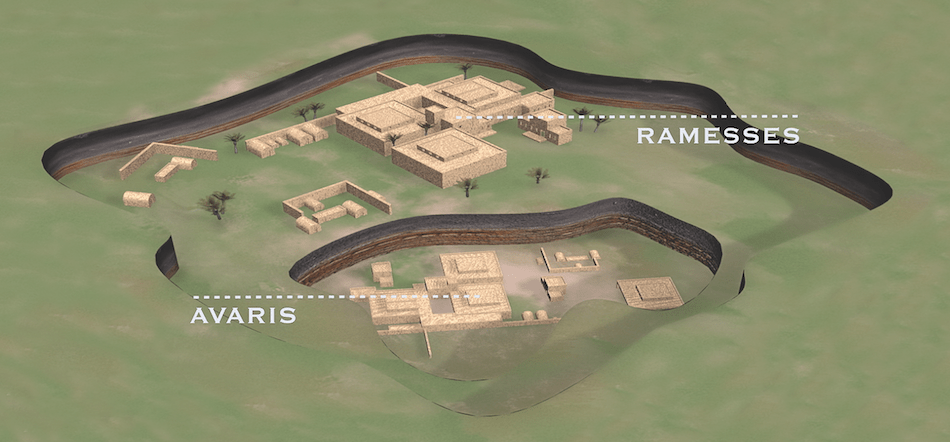
Evidence # 3: Discoveries at Avaris

According to Genesis 47:11, the families of Joseph settled in the land of Rameses. While they were initially free, at some point they became slaves to the Egyptians and were pressed into building the city of Rameses (Exodus 1:11). When they left Egypt in 1446 BC, some 430 years later, they departed from Rameses (Ex 12:37). The use of the word “Rameses” is an update of the biblical text by later editors to replace an outdated name, Avaris. Avaris was originally settled in the time of Joseph by a group of non-Egyptians from Canaan, as evidenced by the Canaanite pottery and weapons they used. This would seem to be a link to the Hebrews. What is astonishingly remarkable is the discoveries of a multi-colored coat and 12 tombs.

  • Joseph’s Coat: In Avaris there is evidence of a four-roomed house in the village (the same layout as houses typical in Israelite settlements), as well as a prominent tomb in which the remains of a statue of a Semitic (the Jews are Semitic) man with a multicolored robe was found.
  • Twelve Tribes: Around the palace are 12 tombs which some would associate that these point to the 12 tribes of Israel. This later palatial complex dates to the time of Moses and is likely where he spent time when he was raised in Pharaoh’s courts.

Interestingly, the excavators noted that the site was suddenly and mysteriously abandoned after the reign of Amenhotep II, suggesting that a plague may have been the reason. We also see his palace at Avaris on the Nile Delta, that was abandoned during his reign. And then we see his son, his firstborn son, seems to disappear from the historical record. The next son in line is the one who becomes the Pharaoh.

Exodus

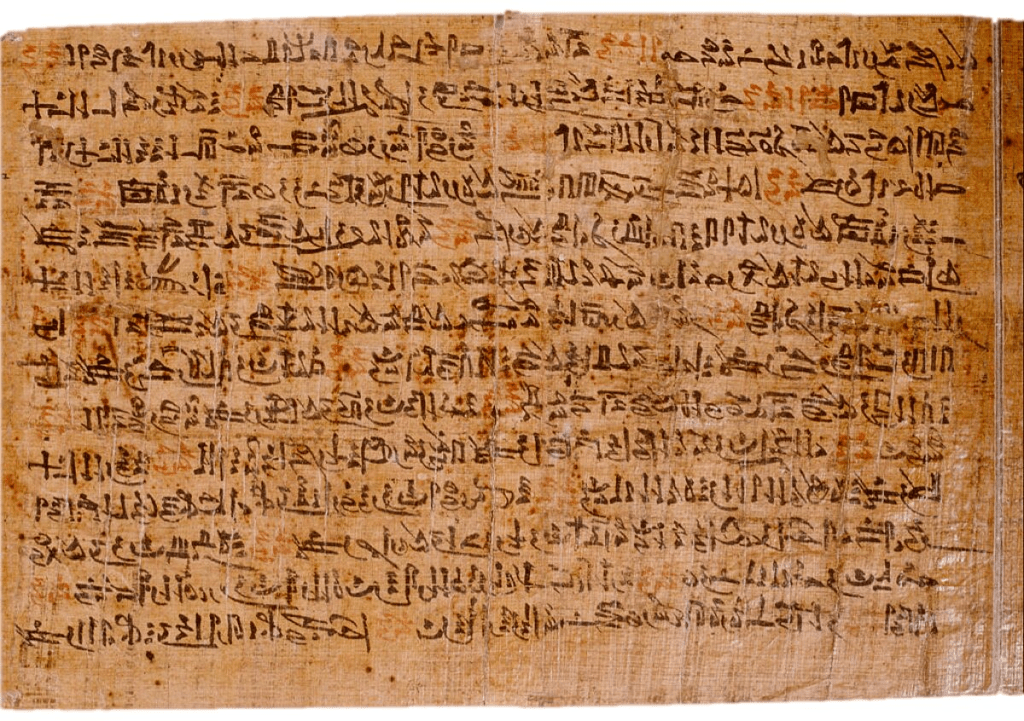
Evidence # 4: Ipuwer Papyrus

Ipuwer Papyrus

The Ipuwer Papyrus is a lengthy scroll which was written around 1200 B.C. It is known to be a copy of an earlier work in which the date of the original is not known. The scroll is named after its author, Ipuwer, who was a a royal Egyptian scribe. He tells of absolute calamity befalling Egypt. Many references throughout the papyrus are strikingly similar to the biblical account of the 10 plagues. Below are some examples:

Indeed, the river is blood, yet men drink of it. Men shrink from human beings and thirst after water …

Indeed, [hearts] are violent, pestilence is throughout the land, blood is everywhere, death is not lacking ….

Indeed, all animals, their hearts weep; cattle moan because of the state of the land …. 

Behold, the fire has gone up on high, and its burning goes forth against the enemies of the land …. Indeed, gates, columns and walls are burnt up ….

Indeed, everywhere barley has perished ….

The land is without light ….

Indeed, every dead person is as a well-born man …. Indeed, the children of princes are dashed against walls …. 

Indeed, laughter is perished and is [no longer] made; it is groaning that is throughout the land …. 

Evidence # 5: Seti War Relief (Carving)

A triumphal scene of Seti I slaying enemy prisoners.

The famous relief (carved image on a surface) of the campaigns of the Pharaoh Seti I (1291–1279 BC) at the Karnak Temple depicts the eastern border of Egypt in pictorial form (like a map) and likely relates to the route Moses and the Israelites took during the Exodus. Exodus 13:17 reads:

“When Pharaoh let the people go, God did not lead them by way of the land of the Philistines, although that was near. For God said, ‘Lest the people change their minds when they see war and return to Egypt.’”

The Seti relief depicts this road, known as the Horus Way, which is a 137-mile-long route between Egypt and Canaan and was used for trade and military activity. The carving shows a vertical waterway lined with reeds as well as a larger body of water at the bottom of the waterway (a feature that explorers say is no longer visible). The Seti relief is evidence that there was, at one time, a canal or waterway on the eastern border of Egypt, even though the area is a desert now. This has been affirmed by geological studies that have demonstrated that there was indeed a man-made canal joining a string of lakes between the Gulf of Suez and the Mediterranean Sea. These canals and lakes formed a defensive barrier on the eastern frontier of Egypt. The Bible says in Exodus 15:4:

Pharaoh’s chariots and his army
    he has hurled into the sea.
The best of Pharaoh’s officers
    are drowned in the Red Sea.


In Hebrew it reads yam suf which is literally “sea of reeds.” which may correspond to this system of lakes on Egypt’s eastern border. 

Evidence # 6: Berlin Pedestal

Berlin Pedestal

The Berlin Pedestal is an Egyptian inscription housed in Berlin that almost certainly refers to Israel as a nation in Canaan. It has three name rings, two of which clearly read “Ashkelon” and “Canaan,” and the third of which reads “Ishrael.” This appears to be the biblical Israel. There are no other candidates for what it could be. These inscriptions reflect the writing of the time period of Amenhotep II. This pedestal provides evidence it would indicate that the Israelites had migrated to Canaan sometime in the same period (1446 BC), exactly at the time the Bible says they did.

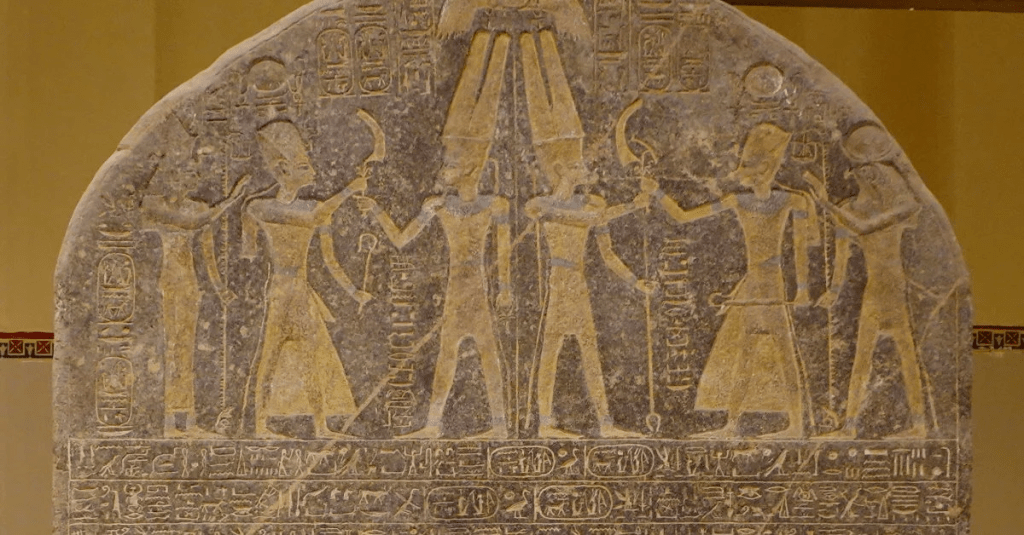
Evidence # 7: The Merneptah Stele

The Merneptah Stele

Arguably the most important discovery is the Merneptah Stele. Around 1200 BC Pharaoh Merneptah erected a 10-foot tall victory monument (called a “stele”) to brag about his claims of victory in both Libya and Canaan. It was discovered in 1896. On it, Merneptah boasts, “Israel is wasted, its seed is not; And Hurru is become a widow because of Egypt.” This likely refers to a small campaign into Canaan where only three cities were taken. Despite Merneptah’s boast, Israel was not destroyed. What stands out is the claim of going into Canaan and declaring that, “Israel is laid waste.” Most scholars agree that this is the oldest definitive reference to Israel as a nation outside of the Bible.

Evidence # 8: The Walls of Jericho

After the Israelites marched around the walls of Jericho seven times and blew the trumpets and shouted, Joshua 6:20 records:

When the trumpets sounded, the army shouted, and at the sound of the trumpet, when the men gave a loud shout, the wall collapsed

They went on to burn the city. Archaeologists found that the high walls of the city did fall outward. A very thick burn layer that took place after the walls came down convinced the excavators that the city was intentionally burned by an enemy. Other evidence such as uneaten and abundant grain stores show that the city was taken after a very short siege.

Other Evidence

  1. The Passover Feast. Just as the uninterrupted celebration of American independence on July 4th is evidence of liberation from England; the uninterrupted celebration of the Passover is evidence of the liberation from Egypt. The Passover is unlike any other festival reinforcing its authentic origins. It is not related to traditional celebrations of seasons or agriculture, which have been common. Instead it involves the eating bitter foods and the remembrance of a horrible sacrifice and dark plagues. This is not like Christmas or Thanksgiving.
  2. The Levites. It would be hard to explain how the smallest of all the tribes gained their priestly authority except it was given to them in the Exodus.
Tribes of IsraelNumbers of fighting men
1.  Ruben46,500
2.  Simeon59,300
3.  Gad45,650
4.  Judah74,600
5.  Issachar54,400
6.  Zebulun57,400
7.  Ephraim40,500
8.  Manasseh32,200
9.  Benjamin35,400
10. Dan62,700
11. Asher41,500
12. Naphtali53,400
Total tribe count
men 20 years or older who are eligible for military service.  
603,550

A separate census of the families of the sons of Levi who served in the tabernacle which were all males 40 days old and older is 22,000 (Numbers 3:14-39). Because they rallied in support of Moses against the rebellion of the Israelites, they were given a favored status (Exodus 32:26-29).

Application

Why is there no historical record of the Exodus outside of the Bible? The Egyptians never recorded any defeats whatsoever. That there is no record of the Exodus is not surprising. It was here that God defeated the ultimate pride and power of men and showed the way for people to be free from oppression. God is in the business of providing Exodus and deliverance from those who are in bondage and captivity to oppressive powers, spiritually and socially. In the Exodus we see the grand national stories that God is in the process of moving nations and people to greater freedom, grace and liberty.

We will continue to see this played out in this Story of Grace.

Hammurabi and the Law of Moses

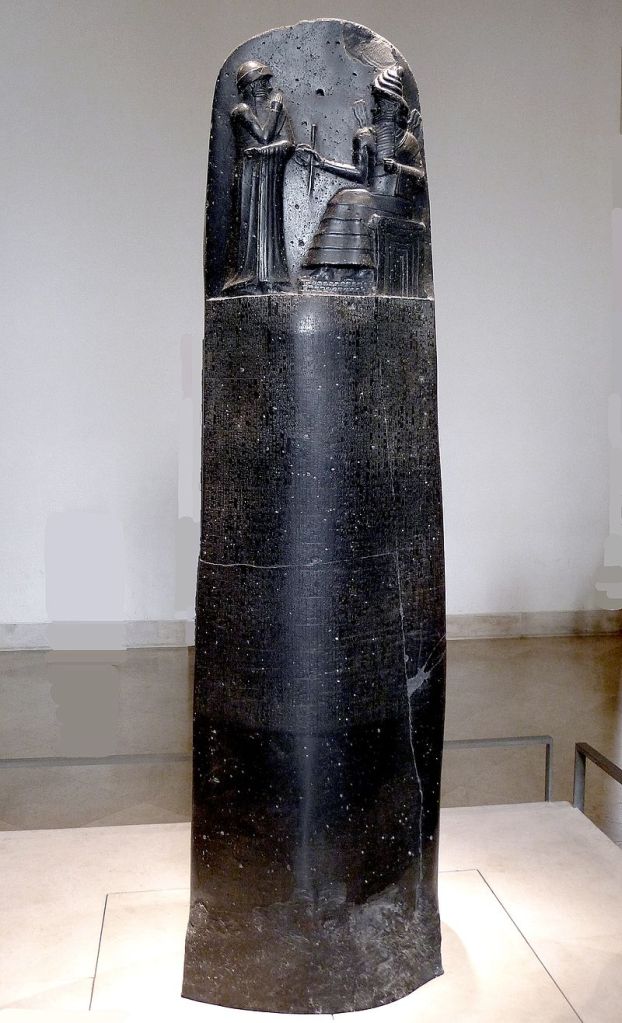
Stele of the Code of Hammurabi

Thomas Aquinas wrote, “Law is an ordinance of reason for the common good, made by him who has care of the community.” Aristotle described the importance of law when he said, “At his best, man is the noblest of all animals; separated from law and justice he is the worst.” In God’s great Story, He gave law. In its fullest expression, it is seen in the Law of Moses which revolutionized the world’s understanding of justice. But before and after of Moses, civilizations developed laws for the better ordering of society which are in many cases grounded in a God-given conscience based on experience and precedent. Laws on a social level, at their best, balance the common good with private rights–order and liberty. (A trinitarian concept of the unity of the One and Many.) One of the biggest advances toward this end in the ancient world was the Code of Hammurabi. The laws of Hammurabi were far from perfect and had many less than desirable elements. Yet, these would help set the stage for such great works as the Magna Carta, Declaration of Independence, and U.S. Constitution. What is notable about them is:

  • they prescribed specific penalties, with limits, for each crime.
  • they were among the first codes to establish the presumption of innocence.
  • they were displayed publicly for all to show that they applied for all.

In this article, we will examine where Hammurabi’s Code advanced God’s order of a just society. We will further see how these laws would be greatly improved upon by the Law of Moses.

Who Is Hammurabi?

We have seen previously that God advanced his plans for human flourishing with the Akkadians, who started the first empire, lasting a century, through establishing services for the common good (though there was much brutality and violence). After them the Amorites created and held an empire for 400 years. They did this through an interconnected network of outsiders who slowly became insiders. One of the city-states of the Amorites was Babylon. Hammurabi, who reigned from 1792-1750 B.C. (43 years) brought Babylon to prominence. He was raised as the crown prince of Babylon where he was taught about the Babylonian gods and the history of the great leaders of Mesopotamia. As he grew, he also learned how to fight and lead an army. Diplomacy and statecraft were modeled by watching his father, who was king, and listening to his advisors. When Hammurabi turned eighteen years old, his father became very sick and died, and the young ruler was crowned king of the city-state of Babylon. At this time, Babylon was a smaller kingdom. It was overshadowed by older, larger, and more powerful kingdoms such as Assyria. Overtime through military power and political skill, Hammurabi built it into an empire that stretched from the Persian Gulf inland for 250 miles along the Tigris and Euphrates rivers.

To govern his territories with justice and peace, he established a code of laws known today as the Code of Hammurabi. The original code was discovered on a black stone stele (an upright stone slab), some 7 ft. tall. It contains 282 laws reflecting the Babylonian judicial regime of the 18th century B.C. It wasn’t the first legal system. Hammurabi actually included laws created by previous kings. What set it apart was the idea that a society should be built upon the principle of law and order and applied to everyone. Before the codes, each case was judged separately and in a chaotic way. In contrast the Code states in the prologue, “to make justice visible in the land, to destroy the wicked person and the evil-doer, that the strong might not injure the weak.” He stands out as probably the first king who was concerned with the welfare of his people and thought of himself as the “shepherd.”

Code of Hammurabi

The codes regulated trade, business, and social relationships in Babylon. Below are some examples:

Laws for Debtors

If any one owe a debt for a loan, and a storm prostrates the grain, or the harvest fail, or the grain does not grow for lack of water; in that year he need not give his creditor any grain, he washes his debt-tablet in water and pays no rent for this year.

Law 48

Laws to Protect Against Neglect

If any one be too lazy to keep his dam in proper condition, and does not so keep it; if then the dam break and all the fields be flooded, then shall he in whose dam the break occurred be sold for money, and the money shall replace the corn which he has caused to be ruined.

Law 53

If any one open his ditches to water his crop, but is careless, and the water flood the field of his neighbor, then he shall pay his neighbor corn for his loss.

Law 55

Protection of Property Due to Wrongful Use

If a shepherd, without the permission of the owner of the field, and without the knowledge of the owner of the sheep, lets the sheep into a field to graze, then the owner of the field shall harvest his crop, and the shepherd, who had pastured his flock there without permission of the owner of the field, shall pay to the owner twenty gur of corn for every ten gan. (a GUR is about 80 gallons)

Law 57

Punishment for theft

If a man has committed robbery and is caught, that man shall be put to death.

Law 22

Regulation of wages

If a man has hired a farm-laborer, he shall give him 8 GUR of corn a year.

Law 257.

If a man has hired an ox-herd, he shall give him 6 GUR of corn a year.

Law 258.

Builder’s Responsibilities

If a builder has built a house for a man and has not made his work sound, and the house which he has built has fallen down and so caused the death of the householder, that builder shall be put to death.

Law 229

Hammurabi and the Law of Moses

There are similarities between the Code of Hammurabi and the Law of Moses. Both impose the death penalty in cases of adultery and kidnapping (Leviticus 20:10; Exodus 21:16; cf. Law 14 and 129). Also, there are similarities in the law of retaliation, such as “an eye for an eye” (Leviticus 24:20; cf. Law 196). Others can be cited, as well. Yet, the differences are incomparably greater than the similarities. The superiority of God’s Laws is that the desired outcome is the walking in covenant relationship with God, whereas the goal of the Law of Hammurabi is for longevity of the king and prosperity for the nation. The Law of Moses went far beyond the Code of Hammurabi which sought to regulate societal behaviors. The Law of Moses was rooted in the worship of one God, supreme over all (Deuteronomy 6:4-5) and sought the blessing and flourishing of humanity who is created in God’s image. Because of this the Mosaic Law emphasized mercy, forgiveness and the value of humans made in the image of God. Mercy is largely absent from Hammurabi. There was only regulation and retribution. Here are some marked differences:

  • Sanctity of human life. The death penalty for thievery in the Code of Hammurabi seems to indicate that the nation valued goods over human life, while God’s Covenant valued people over things, not requiring a thief to die.
  • Favoring the privileged vs. protecting the oppressed.  Protection of the oppressed is near to God’s heart; not so much with Hammurabi.  Many of Hammurabi’s laws favor the free and wealthy.

 Do not mistreat or oppress a foreigner, for you were foreigners in Egypt. “Do not take advantage of the widow or the fatherless.  If you do and they cry out to me, I will certainly hear their cry.

Exodus 22:21-23

He defends the cause of the fatherless and the widow, and loves the foreigner residing among you, giving them food and clothing. And you are to love those who are foreigners, for you yourselves were foreigners in Egypt.

Deuteronomy 10:18-19

Mercy.  The notion of mercy is exceedingly rare in Hammurabi but appears with regularity in Moses.

And he passed in front of Moses, proclaiming, “The Lord, the Lord, the compassionate and gracious God, slow to anger, abounding in love and faithfulness, maintaining love to thousands, and forgiving wickedness, rebellion and sin. 

Exodus 34:6-7
  • The focus of the laws.  The vast majority of The Code of Hammurabi concerns money, property, and business transactions.  While these are addressed in Moses, they flow out of living a covenant relationship with God.

Hear, O Israel: The Lord our God, the Lord is one. Love the Lord your God with all your heart and with all your soul and with all your strength.  These commandments that I give you today are to be on your hearts. 

Exodus 6:4-6

Summary

Evolving Moral Conscience: The Code of Hammurabi shows progress in the understanding of societal justice and fairness. Old Testament scholar John Walton has pointed out that of the thousands of court documents which have been discovered not one shows a reference to any of the 282 laws of this ancient Babylonian king. But this code most likely reflected a growing awareness and understanding of righteousness among leaders in the ancient Mediterranean. Many of those who have studied this Code see it as a compilation of verdicts handed down by Hammurabi himself and/or maybe kings before him. Paul clearly states that there is a universal law in the conscience of humanity.

 Indeed, when Gentiles, who do not have the law, do by nature things required by the law, they are a law for themselves, even though they do not have the law. They show that the requirements of the law are written on their hearts, their consciences also bearing witness

Romans 2:14-15

Hammurabi’s Code was a building block to but a far distance from the ideals of all humanity made in the image of God, later to be affirmed in Mosaic Law and Declaration of Independence. Yuval Noah Harari compares:

Both the Code of Hammurabi and the American Declaration of Independence claim to outline universal and eternal principles of justice, but according to the Americans, all people are equal, whereas according to the Babylonians people are decidedly unequal.

Nonetheless, God’s Story of Grace still continues through history.

Amorites and the Decline of Nations

He makes nations great, and destroys them; he enlarges nations, and disperses them.”

Job 12:23

Every culture and nation has a rise and fall or at least a decline. The Bible declares this pattern to be an act of God. Yet, this act is not arbitrary, for within this pattern of rising and falling, there are virtues within each nation that cause them to rise and the vices which cause them to fall. This is illustrated profoundly in the story of the Amorites: a people group who ascended through the power of strength and freedom, but descended because over time they idolized these qualities above all else, sacrificing the vitality of which their future depended–their children.

God told Abraham (c.2000 B.C.) that his descendants entry into the Promise Land would be linked to the timing of the sin of the Amorites reaching its “full measure,” who were at that time an ascendant power.

13Then the Lord said to him, “Know for certain that for four hundred years your descendants will be strangers in a country not their own and that they will be enslaved and mistreated there. 14But I will punish the nation they serve as slaves, and afterward they will come out with great possessions. 15You, however, will go to your ancestors in peace and be buried at a good old age. 16In the fourth generation your descendants will come back here, for the sin of the Amorites has not yet reached its full measure.”

Genesis 15:13-16

This article will contend that this sin of the Amorites is referencing the results of a sin which plagues societies today: the preservation of freedom at the sacrifice of children and the legacy of the future.

The Strength of the Amorites

Strength and Flexibility

The Amorites positively introduced new economic and social freedoms which allowed for many significant economic developments and even the free movement of Abraham. From the time of the Flood (c. 2500 B.C.), they descended from Canaan (grandson of Noah) which means they were grouped together under the title, Canaanites.

Canaan was the father of Sidon his firstborn, and of the Hittites, Jebusites, Amorites, Girgashites, 

Genesis 10:15-16

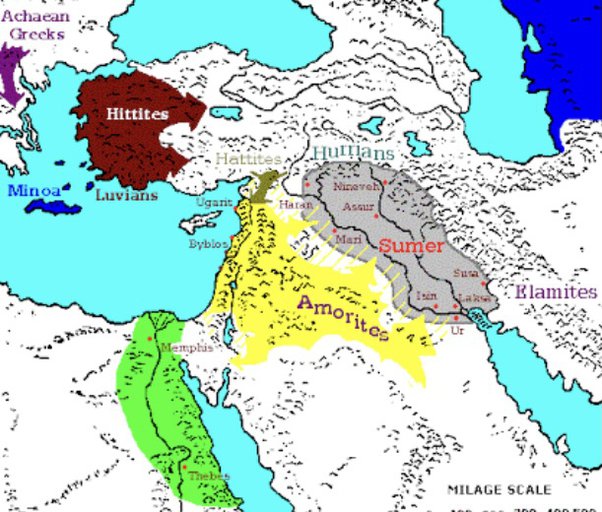
The Amorites began to arrive in the territory to the west of the Euphrates (around Sumer on the map below), modern Syria. There was no actual invasion, but rather for a period of five hundred years they drifted down into southern Mesopotamia, integrating into Sumerian civilization where they lived in enclaves.

The fall of Sumerian civilization, around 2000 BC left a vacuum that lasted for about a century. Conflict and chaos in the Sumerian state were eventually overcome as the Amorites began to rise in power and importance and they were in a strong position to pick up the pieces. They expanded and became dominant for about 400 years. At the time of Abraham some of the Amorites lived in Hazazon (Genesis 14:7), a large active oasis on the western shore of the Dead Sea. When the Exodus (c. 1446 BC) came about they ruled much of Canaan and Jordan.

As Israel tried to enter the Promised Land, they were chased out by the Amorites:

 44The Amorites who lived in those hills came out against you; they chased you like a swarm of bees and beat you down from Seir all the way to Hormah. 45You came back and wept before the Lord, but he paid no attention to your weeping and turned a deaf ear to you. 46And so you stayed in Kadesh many days—all the time you spent there.

Deuteronomy 1:44-46

This means that the Amorite power center was the Transjordan, but they were still west of the Dead Sea during the time of the Exodus. On the other hand, Judges 1:34-36 says they banished the tribe of Dan into the mountains and they lived in the Valleys.

34The Amorites confined the Danites to the hill country, not allowing them to come down into the plain. 35And the Amorites were determined also to hold out in Mount Heres, Aijalon and Shaalbim, but when the power of the tribes of Joseph increased, they too were pressed into forced labor. 36The boundary of the Amorites was from Scorpion Pass [ascent of Akrabbim] to Sela and beyond.

Judges 1:34-36

From this record, it shows they were physically powerful and socially agile and could maneuver and fit into many different places. This strength and flexibility set them apart giving them unique skills for adaptation and conquest. This was a new advance in humanity learning the power of its human potential.

Freedom

Given their strength and flexibility, the Amorites also created a new society of free subjects able to farm their own lands and conduct business as they saw fit. They founded many of the basic concepts of early mathematics, developing multiplication which aided in mercantile and sales transactions. They also had literary development which led to the creation of the Code of Hammurabi, as a series of laws which emphasized the pursuit of justice, especially in relation to commerce. This set a precedent for later law codes. As they took over as rulers, the Amorites became entrepreneurial leaders who freed much of their civilization to own land and cultivate it for profit.

Abraham

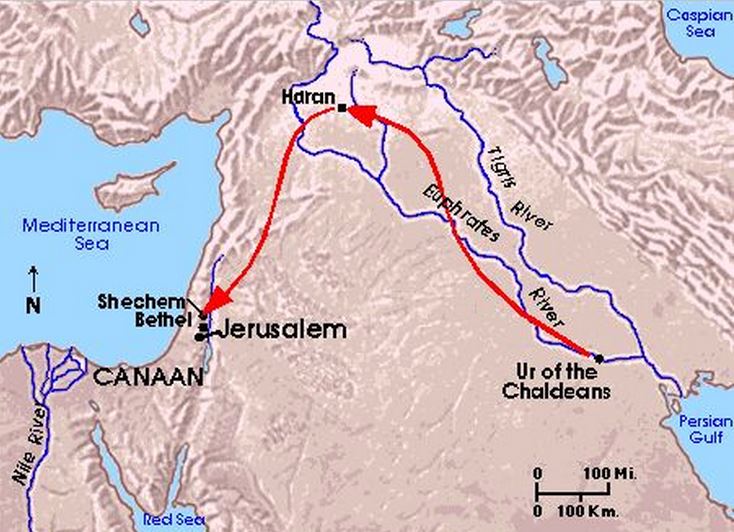
Ezekiel 16:3 says that Terah, the father of Abraham, was an Amorite. Genesis 11:31 says they went from Ur to Haran on their way to Canaan.

A. L. Oppenheimer, of the University of Chicago, adds, “There seem to have been few periods in the history of the region [Mesopotamia] when . . .a private person could move [herds] around freely.” The historical record and the biblical account appear to overlap nicely with what we know regarding the migrations of the Amorites and the travel of Abraham.

Power & Prosperity at any Cost

So, what was the “sin of the Amorites” which would lead to their decline? R. A. Stewart Macalister (1870 –1950) was an Irish archaeologist who studied historic areas where the Amorites were inhabitants. He looked particularly in the high places (elevated pieces of ground where sacrifices were made to pagan gods) of Gezer, which is where the Amorites would have dwelled. He documented his findings of child sacrifice.  He associated his findings with biblical record of the “sin of the Amorites”(Genesis 15:16) in his publication “Bible side-lights from the mound of Gezer.” He observed the evidence of human sacrifice on a barbaric scale. Among other things, he found the remains of burnt babies who were burnt in cultic ritual. This mirrored the warnings given by Moses:

You must not worship the Lord your God in their way, because in worshiping their gods, they do all kinds of detestable things the Lord hates. They even burn their sons and daughters in the fire as sacrifices to their gods.

Deuteronomy 12:31

The Reason for Child Sacrifice

At the heart of child sacrifice is the perverse desire for power. The idea was that the more important and pure the sacrifice, the more it would satisfy the gods and provide favor and power to those making the sacrifice. This was true in the time of the Amorites, and it is still the justification for many of the ways children are sacrificed today.

Cultic

Child offerings are literally done in parts of Africa today. Dennis Kilma describes the reason for the practice in Uganda:

Through child sacrifice, many Africans believe they can secure wealth and happiness. Thus child sacrifice today is about much more than religion. Through it, and the mediation of the spirits, many Africans believe they can secure wealth and happiness. It’s a means to an end: the purer the sacrifice the more influential its power; the greater one’s desire the greater the sacrifice needs to be. Because political or material gain is not cheap in the African spirit world. While animal blood sacrifices can achieve much, many hold that a child’s blood is unparalleled in its effect.

Clinical (Abortion)

The fundamental justification for abortion is increased freedom. This is why politically it is called pro-choice. According to one study the main reason has to do with financial freedom or financial ability. Ultimately, the carrying, delivery and raising of a child presents a major limitation on human mobility and financial advancement. Pregnancy often interferes with future opportunities. The sacrifice of children in the womb is the price that must be paid for our dreams to be lived out.

The Result

Society devalues the worth of life. When a human being’s right to live is based upon someone else’s evaluation of their worth, then life is severely cheapened in value. It is a dangerous place when we can determine who is disposable or sacrificial based off of what we judge as valuable. Our value as humans comes from our being made in the image of God. Human beings do not get to define their own existence and meaning. That is something which is given to us by our Creator.

“No society that permits the active or passive killing of people because they are unwanted can long survive. No society that defines away personhood has any claim to knowing right from wrong. Whose personhood will the government define away next?”

Andrew Napolitano

This cheapening of life reduces the strength of society leading to decline.

Society declines in quality of life. As life is devalued, then society loses the compass of its direction and source of its moral strength. One of the greatest dangers facing us today is depopulation. For the first time in America’s history, we are trending toward a decreasing population as the number of births is not replacing the death rate. The results of this will be an unbearable burden of the younger generations unable to care for the older generations, either through financial resources or human labor. Further, there is a loss of economic growth and influence in the world. A hallmark of American growth and confidence has been an expanding population. Eliminating a population through abortion destroys a population that will work and pay taxes and imposes a serious economic loss. This has already been happening in Europe over the last three decades. Social scientists Nicholas Eberstadt writes why:

Back in the 1980s, after most of Western Europe had gone sub-replacement, two Flemish demographers diagnosed what they identified… The symptoms of this new demographic order included rising cohabitation and serial partnerships in the place of marriage, increasing childlessness, declining family size for those who did bear children, and a shift to more or less permanent sub-replacement fertility. In their diagnosis, this fundamental social change was driven by a transformation of values…In their assessment, the new demography of Europe was powered by a quest for “self-actualization,” for “personal autonomy.” Old family forms and fertility patterns did not square terribly well with these new and widely accepted personal imperatives, and so they gave way.

The reasons for these population changes are one centered on the promise of freedom: “self-actualization” and “personal autonomy.” A declining population is a sure signal of a society’s loss of confidence in the future and decline. There is a sacrificing of the vitality of the future in the effort to hang on to freedom in the present. The Amorites killed their babies because they wanted to maintain their power and dominance. We kill babies because we want a better life. The only difference between us and the Amorites is that they sacrificed children to their gods, while we sacrifice them to ourselves.

The First Antichrist And the Secret Power of Rebellion (Genesis 10)

Nimrod may be near the top of one of the most intriguing yet mysterious characters of the Bible. The Old Testament mentions him four times. He is referred to as:

  • mighty warrior on the earth (Gen. 10:8, 1 Chron 1:10),
  • a mighty hunter before the LORD (Gen. 10:9)
  • founder of the Assyrian Empire (Mic. 5:6).

His name has often been found in popular culture: cartoons (Elmer Fudd is referred to as Nimrod), rock music (Green Day named their fifth album, Nimrod), classical music (Edward Elgar has a composition by that name), slang (a term for being stupid), comics (a villain in X-Men that hunts mutants), to name a few. Yet, who is Nimrod? Why is there such interest in him? The ancient Jewish writers Philo of Alexandria (15 BC-AD 50) stated Nimrod to be a giant that opposed God, and Josephus (AD 38-100) suggested Nimrod was the tyrant behind the construction of the Tower of Babel.  Here is the most extensive narrative we have about him:

Cush was the father of Nimrod, who became a mighty warrior on the earth. He was a mighty hunter before the Lord; that is why it is said, “Like Nimrod, a mighty hunter before the Lord.” 10 The first centers of his kingdom were Babylon, Uruk, Akkad and Kalneh, in Shinar.11 From that land he went to Assyria, where he built Nineveh, Rehoboth Ir, Calah 12 and Resen, which is between Nineveh and Calah—which is the great city.

Genesis 10:8-12

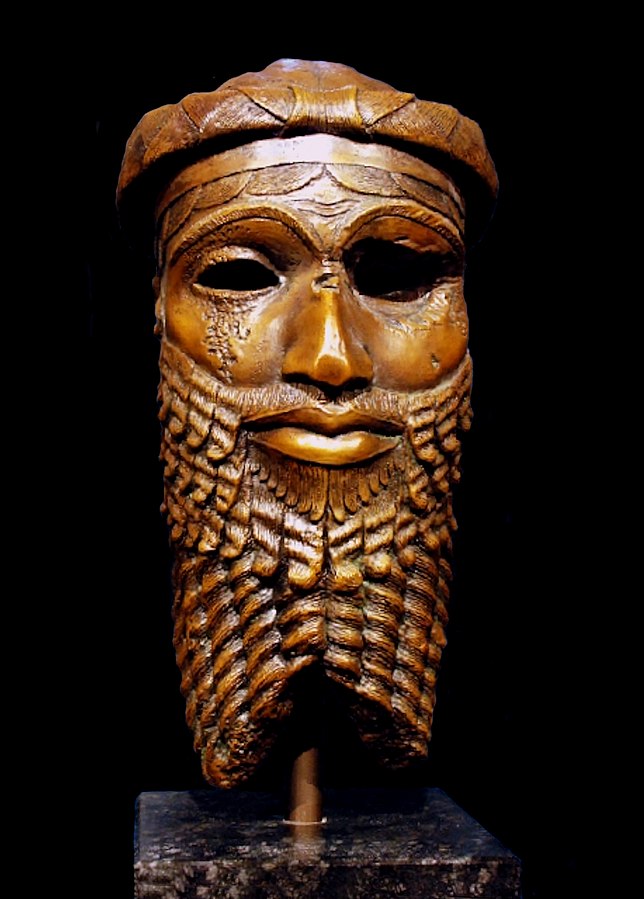
This article will argue that the real identify of Nimrod is Sargon of Akkad (2334–2279 BC), the first empire builder in human history. If this is correct, it holds several keys to understanding how God can overcome the rebellion of man for His purposes. Nimrod’s hunger for power was directed by God to bring a sustainable unity out of a warring anarchy. This advanced the next step of God forming humanity after the image of the Trinity, with the balance of unity in diversity.

Commonalities of Nimrod and Sargon

1. Nimrod and Sargon came from the same region.

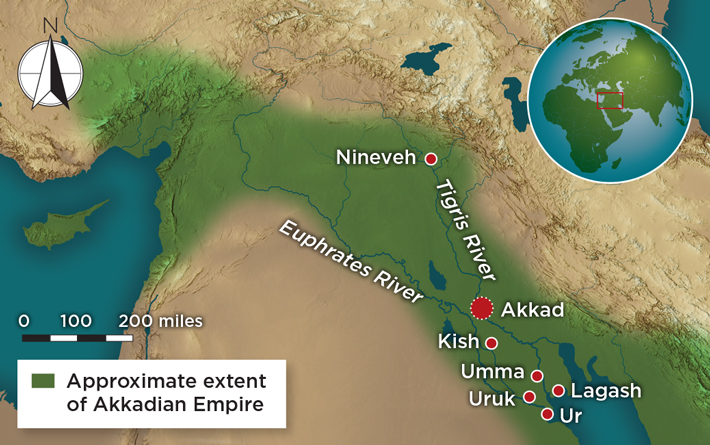
Nimrod’s origin is in Cush (a city likely named after his father, Genesis 10:8) which possibly matches Sargon’s origin in Kish (see below), a city in southern Mesopotamia, which is the land between the Tigris and Euphrates Rivers. These areas are considered the same place by many scholars. The Sumerian King List (ancient Sumerian book which lists Sargon) names Kish as the first city on which “kingship was lowered from heaven” after the flood and says it became the leading city of Sumer. Kish eventually did come to dominate the landscape of the surrounding area. Seeing the similarities between Kish and Cush draws the first interesting parallel.

2. Nimrod and Sargon made Akkad a prominent city.

Although scholars don’t know the exact location of Akkad (Genesis. 10:10), ancient texts place it in Babylon and suggest that it became prominent once Sargon made it his capital and restored Kish. From Akkad, Sargon conquered areas to the north, most prominently Assyria. The archaeological record fits with the biblical record of Nimrod’s location and his conquests of Uruk—the center of power in Mesopotamia—from which he extended his rule north.

3. Nimrod and Sargon initiated building projects in Assyria.

The Bible reveals Nimrod built the principal cities of Assyria (vv. 11–12). Archaeological discoveries credit the same accomplishment to Sargon. Inscriptions of Sargon’s rule on monuments have been discovered in the Assyrian cities of Ashur and Nineveh. They also found the remains of a statue dating to the reign of Manishtushu, Sargon’s son and successor. Since Manishtushu was recorded as a less powerful figure, his attaining such stature leads to the strong conclusion that his father had seized power in Ashur.

4. Nimrod and Sargon were legendary for their military exploits. 

Genesis 10:9 reads: “He was a mighty hunter before the LORD; that is why it is said, ‘Like Nimrod, a mighty hunter before the LORD.’” The context of this description, “mighty hunter before the LORD,” indicates he was a warrior of skill and military exploits, not just skilled and tracking and killing wild game. Most likely because his prowess as a warrior became legendary, the writer of Genesis could reference a common saying where Nimrod’s legend was told for successive generations. (This would be like referencing legends Muhammad Ali for boxing or General Patton for the military but significantly greater.) Statues discovered in ancient Nineveh display the hunting exploits and military conquests of Assyrian kings. Ancient tombs and columns reveal Sargon was renowned for his military conquests.

Why is he an important figure biblically?

God holds evil on a leash.

Since ancient times, Nimrod (Sargon) has been thought by some, most notably Josephus, as the person who tried to incite those at Babel into the infamous building projects in rebellion against God. (Genesis 11:4) This idea is supported by the name, Nimrod, which means “rebellion against God.” This was likely the name given by the Hebrews and not a birth name. God circumvented this rebellion by confusing the languages. Because of this the people and eventually nations had to spread on the earth, forming different nations, and Israel could ultimately be established. (see Genesis 11:27-32) The promise of blessing to all of the nations could be given through the Jews. As God called Abraham from Ur, this foundational promise was made:

1The Lord had said to Abram, “Go from your country, your people and your father’s household to the land I will show you.

“I will make you into a great nation,
    and I will bless you;
I will make your name great,
    and you will be a blessing.
I will bless those who bless you,
    and whoever curses you I will curse;
and all peoples on earth
    will be blessed through you.

Genesis 12:1-3

God uses rebellion toward his ends.

God was able to take Nimrod’s (Sargon) lust for power and channel it away from Babel for ultimate good in the development of the Akkadian Empire. Before Sargon (Nimrod), conflict was embedded in cities like Ur, Kish, Lagash, etc. There was a state of constant armed warfare. Part of the reason for this is that farmland was needed to nourish their inhabitants.  The small tracks of land were necessary to fight for in order to have control. Yet, the only means of rule was by force which did not have long-term sustainability or empire building. There was no cooperation, but to the victors were the spoils. No city had thought of setting up a rule over large territories which could be managed through administration and services which benefitted several territories.

Sargon, who came up from nothing as an orphan, eventually became a cupbearer for the king of Akkad, Ur-Zababa, and in the course of time became king. Akkad stood apart in many ways outside the web of conflicts of the region. This allowed them to employ power differently than the other city-states.  They wielded power by starting from different assumptions and realizing different ends.  Sargon sought to provide control with stability across territories. He introduced administration and organization which led to the development of trade routes for increased commerce, record keeping for laws, a postal service for protected communication, irrigation canals for agricultural development, standard weights and measures for economic exchange, fairer tax systems for the rich and poor, along with art and culture. All of this was held together by the first standing army which he established.

It has been said that Sargon’s iron fist was in a velvet glove. It was a mixture of unbending strength with administrative skill. He ruled about 55 years. The Akkadian Empire he founded lasted a hundred years in total. Though the empire came to an end, for the next two-thousand years, Sargon became the model of empire building for the Assyrians, Babylonians, Persians and Greeks.

Conclusion

As God was making human civilization more to conform to his image (Trinity), he guided even the rebellion of Nimrod (Sargon) to bring the first model of a civilizational unity that brought and held together a diversity of warring city-states. This was far from a perfect harmony, though. After Sargon’s death, five of the nations revolted against his son, Rimush (r. 2279– 2270 BC). Rimush was killed by palace servants.  Manishtushu (r. 2270–2255 BC), his younger brother, came to the throne.  His reign lasted about 14 years without any great effectiveness.  Manishtushu’s son, Naram-Sin, reigned from 2254 – 2218 BC. He became a greater ruler exceeding the influence of his grandfather, Sargon. Yet, Naram-Sin introduced something new–he claimed to be “God of the Universe.” The introduction of this would be a fatal deception in the heart of humanity making him the first, in a long line, of antichrists since the flood. In a generation after Naran-Sin the Akkadian Empire would be destroyed. Seeds for human maturity and flourishing were sown; even though rebellion was alive and growing. God advances His purposes even alongside man’s lawlessness.


Guarding Cultural Freedom and Flourishing (Genesis 11:1-9)

Photo by Mike van Schoonderwalt on Pexels.com

The destiny of human civilizations is to become collectively shaped into the likeness of God, a harmonious unity connected together in an increasingly rich and beautiful diversity. This is God’s BIG vision for the nations. This unity in diversity is the essence of the Trinity (God in ONE and Three), the foundation and model for thriving human community.

For the earth will be filled with the knowledge of the glory of the LORD as the waters cover the sea.

Habakkuk 2:14

And this is the plan: At the right time he will bring everything together under the authority of Christ—everything in heaven and on earth.

Ephesians 1:10

After this I looked, and there before me was a great multitude that no one could count, from every nation, tribe, people and language, standing before the throne and before the Lamb. They were wearing white robes and were holding palm branches in their hands.

Revelation 7:9

This is the story and arc of scripture and all of history–God making and filling all things into his likeness. The struggle in the forward march of history is for humanity to discover, to progressively step into God’s likeness. This is not easy. The temptation is instead to have a unity at the expense of diversity (totalitarianism, collectivism) or a diversity at the expense of unity (individualism, anarchism). The story of the Tower of Babel is about God’s dramatic corrective of the biggest temptation of these polar enticements: collective or coerced uniformity. It is about bringing the the wayward post-Flood population back from an imposed control to its mandated call to “fill the earth” in what is to become a rich multiplicity of families and nations.

In this article we will see what the real evil is in the building of Babel and the need for a corrective judgement from God to protect human freedom.

The Story

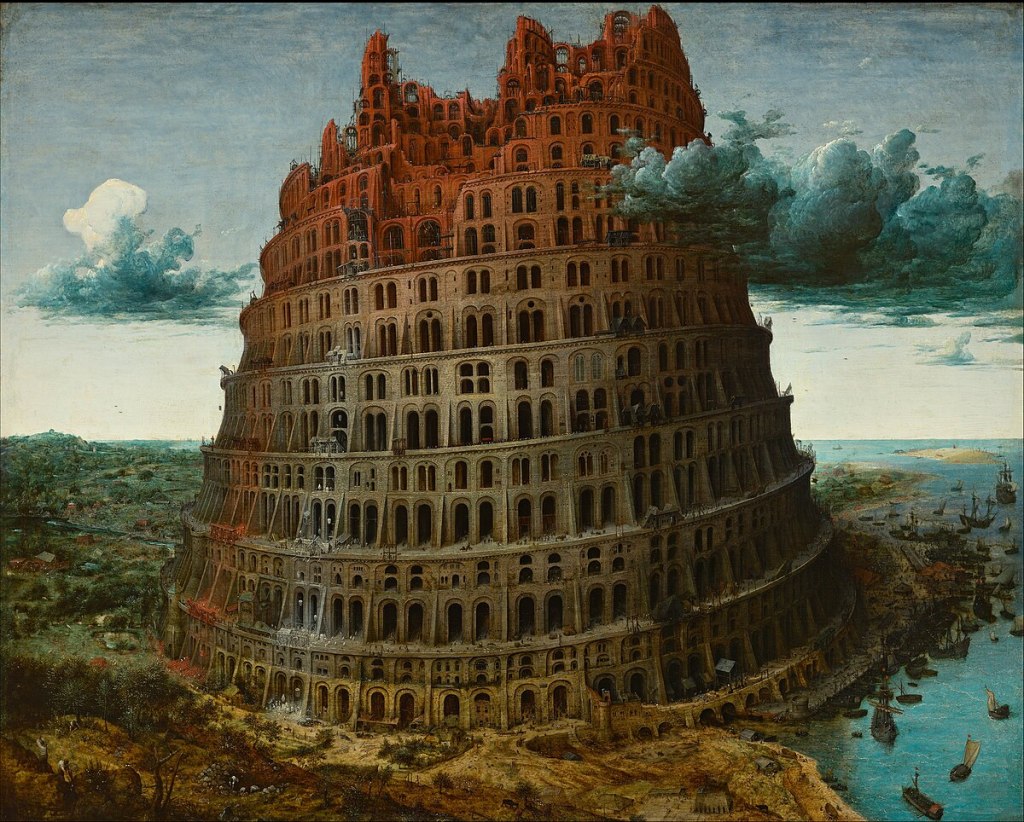
1Now the whole world had one language and a common speech. As people moved eastward, they found a plain in Shinar and settled there. They said to each other, “Come, let’s make bricks and bake them thoroughly.” They used brick instead of stone, and tar for mortar. Then they said, “Come, let us build ourselves a city, with a tower that reaches to the heavens, so that we may make a name for ourselves; otherwise we will be scattered over the face of the whole earth.” 5 But the Lord came down to see the city and the tower the people were building. 6 The Lord said, “If as one people speaking the same language they have begun to do this, then nothing they plan to do will be impossible for them. 7 Come, let us go down and confuse their language so they will not understand each other.” 8 So the Lord scattered them from there over all the earth, and they stopped building the city. 9 That is why it was called Babel—because there the Lord confused the language of the whole world. From there the Lord scattered them over the face of the whole earth.

Genesis 11:1-9

To go more deeply into what this story is, it may help to remove from our minds what it is not. It is not about a human attempt to storm the heavens and displace God, and God stomping out their efforts. Nor is it mainly there to explain the origins of human languages, though it does do this. (The diversity of languages is about something bigger.) This account is about something more central: the importance of human freedom and diversity and interrupting the temptations to stop it with oppressively controlling systems.

Avoiding Coerced Control

What is the justification for this understanding of the story? God had made it clear that the divine vision is for humanity to spread out and fill the earth. To the original parents, God spoke:

Be fruitful and increase in number; fill the earth and subdue it. 

Genesis 1:28

To Noah and his sons the same directive was reaffirmed:

Be fruitful and multiply and fill the earth.

Genesis 9:1

As a large and significant population inhabited the plain of Shinar (southern Babylonia/Iraq), an unnamed group wanted to stay settled in one place. The motivation is to resist the call and blessing of God for people to journey throughout the earth. They propose building a city and a tower “so that we may make a name for ourselves; otherwise we will be scattered over the face of the whole earth. (Genesis 11:4).

Why were they resisting the command of God to fill the earth? Verse 1 states that the “whole world had one language and a common speech.” Since everyone spoke “one language” with one “common speech,” the implication is that they wanted everyone to stay in an enforced uniformity. That everyone had one language was not a problem; rather, there was a resistance to let people explore different paths of freedom to “fill the earth.” Without an outside measure to enforce diversity, the temptation would be toward an imposed control. God was not distressed by what they said, but by an imposed sameness.

Along this line, perhaps this building project was to make Babel the capital of the world with the tower to monitor residents and keep them in line. Rabbi Naftali Berlin makes this case, “It is inconceivable that there would be only one city in the whole world. Rather, they thought that all cities would be connected and subsidiary to that one city in which the tower was to be built.” Rabbi Shai Held remarks:

“In this kind of world If everyone says the same words and thinks the same thoughts, then a society emerges in which there is no room for individual tastes, thoughts, and aspirations or for individual projects and creativity. All difference is (coercively) erased…Strikingly, no names are mentioned in the story of Babel—there are no names because there are no individuals.”

Allowing Freedom and Flourishing

As Rabbi Shai observe, a striking feature that makes the Babel story stand out is that there are no names which is in sharp contrast to the marathon of names in Genesis 10:1-32 and Genesis 11:11-32, on either end of the story. For example, in Genesis 10 we encounter the genealogy of Noah’s son: Ham, Shem and Japheth and their rapid repopulation of the earth where cultural and language diversity is being achieved. Referring to the sons of Javan, who descend from Japheth, a parenthetical note is provided:

 (From these the maritime peoples spread out into their territories by their clans within their nations, each with its own language.)

Genesis 10:5

Referring to the sons of Ham, the writer summarizes his description:

 These are the sons of Ham by their clans and languages, in their territories and nations

Genesis 10:20

Then, for the sons of Shem:

These are the sons of Shem by their clans and languages, in their territories and nations.

Genesis 10:31

Compared with what follows in Genesis 11:1-9, chapter 10 is like an ode to diversity, which is unmistakably part of the divine plan.

Notice further that after the report of events with the Tower of Babel, the following verses (11:10-32) recount the specific lineage of Shem to Abraham (Father of the Jewish people) and concludes near the end of the chapter:

Terah took his son Abram, his grandson Lot son of Haran, and his daughter-in-law Sarai, the wife of his son Abram, and together they set out from Ur of the Chaldeans to go to Canaan. 

Genesis 11:31

This progress of the report streams into the lineage of Shem to Abraham and his journey to Canaan (later Israel) from where the Messiah (Jesus) will be born. The implication of this event is that if God would not have confused the languages, the lineage of Shem would not have established itself in Canaan with Abraham and the Jewish nation and the Messiah (Jesus Christ) would not have been born.

God confuses their speech (v.7), so that one person will not understand the language of the other.’ Such a punishment perfectly fits the crime; after all, a totalitarian state, unites in order to establish a collective name for itself (v.4), which depersonalizes human beings for the machine. It has neither the energy nor the motivation to understand or internalize the individual needs of people. So, God stops this project in its tracks before it does damage to the growing movement of human flourishing, and more specifically the establishing of what will ultimately be the Jewish people, which is the key story line in Genesis 12-50.

1 The Lord had said to Abram, “Go from your country, your people and your father’s household to the land I will show you.

2 “I will make you into a great nation,
    and I will bless you;
I will make your name great,
    and you will be a blessing.[a]
I will bless those who bless you,
    and whoever curses you I will curse;
and all peoples on earth
    will be blessed through you.

Genesis 12:1-3

Conclusion

God has been moving in the midst of our broken and rebellious world, to conform all things to be like himself which is a harmonious unity within a vast diversity: the proper and functioning balance of society (state, community, family and individual). This is learned through the collective experience and wisdom of the ages, one interaction and one event and one era at a time. This is the goal and destiny of all human flourishing and civilization building. It is in fact the grand narrative or story of the Bible–an interdependent unity that encompasses the multifaceted creative diversity.

The biblical vision is that every nation and person has a special and unique role to play in the unfolding of human history, and each one is called to forge their role and identity in relation to God. As Paul declares:

26 From one man he made all the nations, that they should inhabit the whole earth; and he marked out their appointed times in history and the boundaries of their lands. 27 God did this so that they would seek him and perhaps reach out for him and find him, though he is not far from any one of us.

Acts 17:26-27

The Tower of Babel and the Gift of Languages

Languages by Library of Congress is licensed under CC-CC0 1.0

Federico Fellini once declared, “A different language is a different vision of life.” In the world today there are over 7,100 spoken languages. All of these reflect important cultural differences. Yet, languages also reveal deep historic and even regional connections. Of all of these languages, around 99% of these have their origin in 14 language families. A language family is where the word structures show a common origin. For example, the historical relationship between Spanish and Portuguese is easy to detect since 90% of their words are similar.

Spanish (English)Portuguese
Agua (water)Água
Sol (sun)Sol
Casa (house)Casa
Día (day)Dia
Mes (month)Mês

Languages as seemingly diverse as Russian, Spanish, Greek, and English are all derived from a common source known as the Indo-European language family, which comprises around 450 languages. The evident connection between words is clear. Another example is the Sino-Thai language family, consisting of about 500 languages. These include Mandarin (spoken in China), Tibetic (Tibet), Karenic (spoken in Burma and Myamar), Ket (spoken in Siberia). Indo-European and Sino-Thai are among ten major and very distinct language families.

Though much has been discovered about language development and families, at its root it remains unyieldingly mysterious in two ways: First, it is a mystery that humans are the only species with the capacity for language. Second, the origin of language families (e.g., Indo-European) defies evolutionary models of explanation. In this article we will examine how the evolutionary model has considerable trouble explaining these mysterious components, and we will see that the evidence for the origin of languages is consistent with the ancient biblical story of the Tower of Babel.

Challenges of Evolutionary Model

No discernible common ancestry.  

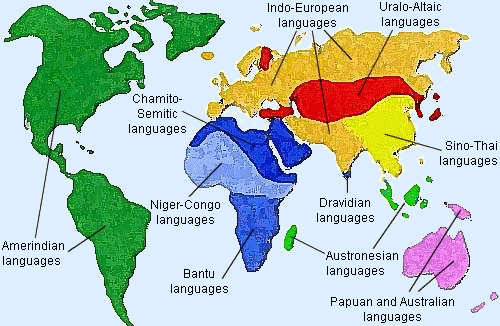
To gain a clearer understanding on the family of languages, below is a distribution map of ten major language families. Remember that a language family is where the word structures show a common origin.

These are the top ten of nearly seventy language families. All of the nearly 7,100 languages can be traced back to these seventy families. Yet, these different language families cannot be traced back any further in their origin or development. The word constructions of these fourteen families do not show a common linkage. By all appearances, they developed independently from each other. This presents a significant obstacle to the evolutionary idea that language evolved from one common root.

The Evolutionary Problem

Language has no equivalent in any nonhuman species. There is no logical way to trace what has been called “grunts to grammar,” from animal expressions to the ability to have meaningful conversations or writing novels. As linguist (one who studies language) Noam Chomsky admits, “The relatively sudden origin of language poses difficulties that may be called ‘Darwin’s problem.’” The historical record shows no picture of language proceeding from a simple form to complex. Language appears to have emerged all at once as a complete package which has went from complex to increasingly simple. Rather than evolution there is devolution. Attic (classical) Greek devolved into the simplified Koine Greek and today’s much easier modern Greek. Classical Latin devolved into the romance languages like French, Italian and Spanish.

In addition to this, anthropologist (one who studies human behavior) Chris Knight highlights the sociological problem of the evolutionary model. He explains that “language simply cannot evolve in a Darwinian world—that is, in a world based ultimately on competition and conflict.” For language to evolve, it would require unusually high levels of cooperation and trust because it is socially developed and learned. The world of naturalistic evolution which paints a brutal world of tooth and claw struggle, in which the strongest survive, could not foster the needed social compatibility for language to emerge. For this reason he concludes that “language exists, but for reasons which no currently accepted [theories] can explain.”

Compatibility to the Genesis Account

So, could the origins of the language families have sprung up from a divine act, like that described in the story of the Tower of Babel (Genesis 11:1-9)? Given the lack of explanatory power of the evolutionary model, one would be left with no other choice but to consider a supernatural origin. Let’s conclude by looking at several lines of evidence which should cause us not to dismiss the Genesis story. So, let’s look at the story and then several lines of evidence which support the accuracy of the story.

1Now the whole world had one language and a common speech. As people moved eastward, they found a plain in Shinar and settled there. They said to each other, “Come, let’s make bricks and bake them thoroughly.” They used brick instead of stone, and tar for mortar. Then they said, “Come, let us build ourselves a city, with a tower that reaches to the heavens, so that we may make a name for ourselves; otherwise we will be scattered over the face of the whole earth.” But the Lord came down to see the city and the tower the people were building. The Lord said, “If as one people speaking the same language they have begun to do this, then nothing they plan to do will be impossible for them. Come, let us go down and confuse their language so they will not understand each other.” So the Lord scattered them from there over all the earth, and they stopped building the city. That is why it was called Babel—because there the Lord confused the language of the whole world. From there the Lord scattered them over the face of the whole earth.

Genesis 11:1-9

Origin of Writing and Civilization

Historians agree that civilization and writing started in the area of Sumer around 3000 B.C. Shinar, as seen in Genesis 11:2, was an area within Sumer. R.H. Robins in General Linguistics: An Introductory Survey, admits that around 3000 B.C. is “as far as one can at present go by comparative and historical inference.” In other words, that is the oldest date in which the evidence takes us. The 3,000 years BC and the Sumer (Shinar) location are significant because they are generally consistent with the biblical account.

Historical Corroboration

Abydenus (a Greek historian of the mid-fourth century B.C.), as quoted by Eusebius, spoke of a great tower at Babylon which was destroyed. The record states,

[U]ntil this time all men had used the same speech, but now there was sent upon them a confusion of many and divers tongues.

Josephus, the Jewish historian, quoting from an ancient source, records these words:

When all men were of one language, some of them built a tower, as if they would thereby ascend up to heaven, but the gods sent storms of wind and overthrew the tower, and gave every one his peculiar language; and for this reason it was that the city was called Babylon.

Antiquities of the Jews, 1.4.3

Authenticity Of Genesis 11

The details of Genesis 11 show striking accuracy from a historical perspective. Consider the following:

  • Genesis 11:2 describes the land of Shinar as one of the cradles of ancient civilization, which corresponds to modern scholarship on the influence of Sumer on the ancient Near East.
  • The identification of Babylonia with Shinar was apparently known in the earliest of times (compare Genesis 10:10, Daniel 1:2).
  • The description of a tower is combatable with the fact that such towers were called ziggurats. These towers consisted of several platforms which were constructed one on top of the other platforms. These became progressively smaller in size till a pinnacle was reached which accommodated a small temple dedicated to a particular deity.
  • The reference to “brick” and “tar” (11:3-4) has a genuine touch of authenticity. The region of Babylon did not contain the common building stone that was characteristic of Palestine, where most of the biblical accounts were written. These fired bricks from that area were usable for centuries showing the author of this story had a correct understanding to the region where the events took place.

For these reasons and others, Donald J. Wiseman, professor of Assyriology at the University of London, has confidently stated that the record in Genesis 11 “bears all the marks of a reliable historical account.”

Other Traditions Around the World

Stories about a tower and sudden language changes appear in ancient histories from Sumerian, Grecian, Polynesian, Mexican, and Native American sources. This is what we might expect if the Tower of Babel was a real event. There would be people spreading throughout the world from Shinar carrying the tradition of the account. Stories of language changes, ziggurats, towers, names of Noah are confirmations of the events at Babel.

Conclusion

The topic of language is complex. What is clear, though, is that language is a gift. Each tongue expresses something beautiful about each tribe, country and culture which speaks it.

“Language is the road map of a culture. It tells you where its people come from and where they are going.”

Rita Brown

The story of the Tower of Babel affirms God’s love of diversity as seen in the different languages. The apostle John’s revelation of the end of the ages magnificently reinforces this.

After this I looked, and there before me was a great multitude that no one could count, from every nation, tribe, people and language, standing before the throne and before the Lamb.

Revelation 7:9

What Was the First Religion?

Photo by Bishesh Pandey on Pexels.com

What was the first religion? Genesis reports that by the third generation from Adam,

“At that time people began to call on the name of the Lord.”

Genesis 4:26

The common view in academic culture is that religion evolved, starting with the worship of objects like trees and animals (animism) and grew into worship of ancestors or multiple gods (polytheism) and eventually one universal God (monotheism), like in the Bible.  In this view there was no original recognition or worship of God. Monotheism is viewed as the last stage of religious development in a long course of “spiritual” evolution.  Behind this idea is that the belief in one God (e.g., Yahweh of the Bible) is something which is a human innovation that grew over time rather than a truth which was divinely revealed.  So which view is accurate? It will be a surprise to many that the best evidence points to monotheism, the worship of one Supreme Creator, as humanity’s oldest religion and idea of God.   

In western cultures it was generally believed for centuries that monotheism, as reflected in the Bible, was the original religious belief system. This began to change as Charles Darwin’s theory of biological evolution gained currency. It started with the publication, On The Origin of Species, in 1859.  As human beings were seen to have evolved from a simple biological form to a complex organism, so religion was assumed to have originated from a very simple and primitive belief system (worship of objects) to a more advanced system of monotheism with its elaborate practices (The temple and priests) and moral codes (The Ten Commandments).  Darwin stated in his 1896 work, Descent of Man, that there is no evidence that people were originally endowed with the ennobling belief in the existence of an Omnipotent God. On the contrary, he claimed, “mental faculties…led man to believe in unseen spiritual agencies, then… [the worship of objects], polytheism, and ultimately monotheism…”  Darwin would be proven wrong on this assertion.   

The Case for Ancient Monotheism

Through the work of leading scholars such as Andrew Lang (1844-1912), Wilhelm Schmidt (1868-1954), Edward Man (1846-1921), Christopher Ehret (b.1941) and the collected reports of many explorers, missionaries, and ethnologists (people who study different societies and cultures), it has been discovered that among the earliest people (tribes and clans) there has been a consistent belief in a supreme being resembling the God of the Bible.  This is seen in three ways:

  1. How God is referenced as, “our father,” “one above,” “divine sky lord,” “great and supreme spirit,” “slayer in the sky,” and “overseer.”
  2. How God is described as the creative power of the universe, the giver of the moral law, incapable of evil, omniscient, omnipotent, and benevolent. (Though these words were not used, their descriptions imply such.
  3. How God is related to in prayer, worship, and intentional obedience.   

The evidence for this is found among people groups on all continents who have the oldest religious belief system. Let’s look at the evidence from different parts of the world.

Australia

Through the path breaking research of Andrew Lang (referred to above), it was discovered that original tribes who lived in isolation (as far back as several thousand years with unchanged beliefs), tended toward monotheism.  In other words, the more a tribe was left unchanged the more it held to a form of monotheism. They showed no evidence of evolving from a previous polytheism, animism or ancestor worship.  Examples include:

  • The Narinari who believed in a supreme being called Nurrundere or Martummere. He created everything and taught humans all necessary rituals and means of survival. 
  • The Maraura who say Nurelli is the supreme god who created the entire land, gave laws, and ascended to heaven. He is represented by a constellation among the stars. 
  • The Woiworung and the Wotjobaluk called their supreme being Bunjil. They all refer to him as “Our Father,” in their respective languages.  
  • The Gunai know their supreme god only by the name of Mungan ngaua, “Our Father.” 
  • The Jeithi, Kamilaroi, and Ualarai worship Baiame who the Ualarai call the “Allfather, whose laws all tribes must obey.” 

These are just representative examples. What makes this finding more significant is that Lang held to the view of monotheism’s evolution from polytheism and animism. He shifted his view because of the clear evidence drawn from his observation and study.

Asia

The Andaman Islands are a chain of islands running roughly parallel to the Southeast Asian peninsula. The Andaman Islanders, a pygmoid group, though richer in their material culture than some of the Australian tribes, were cut off from communication with the rest of the world for a long time. They drew a web of secrecy around their religion. Because of this they were considered to be a religionless people. Anthropologist Edward Man (referred to above) spent eleven years with them, speaking their language and gaining their trust. He eventually learned about their beliefs which had forever remained hidden to outsiders. Their supreme god is an invisible being named Puluga, who is without beginning or end in time, knows our thoughts, and enforces a strict moral code. Among the sins he punishes are “falsehood, theft, grave assault, murder, adultery.”  However, he also has pity on those who are hurting and may possibly provide relief.

James Legge (1815–1897) was a Scottish missionary to China and a leading scholar of Chinese history and culture. During his time in China, Legge produced a massive seven-volume translation of the Chinese classics into English. Previously unknown to Europeans, James Legge’s translation of the Chinese classics into English revealed an astounding picture of religion in ancient China. Legge concluded that Shang Di, the God of the ancient Chinese, was synonymous with the God of the Hebrew Bible. In support of this conclusion, he writes:

“Do the Chinese know the true God? . . . I answer unhesitatingly in the affirmative. The evidence supplied by Chinese literature and history appears to me so strong, that I find it difficult to conceive how any one, who has studied it, can come to the opposite conclusion.”

He further asserted that Shang Di is self-existent and eternal; his years are without end. Moreover, in their 4000 years of history, the Chinese have never fashioned an image of Shang Di.

North America

In North Central California the Yuki are an indigenous people with a rather unique language, who found their way out of Alaska migrating across the Bearing Straits. It is guessed that they navigated the passage through the Yukon Territory, which would have been treacherous, and were looking for comfortable and resource-rich area to settle down. These people show the clearest proof of a truly monotheistic religion. Not only do they recognize a single God, but they pray to him and worship him regularly. Wilhelm Schmidt (mentioned above) summarizes their cultures as follows: In their oldest pure forms they are not animists or polytheists.

“Their simple social constitution is founded on the natural family, and their little village communities exhibit rudimentary chieftainship. This is one example that among the oldest primitive peoples of North America that we find a clear and firmly established belief in a High God. There was the worship of an all-powerful, all-knowing Creator or “Master Spirit”

Africa 

Some scholars, including the historical ethnologist Christopher Ehret (mentioned above), make the case that certain traditional African religions had monotheistic concepts, such as belief in a creator god which date back to the beginning of their history. Ehret specifically points out the similarities between the African and Jewish religion, sharing a similar conception of an inner spirit, as well as circumcising boys as a rite of passage.

Where Did Animism/Polytheism Come From?

If all of this is true, it raises an important question. Where did polytheism come from? According to the Bible, every human being on Earth is a descendent of Noah and his family (Genesis 9:18–19), who were monotheists. If this is true, we should find among ancient cultures the worship of one God. Andrew Lang proposed that humanity started out as monotheists and then devolved into polytheism. This is what Paul teaches:

For since the creation of the world God’s invisible qualities—his eternal power and divine nature—have been clearly seen, being understood from what has been made, so that people are without excuse.  For although they knew God, they neither glorified him as God nor gave thanks to him, but their thinking became futile and their foolish hearts were darkened.  Although they claimed to be wise, they became fools and exchanged the glory of the immortal God for images made to look like a mortal human being and birds and animals and reptiles.

Romans 1:20-23

It is clear that humanity started with a true knowledge of the one God (Genesis 4:26, 9:18-19) but developed the worship of things (animism) from a moral corruption. Humanity devolved in their understanding of God rather than evolved. Paul explains that “they became fools and exchanged the glory of the immortal God (monotheism) for images made to look like a mortal human being and birds and animals and reptiles (animism/polytheism).” When God reveals himself to the Jewish people through Moses and declares:  Hear, O Israel: The Lord our God, the Lord is one (Deuteronomy 6:4), monotheism is now being authoritatively restored. This was not an evolution of understanding but a revolution restoring back to the monotheism which had been originally held.

The Melchizidek Principle

Though animism and polytheism spread, belief in one God has remained latent in many cultures. About 600 years before Moses, when Abraham traveled to pagan dominated Canaan and encountered a priest by the name of Melchizidek. (Genesis 14:18-20) Abraham, though given the special covenant revelation (Genesis 12:1-3), will receive blessing from Melchizidek and tithed to him as a spiritual superior. (Psalms 110:4, Hebrews 7:1-4) Abraham encountered a “pagan” who still had a true knowledge of God. Missionaries, for generations, have observed this “Melchizidek principle” through cultures all over the world where a belief in the one God was held.

Don Richardson tells of many accounts like this in his book, Eternity In Their Hearts. One fascinating story is detailed as follows:

Two Christian missionaries came to the Santal people in India. One day they heard an elder speak of the “genuine God,” Thakur Jiu. When they inquired who this God was, they heard a fascinating story of how the Santal had worshiped Thakur Jiu before they came from the Middle East to India. As they migrated toward India, they could not find a pass through the mountains, so they propitiated the evil spirits of the mountains to let them through. Once through, the people had felt obligated to continue to appease the evil spirits. Over time they lost much of their knowledge of the Creator God, but they longed for reconciliation. The two missionaries concluded that Thakur Jiu and the God of the Bible were the same, and they proceeded to inform the people of what this God had done through his Son to reconcile them. The people were overjoyed to hear that their God had not forgotten them, and a remarkable number of baptisms followed in the years ahead.

Though the knowledge of the one God had been diminished, it has never been destroyed. As Paul affirms,

From one man he made all the nations, that they should inhabit the whole earth; and he marked out their appointed times in history and the boundaries of their lands. God did this so that they would seek him and perhaps reach out for him and find him, though he is not far from any one of us. 

Acts 17:26-27

Isn’t the Bible Just A Bunch Of Conflicting Interpretations?

Photo by Pixabay on Pexels.com

Have you ever heard anyone say, “You can make the Bible say anything you want it to. It is all a matter of interpretation?” One of the obstacles to people embracing Christianity is the idea that Christians can make the Bible mean anything they want it to mean because of all the different interpretations of the Bible. In other words, Christianity is reduced to opinions and preferences about the Bible without a clear set of beliefs.

Let’s respond to this objection. The premise of this article is that God has made “the main things the plain things,” in the Bible. On these areas where God has made his truth clear, Christians do not take different interpretations. Let’s look at two ways God has made the teaching of the Bible clear and then see how we can understand the differences.

Surprise! Surprise!

The first thing to point out is that among Christians (Protestant, Catholic, Orthodox) there is a surprising amount of agreement on what the Bible teaches. In fact, there is far more that unites them than divides them regarding the Bible’s teaching. Jude expressed it as the “faith that was once and for all entrusted to God’s holy people.”

Dear friends, although I was very eager to write to you about the salvation we share, I felt compelled to write and urge you to contend for the faith that was once for all entrusted to God’s holy people.

Jude 1:3

The truth of the Christian faith, which was entrusted to the church, has been passed down and clarified faithfully through the centuries. Here are a list a twenty truths which all Christians agree:

  1. The Bible is God’s revealed Word.
  2. God is the Creator of the heavens and earth.
  3. God is Triune (Father, Son, and Holy Spirit).
  4. God is the Lord over history.
  5. Mankind fell into sin and is incapable of escaping from it or its consequences.
  6. God chose Israel out from among the nations of the world to be a light to the nations around it.
  7. God used Israel to prepare the way for the coming of Jesus.
  8. Jesus was born of a virgin.
  9. Jesus took on human nature as the incarnate second person of the Trinity.
  10. Jesus lived a sinless life of perfect obedience to the will of the Father.
  11. Jesus died on a cross as the sacrifice for sinners in order to provide forgiveness for our sins.
  12. Jesus rose physically from the dead.
  13. Jesus ascended to the right hand of the Father.
  14. Jesus rules supremely over all of history.
  15. Salvation is based on the life, death, and resurrection of Jesus Christ.
  16. Salvation is by grace and through faith in what Christ has accomplished.
  17. The Holy Spirit started the church on Pentecost.
  18. The church is the fellowship of God’s believers living in obedience to Christ.
  19. Jesus Christ will return personally and physically to bring his kingdom to earth.
  20. All humanity will stand before God to be judged.

The writers of scripture makes clear that certain truths stand out in importance. For example, Paul speaking of the resurrection of Jesus emphasizes the centrality of the belief:

And if Christ has not been raised, your faith is futile; you are still in your sins. Then those also who have fallen asleep in Christ are lost. If only for this life we have hope in Christ, we are of all people most to be pitied. But Christ has indeed been raised from the dead, the firstfruits of those who have fallen asleep. 

1 Corinthians 15:17-20

John gives another example of the importance of holding to a central belief as seen in the incarnation of Jesus:

Dear friends, do not believe every spirit, but test the spirits to see whether they are from God, because many false prophets have gone out into the world. This is how you can recognize the Spirit of God: Every spirit that acknowledges that Jesus Christ has come in the flesh is from God, but every spirit that does not acknowledge Jesus is not from God. 

1 John 4:1-3

Many more examples could be given. What is noteworthy to consider is that billions of Christians have held these beliefs in common for over the last 2000 years. We should be rather amazed by this startling level of unity. This faith that has been “once and for all entrusted” has and will continue to hold. This is a testament to the Bible’s clarity because the key truths of the Bible are all evident.

The Overarching Story of the Bible

SIX ACTS

Second, all believers in Christ agree on the story or plot line of the Bible. It can be broken up into six acts with Jesus Christ as the central character. The Bible was written over a period of 1500 years (1400 BC to 100 AD) with more than 40 writers, under many different empires, cultures and circumstances. As you move from book to book, you will detect differences in style, emphases and content. Yet, with all these contributing factors, it tells ONE STORY.

Act 1: The World’s Beginnings  God created humanity in a world with flourishing beauty and life-giving abundance without anything to spoil it. 

Act 2: Humanity’s Rebellion  People rebelled from this original divine artistry and purpose. They traded life-giving abundance for a world governed by self-centered brokenness.  The world descended into a moral fall in which it was impossible for humanity to recover alone.

Act 3: Israel’s Quest  God stepped in to save his story and set in motion a plan to restore the world from this place of brokenness by taking one nation, Israel (from the descendants of Abraham), and setting them apart to be a light and guide to other nations. This was the dawn of restoration from brokenness. 

Act 4: Christ’s Arrival At the height of this story, God sent Jesus to the earth: truly God and truly man who lived a perfect life, died a sacrificial death on the cross, and rose to vanquish sin and the darkness of evil. He was the very standard of understanding how God viewed humanity; and how we should treat one another, and what true justice looks like. Through Jesus’ life and ministry, God’s restoration was breaking into our human experience.

Act 5: Christ’s Kingdom After Jesus had completed his work of demonstrating the power of love over all the brokenness caused by the world’s rebellion and evil, his followers are launched on a mission to expand this life-giving freedom and dignity to every corner of humanity, one conversation, one act of love, one wrong turned right at a time.

Act 6:  Homecoming  The final act tells us Jesus returns and restores what was not fixed and overthrows that which resists love and wholeness. This is the monumental ending to the story as well as the beginning of a new one which never ends in eternity.

JESUS IS the CENTER

The fulfillment and center of this story is Jesus. After Jesus’ death and resurrection, he appears to the men walking on the road to Emmaus. Though they were not aware of who was walking with them, the Savior opens their eyes to the reality of how the entire Bible points to his coming. As they were bewildered by recent events, Jesus gave this explanation.

He said to them, “How foolish you are, and how slow to believe all that the prophets have spoken!  Did not the Messiah have to suffer these things and then enter his glory?” And beginning with Moses and all the Prophets, he explained to them what was said in all the Scriptures concerning himself.

Luke 24:25-27

The writer of Hebrews would emphasize the very same centrality that all of the Bible points to and is fulfilled in Jesus Christ.

In the past God spoke to our ancestors through the prophets at many times and in various ways, but in these last days he has spoken to us by his Son, whom he appointed heir of all things, and through whom also he made the universe.

Hebrews 1:1-2

What About the Disagreements?

There is a lot that can be said as to what are the areas of disagreement and why we have them. Let’s list some important ones.

  1. Christians may agree on the meaning of passages but differ on how to apply them. One example may be the timing (when it should occur) and mode (how it should be done) of baptism. Yet, all followers of Jesus agree on the importance and need to practice baptism. Honestly, much of the difference does not come from interpretations of the Bible but traditions which have been practiced over time.
  2. Some may be more influenced by past tradition than what the Bible teaches. Those in this category will read past traditions into the passage. An instance of this is how some have grown up with an “altar call” at the end of the service, and when they see the word or idea of “altar” (e.g. Romans 12:1) in the Bible, they read their experience into it.
  3. Others may be guided by prejudices (not necessarily racial) and read those into the text. Someone may see a prohibition against tattoos in Leviticus. (Leviticus 19:28) Ignoring that this was a stipulation for the Old Testament Israel, the verse is still cited to confirm a prior dislike of tattoos, when really the Bible is silent on the topic.
  4. Not all scripture is equally clear. Some passages are harder to understand. The apostle Peter said this regarding some of Paul’s writings.

Bear in mind that our Lord’s patience means salvation, just as our dear brother Paul also wrote you with the wisdom that God gave him. He writes the same way in all his letters, speaking in them of these matters. His letters contain some things that are hard to understand, which ignorant and unstable people distort, as they do the other Scriptures, to their own destruction.

2 Peter 3:15-16

As Peter states, some people will not take time to study at a deeper and more thorough level the difficult passages in the scripture. These people remain “ignorant” of what is being taught and then “distort” the truth.

There are more reasons we can provide. This is what is important to sum up. All scripture is inspired and important. Yet, not all the Bible has the same relevance. Isaiah 53 as the prophecy of Christ’s suffering has a lot more relevance than the genealogies of Israel in 1 Chronicles 1-8. What God has wanted to make undeniably clear, the scriptures speak with certainty. What is not as clear, followers of Jesus have the privilege to look deeper into God’s Word to mine the wonderful insights which God’s Word holds in store. Because God has made “the main things the plain things,” we can have confidence in the essential and life-giving truths of the Bible.