The Ascending Church: A Theodosius and the Council of Constantinople

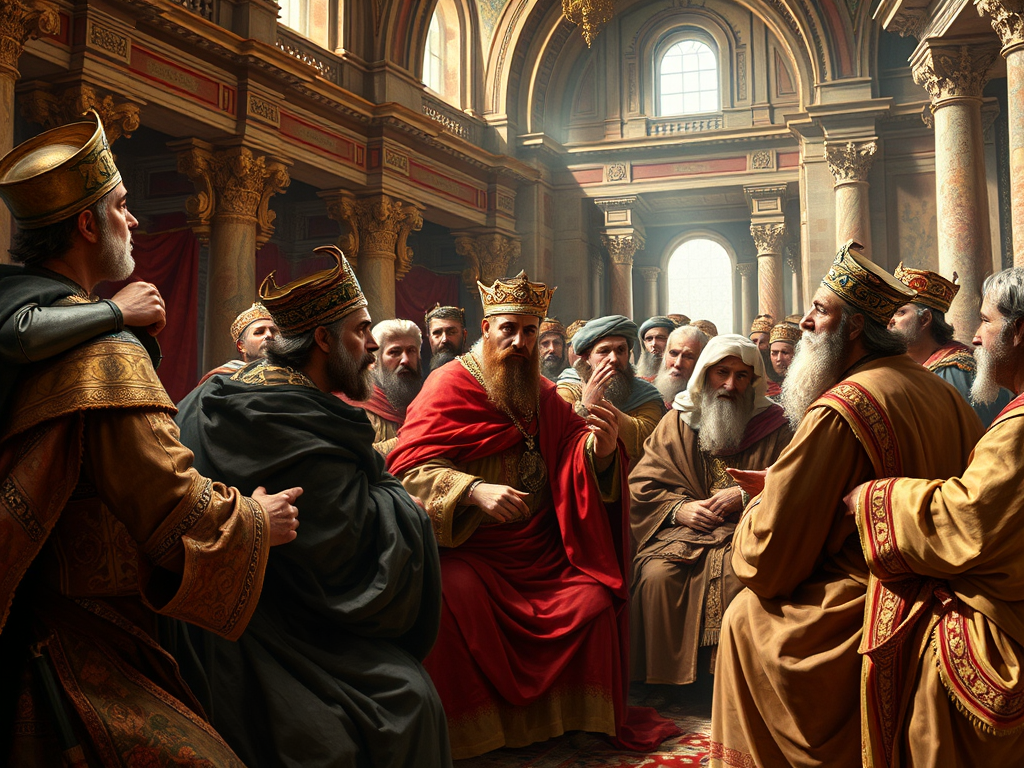
depiction of the Council of Constantinople

Emperor Theodosius, who lived from 347–395, was a man with a singular ambition: to unite the Roman Empire not just politically, but spiritually, under the banner of Nicene Christianity.1 Upon ascending the throne in 379 AD, he sought to consolidate the church under the affirmation of the Nicene Creed.  Theodosius assembled 150 bishops in 381 AD to settle the Arian controversy, which had put the very doctrine of the Trinity at risk.2 As the great emperor entered the hall, the air was not one of harmony, but of simmering tension. He saw men like Gregory of Nazianzus, a brilliant but frail theologian, who bore the weight of biblical truth with a heavy heart. He saw Meletius of Antioch, a powerful figure, who had been a source of division.3 He observed the Macedonian bishops, who arrived late in protest, their faces defiant, ready to challenge his very authority. Theodosius’s first act was not to decree, but to observe. He listened to the arguments, the impassioned speeches, and the subtle maneuvers of both sides of this momentous debate. This was not a battlefield to be won with swords, but a spiritual arena where the mind and the soul held sway.

In this article we will see how this second great council of the church further articulated and universally affirmed the doctrine of Trinity. This would provide a further basis for the advance of God’s Story of Grace where God’s image of a mutual and self-giving love to expand and be lived out on the earth. Further, as Rome would begin to fracture, the Church would become the new unifying center of civilization which would allow God’s image, reflected in the Trinity, to further transform civilization. Theodosius was the emperor who would, after Constantine, lay the ground work to make this possible.

The First Council of Constantinople

The Council of Constantinople was led by Miletus. When he died unexpectedly, Gregory of Nazianzus, who was recently installed as the bishop of Constantinople, was elected to preside. He spoke with fiery eloquence, defending the divinity of the Holy Spirit, in full equality with the Father and the Son. This had been an aspect of the Nicene Creed which was not addressed and still stirred fervent debate. But old rivalries ran deep. Gregory’s authority was challenged by a cabal of bishops who refused to be commanded by a theological rival. Exhausted and disheartened by the infighting, Gregory resigned. To replace Gregory, the council quickly installed Nectarius, a Roman official, who quickly became baptized in order to be the new bishop of Constantinople. Though lacking Gregory’s theological clout, Nectarius was a symbol of imperial favor and political stability.

In the end, it became clear that the work of the bishops was not to create a new document, but to expand upon the one formulated at Nicaea decades earlier. They condemned Arianism, but their most significant work was the clear articulation of the Holy Spirit’s divinity. The bishops, in need of a cohesive faith, arrived at a new consensus. The Constantinopolitan Creed, as it came to be known, was not merely a decree from an emperor but a statement of faith articulated by the Church itself. When the council concluded, Theodosius knew he had achieved his goal: the further strengthening and unification of the Church.

Major Outcomes

The divinity of the Holy Spirit is affirmed forever securing belief in the Trinity. In the original Nicene Creed of 325 reads:

We believe in one God, the Father almighty, Maker of heaven and earth,
and of all things visible and invisible.
And in one Lord Jesus Christ, the Son of God, the only-begotten,
begotten of the Father before all ages.
Light of Light, true God of true God, begotten not made,
of one essence with the Father by whom all things were made;
who for us men and for our salvation, came down from heaven,
and was incarnate of the Holy Spirit and the Virgin Mary
and became man.
And He was crucified for us under Pontus Pilate,
and suffered, and was buried.
And the third day He rose again, according to the Scriptures;
and ascended into heaven, and sits at the right hand of the Father;
and He shall come again with glory to judge the living and the dead;
whose Kingdom shall have no end.
And in the Holy Spirit.

Following the Second Ecumenical Council in Constantinople in 381, the Creed was further
supplemented with the following:

And we believe in the Holy Spirit, the Lord, the Giver of Life,
Who proceeds from the Father; who with the Father and the Son
together is worshipped and glorified; who spoke by the prophets.
In one Holy, Catholic,4 and Apostolic Church.
I acknowledge one baptism for the remission of sins.
I look for the resurrection of the dead, and the life
of the world to come.
Amen.

Theodosius expanded the unity of the Roman Empire with a deepening Christian commitments. This was vital as the Roman Empire would come under increasing attack from German tribes like the Visigoths, Ostrogoths, and Vandals, as well as the Huns. This ultimately created a domino effect of invasions and migrations as the political structure of Rome began to disintegrate, with the last emperor deposed in 479. It was Theodosius who consolidated the empire under the Council of Constantinople and would further push efforts to expand Christian reforms and policies that had begun under Constantine.5 Ironically, his reforms would provide a basis for Christianity to organically spread as the barbarian tribes came into contact with Rome. They converted to Christ, in part, because paganism had been forced into increasing decline.

The reign of Theodosius was not perfect by any measure. But in the expansion of God’s Story of Grace, his reforms and leadership led to the further realization of Revelation 11:15:

“The kingdom of the world has become
    the kingdom of our Lord and of his Messiah,
    and he will reign for ever and ever.”

______________________________________________________________________________

  1. Nicene Christianity affirmed the Council of Nicaea’s declaration that Jesus Christ was “very God of very God,” meaning that he was co-substantial (of the same substance) with the Father, “begotten and not made.” This was distinct against Arianism which promoted the idea that Jesus Christ was a created being, less in than the Father.
  2. The council did formally use the term Trinity, the council’s work was built upon the Council of Nicaea (325 AD), and together they confirmed the divinity of the Son and added the divinity of the Holy Spirit to the creed, affirming the Trinitarian view that is central to Christian orthodoxy today. 
  3. He served as the first president of the council but died shortly after the proceedings began. Meletius of Antioch (Greek: Μελέτιος, Meletios) was a Christian patriarch from Antioch from 360 until his death in 381. He was opposed by a rival bishop named Paulinus II and his ministry was dominated by the division and argument, usually called the Meletian schism. As a result, he was exiled from Antioch in 361–362, 365–366 and 371–378.
  4. The term “Catholic” mean universal church and is not limited to the Roman Catholic Church. In fact, this creed and council favored the leaders and churches at Constantinople over the leaders and churches of Rome.
  5. In some cases his reforms were too harsh against pagans, but in making the Empire more Christian, it provided an environment for missions and Christian philanthropy to spread.


Ambrose and the Courage to Resist the State (Ephesians 1:22)

depiction of Ambrose

On rare occasions, leaders arise in history who possess the vision and capability to effectively address several significant problems at once, often leaving a lasting impact on their societies. In the late fourth century, that exceptional leader was Ambrose of Milan, Italy (340-397 AD). As Bishop of Milan, he was not only a powerful orator but also a devoted theologian whose influence reached far beyond his time. Substantial challenges were confronting the movement of God’s Story of Grace, including political strife, theological disputes, and moral decline in the church, which Ambrose navigated with remarkable skill. He actively worked to bridge the gap between church and state, advocating for Christian values while confronting the powerful rulers of his day, thereby shaping the early Christian church’s influence within the Roman Empire.

  • The church was divided and weakened by the heresy of Arianism.
  • The power and authority of state rulers over the church had become way too great.
  • There were no larger voices to shape a biblical understanding to address the great shifts of the changing times.

All of these factors combined, placed the church at a place of increased impotency. In Ambrose, an unlikely and reluctant bishop in northern Italy, these problems would find a decisive answer. In God’s Story of Grace, he would arise to the occasion and weave together several loose threads into a unified knot. Further, he would ascend to a place of influence–not from his own choosing or ambition–to showcase the supremacy of Christ in the world:

God has put all things under the authority of Christ and has made him head over all things for the benefit of the church. (Ephesians 1:22)

In this article we will see how the life of Ambrose, in his spiritual authority, restrained the most powerful state in the world, showing the supremacy of Christ for his church over all things.

Life of Ambrose

Summoned to Lead

Ambrose, born in 340 AD, was the son of a government official in Trier, a city in present-day Germany. Following in his father’s footsteps he trained as a lawyer to prepare himself for a life of service as a government official. By his early 30s, he was already governor of Milan, a city in northern Italy. Milan had taken over Rome as the place of imperial rule due to the emergence of barbarian invaders threatening the capital city. When the bishop of Milan died in 374 AD, Ambrose expected trouble. Tension between the Nicene (those holding to the divinity of Jesus) and Arian (those holding to Jesus being less than divinity) parties were very sharp. Conflict arose over whether the new bishop would be Arian or Nicene. 

As it was coming time to choose a bishop, crowds surged into the streets, some shouting they wanted an Arian bishop, while others demanded a Nicene replacement. The animosities were potentially boiling to a riot. As regional governor, it was Ambrose’s responsibility to oversee the election. He pleaded with the crowd to keep the peace. He was not publicly identified with either party. As he addressed the riotous crowds, the people were enthralled with his speaking ability. Combined with his existing popularity, the crowd began to shout, “Ambrose for bishop!” The pleas grew more insistent: “Ambrose for bishop! Ambrose for bishop!”

The two major problems with this appeal is that Ambrose had no desire to be bishop; further, he had not even been baptized.  After strongly resisting the call to spiritual leadership over Milan, he finally consented to the will of the citizens. Within eight days, Ambrose was baptized and ordained bishop of Milan. As a leader he was both wise and humble enough to know how much he had to learn. When he became bishop, he gave away his wealth and found teachers in theology to help him learn what he needed to know to effectively shepherd and guide as bishop. He eventually became one of the most learned men of his time.  His influence would be felt for centuries.

Overcoming the Power of Arianism

Upon attaining the role of bishop, he was not publicly aligned with either Nicene or Arian views. This worked to his favor because both parties believed that they had obtained a mutually acceptable candidate in Ambrose. As he grew in spiritual leadership and applied his education to the interpretation and exposition of scripture; he acquired a profoundly biblical and Nicene understanding of the faith. It would be this doctrine that he zealously defended in the face of Arian opposition not only against Arian bishops but from the imperial power of the Rome. Emperor Valentinian II, who was Arian, attempted to have one of the three major churches in Milan under the control of the Arians for their use. Ambrose refused. The conflict culminated in a stand-off between imperial and church authority. Ambrose and his supporters barricaded themselves inside the church successfully resisting the efforts of Valentinian.

During the confrontation Ambrose set forth an important principle that would have ramifications for Church-state relations for centuries: “The emperor is in the church, not above it.” In 381, the same year as the Council of Constantinople, Ambrose presided over the Council of Aquileia in the West. This council deposed several Arian bishops, solidifying support for Nicene and biblical belief in his own realm.

“The emperor is in the church, not above it.” 

Ambrose of Milan

Overcoming the Pride of Rome

Ambrose’s triumph over a politically powerful Arianism was followed by a more thorny confrontation with another imperial authority who arose to the throne in 380, Theodosius. Not long after he became emperor, Theodosius declared Nicene Christianity the official belief of the entire Roman Empire. Yet Ambrose’s principle of the emperor being “in the church, not above it” would face an even greater test with this new ruler. This happened when Theodosius ordered the massacre of some 7,000 people in Thessalonica after a local riot that claimed the lives of several imperial officers. Ambrose, as the emperor’s bishop, ordered him to do public penance. In a carefully worded but firm letter, he chided the emperor, likening his action to King David’s murder of Uriah the Hittite:

Bear it, then, with patience, O Emperor, if it be said to you: You have done that which was spoken of to King David by the prophet. For if you listen obediently to this, and say, “I have sinned against the Lord,” if you repeat those words of the royal prophet: “O come let us worship and fall down before Him, and mourn before the Lord our God, Who made us,” it shall be said to you also: “Since you repent, the Lord puts away your sin, and you shall not die.”

Theodosius complied with this directive and publicly repented and decreed that, going forward, any time he sentenced someone to death, there should be a waiting period of a month before the sentence was carried out. This way he would not act in haste. 

Ambrose’s Legacy

Ambrose was used in God’s Story of Grace to place the church on a footing of moral authority in order that Christianity and the gospel could give spiritual guidance to the larger development of civilization. He did this by bravely and effectively resisting two emperors, demonstrating a remarkable blend of spiritual fortitude and diplomatic skill, and placing the church at its proper place of authority. This courageous stance was not merely an act of defiance but a profound assertion that would allow the church to become a moral compass and conscience of the state, particularly as western Rome began a gradual process of disintegration marked by political turmoil and societal upheaval. In this context, the church would rise to take the lead as the unifying energy of civilization, fostering a sense of community and shared purpose among disparate groups. As God is shaping the world after his trinitarian image, Ambrose’s stance and resistance would create greater humility in the state (after the one God), prompting rulers to recognize the limits of their power. This acknowledgment would allow greater freedom and creativity for society (after the distinctive persons), encouraging a flourishing of culture, art, and thought, rooted in Christian values. Ambrose’s enduring influence would echo through history, reminding future generations of the vital interplay between faith and governance in the pursuit of a just and equitable society.

This would also pave the way for the contributions of Ambrose’s greatest disciple, Augustine. It would be Augustine who would provide a monumental understanding of the role and limits of the state in relation to church, especially in his magisterial writing, The City of God. It would be through the leadership of Ambrose, and to a much greater extent, Augustine, that the church and society would find a way to understand its place, as the Rome of the West would become increasingly weakened by barbarian invasions it was not able to stop.

How St. Anthony and the Desert Fathers Saved Christianity and Civilization (Matthew 4:1)

In a movement starting in the middle of the third century, the deserts of Egypt, Palestine, Arabia and Persia were increasingly populated by a rare breed of men. They have come to be called the Desert Fathers. By the early fourth century as Christianity would become popular and accustomed to greater ease, these men would serve as a prophetic witness to the church, injecting the leaven of discipleship and biblical truth into a church which found it increasingly easy to compromise. The Desert Fathers were men who were unable to passively drift along by following the tenets and values of larger society. They chose to live separated lives forged by seeking God with a singular focus in a scorching and barren landscape. In the biblical tradition of men like Moses, David, Elijah, John the Baptist and Paul, they left the noise of urban life and sought after God.

Then Jesus was led by the Spirit into the wilderness to be tempted by the devil.” 

Matthew 4:1

Though strange to many, their role was indispensable to the continued unfolding of God’s Story of Grace. By their extreme example, they would call the church away from coasting into social complacency to embrace a robust calling to discipleship after Jesus. In so doing, they halted the church from descending into an indistinguishable mass of herd conformity to embrace the mutual and self-giving life of the Trinity.

In this article we will look at the movement of the Desert Fathers, particularly Anthony the Great (251–356), and examine how they were vital to the ongoing growth and development of God’s Story of Grace. They did this through calling the church to personal and doctrinal purity and providing crucial points of guidance to the larger society.

Origins Of the Desert Fathers

The rise of the Desert Fathers began as a spontaneous movement around key locations where Christianity was spreading. No one explanation can spell out this unusual phenomenon except a yearning certain men (in some cases women) had to pursue a higher level of discipleship with Christ. Being stripped of all self-reliance in the hot barrenness of the desert environment, their ears could be sharply tuned to the voice of God. Skip Moen describes the mindset of the Desert Fathers as men who understood, “Heaven on earth is not found in opulent surroundings. It is found in stinky mangers, hostile wastelands, the edges of humanity and the places no one wants to be.

In this yearning, they were motivated to follow certain scriptural precedents.

Precedent # 1: Singleness

Paul spoke of the gift or calling of celibacy to the Corinthians:

32 I would like you to be free from concern. An unmarried man is concerned about the Lord’s affairs—how he can please the Lord. 33 But a married man is concerned about the affairs of this world—how he can please his wife— 34 and his interests are divided. (1 Corinthians 7:32-34)

Eventually the movement of these hermits would evolve into a monastic movement with communities of monks. The original meaning of the word monk is “single.” These were men of an undivided, single and solitary focus.

Precedent # 2: Poverty

Another important strand in Desert Fathers goes back to the instructions which Jesus gave to the seventy-two missionaries to take no provision for the journey as they went:

Do not take a purse or bag or sandals(Luke 10:4)

Like these early adventurers for Jesus’ kingdom, the Desert Fathers were pioneers, with nothing to go on but the examples of the biblical saints and the call of the mission they were to fulfill. Their call to poverty compelled them to innovate a new life and create a new culture in the desert.

Precedent # 3: Cross Bearing

Jesus said to his disciples, “Whoever wants to be my disciple must deny themselves and take up their cross and follow me.(Matthew 16:24)

These men lived lives of extreme discipline and self-denial. In some cases, it was too extreme. But these extremes may have been necessary to be a witness against the church’s increasing embrace of the world.

Precedent # 4: Preparation for Martyrdom

The primary Greek word for “witness” (Acts 1:8) in the Bible is μάρτυς (martus) from which we get the word martyr. Overtime as believers increasingly faced death for Christ, this came to be seen as a witness to the gospel. As the threat of martyrdom receded, the extreme life of discipline and renunciation came to be seen as a kind of substitute for martyrdom.

Anthony the Great

The most famous of the Desert Fathers is Anthony the Great.1 Born in 251 in Egypt, Anthony had a radical conversion at age sixteen when he heard a sermon taken from the words of Jesus in Matthew 19:21:

If you want to be perfect, go, sell your possessions and give to the poor, and you will have treasure in heaven. Then come, follow me.

In 285, as a young man, Anthony withdrew from civilization and ventured into the desert, giving away everything he owned. At first he lived in a desert region about 60 miles west of Alexandria. Later he moved to more distant locations in a search for the solitude he needed to center his attention more intensely on prayer and further disentangle himself from evil. According Athanasius, his biographer, the spiritual trials that Anthony endured over the ensuing decades prepared him for the remarkable movement that drew thousands into the barren wilderness. In Anthony, many found a leader who had faced his own demons and found a vision for a life deeper and richer than anything that even the best of the Roman Empire had to offer.2

Influence

They protected the church’s emerging doctrine of the Trinity.

In 325 the Council of Nicaea affirmed that Jesus Christ is true God of true God, begotten not made, of one essence with the Father. When Emperor Constantine, the sponsor of the Nicaean Council died, the new imperial regimes opposed those adhering this affirmation. Athanasius, Bishop of Alexandria, carried the torch to defend this truth, while it was being severely opposed. With his life under continuous threat and having to hide from his home in Alexandria for seventeen years, Anthony was for him a key source of support, protection and courage. In the sandy outskirts, Athanasius was able to escape while under the protection of Anthony and the other desert hermits. At one point, according to Athanasius, Anthony traveled to Alexandria and “denounced the Arians [those denying the deity of Christ], saying that their heresy was the last of all and a forerunner of Antichrist.” The Christian historian Sozomen (400-450) wrote that, “The monks were prepared to subject their necks to the sword rather than to swerve from the Nicene doctrines.” Had it not been for the protection of these Desert Fathers, the defenders of the Nicene doctrine would have been arrested and eventually killed. This would have spelled a probable end for biblical orthodox truth.3

They protected civilization.

Overtime the Desert Fathers built gathered communities known as monasteries which played a decisive role in the West as oases of civilization in a world descending into barbarism. Eventually, these monks protected civilization by preserving knowledge through copying manuscripts, which saved classical and religious texts from being lost. They preserved and systematically copied two main categories of essential texts: religious works that formed the foundation of Christian faith and a significant body of classical Greco-Roman literature. Most importantly was the preservation of the Bible. The most notable surviving example includes the 4th-century Codex Sinaiticus, found at St. Catherine’s Monastery. This is the old known copy of the entire Bible. Monks copied important philosophical works from ancient Greece and Rome, including the writings of Aristotle and Plato. In the Middle Ages, some of these Greco-Roman works were reinterpreted through a Christian lens.

They mediated conflicts in society.

By the third and fourth centuries certain Desert Fathers acquired considerable power precisely because of their position outside society. Their renunciation of sex, marriage, and property lifted them out of kinship and property networks. This, combined with their reputation for total devotion to God, favorably positioned them to be “third party” mediators and arbiters from quarreling villagers to powerful political leaders. Their radical independence enabled them to intervene with great authority even in public affairs.4

Conclusion

The Desert Fathers, though extreme to many, in fact served a vital role for the preservation and advance of God’s Story of Grace. In once sense, their separation was to preserve the reality of what radical discipleship could look like to a church that would move toward greater complacency and comfort. These desert hermits would separate from society becoming an example and inspiration of reformation movements in doctrine and spiritual life for centuries to come. This would allow society to form along the two tracts: increasing scale and growth of social structures of the state (the one) and the radical call of discipleship (the many).5 The Trappist Monk, Thomas Merton, summarizes their importance and spiritual brilliance toward the larger society:

They were men who did not believe in letting themselves be passively guided and ruled by a decadent state, and who believed that there was a way of getting along without slavish dependence on accepted, conventional values. But they did not intend to place themselves above society. They did not reject society with proud contempt, as if they were superior to other men.

As stated earlier, in so doing, they halted the church (and the world) from descending into mass conformity so that humanity, in the development of history, could embrace the mutual and self-giving life of the Trinity.

___________________________________________________________________________

  1. The first Desert Father was Paul of Thebes, also known as St. Paul the First Hermit. He is traditionally regarded as the earliest Christian hermit, living in the Theban desert in Egypt. A biography written by St. Jerome recounts his life of solitude, prayer, and reliance on divine provision. 
  2. In Alexandria, the theologian Origen (who lived in the early third century) had taught new converts about Christianity and amazed them with his renunciations, including sleeping on the floor, going barefoot, extreme fasting, and abstaining completely from wine. Origen did not invent the idea that one must pursue purity of heart in order to understand the deeper spiritual meanings of Scripture. But his teaching ministry at Alexandria in the early third century gave this idea a deep and longstanding influence in the church. It was from the church at Alexandria that Christianity’s first ascetics went out to the Egyptian desert, taking with them the great teacher’s deep insights into the reading of the Bible and the quest for holiness.
  3. The Desert Fathers appeared to be a remnant given by God to preserve Christian truth affirming the promise of Jesus that the gates of hell would not prevail. (Matthew 16:18)
  4. For example, a Desert Father by the name of Apollo more than once resolved conflicts over land boundaries between pagan and Christian visitors. In another instance, he converted a group of pagan priests, discipled them, and turned them over to the local parishes. Another example is John of Lycopolis, counseled Emperor Theodosius, as well as generals, tribunes, and wives of military officers.
  5. The great developments have occurred in history when ideas which were developed or preserved in the margins of society take root in society. Such examples would be representative democracy, the Protestant Reformation, universal education.