Aristotle, Eudaimonia and Shalom: The Ultimate Guide to Ethics

In this third and final article on the influence of Aristotle, we will see that the great philosopher significantly contributed to God’s Story of Grace by introducing what is called virtue ethics. Virtue ethics emphasizes the development of moral character (virtues) through repeated behaviors to cultivate a life which advances human flourishing. Aristotle was not really concerned with laying down strict rules for moral choices or considering the best outcomes of actions; rather he wanted ethics to focus on how an individual’s character leads to virtue creating a life of blessedness (similar to the beatitudes of Jesus in Matthew 5:3-10). We will consider, then, the unique contribution of Aristotle’s thought on ethics and how it shaped the world’s understanding and experience of moral development. We will tie this into how virtue ethics enriches our understanding of Christian discipleship.

What Is the Ultimate Purpose of Ethics?

Eudaimonia the Goal

The ultimate aim of ethics can be summed up in the word: eudaimonia. This is a Greek term first used by Aristotle in the context of philosophy. The word carries the idea of “flourishing.” Sometimes the word is translated “happiness” or “well-being.” When translated “happiness” it does not refer to a temporary state of good feelings; it rather describes a life that is lived well that brings a growing experience of moral satisfaction–fulfillment. This is the “good life,” and in the ethical sense there is no other end or higher purpose beyond it. Thus, this eudaimonia, in Aristotle’s thinking, is the proper aim or goal of all human action. He describes this as follows in his work, Nicomachen Ethics:

Now happiness, more than anything else, seems complete without qualification. For we always choose it because of itself, never because of something else. Honor, pleasure, understanding, and every virtue we certainly choose because of themselves, since we would choose each of them even if it had no further result; but we also choose them for the sake of happiness, supposing that through them we shall be happy. Happiness, by contrast, no one ever chooses for their sake, or for the sake of anything else at all.

Virtue the Means

But how does one gain this human flourishing? Aristotle makes the case that this is by the cultivation and exercise of virtue. Again from Nichomachean Ethics: “…the human good proves to be activity of the soul in accord with virtue…” What is meant by this activity of the soul is that virtue is attained by the ongoing practice of virtuous acts. He further explains, “We become just by doing just actions, temperate by doing temperate actions, brave by doing brave actions.” After the virtues have become a habit (a normal behavior) through practice, they bring a transformation of character. This character can be defined as to who we really are and how we are really inclined to act. It has been more popularly expressed as who we are when no one is looking. For Aristotle virtue is not a rote habit but something deeper in the soul. It is a trained habit of soul which guides our moral compass where our choices will shape the outcome of our life. A modern expression of Aristotelian thinking goes as follows:

Thoughts Become Words, 
Words Become Actions, 
Actions Become Habits, 
Habits Become Character, 
Character Becomes Your Destiny.

The Golden Means

A central concept in Aristotle’s thinking is the golden means. Virtue is not only right action flowing from habits that develop into character; it also entails a wisdom of deciding the right action from situation to situation. This means that virtue, as Aristotle explains, “is a mean between two vices [golden means], one of excess and one of deficiency.”  Author and teacher, Brett Kunkle, provides the following elaboration and helpful chart:

The mean balances virtue between two extremes. For instance, when we examine the virtue of courage we come to see that it is balanced between the appropriate feelings of fear and confidence. Too much confidence leads to rash action, yet too much fear leads to cowardice. The individual who has attained the virtue of courage avoids both vices when he experiences the appropriate amount of fear or confidence in a particular situation.

ActivityVice—DeficiencyVirtue—MeanVice—Excess
Facing loss or deathCowardiceCourageRashness
Bodily appetites or pleasuresInsensibilityTemperanceIntemperance
Giving moneyStinginessGenerosityExtravagance
Retribution for wrongInjusticeJusticeRevenge
Examples of virtues and their corresponding vices in excess and deficiency.

By using the golden means Aristotle is not prescribing general rules, but rather a guiding principle. The guide is grounded in a wisdom which has developed the ability to choose the right action in specific cases.

Humanities teacher, Brett Saunders, provides this illustration:

Suppose I am shopping with my daughter and she is affronted by some fellow. The “right” intervention, according to Aristotle, falls between cowardice and recklessness, perhaps as a mix of cautious de-escalation and definitive show of strength. What the mean looks like for a specific act depends on the circumstances—why, how, with whom, and how much the agent acts, as well as who the agent is. Considering these variables and hitting the mean with regard to, for instance, the time of day, absence of other shoppers, appearance and manner of my daughter’s accoster, proximity or absence of security personnel— this belongs to the virtue of prudence. As a sort of keystone virtue, prudence stands out from others (self-control, justice, friendship, etc) because it is the capacity for considering the variables and determining the “mean” act (not too late or soon, not too bold and timid, not too abrasive or deferential) in the proper amount of time. Prudence is the knack of taking the right amount of time to decide on the right action.

The Lasting Legacy of Aristotle’s Ethics

A lasting influence on education.

Aristotle grounded ethics in the ideas of human flourishing and virtue. This was quite substantial for the influence of Western Civilization which emphasized the formation of character development in education. If virtue is not emphasized at the youngest age, then it is impossible to have a virtuous society. To bring about virtue in youth, Aristotle emphasized (what is another Greek term) paideia. This word means “child” but it became the shorthand for the training and education of children which cultivates virtue. Paidea had four emphases:

  • Stories. There was a focus on the action of heroes to deeply impress the imaginations of the young. Literature was a key facet of paideia because it forms the heart with its deepest desires, values, and loyalties.
  • Music. This was an influence carried over to Aristotle from Aristotle’s teacher, Plato. Plato focused attention on music “because rhythm and harmony most of all insinuate themselves in to the inmost part of the soul and most vigorously lay hold of it in bringing grace with them.”
  • Gymnastics. Gymnastics largely meant physical training to the Greeks. The physical training refined the whole person: intellect, imagination, sensibilities and the body.
  • Imitation. The Greek term used for this is mimesis (where we get our word mimic). Aristotle saw this as the soul’s imitation of the pattern from another human being. More simply put is was about having proper role models.

A lasting influence on ethics.

After Aristotle, society could begin to think in richer ways about the goals of being a community or to live together as a human family. From Persia, the world saw the spread of the empire, which did allow for the protection of certain religious and cultural freedoms. From the earlier Greeks (e.g. Cleisthenes), the world saw the introduction of democracy and ways for it to be practiced. But the deeper question for Aristotle was what are these different forms of government for? He would answer eudaimonia or human flourishing. The idea is not to have any ideal form of government (democracy, empire, etc.), but to understand that the role of government is to promote human flourishing or moral happiness. In the Old Testament a somewhat equivalent term for eudaimonia is shalom. Shalom in Hebrew means “wholeness” or “well-being.” These are both concepts that describe a life of flourishing or a life lived as it is meant to be. Theologian Cornelius Plantinga beautifully captures the meaning of shalom:

The webbing together of God, humans, and all creation in justice, fulfillment, and delight is what the Hebrew prophets call shalom. We call it peace, but it means far more than mere peace of mind or a cease-fire between enemies. In the Bible, shalom means universal flourishing, wholeness, and delight…. Shalom, in other words, is the way things ought to be.

So, in Aristotelian and biblical thinking the political form of government we adopt is a mean toward an ends: eudaimonia or shalom. The Declaration of Independence reflects this thinking in the phrase “the pursuit of happiness.” The goal of politics is to develop societies where virtue is taught and practiced and the interest of the whole can be balanced with personal freedom for increased flourishing. (This is the trinitarian model which sees flourishing as a balance of the one and the many.)

A lasting influence on Christianity

The biblical call to discipleship is centered around developing the character of our lives to become like Christ. Paul expresses it very simply: “…train yourself to be godly.” (1 Timothy 4:7) Though Christianity did not derive its understanding of discipleship from the Greeks, the ways of Jesus reflect some of what Aristotle taught. For after all, Aristotle did not invent the pursuit of virtue but discovered its reality. Repeatedly the Bible refers to how our circumstances are training us to walk in Christ-like maturity (virtue):

Consider it pure joy, my brothers and sisters, whenever you face trials of many kinds, because you know that the testing of your faith produces perseverance. Let perseverance finish its work so that you may be mature and complete, not lacking anything.  (James 1:2-4)

Again…

28 And we know that in all things God works for the good of those who love him, who have been called according to his purpose. 29 For those God foreknew he also predestined to be conformed to the image of his Son… (Romans 8:28-29)

Summary

There are many more scriptures which could be listed. But let’s close with a statement from C.S. Lewis, in his essay “The Weight of Glory” as he explains that biblical ethics is not simply about obeying raw commands, but they are geared toward the formation of positive blessing or eudaimonia:

If you asked twenty good men today what they thought the highest of the virtues, nineteen of them would reply, Unselfishness. But if you had asked almost any of the great Christians of old, he would have replied, Love. You see what has happened? A negative term has been substituted for a positive…. The negative idea of Unselfishness carries with it the suggestion not primarily of securing good things for others, but of going without them ourselves, as if our abstinence and not their happiness was the important point. I do not think this is the Christian virtue of Love. The New Testament has lots to say about self-denial, but not about self-denial as an end in itself. We are told to deny ourselves and to take up our crosses in order that we may follow Christ; and nearly every description of what we shall ultimately find if we do so contains an appeal to desire.
Aristotle’s Chain of Being and the “Kinds” of Genesis

God has built the desire in humans to understand and classify nature. This was one of original man’s first tasks in the Garden of Eden according to Genesis:

Now the Lord God had formed out of the ground all the wild animals and all the birds in the sky. He brought them to the man to see what he would name them; and whatever the man called each living creature, that was its name. So the man gave names to all the livestock, the birds in the sky and all the wild animals. (Genesis 2:19-20)

Yet, since the rebuilding of the earth after the Flood, this task of the classification of nature was not systematically taken up until Aristotle. Though Aristotle’s work in zoology was not without errors; in God’s Story of Grace, the great philosopher provided the grandest biological system of the time which forwarded humanity’s understanding of the great order and variety of the created world. His observations were so wide ranging to include the anatomy of marine invertebrates; the minute details the embryological development of a chick, and even the internal anatomy of snails. He went into such variety to describe the chambered stomachs of cows to the social organization of bees. Some of his observations were not confirmed until many centuries later.

As a philosopher, Aristotle is largely known for his instruction in logic, ethics and virtue. Yet, his work on the biological order of life left an enduring mark on the advancement of scientific understanding. Before Aristotle, philosophers like Heraclitus, Empedocles and Democritus focused on offering quasi-scientific explanations of the physical universe based on philosophical ideas. Aristotle largely discarded that and sought to base his views of the world on painstaking observation. What drove him to do this extremely detailed and complex work was his belief that all of nature has a logical purpose and order which could be studied and understood. This belief in a logical order and purpose of the world was grounded in his theology (belief about God). Theology, for Aristotle, was an invitation to biology. Studying living things was a way to understand the divine nature. In even in the most most humble of animals, Aristotle reasoned, there is order and beauty that reflected a divine reality.

In this article, the second on Aristotle, we will uncover the order of Aristotle’s discoveries and how his theology drove those discoveries. We will then conclude how he advanced God’s Story of Grace in the area of science.

Aristotle’s Science

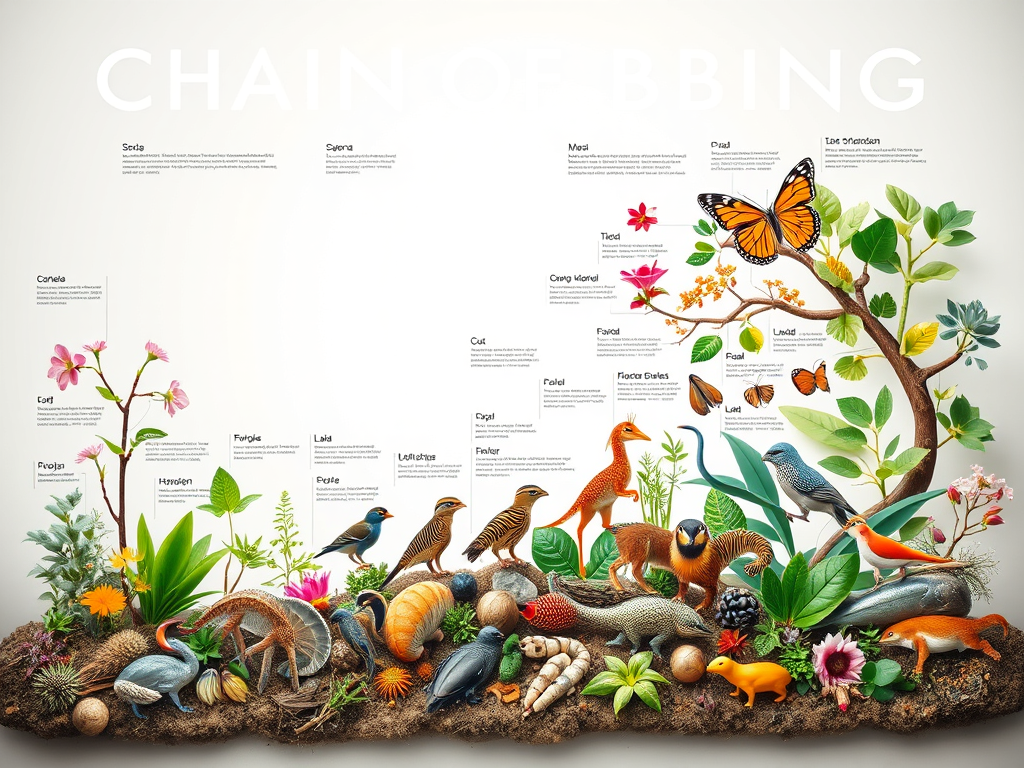
Aristotle was the first to conceive of a great chain of being among all living things. He took his observations of living things and ranked them based on complexity. The greater the complexity the higher its place of the great scale of being. For example, he distinguished animals from plants, because animals have a consciousness and can move in their surroundings. Among animals he created a hierarchy based on their complexity. He separated vertebrates from invertebrates. Of the vertebrates he included five genera (a classification of common characteristics bearing similarities to the biblical “kind”). These include:

  1. mammals
  2. birds
  3. reptiles and amphibians,
  4. fish
  5. whales (which Aristotle did not realize were mammals).

The invertebrates were classified as:

  1. cephalopods (such as squid and octopus)
  2. crustaceans
  3. insects
  4. shelled animals

In total, he classified about 500 animals, vertebrae and invertebrate, into the genera listed above. As already mentioned he classified plants, as well.

What Motivated Aristotle?

Aristotle saw organisms as having an inherent structure and purpose which leads to the overall function of the organism. This structure and purpose he called “soul.” By this he did not mean an immaterial identity separate from the physical/biological structure. The soul for Aristotle is the function of the physical organism inseparable from the body. By this definition even plants have souls. Because of this he believed all living things could be classified because all living things have a purposeful function (soul). So, where did this inherent purpose come from? The answer for this monumental thinker is God.

His understanding of God was not the same as the God of Abraham, Isaac and Jacob or the Jews. There are some similarities, but the differences are significant.

Similarities:

  • God is the highest being over all other beings.  
  • God is pure purpose, existing without matter. 
  • God is the unmoved mover, the first cause of motion in the universe. 
  • God is the source of order and purpose in the world. 
  • God is eternal.  

Differences:

  • God is not personal.
  • God does not have a plan for us.
  • God is not affected by us.

What does all of this mean?

The advancement of science is driven by faith.

Aristotle did not come to believe that the world has purpose and order because of science; rather, he believed that the world had purposeful order, so he pursued a scientific understanding. His theology drove his science. Without the prior belief, he would have had no basis or motivation to do the meticulous research he did. It was clear to him that all of nature did not function by random chance, and that there is an order to be discovered. Everything which is purposeful necessarily is based on purposeful (intelligent) action. For example, imagine two men surprisingly meeting in a clothing store who happen to know each other, and in the process of meeting they strike up a conversation leading toward a business deal. The chance occurrence was based upon their prior and purposeful choices to go to the clothing store to buy a shirt (or whatever item). Chance occurrences, as we observe them, all occur from goal oriented or purposeful action not the other way around. Spontaneity and chance come after thoughtful purpose.

Aristotle sums it up well in his work, Physics:

Spontaneity and chance, therefore, are posterior (follow) to intelligence and nature. Hence, however true it may be that the heavens are due to spontaneity, it will still be true that intelligence and nature will be prior causes of this All and of many things in it besides.

Purposeful design and unguided evolution have an ancient contrast.

It is important to realize that Aristotle’s view of the purposeful order of nature was not at all taken for granted in the intellectual climate of the Greek world he inhabited. Aristotle references, in his work, Empedocles (495–435 BC), who proposed that nature consists of a primordial state where different organs and parts of animals were accidentally and randomly combined in different configurations. Empedocles thought that these early creatures were monstrous and unfit for life, and that most died out.  He believed that the remaining creatures who survived were the result of natural selection, which removed the freakish creatures and left the ones that were best adapted to the environment. This is an early version of survival of the fittest. Those configurations which were most fitting survived, while others perished. Empedocles wrote as follows:

From it [the earth] blossomed many faces without necks,
Naked arms wandered about, bereft of shoulders,
And eyes roamed about alone, deprived of brows.
Many grew double of face and double of chest,
Races of man-prowed cattle, while others sprang up inversely,
Creatures of cattle-headed men, mixed here from men,
There creatures of women fitted with shadowy genitals.


Philosopher and theologian, Joe Carini, comments on how modern science confirms the viewpoint of Aristotle over Empedocles.

…our world is not at all like the world Empedocles imagined. Instead, we encounter a world replete with bodies that have a highly complex but ordered and functional arrangement of their parts. What is more, each of these bodies is self-reproducing, by a system that itself is highly complex but ordered and functional. Even more, these bodies exhibit engineering down to the molecular level, with parts so exquisitely ordered to a purpose that they easily surpass the best of engineering done by humans.

The advance of science confirmed revelation in scripture.

In Genesis 1 it describes a biological categorization similar to what Aristotle discovered by using the word kind. We see the designation kind used three times relation to vegetation and plant life:

11 Then God said, “Let the land produce vegetation: seed-bearing plants and trees on the land that bear fruit with seed in it, according to their various kinds.” And it was so. 12 The land produced vegetation: plants bearing seed according to their kinds and trees bearing fruit with seed in it according to their kinds. And God saw that it was good.  (Genesis 1:11-12)

Then we see the designation of kind used six times in reference to animal life:

 20And God said, “Let the water teem with living creatures, and let birds fly above the earth across the vault of the sky.” 21 So God created the great creatures of the sea and every living thing with which the water teems and that moves about in it, according to their kinds, and every winged bird according to its kind. And God saw that it was good. 22 God blessed them and said, “Be fruitful and increase in number and fill the water in the seas, and let the birds increase on the earth.” 23 And there was evening, and there was morning—the fifth day. 24And God said, “Let the land produce living creatures according to their kinds: the livestock, the creatures that move along the ground, and the wild animals, each according to its kind.” And it was so.  25God made the wild animals according to their kinds, the livestock according to their kinds, and all the creatures that move along the ground according to their kinds. And God saw that it was good. (Genesis 1:20-25)

The term “kind” refers to broad categories of genetically related organisms which can breed and reproduce.  This “kind” in Genesis has a nonchanging “fixity” within the design of the biological order. Kinds do not change. This means, for example, that the canine “kind” which includes the dog or dingo or wolf or jackal can reproduce together because they are members of the same canine kind. The canine kind can adapt into different species within their kind through breeding and environmental influences (e.g., chihuahua), but they do not change into another kind like a feline (cat).

Paul writes:  

For since the creation of the world God’s invisible qualities—his eternal power and divine nature—have been clearly seen, being understood from what has been made… 

Romans 1:20

Aristotle wisely helped us to understand this.

Aristotle and the Discovery of God’s Laws of Logic

No other thinker has been so influential in laying the foundations of Western thought as Aristotle. Aristotle was born in 384 B.C. in Stargis, a city in Northern Greece. Aristotle’s father, Nicomachus, was a court physician to King Amyntas II of Macedon.  He was raised in an environment which was rich with opportunities to learn and think scientifically. Both his mother and father died when he was young. Around the age of 13, Aristotle was raised by his guardian, Proxenus, who may have been an uncle. By age 17, he travelled to Plato’s Academy. The young thinker was driven by an insatiable desire for knowledge. At the Academy, Plato became a major influence on Aristotle. He spent 20 years there. He explored the fundamental questions of meaning and existence. Overtime, though, Aristotle began to see the world differently from his revered mentor. Plato saw the ideal world of the unseen as primary basis of knowledge, Aristotle argued from the primacy of the visible world. This presented a great departure between the two philosophers.

Plato died in 347 B.C. and Aristotle left Athens. By 345 B.C. he married Pythias. In 343 B.C. he received an invitation by Philip of Macedon to tutor his 13 year old son, Alexander. This adolescent would grow into Alexander the Great. Even from Alexander’s young age, Aristotle was to train him to rule a vast empire. Aristotle did this for approximately three years until Alexander turned 16, and it was determined he would take on more responsibilities for the throne. In 335 B.C. Aristotle established the Lyceum, just outside of Athens. The Lyceum was an academy to train men in philosophy (love of wisdom) for a virtuous life. It was well funded due to the patronage of Alexander. After Alexander’s death (323 B.C.), Aristotle fell out of favor with the Athenians. Rather than being executed, to be spared the fate of Socrates, he was exiled from Athens to Chalcis, a town about 40 miles north of Athens and died in 322 B.C.

Aristotle established the foundations of Western culture in three areas: logic, science and ethics. In this article and the following two, we will look at how Aristotle advanced God’s Story of Grace in each of these areas. As his thinking matured, it is largely thought that he first developed his teaching in the areas of logic (the way we discern truth), then science (the way we understand the world) and finally ethics (the way we live). We will begin by exploring his ideas on logic.

What is Logic? 

Immanuel Kant (1724-1804) famously claimed that Aristotle had discovered all that there was to discover about logic. This was historically short sighted as later insights would be realized, yet it calls attention to the immense importance of Aristotle on this point. What drove Aristotle in this regard was his belief that every person has a desire to understand the world; in order to aid that understanding, he focused on laws of reason which helped people to better work out the truth or falsehood of an argument. These laws reflected general patterns of truth that are valid no matter what. Aristotle defined these rules in his work titled  the Organon (Greek for organ, tool, instrument). To simplify his thinking we will focus on the the three laws of logic and the key tool in which these laws could be utilized–the syllogism.

The Three Laws of Logic

When looking at Aristotle’s laws, they sound almost like a math equation. In some sense they are in so far as they represent absolute and changeless laws. These are laid out as follows:

  • The law of identity: P is P.
  • The law of noncontradiction: P is not non-P.
  • The law of the excluded middle: either P or non-P.

The law of identity says P is P. This means that everything is itself and not something else. For example, we can look at a tree and observe that it is 20 feet tall and has a lightning burn. (P) In this case, the fact that this tree is 20 feet tall and has a lightning scar is not relevant to this law. It may have a lightning scar as well as letters carved (“Eileen love Al forever”) 5 feet from the base on its east side. What is important is that this particular tree is its own being and not something else. Though this seems obvious, we should not take for granted that without this law reasoning would be impossible because there would be no clear distinctions.

The law of noncontradiction says that P is not non-P. To illustrate, if we observe this same 20 foot tall tree as referred to above, it cannot both have a lightning scar and not have a lightning scar at the same time. That would violate the law of contradiction. Now It can have a lightning scar today whereas a year ago it did not because it was hit with lightning only 2 weeks ago. But it cannot have both a lightning scar and not have a lightning scar at the same time.

The law of the excluded middle says that either P or non-P. Using the idea of the same 20 foot tree, it either has a lightning scar or is does not. There is no other alternative. It cannot both have and not have a lightning scar at the same time. Though this seems way too obvious, it is a fact that many cultures, as we will see, have not viewed reality through these laws.

The Syllogism

A syllogism is a form of reasoning based on logical deduction. Deduction is where you start with known facts (called premises) and use them to reach a certain conclusion. If the premises are true then the conclusion must also be true. For example:

  • Premise 1: All pine trees are conifers.
  • Premise 2: Conifers have needle-like leaves.
  • Conclusion: Therefore, all pine trees have needle-like leaves.

Or…

  • Premise 1: God loves and has a purpose for all humans.
  • Premise 2: Bernardo is a human.
  • Conclusion: Therefore, God loves and has a purpose for Bernardo.

The key points about logical deduction are as follows:

  • Start with established facts or statements.
  • Follow a logical path of deduction for the statements. 
  • The conclusion from this path has a certain accuracy. 

The accuracy of a syllogism is based on the premises being true. If the premises are false, then the conclusion will be false, as well. Here is an example of a wrong conclusion due to false premises.

  • Premise 1: God can do everything.
  • Premise 2: Sin is a part of everything.
  • Conclusion: Therefore, God can sin.

The problem with this syllogism is with premise 1: God can do everything. That statement is incorrect. It should be greatly modified to read: God can do everything he wants to do. With that modification the statement should read as follows:

  • Premise 1: God can do everything he wants to do.
  • Premise 2: God does not want to sin.
  • Conclusion: Therefore, God cannot sin.

Logic and God’s Story of Grace

Understanding the LOGOS. Aristotle’s discovery of logic was important for a greater understanding of the LOGOS–Jesus as the Word (logic) of God (John 1:1). The laws of logic are neither inventions of God nor rules that exist outside God’s being. From the perspective of God’s Story of Grace, Aristotle didn’t invent the laws of logic; he discovered them. These laws are embedded in the very eternal being of God, himself. Because these laws are based in the very being of God they are more enduring than the physical laws (e.g. thermodynamics, gravity) which are created. God can alter the laws of nature (e.g., suspend gravity, override entropy), but he cannot in any way alter or override the laws of logic. To do so would require God altering, at an essential level, himself. In Malachi 3:6, God declares: “I the Lord do not change.”  

  • God reflects the law of identity. God cannot exist and not exist at the same time. God says, “I am who I am” (Exodus 3:14). 
  • God reflects the law of non-contradiction. All truth is in God (Colossians 2:3) and God cannot deny himself (2 Timothy 2:13). Because of this law, truth will never contradict truth. 
  • God reflects the law of the excluded middle. Because God exists and does not contradict himself, this means there are no other alternatives to truth.

Quite often God acts in ways we do not understand, but that in no way means that God behaves illogically. So, these laws exist in God’s very being. Had Aristotle nor anyone else never articulated them, they would still exists. Nonetheless, in God’s Story of Grace, Aristotle methodically expressed them.

Understanding Western Civilization. Aristotle’s laws of logic reinforced an irreconcilable difference between the Western (based in Christianity) and the Eastern civilizations. Christianity holds that God (as a distinct identity) created the universe (as a distinct identity) with the earth (as a distinct identity) and all that is in the earth (as distinct identities). This reflects the law of identity: P is P, and the law of non-contradiction: p is not non-p. There is no alternative to this understanding which is the law of the excluded middle: either P or non-P. This is in sharp distinction from the Eastern religions such as Buddhism and Hinduism which are pantheistic. Pantheism holds that everything is ONE. They deny any distinctions which are communicated in Aristotle’s laws of logic. This has created very different outcomes with the Western and Eastern worlds. More about this in forthcoming articles.