The Ascending Church: A Theodosius and the Council of Constantinople

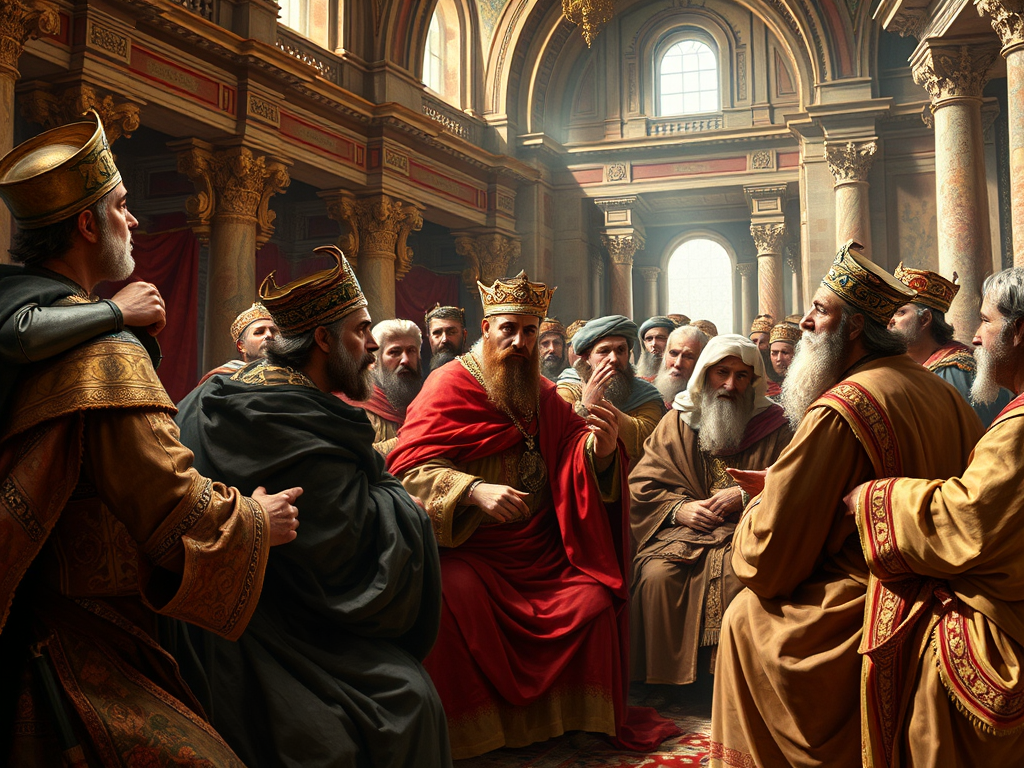
depiction of the Council of Constantinople

Emperor Theodosius, who lived from 347–395, was a man with a singular ambition: to unite the Roman Empire not just politically, but spiritually, under the banner of Nicene Christianity.1 Upon ascending the throne in 379 AD, he sought to consolidate the church under the affirmation of the Nicene Creed.  Theodosius assembled 150 bishops in 381 AD to settle the Arian controversy, which had put the very doctrine of the Trinity at risk.2 As the great emperor entered the hall, the air was not one of harmony, but of simmering tension. He saw men like Gregory of Nazianzus, a brilliant but frail theologian, who bore the weight of biblical truth with a heavy heart. He saw Meletius of Antioch, a powerful figure, who had been a source of division.3 He observed the Macedonian bishops, who arrived late in protest, their faces defiant, ready to challenge his very authority. Theodosius’s first act was not to decree, but to observe. He listened to the arguments, the impassioned speeches, and the subtle maneuvers of both sides of this momentous debate. This was not a battlefield to be won with swords, but a spiritual arena where the mind and the soul held sway.

In this article we will see how this second great council of the church further articulated and universally affirmed the doctrine of Trinity. This would provide a further basis for the advance of God’s Story of Grace where God’s image of a mutual and self-giving love to expand and be lived out on the earth. Further, as Rome would begin to fracture, the Church would become the new unifying center of civilization which would allow God’s image, reflected in the Trinity, to further transform civilization. Theodosius was the emperor who would, after Constantine, lay the ground work to make this possible.

The First Council of Constantinople

The Council of Constantinople was led by Miletus. When he died unexpectedly, Gregory of Nazianzus, who was recently installed as the bishop of Constantinople, was elected to preside. He spoke with fiery eloquence, defending the divinity of the Holy Spirit, in full equality with the Father and the Son. This had been an aspect of the Nicene Creed which was not addressed and still stirred fervent debate. But old rivalries ran deep. Gregory’s authority was challenged by a cabal of bishops who refused to be commanded by a theological rival. Exhausted and disheartened by the infighting, Gregory resigned. To replace Gregory, the council quickly installed Nectarius, a Roman official, who quickly became baptized in order to be the new bishop of Constantinople. Though lacking Gregory’s theological clout, Nectarius was a symbol of imperial favor and political stability.

In the end, it became clear that the work of the bishops was not to create a new document, but to expand upon the one formulated at Nicaea decades earlier. They condemned Arianism, but their most significant work was the clear articulation of the Holy Spirit’s divinity. The bishops, in need of a cohesive faith, arrived at a new consensus. The Constantinopolitan Creed, as it came to be known, was not merely a decree from an emperor but a statement of faith articulated by the Church itself. When the council concluded, Theodosius knew he had achieved his goal: the further strengthening and unification of the Church.

Major Outcomes

The divinity of the Holy Spirit is affirmed forever securing belief in the Trinity. In the original Nicene Creed of 325 reads:

We believe in one God, the Father almighty, Maker of heaven and earth,
and of all things visible and invisible.
And in one Lord Jesus Christ, the Son of God, the only-begotten,
begotten of the Father before all ages.
Light of Light, true God of true God, begotten not made,
of one essence with the Father by whom all things were made;
who for us men and for our salvation, came down from heaven,
and was incarnate of the Holy Spirit and the Virgin Mary
and became man.
And He was crucified for us under Pontus Pilate,
and suffered, and was buried.
And the third day He rose again, according to the Scriptures;
and ascended into heaven, and sits at the right hand of the Father;
and He shall come again with glory to judge the living and the dead;
whose Kingdom shall have no end.
And in the Holy Spirit.

Following the Second Ecumenical Council in Constantinople in 381, the Creed was further
supplemented with the following:

And we believe in the Holy Spirit, the Lord, the Giver of Life,
Who proceeds from the Father; who with the Father and the Son
together is worshipped and glorified; who spoke by the prophets.
In one Holy, Catholic,4 and Apostolic Church.
I acknowledge one baptism for the remission of sins.
I look for the resurrection of the dead, and the life
of the world to come.
Amen.

Theodosius expanded the unity of the Roman Empire with a deepening Christian commitments. This was vital as the Roman Empire would come under increasing attack from German tribes like the Visigoths, Ostrogoths, and Vandals, as well as the Huns. This ultimately created a domino effect of invasions and migrations as the political structure of Rome began to disintegrate, with the last emperor deposed in 479. It was Theodosius who consolidated the empire under the Council of Constantinople and would further push efforts to expand Christian reforms and policies that had begun under Constantine.5 Ironically, his reforms would provide a basis for Christianity to organically spread as the barbarian tribes came into contact with Rome. They converted to Christ, in part, because paganism had been forced into increasing decline.

The reign of Theodosius was not perfect by any measure. But in the expansion of God’s Story of Grace, his reforms and leadership led to the further realization of Revelation 11:15:

“The kingdom of the world has become
    the kingdom of our Lord and of his Messiah,
    and he will reign for ever and ever.”

______________________________________________________________________________

  1. Nicene Christianity affirmed the Council of Nicaea’s declaration that Jesus Christ was “very God of very God,” meaning that he was co-substantial (of the same substance) with the Father, “begotten and not made.” This was distinct against Arianism which promoted the idea that Jesus Christ was a created being, less in than the Father.
  2. The council did formally use the term Trinity, the council’s work was built upon the Council of Nicaea (325 AD), and together they confirmed the divinity of the Son and added the divinity of the Holy Spirit to the creed, affirming the Trinitarian view that is central to Christian orthodoxy today. 
  3. He served as the first president of the council but died shortly after the proceedings began. Meletius of Antioch (Greek: Μελέτιος, Meletios) was a Christian patriarch from Antioch from 360 until his death in 381. He was opposed by a rival bishop named Paulinus II and his ministry was dominated by the division and argument, usually called the Meletian schism. As a result, he was exiled from Antioch in 361–362, 365–366 and 371–378.
  4. The term “Catholic” mean universal church and is not limited to the Roman Catholic Church. In fact, this creed and council favored the leaders and churches at Constantinople over the leaders and churches of Rome.
  5. In some cases his reforms were too harsh against pagans, but in making the Empire more Christian, it provided an environment for missions and Christian philanthropy to spread.

The Council Of Nicaea: How the Church Came to Universally Affirm that Jesus Is Truly God (John 1:1)

portrayal of Constantine before the bishops of Nicaea

Constantine (AD 272-337) became the first Roman Emperor to convert to Christianity. After ascending to his throne in AD 306, he would go on to defeat his greatest rival, Licinus, in AD 324, to make his control over the empire secure. Having reached this perch, he faced an even greater threat to the strength and unity of his empire: a theological division within the rapidly growing Christian movement. This division was regarding whether or not Jesus Christ is truly God, equal in nature to the Father. This issue, if not addressed, would escalate a social rift that could eventually spread across three continents. To stave this off, he summoned a council of all the bishops (leaders over a region of churches) for the first ecumenical (worldwide) council. This became known as the Council of Nicaea. This would establish a powerful move forward within God’s Story of Grace. This council would develop the foundational creedal statement forever shaping the universal church’s belief in the deity of Christ. It would begin the process of formally unifying the beliefs and identity of a movement which had spread to millions in just three centuries. The diversity of the many churches would be brought closer together in the unity and oneness of faith, reflecting the diversity and oneness of the Trinity on earth.

The Council

The controversy that led to Nicaea had two key figureheads: Alexander and Arius,1 both from Alexandria Egypt. Arius taught that Jesus was a created being, less than God. Alexander, in strong opposition, affirmed that Jesus was fully God, equal to the Father. Arius’ view was increasing in popularity, in part because he was able to put his teaching in witty rhymes set to catchy tunes. Even the dockhands on the wharves at Alexandria could hum the ditties while unloading fish. To him, the idea of Jesus being equal in divinity with the Father, threatened the oneness of God. In sharp contrast for Alexander, reducing Christ to a created being called into question the very heart of the Christian faith. If Jesus is not truly God then he alone is not sufficient to save humanity from sin.

“In the beginning was the Word, and the Word was with God, and the Word was God.” (John 1:1)
“The Word became flesh and made his dwelling among us.” (John 1:14)
“I and the Father are one.” (John 10:30)
“Anyone who has seen me has seen the Father.” (John 14:9)
“For in Christ all the fullness of the Deity lives in bodily form.” (Colossians 2:9)
“Christ, who is God over all.” (Romans 9:5)
“Our great God and Savior, Jesus Christ” (Titus 2:13)
Scriptures Alexander Would Have Used

Constantine appealed to them to come to agreement so that it would not cause commotion among the people they led.2 His appeal was ineffective, and the controversy continued. To the emperor’s own mind, whether Jesus Christ was equally divine with the Father was a trivial matter in comparison with the unity of the Empire. Arius and Alexander, on the other hand, understood the consequences of the issue had unparalleled importance. So, without the two parties coming to agreement, Constantine initiated a conference of bishops to decide the issue.

On AD 325, about 3003 bishops set foot upon the town of Nicaea, in modern day Turkey, along with thousands of other deacons and elders.4 In the conference hall where they gathered was a table in which lay an open copy of the Gospels, which was there to express the scripture as their ultimate authority. For three centuries they and their spiritual ancestors experienced periodic persecutions instigated by various emperors. Not that long ago they experienced their most fierce persecution under Diocletian. Now they were actually gathered before the leading ruler of the land as allies with him.5 Constantine entered the hall without his customary train of soldiers showing that he was operating in the spirit of peace. As a mark of his reverence for them, he would not take his seat until the bishops nodded their assent. Like the king in chess, Constantine occupied a prominent position, but he did not actually do very much as the council went underway.6 He spoke only briefly compelling these men of the church to come to some agreement on the questions dividing them. “Division in the church is worse than war,” he declared solemnly. The once-despised religion was on its way to becoming acknowledged and favored by the state. This was all a monumental change for these leaders of the church.

The Controversy

The various sides in the conflict each raised their own points, and from the start there was a tremendous argument. It was possibly Bishop Hosius of Cordova (modern Spain), a theological adviser of the emperor, who suggested that the focus of the debate should be around the Greek word, homoousios. The word, drawn from two Greek words, means “of the same substance.”7 This is very different to the modern idea of a physical “substance” like milk or copper. It means something more like “being” or “nature.” When homoousios is applied to Jesus Christ, it means that his nature (substance) was divine in the same way as God the Father is divine, not inferior or different. Jesus Christ was truly God alongside the Father. As the debate centered around homoousios, the two parties interpreted the word in two different ways as it related to the nature of Jesus Christ. It came down to whether you will put an additional i (Greek letter for i is iota) or not.

  • HOMOOUSIAS=SAME SUBSTANCE
  • HOMOIOUSIAS=SIMILAR SUBSTANCE (the i between the two oo’s-oio-changes the meaning of the word from same to similar)
LeadersViewpoint
Alexanderof the same substance— homoousios
Ariusof a similar substance— homoiousios

As the debate continued, homoousias rather than homoiousias won out.

This is the agreement of faith that the great council came to:

We believe in one God, the Father almighty, Maker of heaven and earth,
and of all things visible and invisible.
And in one Lord Jesus Christ, the Son of God, the only-begotten,
begotten of the Father before all ages.
Light of Light, true God of true God, begotten not made,8
of one essence [homoousias] with the Father by whom all things were made;
who for us men and for our salvation, came down from heaven,
and was incarnate of the Holy Spirit and the Virgin Mary
and became man.
And He was crucified for us under Pontius Pilate,
and suffered, and was buried.
And the third day He rose again, according to the Scriptures;
and ascended into heaven, and sits at the right hand of the Father;
and He shall come again with glory to judge the living and the dead;
whose Kingdom shall have no end.
And in the Holy Spirit.9

This creed was agreed to and signed by the nearly 300 members of council. Only five refused to sign. Two of those five did sign later.

Importance of the Nicaean Council

The Nicene Creed is the basis of all other creeds. It’s difficult to overstate the importance of this moment. It was the first conciliar (worldwide) creed since Christianity began as a movement. It formed the basis of how conciliar counsels would function afterword. These counsels would help to define what is clearly taught in scripture on the most important matters of doctrine and faith.

The Nicene Creed would begin to formulate the standard for the definition of the Trinity. In affirming the divinity of Jesus the foundations for the Trinity were being laid in a clear way. Through the work of Athanasius and Basil (among others), they would provide the definitions and language to give clarity to the doctrine of the Trinity. The doctrine of the Trinity is the most distinctive and important picture of God from the Christian faith. It may be no accident, but providential, that the ideas and concepts around this doctrine were the first to be creedally and universally formed.

The Nicene Creed brought greater order and unity to Christianity. With the Christian faith numbering perhaps as many as 15 million, existing on three continents and innumerable cultures; this was the first authoritative statement which was declared and enforced for the entire church. This further established the development of the church into the unity and diversity of the Trinity. With all of the beautiful and wonderful diversity which was the church before Nicaea, there would now be an increased unity or oneness to hold the diversity together.9

___________________________________________________________________________

  1. Most historians of the Council of Nicaea begin their story with the fiery exchange of words between Arius and Alexander. But the discussion of the nature of Christ has a much longer history in the church. The great third-century theologian Origen, for example, pressed a bishop named Heraclides to define the relationship of Christ to God the Father. After much careful questioning, Heraclides admitted to believing in two Gods but clarified that “the power is one.” Origen reminded Heraclides that some Christians would “take offense at the statement that there are two Gods. We must express the doctrine carefully to show in what sense they are two, and in what sense the two are one God.”
  2. Emperor Constantine’s letter to Alexander and Arius, which was sent through Hosius, the Bishop of Cordova: “Concerning divine providence, let there be among you one faith, one understanding, and one agreement about the Almighty. But as for the things which you discuss in detail with each other during your trivial inquiries, if you do not arrive at one conclusion, they should remain in your own head, kept hidden in the secret recesses of your mind. Indeed, let remarkable shared friendship, true faith, honor towards God, and observance of the law remain unshaken among you. Return to showing friendship and favor to one another. Embrace the whole people once again. When you have cleansed your own souls, acknowledge each other as brothers once again, for friendship is often pleasant after a hateful situation once it has reconciled.
  3. About 1,800 bishops were invited.
  4. To quote Eusebius: “The most distinguished of God’s ministers from all the churches which abounded in Europe, Africa, and Asia assembled here. The one sacred building, as if stretched by God, contained people from [a very long list of nations]. There were more than 300 bishops, while the number of elders, deacons and the like was almost incalculable. Some of these ministers of God were eminent for their wisdom, some for the strict living, and patient endurance of persecution, and others for all three. Some were venerable because of their age, others were conspicuous for their youth and mental vigor, and others were only just appointed. The Emperor provided them all with plenty of food.”
  5. Just before a decisive battle in 312, Constantine became the first emperor to convert to the faith of those who claimed to be Christ followers.
  6. Generations of critics have accused him of manipulating the proceedings, jamming words into the creed, and generally trumping theology with politics, but in fact he mainly sat and listened. An ambitious politician and effective propagandist, Constantine had come to power in the usual swirl of conflict and intrigue.
  7. The term “homoousios” breaks down from the Greek words “homos” meaning same and “ousia” meaning “of one substance” or “of one being.” Brought together as one word, “homoousios” means “of the same substance.” Other Greek words used in the debates at Nicaea—words unclear to speakers of non-Greek languages, such physis (nature), and prosopon (person)—bore meanings drawn from pre-Christian philosophers.
  8. Most of the pastors, however, recognized that something more specific was needed to exclude the possibility of Arian teaching. For this purpose they produced another creed, probably from Palestine. Into it they inserted an extremely important series of phrases: “True God of true God, begotten not made, of one substance with the Father. . . . “
  9. Following the Second Ecumenical Council in Constantinople in 381, the Creed was further supplemented with the following: And we believe in the Holy Spirit, the Lord, the Giver of Life, Who proceeds from the Father; who with the Father and the Son together is worshipped and glorified; who spoke by the prophets. In one Holy, Catholic, and Apostolic Church. I acknowledge one baptism for the remission of sins. I look for the resurrection of the dead, and the life of the world to come. Amen.
  10. It is important to realize that the Nicaean Council sought to make clear what was in the scripture. There is nothing within the statements of the Council contributors or the Council statements which indicates that they saw themselves as doing nothing more than clarifying what is in scripture. They did not see themselves as an authority beside or alongside of scripture, but they saw scripture as their only authority.