

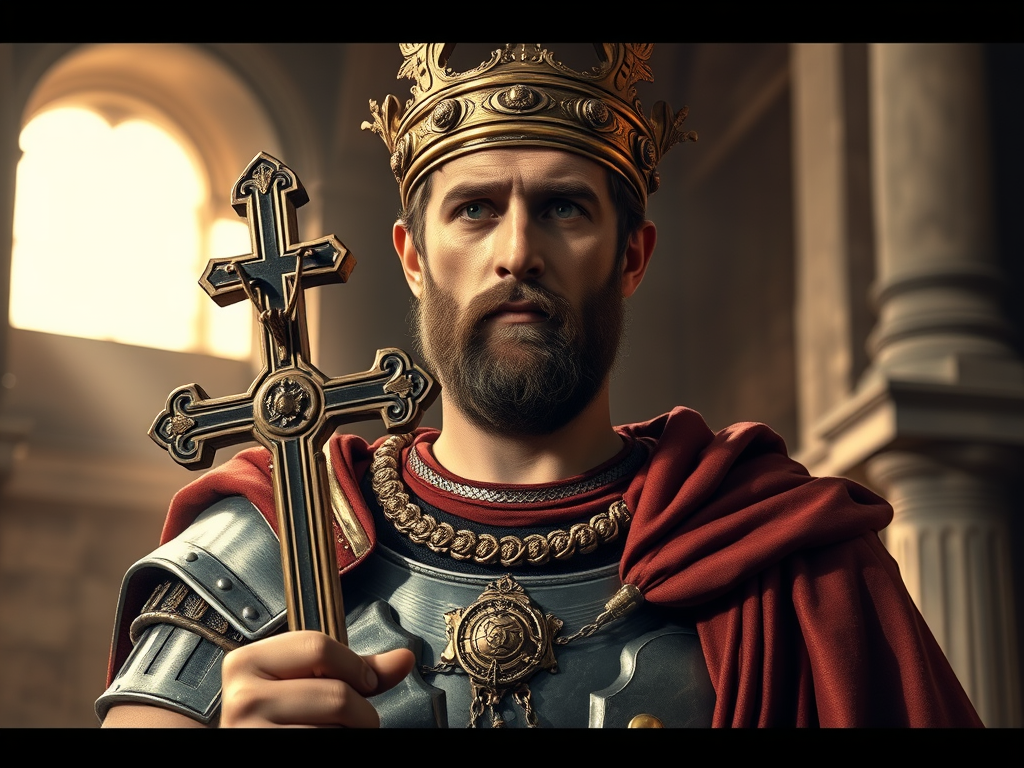
On rare occasions, leaders arise in history who possess the vision and capability to effectively address several significant problems at once, often leaving a lasting impact on their societies. In the late fourth century, that exceptional leader was Ambrose of Milan, Italy (340-397 AD). As Bishop of Milan, he was not only a powerful orator but also a devoted theologian whose influence reached far beyond his time. Substantial challenges were confronting the movement of God’s Story of Grace, including political strife, theological disputes, and moral decline in the church, which Ambrose navigated with remarkable skill. He actively worked to bridge the gap between church and state, advocating for Christian values while confronting the powerful rulers of his day, thereby shaping the early Christian church’s influence within the Roman Empire.
- The church was divided and weakened by the heresy of Arianism.
- The power and authority of state rulers over the church had become way too great.
- There were no larger voices to shape a biblical understanding to address the great shifts of the changing times.
All of these factors combined, placed the church at a place of increased impotency. In Ambrose, an unlikely and reluctant bishop in northern Italy, these problems would find a decisive answer. In God’s Story of Grace, he would arise to the occasion and weave together several loose threads into a unified knot. Further, he would ascend to a place of influence–not from his own choosing or ambition–to showcase the supremacy of Christ in the world:
God has put all things under the authority of Christ and has made him head over all things for the benefit of the church. (Ephesians 1:22)
In this article we will see how the life of Ambrose, in his spiritual authority, restrained the most powerful state in the world, showing the supremacy of Christ for his church over all things.
Life of Ambrose
Summoned to Lead
Ambrose, born in 340 AD, was the son of a government official in Trier, a city in present-day Germany. Following in his father’s footsteps he trained as a lawyer to prepare himself for a life of service as a government official. By his early 30s, he was already governor of Milan, a city in northern Italy. Milan had taken over Rome as the place of imperial rule due to the emergence of barbarian invaders threatening the capital city. When the bishop of Milan died in 374 AD, Ambrose expected trouble. Tension between the Nicene (those holding to the divinity of Jesus) and Arian (those holding to Jesus being less than divinity) parties were very sharp. Conflict arose over whether the new bishop would be Arian or Nicene.
As it was coming time to choose a bishop, crowds surged into the streets, some shouting they wanted an Arian bishop, while others demanded a Nicene replacement. The animosities were potentially boiling to a riot. As regional governor, it was Ambrose’s responsibility to oversee the election. He pleaded with the crowd to keep the peace. He was not publicly identified with either party. As he addressed the riotous crowds, the people were enthralled with his speaking ability. Combined with his existing popularity, the crowd began to shout, “Ambrose for bishop!” The pleas grew more insistent: “Ambrose for bishop! Ambrose for bishop!”
The two major problems with this appeal is that Ambrose had no desire to be bishop; further, he had not even been baptized. After strongly resisting the call to spiritual leadership over Milan, he finally consented to the will of the citizens. Within eight days, Ambrose was baptized and ordained bishop of Milan. As a leader he was both wise and humble enough to know how much he had to learn. When he became bishop, he gave away his wealth and found teachers in theology to help him learn what he needed to know to effectively shepherd and guide as bishop. He eventually became one of the most learned men of his time. His influence would be felt for centuries.
Overcoming the Power of Arianism
Upon attaining the role of bishop, he was not publicly aligned with either Nicene or Arian views. This worked to his favor because both parties believed that they had obtained a mutually acceptable candidate in Ambrose. As he grew in spiritual leadership and applied his education to the interpretation and exposition of scripture; he acquired a profoundly biblical and Nicene understanding of the faith. It would be this doctrine that he zealously defended in the face of Arian opposition not only against Arian bishops but from the imperial power of the Rome. Emperor Valentinian II, who was Arian, attempted to have one of the three major churches in Milan under the control of the Arians for their use. Ambrose refused. The conflict culminated in a stand-off between imperial and church authority. Ambrose and his supporters barricaded themselves inside the church successfully resisting the efforts of Valentinian.
During the confrontation Ambrose set forth an important principle that would have ramifications for Church-state relations for centuries: “The emperor is in the church, not above it.” In 381, the same year as the Council of Constantinople, Ambrose presided over the Council of Aquileia in the West. This council deposed several Arian bishops, solidifying support for Nicene and biblical belief in his own realm.
“The emperor is in the church, not above it.”
Ambrose of Milan
Overcoming the Pride of Rome
Ambrose’s triumph over a politically powerful Arianism was followed by a more thorny confrontation with another imperial authority who arose to the throne in 380, Theodosius. Not long after he became emperor, Theodosius declared Nicene Christianity the official belief of the entire Roman Empire. Yet Ambrose’s principle of the emperor being “in the church, not above it” would face an even greater test with this new ruler. This happened when Theodosius ordered the massacre of some 7,000 people in Thessalonica after a local riot that claimed the lives of several imperial officers. Ambrose, as the emperor’s bishop, ordered him to do public penance. In a carefully worded but firm letter, he chided the emperor, likening his action to King David’s murder of Uriah the Hittite:
Bear it, then, with patience, O Emperor, if it be said to you: You have done that which was spoken of to King David by the prophet. For if you listen obediently to this, and say, “I have sinned against the Lord,” if you repeat those words of the royal prophet: “O come let us worship and fall down before Him, and mourn before the Lord our God, Who made us,” it shall be said to you also: “Since you repent, the Lord puts away your sin, and you shall not die.”
Theodosius complied with this directive and publicly repented and decreed that, going forward, any time he sentenced someone to death, there should be a waiting period of a month before the sentence was carried out. This way he would not act in haste.
Ambrose’s Legacy
Ambrose was used in God’s Story of Grace to place the church on a footing of moral authority in order that Christianity and the gospel could give spiritual guidance to the larger development of civilization. He did this by bravely and effectively resisting two emperors, demonstrating a remarkable blend of spiritual fortitude and diplomatic skill, and placing the church at its proper place of authority. This courageous stance was not merely an act of defiance but a profound assertion that would allow the church to become a moral compass and conscience of the state, particularly as western Rome began a gradual process of disintegration marked by political turmoil and societal upheaval. In this context, the church would rise to take the lead as the unifying energy of civilization, fostering a sense of community and shared purpose among disparate groups. As God is shaping the world after his trinitarian image, Ambrose’s stance and resistance would create greater humility in the state (after the one God), prompting rulers to recognize the limits of their power. This acknowledgment would allow greater freedom and creativity for society (after the distinctive persons), encouraging a flourishing of culture, art, and thought, rooted in Christian values. Ambrose’s enduring influence would echo through history, reminding future generations of the vital interplay between faith and governance in the pursuit of a just and equitable society.
This would also pave the way for the contributions of Ambrose’s greatest disciple, Augustine. It would be Augustine who would provide a monumental understanding of the role and limits of the state in relation to church, especially in his magisterial writing, The City of God. It would be through the leadership of Ambrose, and to a much greater extent, Augustine, that the church and society would find a way to understand its place, as the Rome of the West would become increasingly weakened by barbarian invasions it was not able to stop.


 Story of Grace