Aristotle’s Chain of Being and the “Kinds” of Genesis

God has built the desire in humans to understand and classify nature. This was one of original man’s first tasks in the Garden of Eden according to Genesis:

Now the Lord God had formed out of the ground all the wild animals and all the birds in the sky. He brought them to the man to see what he would name them; and whatever the man called each living creature, that was its name. So the man gave names to all the livestock, the birds in the sky and all the wild animals. (Genesis 2:19-20)

Yet, since the rebuilding of the earth after the Flood, this task of the classification of nature was not systematically taken up until Aristotle. Though Aristotle’s work in zoology was not without errors; in God’s Story of Grace, the great philosopher provided the grandest biological system of the time which forwarded humanity’s understanding of the great order and variety of the created world. His observations were so wide ranging to include the anatomy of marine invertebrates; the minute details the embryological development of a chick, and even the internal anatomy of snails. He went into such variety to describe the chambered stomachs of cows to the social organization of bees. Some of his observations were not confirmed until many centuries later.

As a philosopher, Aristotle is largely known for his instruction in logic, ethics and virtue. Yet, his work on the biological order of life left an enduring mark on the advancement of scientific understanding. Before Aristotle, philosophers like Heraclitus, Empedocles and Democritus focused on offering quasi-scientific explanations of the physical universe based on philosophical ideas. Aristotle largely discarded that and sought to base his views of the world on painstaking observation. What drove him to do this extremely detailed and complex work was his belief that all of nature has a logical purpose and order which could be studied and understood. This belief in a logical order and purpose of the world was grounded in his theology (belief about God). Theology, for Aristotle, was an invitation to biology. Studying living things was a way to understand the divine nature. In even in the most most humble of animals, Aristotle reasoned, there is order and beauty that reflected a divine reality.

In this article, the second on Aristotle, we will uncover the order of Aristotle’s discoveries and how his theology drove those discoveries. We will then conclude how he advanced God’s Story of Grace in the area of science.

Aristotle’s Science
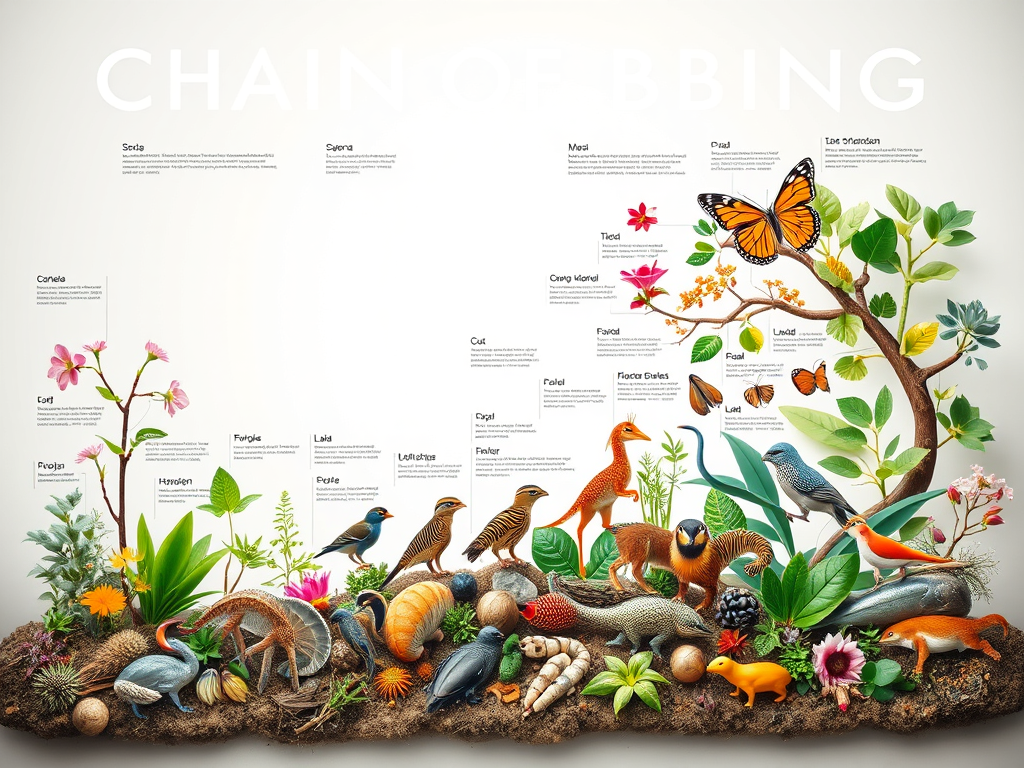
Aristotle was the first to conceive of a great chain of being among all living things. He took his observations of living things and ranked them based on complexity. The greater the complexity the higher its place of the great scale of being. For example, he distinguished animals from plants, because animals have a consciousness and can move in their surroundings. Among animals he created a hierarchy based on their complexity. He separated vertebrates from invertebrates. Of the vertebrates he included five genera (a classification of common characteristics bearing similarities to the biblical “kind”). These include:

  1. mammals
  2. birds
  3. reptiles and amphibians,
  4. fish
  5. whales (which Aristotle did not realize were mammals).

The invertebrates were classified as:

  1. cephalopods (such as squid and octopus)
  2. crustaceans
  3. insects
  4. shelled animals

In total, he classified about 500 animals, vertebrae and invertebrate, into the genera listed above. As already mentioned he classified plants, as well.

What Motivated Aristotle?

Aristotle saw organisms as having an inherent structure and purpose which leads to the overall function of the organism. This structure and purpose he called “soul.” By this he did not mean an immaterial identity separate from the physical/biological structure. The soul for Aristotle is the function of the physical organism inseparable from the body. By this definition even plants have souls. Because of this he believed all living things could be classified because all living things have a purposeful function (soul). So, where did this inherent purpose come from? The answer for this monumental thinker is God.

His understanding of God was not the same as the God of Abraham, Isaac and Jacob or the Jews. There are some similarities, but the differences are significant.

Similarities:

  • God is the highest being over all other beings.  
  • God is pure purpose, existing without matter. 
  • God is the unmoved mover, the first cause of motion in the universe. 
  • God is the source of order and purpose in the world. 
  • God is eternal.  

Differences:

  • God is not personal.
  • God does not have a plan for us.
  • God is not affected by us.

What does all of this mean?

The advancement of science is driven by faith.

Aristotle did not come to believe that the world has purpose and order because of science; rather, he believed that the world had purposeful order, so he pursued a scientific understanding. His theology drove his science. Without the prior belief, he would have had no basis or motivation to do the meticulous research he did. It was clear to him that all of nature did not function by random chance, and that there is an order to be discovered. Everything which is purposeful necessarily is based on purposeful (intelligent) action. For example, imagine two men surprisingly meeting in a clothing store who happen to know each other, and in the process of meeting they strike up a conversation leading toward a business deal. The chance occurrence was based upon their prior and purposeful choices to go to the clothing store to buy a shirt (or whatever item). Chance occurrences, as we observe them, all occur from goal oriented or purposeful action not the other way around. Spontaneity and chance come after thoughtful purpose.

Aristotle sums it up well in his work, Physics:

Spontaneity and chance, therefore, are posterior (follow) to intelligence and nature. Hence, however true it may be that the heavens are due to spontaneity, it will still be true that intelligence and nature will be prior causes of this All and of many things in it besides.

Purposeful design and unguided evolution have an ancient contrast.

It is important to realize that Aristotle’s view of the purposeful order of nature was not at all taken for granted in the intellectual climate of the Greek world he inhabited. Aristotle references, in his work, Empedocles (495–435 BC), who proposed that nature consists of a primordial state where different organs and parts of animals were accidentally and randomly combined in different configurations. Empedocles thought that these early creatures were monstrous and unfit for life, and that most died out.  He believed that the remaining creatures who survived were the result of natural selection, which removed the freakish creatures and left the ones that were best adapted to the environment. This is an early version of survival of the fittest. Those configurations which were most fitting survived, while others perished. Empedocles wrote as follows:

From it [the earth] blossomed many faces without necks,
Naked arms wandered about, bereft of shoulders,
And eyes roamed about alone, deprived of brows.
Many grew double of face and double of chest,
Races of man-prowed cattle, while others sprang up inversely,
Creatures of cattle-headed men, mixed here from men,
There creatures of women fitted with shadowy genitals.


Philosopher and theologian, Joe Carini, comments on how modern science confirms the viewpoint of Aristotle over Empedocles.
…our world is not at all like the world Empedocles imagined. Instead, we encounter a world replete with bodies that have a highly complex but ordered and functional arrangement of their parts. What is more, each of these bodies is self-reproducing, by a system that itself is highly complex but ordered and functional. Even more, these bodies exhibit engineering down to the molecular level, with parts so exquisitely ordered to a purpose that they easily surpass the best of engineering done by humans.

The advance of science confirmed revelation in scripture.

In Genesis 1 it describes a biological categorization similar to what Aristotle discovered by using the word kind. We see the designation kind used three times relation to vegetation and plant life:

11 Then God said, “Let the land produce vegetation: seed-bearing plants and trees on the land that bear fruit with seed in it, according to their various kinds.” And it was so. 12 The land produced vegetation: plants bearing seed according to their kinds and trees bearing fruit with seed in it according to their kinds. And God saw that it was good.  (Genesis 1:11-12)

Then we see the designation of kind used six times in reference to animal life:

 20And God said, “Let the water teem with living creatures, and let birds fly above the earth across the vault of the sky.” 21 So God created the great creatures of the sea and every living thing with which the water teems and that moves about in it, according to their kinds, and every winged bird according to its kind. And God saw that it was good. 22 God blessed them and said, “Be fruitful and increase in number and fill the water in the seas, and let the birds increase on the earth.” 23 And there was evening, and there was morning—the fifth day. 24And God said, “Let the land produce living creatures according to their kinds: the livestock, the creatures that move along the ground, and the wild animals, each according to its kind.” And it was so.  25God made the wild animals according to their kinds, the livestock according to their kinds, and all the creatures that move along the ground according to their kinds. And God saw that it was good. (Genesis 1:20-25)

The term “kind” refers to broad categories of genetically related organisms which can breed and reproduce.  This “kind” in Genesis has a nonchanging “fixity” within the design of the biological order. Kinds do not change. This means, for example, that the canine “kind” which includes the dog or dingo or wolf or jackal can reproduce together because they are members of the same canine kind. The canine kind can adapt into different species within their kind through breeding and environmental influences (e.g., chihuahua), but they do not change into another kind like a feline (cat).

Paul writes:  

For since the creation of the world God’s invisible qualities—his eternal power and divine nature—have been clearly seen, being understood from what has been made… 

Romans 1:20

Aristotle wisely helped us to understand this.

What Was Before the Birth of the Universe?

Photo by Pixabay on Pexels.com

A story is told of some atheist scientists who wanted to show that they no longer needed any supernatural component to explain how the world works.  So, they arranged an audience with God to demonstrate that they could form a human being out of dirt just like God did.  They set up a contraption that would sort out the chemical elements from the dirt and recombine them into a human being.  Just as they were scooping up some dirt to put into the device, God responded, “Hold on a minute…get your own dirt.” This humorous story reflects the long held Christian belief that God created the universe “out of nothing” (ex nihilo).   

The opening line of the Bible affirms creation ex nihilo:

“In the beginning God created the heavens and the earth.”

Genesis 1:1

Genesis employs a special Hebrew verb for the act of creation (bara). In Genesis bara is used only for God in the sense that he brings something into existence that did not exist. This is different than people creating buildings, antibodies, musical compositions, or sculptures from material that already exists.  The creation (bara), out of nothing, as described in Genesis is on an infinitely different scale. Now think about this and try to imagine the power it takes to bring into existence the entire universe from nothing. There is really no way to wrap our minds around this. And yet, the Bible insists that at a point in time, there was nothing apart from God and the “beginning” started when God brought “the heavens and the earth” (universe) into being by him.

By faith we understand that the universe was formed at God’s command, so that what is seen was not made out of what was visible.

Hebrews 11:3

Again…

“You are worthy, O Lord, To receive glory and honor and power; For You created all things, And by Your will they exist and were created.” 

Revelation 4:11

As difficult as it may be to conceive of creation from nothing, it is a remarkable fact today that science is in agreement that the universe began at a single point and time. Astrophysicists John Barrow and Frank Tippler write, “At this singularity [point and time of creation], space and time came into existence; literally nothing existed before the singularity, so, if the universe originated at such a singularity, we would truly have a creation ex nihilo.” 

The idea of creation ex nihilo tells us several things all at once about God, the Bible and our purpose in the universe.

Creation Ex Nihilo Vindicated

The biblical concept of creation ex nihilo is wholly unique.  It has taken science over 2000 years to affirm this truth. All ancient Near Eastern creation stories (from Egypt and Mesopotamia) assume that their gods worked with material that already existed from eternity. The idea of creation from nothing is in sharp contrast with the other religious writings of the ancient world.  In addition, until recently, the Bible’s view of creation from nothing has stood in disagreement with the prevailing scientific views for over two thousand years. The greatest thinker of ancient times who had shaped much of the world’s understanding of physics, Aristotle (d. 322 B.C.), held that the universe eternally existed. The physics of Aristotle prevailed until Isaac Newton (d. 1727). Newton decisively overturned the physics of Aristotle with what could be called a mechanical view of the universe. Nonetheless, Newton still held that the universe had the appearance of always existing. By the time Albert Einstein developed his theory of general relativity in 1916, he assumed that the universe always existed, as well.  His equations of general relativity predicted an expanding universe which implied that it had a beginning.  Unwilling to accept that the universe had a starting point, he altered his theory to conform with the prevailing idea of an eternally existing universe. This conclusively changed for the legendary physicist in 1931 when he looked through Edwin Hubble’s telescope and saw conclusive proof of an expanding universe which confirmed his earlier and stronger version of the theory of general relativity, demonstrating that the universe had a starting point. This change in the thinking of Einstein brought a marked transformation in the field of physics. As one commentator remarked, up to this time the idea of the expansion of the universe which had a beginning “was absolutely beyond comprehension.”  John Wheeler in his book, Beyond the Black Hole, writes that this discovery went “against all expectation.” Since Einstein, subsequent discoveries have increasingly confirmed and reinforced the idea of the universe having a starting point, making it overwhelmingly the dominant view among astrophysicists. This has also given vindication to the biblical idea of creation ex nihilo.

A Wise and Powerful Intelligence Behind the Universe

From the concept of the universe having a beginning, there are three areas from this science which reveals magnificent insights into the wisdom and intelligence of God and the proof of scripture:

  1. finely tuned universe.
  2. expanding universe.
  3. decaying universe.

Finely Tuned Universe

There is a fascinating book called The First Three Minutes that’s about the very beginning of the universe. What was there before those first three minutes? Some physicists speculate that in the beginning all of the matter of the universe was compressed into a point of infinite density—a singularity, as it has been called. This means that the entire universe, everything that is out there, existed as one tiny point, smaller than an atom. What is mind blowing to scientists is how they now concede that before that singular point, there was no space, no time, no matter, no energy, not even a void because a void needs boundaries. What was there, then? This is the mystery. No less a person than the late Cambridge University cosmologist Steven Hawking declared that “the actual point of creation lies outside the scope of presently known laws of physics.” Genesis answers this mystery with “in the beginning God”: a being whose immensity is equally near and far from everything in the universe and whose infinity is beyond everything in the universe.

This beginning or singularity started with a measureless expanse of heat and light.  In less than a minute at the beginning there was the development of gravity and all of the forces that govern physics which expanded a million billion miles. From this emerged nuclear reactions to create the lighter elements of hydrogen and helium.  Then in three minutes 98% of all the matter began to exist. This is popularly known as the Big Bang. From the perspective of creation ex nihilo there was a bumper sticker which read: “I believe in the big bang.  God spoke and bang it happened.” 

Expanding Universe

According to astronomer, Hugh Ross, the characteristic most frequently stated about the universe in the Bible is its being “stretched out.” Five different Bible authors pen such a statement in eleven different verses. Here are representative examples:

He alone stretches out the heavens
    and treads on the waves of the sea.

Job 9:8

The Lord wraps himself in light as with a garment;
    he stretches out the heavens like a tent

Psalm 104:2

He sits enthroned above the circle of the earth,
    and its people are like grasshoppers.
He stretches out the heavens like a canopy,
    and spreads them out like a tent to live in.

Isaiah 40:22

The Lord, who stretches out the heavens, who lays the foundation of the earth, and who forms the human spirit within a person, 

Zechariah 12:1

Ross states that these verses employ an active participle form of the Hebrew verb natah (stretch). This form implies continual or ongoing stretching or expanding of the heavens.

At this beginning, it is agreed by physicists that the laws which guided the original expansion of the universe had to be so perfectly fine tuned to support life, that they overwhelming point to extraordinary intelligence and boundless power. Physicist, Freeman Dyson said, “It’s as if the universe saw us coming.” It is the Goldilocks Principle: Not too hot not too cold but just right.  The physical laws and balance of matter to antimatter had to be just right with a razor sharp precision. For example, gravity had to be at exactly the right force—if it was a bit heavier (one billionth of a gram), it would have pulled all the atoms together into one big ball and ended in a big crunch. If gravity was a bit lighter (one billionth of a gram), the expanding universe would have distributed the atoms so widely that they would never have been gathered into stars and galaxies. Either way there would be a universe with no life.

The universe’s initial expansion needed a perfect balance of the different forms of matter and energy not only at the level of gravity but also nuclear and electromagnetic forces, among many others. The chances of this randomly happening are like two people guessing the same 1-to-1,000,000 number three times in a row, and then predicting the outcome of 16 consecutive coin-flips immediately afterwards.

Decaying Universe

Since the universe is expanding, it will do so at a slower and slower rate. Galaxies will turn their gas into stars, and the stars will burn out. Our own sun, we know, loses 4,200,000 tons of mass every second of every day. One day it will become a cold, dead remnant, floating among the corpses of other stars in an increasingly isolated Milky Way. This means that the entire universe will run out of energy and experience a heat death. Because it has an end, it must have had a beginning. It has not always existed because with its finite amount of energy it would have burned out by now.

What Does This Mean?

Creation speaks to the awesomeness and wisdom of God.

The heavens declare the glory of God;
    the skies proclaim the work of his hands.
Day after day they pour forth speech;
    night after night they reveal knowledge.

Psalm 19:1-2

Paul Davies, a renowned physicist from Arizona State University writes, “There is for me powerful evidence that there is something going on behind it all. . . It seems as though somebody has fine tuned nature’s numbers to make the Universe. . . The impression of design is overwhelming.”  

Creation speaks to the immeasurable love of God.

King David gives this amazing statement about the immeasurable love of God.

For as high as the heavens are above the earth,
    so great is his love for those who fear him

Psalm 103:11

David was not an astronomer. He had no grasp on the unimaginable magnitude of the expanding heavens, which displays the immensity of God’s presence and love, which we do today. He did not know that a light travels at 186,000 miles a second. He did not know that in a year which consists of 31,536,000 seconds x 186,000 miles that light travels almost six trillion miles (the number six followed by 12 zeroes). That’s the equivalent of about 12,000,000 round trips to the moon from earth. He had no idea that our best telescopes can detect a distance so far that it would take an airplane at 500 miles per hour nonstop, 52 weeks in every year, with not a moment’s pause, to reach this distance in 20 quadrillion years (The number 20 followed by 15 zeroes). David had no clue that this would only be the mere fringe of what lies beyond the universe which is composed of some two trillion galaxies.

This helps me to appreciate even more Paul’s prayer that we:

may have power, together with all the Lord’s holy people, to grasp how wide and long and high and deep is the love of Christ,  and to know this love that surpasses knowledge—

Ephesians 3:18-19

We serve a God whose immensity is matched by a love which was expressed in the incarnation, crucifixion and resurrection of Jesus Christ to bring us in our brokenness to God.