
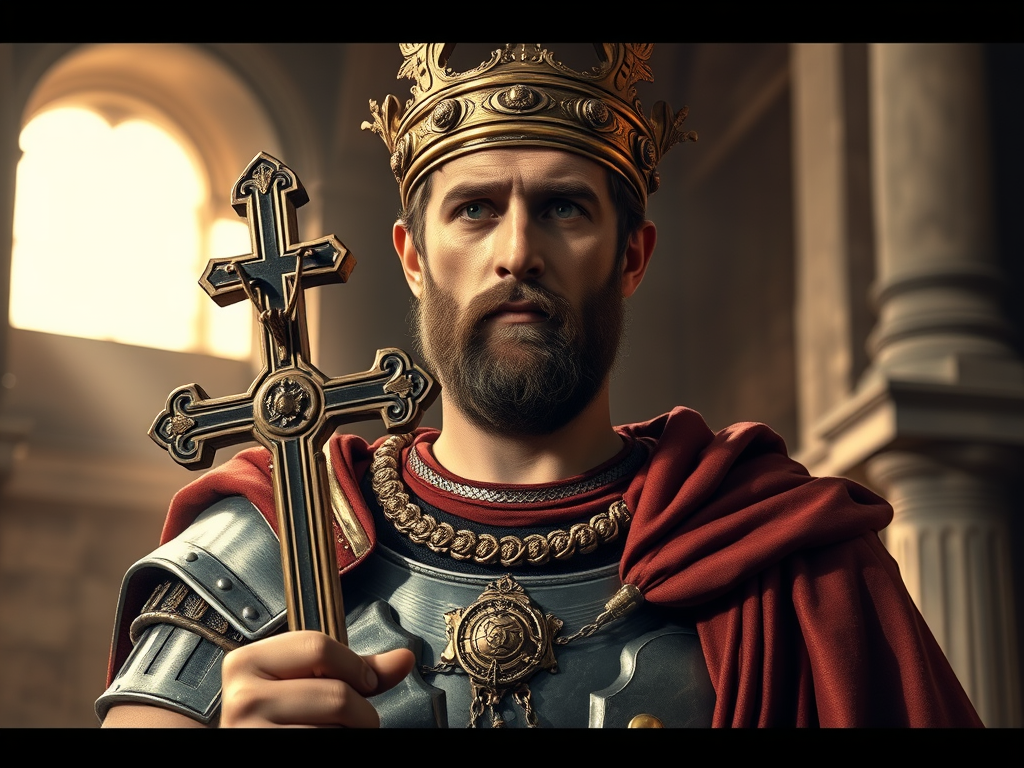
Two rivals, Constantine and Maxentius, met in an earth-shaking confrontation at the Milvian Bridge, north of Rome, over the Tiber River. Maxentius held Rome in his iron grip. As Constantine descended from the north, this brilliant general marched his smaller, battle-hardened army toward Rome. The day before the final battle, Constantine was filled with a familiar anxiety. At midday, his gaze drifted upward, away from the turmoil of his camp. There, he saw a cross of light above the sun itself, with the Greek words “Ἐν Τούτῳ Νίκα” (“In this sign, conquer”) emblazoned upon it. Later that night, another vision came to him in a dream. Christ appeared, bearing the same cross, and commanded Constantine to make this symbol his standard in battle. The symbol was the Chi-Rho, an elegant monogram formed from the first two Greek letters of “Christ.” The next day, he ordered his soldiers to paint the sacred monogram on their shields. Within hours, the two armies clashed fiercely on the plain north of Rome. Constantine’s cavalry, emblazoned with the Chi-Rho, charged with a ferocity that Maxentius’s larger army could not match. It was a decisive victory. After his victory at the Milvian Bridge, what Constantine did next—or did not do—would begin to echo through the ages. The rules of the triumph required Constantine to enter the Roman capital and offer the sacrifice of an animal to Jupiter; Constantine refused. This was because he attributed his win to the Christian God.
Constantine became the first Roman emperor to embrace and then promote Christianity. To some, this royal acceptance is what led to a corruption and decline of biblical Christianity for the centuries ahead. The worldly priorities of state power overtook the founding mission to make disciples given by Jesus (Matthew 28:19). so it is claimed. But what if Constantine had not become favorable to Christianity? Would the church have been stronger as a persecuted and minority faith? The answer is probably not. From the angle of God’s Story of Grace, Constantine was part of a kairos (“fullness of time moment”) that brought a pivotal change: he shifted the dominant religious theme of Rome from the pervasively practiced pagan blood sacrifice to a civic acknowledgment of the completed blood sacrifice of Christ. For all of Constantine’s alleged blessings and flaws, this exchange brought a pivotal shift in Western civilization.
In this article, the claim will be made that the effects of the atonement of Christ, which began to be embraced by the Roman Empire, liberated society from the fear of appeasing angry and volatile deities to providing increasing mercy to increase compassion in society. This would be a turning point for the widespread improvement of civilization reflecting the mutual and self-giving love of the Trinity.
Bloody Rome
The core of Rome’s existence was built on sacrifice. These frequently included animal offerings like rams and ox; but also human slaughter through gladiatorial games, strangling prisoners at the temple, burying prisoners of war alive, among others atrocities. Sacrifices were central to establishing favor with the deities in order to appease them for transgressions or demonstrate devotion to gain their favor. Another way this sacrificial devotion was expressed was the killing of Christians. This occurred at its greatest extent from 303 to 311, just before Constantine ascended to the throne in 312. Diocletian became emperor in 284. In 299, he participated in a sacrifice to seek the favor of the Roman Empire, while in the city of Antioch, that proved alarming. When the liver of a slaughtered animal was examined, the pagan priest said it showed unfavorable signs. For Diocletian this was very disturbing. The very peace of Rome was at stake. Theologian Peter Leithart describes what happens next:
The presiding diviner investigated and concluded that “profane persons” had interrupted the rites, and attention focused on Christians in Diocletian’s court who had made the sign of the cross to ward off demons during the proceedings. Diocletian was outraged and demanded that all members of his court offer sacrifice, a test designed to weed out Christians. Soldiers were required to sacrifice or leave the sacred Roman army. At least at the heart of the empire, in the court and in the army, sacrifices would continue without being polluted by Christians. At the heart of the empire, where it really mattered, gods and men would remain in communion.
Still the problem was not solved. Leithart continues:
Several years after the failed sacrifice, Diocletian was back in Antioch when a Christian deacon, Romanus, burst in on another imperial sacrifice loudly denouncing the worship of demons. Diocletian ordered that his tongue be cut out and sentenced him to prison, where he was executed, but the emperor knew something more needed to be done. Wintering in Nicomedia the following year, Diocletian consulted with his Caesar Galerius about the problem. “Arrogant and ambitious” and a “fanatical pagan,” Galerius urged Diocletian to issue a general order against the Christians.

Diocletian was charged with guarding the frontiers of the empire and maintaining the sacredness of Rome. It was his solemn duty to expel any pollution that might infect it and bring down the wrath of the gods. Christianity was spreading, and Christians were everywhere. From Diocletian’s point of view, Rome could only be saved by a massive sacrifice of Christian blood. What started out in 303 as an arrest and violence against Christian leaders turned into a bloodshed in the most widespread, long lasting and severe persecution which the church had ever faced under the hammer of Rome. The beginning of the end would finally occur at the battle at the Milvian Bridge in 312 and one year later the blood sacrifice of Christians ended in 313 when Constantine issued the Edict of Milan. This gave Christians legal status to practice their faith.
This was the beginning of a series of reforms which would baptize the Roman Empire in a Christian direction away from paganism. He prohibited his provincial governors from offering sacrifices at official functions, thus opening up civil offices to Christians. Eusebius, the ancient historian, claimed Constantine passed a law around 324 that “was intended to restrain the idolatrous abominations which in times past had been practiced in every city and country; and it provided that no one should erect images, or practice divination and other false and foolish arts, or offer sacrifices in any way.” In 325, he issued an edict against the gladiatorial games declaring that “bloody spectacles are not suitable for civil ease and domestic quiet.” Constantine himself fought imperial wars, but his victories were not celebrated as the honor-wars to the gods of previous emperors had done.
With Constantine, the Roman Empire became officially an empire without sacrifice or at least a bloody sacrifice. It still had acknowledgement of sacrifice, but it was the sacrifice provided once and for all by Jesus Christ. The implications had earth-quaking significance. Again, Peter Leithart explains:
Every city is sacrificial, but Constantine eliminated sacrifice in his own city and welcomed a different sacrificial city into Rome. For a fourth-century Roman, eliminating sacrifice from the city was as much as to say, “My city is no longer a city.” For a fourth-century Roman, acknowledging the church’s bloodless sacrifice as the sacrifice was as much as to say, “The church is the true city here.” When Constantine began to end sacrifice, he began to end Rome as he knew it, for he initiated the end of Rome’s sacrificial lifeblood and established that Rome’s life now depended on its adherence to another civic center, the church.
Because Rome couldn’t acknowledge the ultimate and final sacrifice for humanity, it was not free to exercise mercy. Above all God desires from his people “mercy not sacrifice.” (Hosea 6:6)
Pagan Sacrifice to the Sacrifice of Christ
The state became more compassionate. Because the sacrifice of Christ was accomplished “once and for all,” Rome no longer needed to be consumed with the brutal work of appeasing bloodthirsty entities. Rather, it could promote compassion and mercy as expressed through the message of the church. This would, in turn, bring the promotion of more just laws.
- Crucifixion was abolished.
- Funding for the poor, orphans, and widows was introduced.
- The practice of infanticide through exposing unwanted babies was made illegal. Care for unwanted children was provided for from the public treasury.
- More humane policies toward slaves was put in place.
- Branding on the faces of criminals was made illegal.
- Prison reform was inaugurated requiring that prisoners be given daylight and fresh air instead of being kept in total darkness.
- Gladiator games were banned.
- Women were given more rights in regard to their children.
- A day of rest was put in place , thereby reordering the life of society to make space for Christian worship.1
The mission of the church expanded. The Constantinian revolution created space for Christianity to shape the new society that was being constructed away from paganism. The church put forward a new idea of a separate community within society. No longer did the state control the ultimate meaning of life. The church was a gathered community within the state that brought in God’s Story of Grace in Jesus Christ. The result was a great flowering of Christian expression in art, architecture, law, theology, philosophy, and spiritual literature. None of this was imposed by the state but came as a natural outgrowth of the dynamic movement of Christianity. The number of disciples would mount across the empire. Historian Robert Louis Wilken describes the church’s growth:
The transformation that took place within the empire would be replicated again and again as Christianity spread beyond Rome’s boundaries into northern Europe, among the Franks and the Germans, the British and the Irish, the Scandinavians and the Poles, the Lithuanians and the Bulgars, the Ukrainians and the Russians, into Asia among the Armenians and Georgians, and into Africa among the Nubians and Ethiopians. For all these peoples conversion to Christianity meant a change of public practice in law, in architecture, in calendar, in marriage customs, in political institutions, in social mores, in burial practices, and much more.
Statistically, it would be at the time of Constantine that Christianity would experience an exponential growth.2
Conclusion
In Constantine, God’s Story of Grace would advance primarily with the cross triumphing over paganism, and compassion beginning to overtake the Roman jaws of power. The Christian ethic of human value would advance as a widespread value in Western culture. It would be from this place that the boundaries of Christian mission and influence would be expanded. For the first time, the organic movement of the church would intersect with the force of Roman power, and a new phase of the image of the Trinity would be born into the world. All the parts of Rome (the many) would become more unified as a larger body (the one) under the sign of the cross.3
_______________________________________________________________
- Though Constantine would have a revolutionary influence, he did not usher in a “golden age” of Christianity. Over the next decades after Constantine, Christianity would face a battle against Arianism to affirm the deity of Christ as affirmed in the Council of Nicaea. Often those like Athanasius, who affirmed the Nicaean Creed were severely persecuted.
- Rodney Stark has provided these stats on the growth of Christianity in the first four centuries: 7,500 Christians by the end of the first century (0.02% of sixty million people); 40,000 Christians by 150 AD (0.07%); 200,000 by 200 AD (0.35%); 2 million by 250 AD (2%)6 million by 300 AD (10%); 34 million by 350 AD (57%)
- Under Constantine, the church held its first ecumenical council, which affirmed the doctrine of the deity of Christ at the Nicaean Council in 325.
 Story of Grace