Two Triumphal Entries: Alexander the Great and Jesus the Messiah (Zechariah 9:1-10)

It is the distinct reality that in God’s Story of Grace, God uses even the wicked for his overall purposes and plans. Scripture testifies to this in many places.
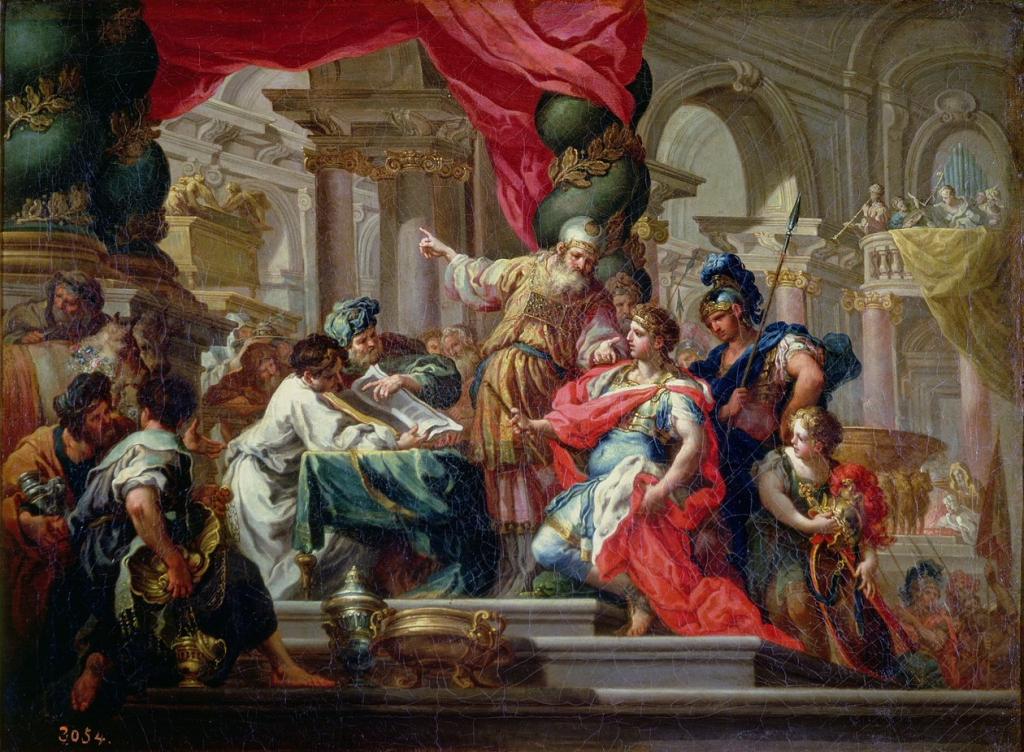
Alexander the Great in the Temple by
Sebastiano Conca (1680-1761) 

Human defiance only enhances your glory, for you use it as a weapon.”

Psalm 76:10

In this article, we will see four prophecies (these four cover a one year period) where the prophet hydroplanes over four mountain peak events where we see God uses Alexander the Great as an agent of judgement against the pride and wickedness of different regions which were near Jerusalem. Then we will see how the ambitious conqueror, instead of conquering the holy city of Jerusalem, acknowledges the God of Israel and makes sacrifices to him. This shows in a dramatic and definitive way how God is Lord even over those who oppose him. We will see how God uses evil to overturn evil and prepare the way for the Triumphal Entry of Christ to advance His Story of Grace. What will become clear is that the destructive force of Alexander’s army tears down obstinate forms of evil and opens up the way for the grace of the Messiah, Jesus Christ, to come into the world at the proper time.

An Invader From the North (Zechariah 9:1-8)

In the previous article we saw how Daniel 8:1-8 foretold about the rapid conquest of Alexander the Great’s military machine to overtake 200 million square miles of territory over three continents in thirteen years. This prophecy occurred nearly 300 years before Alexander’s time. Then emerges Zechariah, who spoke the Word of God soon after Daniel’s death, from 520 to 518 BC, and forecasted with precision a one year portion (ca. 333-332 B.C.) of Alexander’s 13 year conquest. Like Daniel, he did this with stunning accuracy a few centuries before the actual events unfolded. This is seen through the subduing of three regions along the Mediterranean Sea and then a miracle at Jerusalem.

Syria Invaded

1A prophecy:

The word of the Lord is against the land of Hadrak and will come to rest on Damascus— for the eyes of all people and all the tribes of Israel are on the Lord—
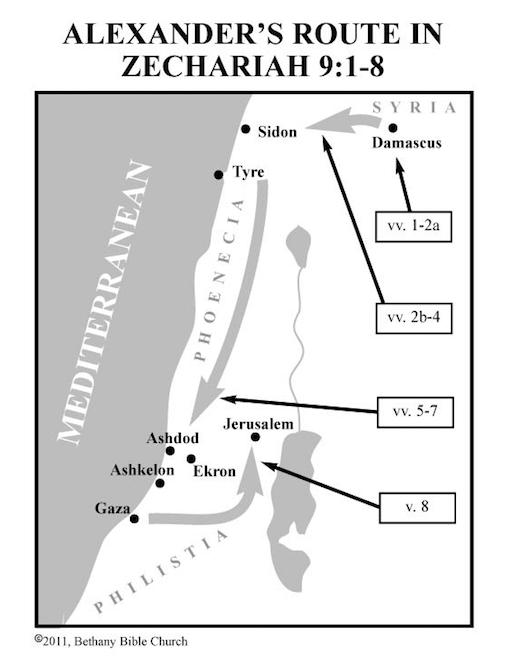
In Zechariah’s time no one would have dreamed that the Greeks could ever constitute a significantly powerful military force which would bolt through the world. In retrospect that is what is depicted in Zechariah 9. The prophecy deals with the punishment that God would visit on various city-states down the Mediterranean coast. It commences after Alexander marched into Syria in 333 BC and defeated the Persian army at the battle of Issus. It is here that the prophecy picks up with Alexander’s conquest into Damascus and will proceed southward. The prophet begins by pointing out in v.1 that God has sovereign power over Hadrach (either an ancient area or city in Syria) near Damascus. This is the only place where Hadrach is mentioned in the Old Testament, though it is mentioned in Assyrian cuneiform tablets. Hadrach may represent the far and obscure reaches of the world. What is shown through this subjugation is that “all people” will acknowledge God’s reign in the world.

Phoenicia Invaded

and on Hamath too, which borders on it, and on Tyre and Sidon,  though they are very skillful. Tyre has built herself a stronghold; she has heaped up silver like dust, and gold like the dirt of the streets. But the Lord will take away her possessions
 and destroy her power on the sea,
 and she will be consumed by fire.

In v.2 Hamath is a city to the far north of Syria. The prophet moves over to the area of Phoenicia and references the coastal cities of Tyre and Sidon. In v.3 Tyre is singled out for special attention because of its tremendous wealth, power and security which has “silver like dust, and gold like the dirt of the streets.” Not only did Tyre have great wealth, but it was known for its cunning shrewdness in business and politics. It was a city which was a model of human perfection in many ways. This brought to the leaders of the city a great arrogance. Ezekiel describes the king of Tyre as being filled with an enormous pride at an anti-Christ level, mistaking themselves for God. Ezekiel points out that Tyre was filled with pride claiming, “I am a god:”

1The word of the Lord came to me:  “Son of man, say to the ruler of Tyre, ‘This is what the Sovereign Lord says:

“‘In the pride of your heart
    you say, “I am a god;
I sit on the throne of a god
    in the heart of the seas.”
But you are a mere mortal and not a god,
    though you think you are as wise as a god.
Are you wiser than Daniel?
    Is no secret hidden from you?
By your wisdom and understanding
    you have gained wealth for yourself
and amassed gold and silver
    in your treasuries.
By your great skill in trading
    you have increased your wealth,
and because of your wealth
    your heart has grown proud.

As a result of this swelling arrogance, judgement is coming:

“‘Therefore this is what the Sovereign Lord says:

“‘Because you think you are wise,
    as wise as a god,
I am going to bring foreigners against you,
    the most ruthless of nations;
they will draw their swords against your beauty and wisdom
    and pierce your shining splendor.
They will bring you down to the pit,
    and you will die a violent death
    in the heart of the seas.
Will you then say, “I am a god,”
    in the presence of those who kill you?
You will be but a mortal, not a god,
    in the hands of those who slay you.
10 You will die the death of the uncircumcised
    at the hands of foreigners.

The destruction at the hands of foreigners came in several waves. The Babylonians besieged it for thirteen years from 586 to 573 BC. Cyrus the Great of Persia surrounded it in 539 BC. In both of these cases, though the main land became ravaged, Tyre was ultimately not subdued because it had an island isolated from the mainland. This island was highly fortified and had access to the other countries of the Mediterranean for its supplies. With its great wealth it could sustain itself under siege for years. Though the mainland was taken by conquerors, it remained for Alexander to finally destroy its island fortification. He did this by taking the rubble from the mainland of Tyre and making a causeway to the island. In seven months it was totally destroyed vindicating Ezekiel and Zechariah’s predictions.

Philistia Invaded

Ashkelon will see it and fear;
    Gaza will writhe in agony,
    and Ekron too, for her hope will wither.
Gaza will lose her king
    and Ashkelon will be deserted.
A mongrel people will occupy Ashdod,
    and I will put an end to the pride of the Philistines.
I will take the blood from their mouths,
    the forbidden food from between their teeth.
Those who are left will belong to our God
    and become a clan in Judah,
    and Ekron will be like the Jebusites.

Four of five cities of the Philistines are mentioned in vs.5-7. (Gath is the only one not mentioned.) Zechariah predicts that this tribe of people will lose its ethnic identity as a mongrel people will occupy Ashdod. Ekron will be like the Jebusites meaning Ekron will be overtaken like the Jebusites had been, when King David invaded, and it become a mixed race of people. The Greek armies subdued this area after their conquest of the Phoenicians.

Israel Spared (The Miracle!)

The next major city for the ambitious general to overrun was the Hebrew capital of Jerusalem only forty miles to the east of Philistia. This was only logical and was ripe for taking by the unquenchable appetite for conquest of the Greek army. This did not happen because Zechariah declared that Jerusalem would be given divine protection. In v.8 God declares:

But I will encamp at my temple
    to guard it against marauding forces.
Never again will an oppressor overrun my people,
    for now I am keeping watch.

Alexander, while still at the siege of Tyre, sent a letter to the Jews demanding their loyalty. They had previously pledged themselves to Darius the Mede, but when they saw that he was defeated by the Greeks at the Battle of Issus, they changed their minds. Josephus (37–100 AD) details how this prophecy was carried out:

.. [Alexander] gave his hand to the high priest and, with the Jews running beside him, entered the city. Then he went up to the temple, where he sacrificed to God under the direction of the high priest, and showed due honour to the priests and to the high priest himself. And, when the book of Daniel was shown to him, in which he had declared that one of the Greeks would destroy the empire of the Persians, he believed himself to be the one indicated; and in his joy he dismissed the multitude for the time being, but on the following day he summoned them again and told them to ask for any gifts which they might desire …

Not only did he not assault the city, and he also allowed them to practice the laws of their forefathers. Many of the Jews joined Alexander’s army and accompanied him in his mission of conquest.

What Can We Conclude From Josephus’ Account?

  1. First, in describing Alexander’s Mediterranean conquests, Zechariah declared that Jerusalem would not be taken.
  2. Second, there is no logical reason why Jerusalem should not have been captured. It was a very wealthy city when compared to some of the others which had just been overrun.
  3. Third, for some seemingly inexplicable reason, Alexander spared the city and became friendly towards the Jews.
  4. Fourth, in view of the prophecies, it is most logical to conclude that God was providentially directing the activities of the Greek ruler.

The Real Triumphal Entry

Zechariah will go on to prophesy of another conqueror in 9:9-10:

9Rejoice greatly, Daughter Zion!
    Shout, Daughter Jerusalem!
See, your king comes to you,
    righteous and victorious,
lowly and riding on a donkey,
    on a colt, the foal of a donkey.
10 I will take away the chariots from Ephraim
    and the warhorses from Jerusalem,
    and the battle bow will be broken.
He will proclaim peace to the nations.
    His rule will extend from sea to sea
    and from the River to the ends of the earth.

This is a prediction of Jesus Christ coming into Jerusalem on a donkey on His Triumphal Entry the week before his crucifixion. (Matthew 21:1-11, Mark 11:1-11, Luke 19:28-44 and John 12:12-19).  Alexander weakened the cities around Jerusalem and strengthened Jerusalem to protect and preserve the coming of the Messiah whose rule will extend from sea to sea and from the River to the ends of the earth. This is incredible evidence of God’s sovereign and providential order over history.

Alexander and Jesus Compared (Christ and Anti-Christ)

Jesus had a triumphal entry into Jerusalem Alexander had a triumphal entry into Jerusalem
Jesus is God.Alexander claimed to be God.
Jesus died for multiplied millions.Alexander killed multiplied thousands.
Jesus died in his early 30’s.Alexander died in his early 30’s.
Jesus rose from the dead and reigns forever. Alexander reigned briefly.

God in His Story of Grace would even use the pride and wickedness of Alexander to pave the way for the triumph of Jesus Christ. God uses even human defiance as a weapon to accomplish his purposes to advance His Story of Grace.

How Alexander the Great Prepared the Advance Christianity (Daniel 8:1-21)

Wall Painting of Alexander the Great

Alexander the Great (356 BC – 323 BC) was a world historical force with “god-like” powers to shift the entire directions of nations and continents. In a period of 12 years he conquered the Persian Empire which spanned from Egypt to India and extended his conquests to cover approximately 2 million square miles. He achieved legendary victories in some of the most epic battles which displayed a tactical brilliance of extraordinary skill. As a result he spread the culture and language of the Greeks which would pave the way eventually for the Roman Empire and allow for the rapid advance of Christianity 300 years later. In this article and the next articles we will see how God, in His Story of Grace, used Alexander to expand civilization after the trinitarian image of bringing increased unity (the one) among the nations which carried with it the idea of individual freedom (the many). We will also see that Alexander’s record is tragically mixed.

In this article we will look at Alexander from the perspective of biblical prophecy in Daniel 8. We will understand that the large scale events of history and the world are under God’s hand to accomplish His Story of Grace.

Daniel’s Vision

Daniel received a prophecy regarding the overthrow of the Persian Empire and the advance of the Greek Empire around 553-554 B.C., approximately 200 years before it unfolded. The language is apocalyptic (which means to “unveil”). It opens up the curtain of what is seen so that we may peer beyond what we naturally see to understand bigger realities shaping world events. To do this it uses ideas and concepts we do understand to reveal concepts and ideas we do not as easily understand. Daniel is given the vision of a ram with two horns (representing Persia) and a goat with one horn between its eyes (representing Greece and the conquest of Alexander). The vision reads as follows:

1In the third year of King Belshazzar’s reign, I, Daniel, had a vision, after the one that had already appeared to me. In my vision I saw myself in the citadel of Susa in the province of Elam; in the vision I was beside the Ulai Canal. I looked up, and there before me was a ram with two horns, standing beside the canal, and the horns were long. One of the horns was longer than the other but grew up later. I watched the ram as it charged toward the west and the north and the south. No animal could stand against it, and none could rescue from its power. It did as it pleased and became great.As I was thinking about this, suddenly a goat with a prominent horn between its eyes came from the west, crossing the whole earth without touching the ground. It came toward the two-horned ram I had seen standing beside the canal and charged at it in great rage. I saw it attack the ram furiously, striking the ram and shattering its two horns. The ram was powerless to stand against it; the goat knocked it to the ground and trampled on it, and none could rescue the ram from its power. The goat became very great, but at the height of its power the large horn was broken off, and in its place four prominent horns grew up toward the four winds of heaven.

The vision is interpreted for Daniel by Gabriel the angel. The interpretation reads as follows:

15 While I, Daniel, was watching the vision and trying to understand it, there before me stood one who looked like a man. 16 And I heard a man’s voice from the Ulai calling, “Gabriel, tell this man the meaning of the vision.” 17 As he came near the place where I was standing, I was terrified and fell prostrate. “Son of man,” he said to me, “understand that the vision concerns the time of the end.” 18 While he was speaking to me, I was in a deep sleep, with my face to the ground. Then he touched me and raised me to my feet. 19 He said: “I am going to tell you what will happen later in the time of wrath, because the vision concerns the appointed time of the end. 20 The two-horned ram that you saw represents the kings of Media and Persia. 21 The shaggy goat is the king of Greece, and the large horn between its eyes is the first king.

These identifiers by Gabriel point to the fact that the Ram represents Media (elite rulers of Babylon) and Persia (who overtakes Media). There are, then, several ways this vision demonstrates the spiritual realities behind Alexander the Great and the advance of Greek culture.

Meaning # 1: Alexander’s Rapid Power

a goat with a prominent horn between its eyes came from the west, crossing the whole earth without touching the ground. (Daniel 8:5)

The Macedonians, from which Alexander came, were called “goat people.” Commentator Joseph Benson explains:

This is because, according to one report, their first king was commanded by the oracle to take the goats for his guides to empire. Afterward, seeing a herd of goats flying from a violent storm, he followed them to Edessa, and there fixed the seat of his empire, made the goats his ensigns, or standards, and called the city The Goats’ Town.

After 13 years he conquered an empire that stretched from the Balkans to northern India with his armies travelling some 20,000 miles. Through this he fought 20 major battles with no losses; he named 70 cities after himself, conquering an area spanning three continents covering approximately two million square miles.  

Meaning # 2: Alexander’s Ruthless and Total Conquest

It came toward the two-horned ram I had seen standing beside the canal and charged at it in great rage. I saw it attack the ram furiously, striking the ram and shattering its two horns. The ram was powerless to stand against it; the goat knocked it to the ground and trampled on it, and none could rescue the ram from its power. (Daniel 8:6-7)

When the vision describes “the goat knocked it to the ground and trampled in it,” this describes the ruthless and complete nature of the conquest over Persia. At the battle of Issus, Darius offered concessions of land for peace. Alexander wanted more than concessions; he wanted to be recognized as sole ruler of the Persian territories. Darius was unwilling, and so Alexander mercilessly crushed Persia. In the ensuing battle there are claims that the Greek army killed up to 100,000 in the battle. If this number is true, it would amounted to 200 to 300 men killed a minute for 8 hours. This one battle is illustrative of how this world conqueror brought a level of carnage and destruction which the world had never seen. Historical scholar of Greek antiquity, Victor Davis Hanson, estimates that his armies may, in all of their battles combined, have killed around 1,000,000.

Meaning # 3: Civil War and Division

The goat became very great, but at the height of its power the large horn was broken off, and in its place four prominent horns grew up toward the four winds of heaven. (Daniel 8:8)

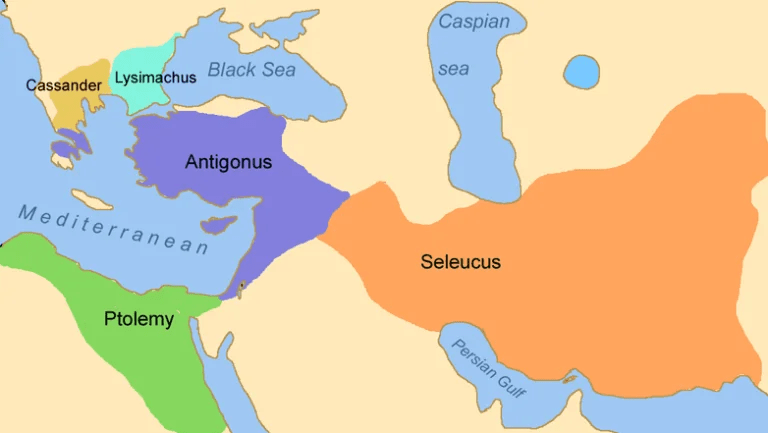
At this great peak, Alexander’s life comes to a sudden end. This is represented in Daniel 8:8 as a “large horn was broken off.” How he died “at the height of his power,” with millions upon millions as his subjects, is uncertain. Some theories are infectious disease, poisoning, or alcoholism. The definitive cause(s) are not known. What is known is that he had no successor. This then led to an eruption of civil strife which led to the Wars of Diadochi (meaning successor). These wars lasted almost for half a century (roughly 322-275 BC) and involved multiple battles and alliances. The most prominent figures in the battles were Antigonus, Cassander, Ptolemy, and Seleucus. These are the four prominent horns in Daniel 8:8. That they grew up toward the four winds of heaven means they eventually carved out their own kingdoms in what became known as the Hellenistic period.  (The word “Hellen” means Greek.) This division resulted in the formation of separate powerful and independent kingdoms:

Ptolemaic Kingdom: Ptolemy established control over Egypt and its surrounding territories. 

Seleucid Empire: Seleucus took control of the eastern regions, including Persia and Mesopotamia. 

Antigonid Kingdom: Antigonus and later his descendants ruled over Macedonia and Greece.

Other: Lysimachus controlled part of Asia Minor and Cassander controlled part of Greece which Antigonus did not. 

This is described in a later chapter of Daniel, as well:

Then a mighty king will arise, who will rule with great power and do as he pleases. After he has arisen, his empire will be broken up and parceled out toward the four winds of heaven. It will not go to his descendants, nor will it have the power he exercised, because his empire will be uprooted and given to others. (Daniel 11:3-4)

A Monumental Shift in Civilization

We will look at the negative implications of Alexander’s conquests in a later article. Yet, the fact is that God used Alexander the Great to prepare the way for advancing His Story of Grace.

Greek Language: Because of Alexander the Great, the Greek language became the common or business language from Egypt to India. Each territory had its own native language, but each one learned to speak Greek. This allowed for rapid communication since the world was able to speak a common tongue. It is for this reason that over 300 years later after Alexander the 27 books of the New Testament was penned in Greek. Everyone could read this and have access to the New Testament letters.

Greek Culture: Not only was there the spread of Greek language, but there was also the spread of art, architecture, philosophy, and political ideas across a vast area. Greek culture did not replace existing cultures but blended with them. This was monumental because it was the first time in which there was a international blending of one culture into many different ones. A result of this is that in many ways Christianity became a blend of Jewish and Greek cultures. Because of the migration of Greek culture to the East, it would forever shape Christian thinking and practice. This is seen first and foremost in the doctrine of Logos (John 1:1) which would lead to our understanding of the Trinity, with the Son at the eternal Logos of the Father.

Other: The spread of Greek culture made possible by Alexander had impacts on political structures, art, architecture, travel, commerce, science and medicine. These would lay a foundation for the growth of what would become the Roman Empire.

Conclusion

What is most noteworthy was that Daniel prophesied the advance of Alexander and the spread of Hellenism. Daniel did not use the name (Alexander) or the term (Hellenism). This was beyond the scope of his prophesy. His purpose was not to focus on the seen realities but to address the unseen spiritual realities behind the seen ones. As Daniel write earlier in his book:

He changes times and seasons;
    he deposes kings and raises up others.
He gives wisdom to the wise
    and knowledge to the discerning.
(Daniel 2:21)