Two Triumphal Entries: Alexander the Great and Jesus the Messiah (Zechariah 9:1-10)

It is the distinct reality that in God’s Story of Grace, God uses even the wicked for his overall purposes and plans. Scripture testifies to this in many places.
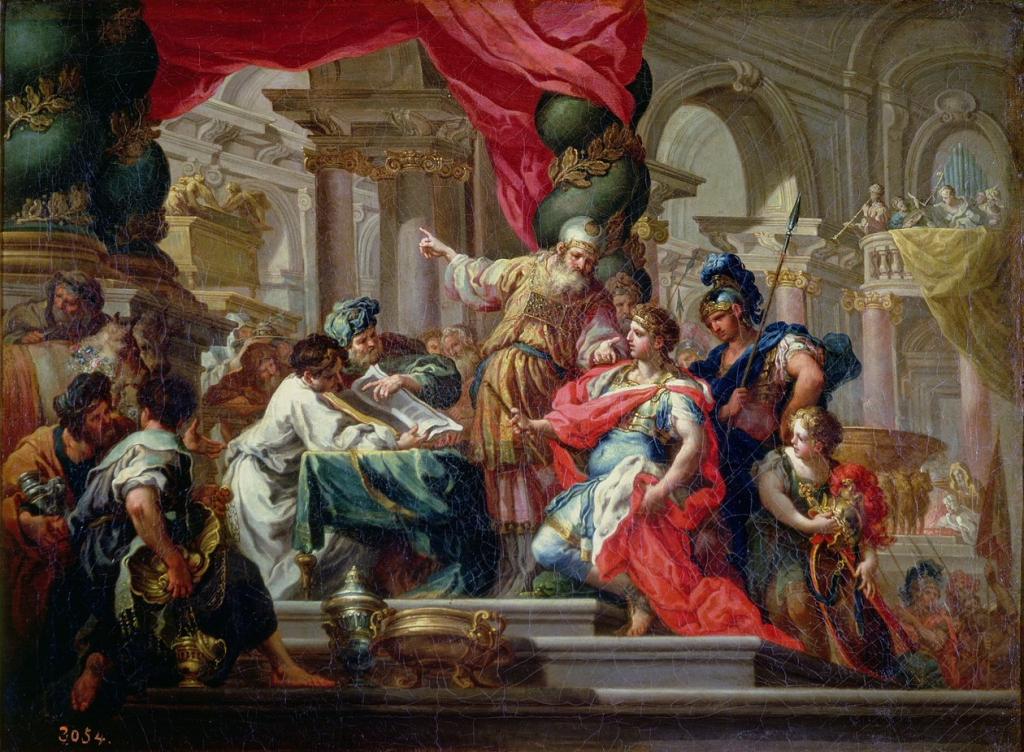
Alexander the Great in the Temple by
Sebastiano Conca (1680-1761) 

Human defiance only enhances your glory, for you use it as a weapon.”

Psalm 76:10

In this article, we will see four prophecies (these four cover a one year period) where the prophet hydroplanes over four mountain peak events where we see God uses Alexander the Great as an agent of judgement against the pride and wickedness of different regions which were near Jerusalem. Then we will see how the ambitious conqueror, instead of conquering the holy city of Jerusalem, acknowledges the God of Israel and makes sacrifices to him. This shows in a dramatic and definitive way how God is Lord even over those who oppose him. We will see how God uses evil to overturn evil and prepare the way for the Triumphal Entry of Christ to advance His Story of Grace. What will become clear is that the destructive force of Alexander’s army tears down obstinate forms of evil and opens up the way for the grace of the Messiah, Jesus Christ, to come into the world at the proper time.

An Invader From the North (Zechariah 9:1-8)

In the previous article we saw how Daniel 8:1-8 foretold about the rapid conquest of Alexander the Great’s military machine to overtake 200 million square miles of territory over three continents in thirteen years. This prophecy occurred nearly 300 years before Alexander’s time. Then emerges Zechariah, who spoke the Word of God soon after Daniel’s death, from 520 to 518 BC, and forecasted with precision a one year portion (ca. 333-332 B.C.) of Alexander’s 13 year conquest. Like Daniel, he did this with stunning accuracy a few centuries before the actual events unfolded. This is seen through the subduing of three regions along the Mediterranean Sea and then a miracle at Jerusalem.

Syria Invaded

1A prophecy:

The word of the Lord is against the land of Hadrak and will come to rest on Damascus— for the eyes of all people and all the tribes of Israel are on the Lord—
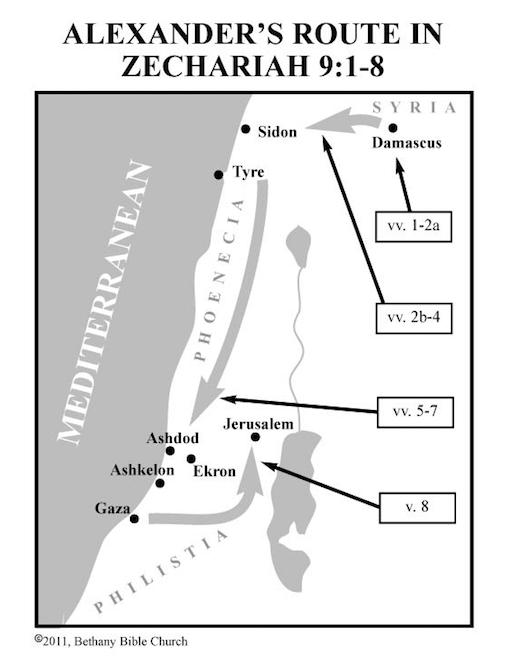
In Zechariah’s time no one would have dreamed that the Greeks could ever constitute a significantly powerful military force which would bolt through the world. In retrospect that is what is depicted in Zechariah 9. The prophecy deals with the punishment that God would visit on various city-states down the Mediterranean coast. It commences after Alexander marched into Syria in 333 BC and defeated the Persian army at the battle of Issus. It is here that the prophecy picks up with Alexander’s conquest into Damascus and will proceed southward. The prophet begins by pointing out in v.1 that God has sovereign power over Hadrach (either an ancient area or city in Syria) near Damascus. This is the only place where Hadrach is mentioned in the Old Testament, though it is mentioned in Assyrian cuneiform tablets. Hadrach may represent the far and obscure reaches of the world. What is shown through this subjugation is that “all people” will acknowledge God’s reign in the world.

Phoenicia Invaded

and on Hamath too, which borders on it, and on Tyre and Sidon,  though they are very skillful. Tyre has built herself a stronghold; she has heaped up silver like dust, and gold like the dirt of the streets. But the Lord will take away her possessions
 and destroy her power on the sea,
 and she will be consumed by fire.

In v.2 Hamath is a city to the far north of Syria. The prophet moves over to the area of Phoenicia and references the coastal cities of Tyre and Sidon. In v.3 Tyre is singled out for special attention because of its tremendous wealth, power and security which has “silver like dust, and gold like the dirt of the streets.” Not only did Tyre have great wealth, but it was known for its cunning shrewdness in business and politics. It was a city which was a model of human perfection in many ways. This brought to the leaders of the city a great arrogance. Ezekiel describes the king of Tyre as being filled with an enormous pride at an anti-Christ level, mistaking themselves for God. Ezekiel points out that Tyre was filled with pride claiming, “I am a god:”

1The word of the Lord came to me:  “Son of man, say to the ruler of Tyre, ‘This is what the Sovereign Lord says:

“‘In the pride of your heart
    you say, “I am a god;
I sit on the throne of a god
    in the heart of the seas.”
But you are a mere mortal and not a god,
    though you think you are as wise as a god.
Are you wiser than Daniel?
    Is no secret hidden from you?
By your wisdom and understanding
    you have gained wealth for yourself
and amassed gold and silver
    in your treasuries.
By your great skill in trading
    you have increased your wealth,
and because of your wealth
    your heart has grown proud.

As a result of this swelling arrogance, judgement is coming:

“‘Therefore this is what the Sovereign Lord says:

“‘Because you think you are wise,
    as wise as a god,
I am going to bring foreigners against you,
    the most ruthless of nations;
they will draw their swords against your beauty and wisdom
    and pierce your shining splendor.
They will bring you down to the pit,
    and you will die a violent death
    in the heart of the seas.
Will you then say, “I am a god,”
    in the presence of those who kill you?
You will be but a mortal, not a god,
    in the hands of those who slay you.
10 You will die the death of the uncircumcised
    at the hands of foreigners.

The destruction at the hands of foreigners came in several waves. The Babylonians besieged it for thirteen years from 586 to 573 BC. Cyrus the Great of Persia surrounded it in 539 BC. In both of these cases, though the main land became ravaged, Tyre was ultimately not subdued because it had an island isolated from the mainland. This island was highly fortified and had access to the other countries of the Mediterranean for its supplies. With its great wealth it could sustain itself under siege for years. Though the mainland was taken by conquerors, it remained for Alexander to finally destroy its island fortification. He did this by taking the rubble from the mainland of Tyre and making a causeway to the island. In seven months it was totally destroyed vindicating Ezekiel and Zechariah’s predictions.

Philistia Invaded

Ashkelon will see it and fear;
    Gaza will writhe in agony,
    and Ekron too, for her hope will wither.
Gaza will lose her king
    and Ashkelon will be deserted.
A mongrel people will occupy Ashdod,
    and I will put an end to the pride of the Philistines.
I will take the blood from their mouths,
    the forbidden food from between their teeth.
Those who are left will belong to our God
    and become a clan in Judah,
    and Ekron will be like the Jebusites.

Four of five cities of the Philistines are mentioned in vs.5-7. (Gath is the only one not mentioned.) Zechariah predicts that this tribe of people will lose its ethnic identity as a mongrel people will occupy Ashdod. Ekron will be like the Jebusites meaning Ekron will be overtaken like the Jebusites had been, when King David invaded, and it become a mixed race of people. The Greek armies subdued this area after their conquest of the Phoenicians.

Israel Spared (The Miracle!)

The next major city for the ambitious general to overrun was the Hebrew capital of Jerusalem only forty miles to the east of Philistia. This was only logical and was ripe for taking by the unquenchable appetite for conquest of the Greek army. This did not happen because Zechariah declared that Jerusalem would be given divine protection. In v.8 God declares:

But I will encamp at my temple
    to guard it against marauding forces.
Never again will an oppressor overrun my people,
    for now I am keeping watch.

Alexander, while still at the siege of Tyre, sent a letter to the Jews demanding their loyalty. They had previously pledged themselves to Darius the Mede, but when they saw that he was defeated by the Greeks at the Battle of Issus, they changed their minds. Josephus (37–100 AD) details how this prophecy was carried out:

.. [Alexander] gave his hand to the high priest and, with the Jews running beside him, entered the city. Then he went up to the temple, where he sacrificed to God under the direction of the high priest, and showed due honour to the priests and to the high priest himself. And, when the book of Daniel was shown to him, in which he had declared that one of the Greeks would destroy the empire of the Persians, he believed himself to be the one indicated; and in his joy he dismissed the multitude for the time being, but on the following day he summoned them again and told them to ask for any gifts which they might desire …

Not only did he not assault the city, and he also allowed them to practice the laws of their forefathers. Many of the Jews joined Alexander’s army and accompanied him in his mission of conquest.

What Can We Conclude From Josephus’ Account?

  1. First, in describing Alexander’s Mediterranean conquests, Zechariah declared that Jerusalem would not be taken.
  2. Second, there is no logical reason why Jerusalem should not have been captured. It was a very wealthy city when compared to some of the others which had just been overrun.
  3. Third, for some seemingly inexplicable reason, Alexander spared the city and became friendly towards the Jews.
  4. Fourth, in view of the prophecies, it is most logical to conclude that God was providentially directing the activities of the Greek ruler.

The Real Triumphal Entry

Zechariah will go on to prophesy of another conqueror in 9:9-10:

9Rejoice greatly, Daughter Zion!
    Shout, Daughter Jerusalem!
See, your king comes to you,
    righteous and victorious,
lowly and riding on a donkey,
    on a colt, the foal of a donkey.
10 I will take away the chariots from Ephraim
    and the warhorses from Jerusalem,
    and the battle bow will be broken.
He will proclaim peace to the nations.
    His rule will extend from sea to sea
    and from the River to the ends of the earth.

This is a prediction of Jesus Christ coming into Jerusalem on a donkey on His Triumphal Entry the week before his crucifixion. (Matthew 21:1-11, Mark 11:1-11, Luke 19:28-44 and John 12:12-19).  Alexander weakened the cities around Jerusalem and strengthened Jerusalem to protect and preserve the coming of the Messiah whose rule will extend from sea to sea and from the River to the ends of the earth. This is incredible evidence of God’s sovereign and providential order over history.

Alexander and Jesus Compared (Christ and Anti-Christ)

Jesus had a triumphal entry into Jerusalem Alexander had a triumphal entry into Jerusalem
Jesus is God.Alexander claimed to be God.
Jesus died for multiplied millions.Alexander killed multiplied thousands.
Jesus died in his early 30’s.Alexander died in his early 30’s.
Jesus rose from the dead and reigns forever. Alexander reigned briefly.

God in His Story of Grace would even use the pride and wickedness of Alexander to pave the way for the triumph of Jesus Christ. God uses even human defiance as a weapon to accomplish his purposes to advance His Story of Grace.

The Birth of the World’s Most Important Idea: LOGOS

The emergence of philosophy comes from an obscure philosopher from Ephesus named Heraclitus (540-480 B.C.). As the first philosopher of the West, he gave society, its most foundational and important concept: LOGOS (Word). Little is known about his life, and what we have of his writings exists in 129 fragments (brief proverbs, teachings and statements). He was an alone and solitary figure who did not have much use for the masses. As such, he was not a fan of popular democracy which made decisions based off of the will of the majority. Yet, this solitary figure was the first to coin and inspire a concept which would grow to become the most important idea in Western Civilization and more importantly Christian revelation and theology: the Greek term LOGOS which means WORD.

It was this concept of the LOGOS which would become a central organizing idea for understanding and developing science, mathematics, and psychology. Yet, of even greater importance, the concept of LOGOS became a key basis to formulate the understanding of a unified and transcendent God for the gentiles and later an organizing basis for understanding Jesus Christ and the Trinity. Of the 129 fragments of Heraclitus, 3 of them reference the LOGOS directly (Fragments 1, 2 & 50). In addition, other parts of the fragments provide clues as to the philosopher’s thinking. We will look at the three fragments where the LOGOS is directly mentioned; then we will look at other statements of the fragments which provide additional meaning to LOGOS. Finally, we will examine how, in God’s Story of Grace, the LOGOS concept provided a framework to advance human understanding of science, psychology, mathematics and theology.

Heraclitus and the LOGOS

For Heraclitus, the LOGOS was the underlying reality which brings order through all of the changes to the cosmos.

Fragment # 1

Though this Word is true evermore, yet men are as unable to understand it when they hear it for the first time as before they have heard it at all. For, though all things come to pass in accordance with this Word, men seem as if they had no experience of them, when they make trial of words and deeds such as I set forth, dividing each thing according to its kind and showing how it is what it is. But other men know not what they are doing when awake, even as they forget what they do in sleep. (Fragment 1)

Depiction of Heraclitus

Though a somewhat obscure statement, Heraclitus communicates three principles about the LOGOS:

  1. The Word (LOGOS) is always true (true evermore).
  2. The Word (LOGOS) brings all thing to pass, and is before all things (all things come to pass in accordance).
  3. Men barely comprehend and are largely blind to the Word (LOGOS) even though it is the basis of all existence.

Fragment # 2

Though the logos is common, the many live as if they had a wisdom of their own. (Fragment 2)

In this fragment there are two principles which stand in support of what is already observed in Fragment # 1.

  1. The Word (LOGOS) is not only “ever true” (Fragment 1), but it appears to be ever present (logos is common).
  2. Most do not comprehend it or are willfully blind to it because they live as if “they had a wisdom of their own.”

Though the term LOGOS is not used in Fragment 72, Heraclitus gives additional meaning to what we see in Fragment 2.

Most are at odds with that with which they most constantly associate — the account which governs the universe — and … what they meet with every day seems foreign to them. (Fragment 72)

Fragment # 50

 It is wise to hearken, not to me, but to my Word, and to confess that all things are one. (Fragment 50)

Heraclitus, in Fragment 50, appears to see himself as one who expressed the Word (LOGOS). He sees his task as expressing the truth and wisdom of the LOGOS. There are at least two supporting principles that can be seen in this fragment.

  1. The Word (LOGOS) is accessible to people (hearken…to my Word).
  2. The Word (LOGOS) is the unifying reality in and under everything which exists (all things are one).

Summary

A summary of his thinking on the LOGOS would be as follows:

  • Truth # 1: LOGOS is the creative reality by which everything exists and which everything is sustained.
  • Truth # 2: Men do not perceive its reality and often remain in a foolish blindness.
  • Truth # 3: The task of the philosopher is to lead men to live by the LOGOS.

Additional Concepts of LOGOS

Fire

Depiction of Artemis

These shreds of statements may not seem significant. Keep in mind, however, that this is the very first effort for anyone to systematically express that there is a larger unifying reality behind all that is seen. As Heraclitus is relating to his audience, he references common realities as symbols of LOGOS. One of those is fire. German philosopher Martin Heidegger sees that the ancient teacher of wisdom connects LOGOS to fire because the prominent goddess in Ephesus was Artemis–THE LIGHT-BEARER. Artemis was sometimes depicted as one who carries a torch of light in both hands. Five hundred years later it is seen that Artemis was still the chief deity of the city because when Paul was in Ephesus (the very same city of Heraclitus), he caused an uproar as his preaching of Christ posed a threat. This is reported for us in Acts as Demetrius the silversmith, who made silver shrines of Artemis, leads the city in a revolt against Paul (see Acts 19:26-27).

Martin Heidegger interprets Heraclitus’ use of fire as symbolic of how the LOGOS brings light and clarity, revealing what is concealed. In Fragment 30, the sage uses this symbol of Artemis’ fire as a way of showing that the light Artemis is bearing is the LOGOS. This relativizes Artemis with the goal of pointing people to focus on the LOGOS.

This world, which is the same for all, no one of gods or men has made. But it always was, is, and will be: an ever-living Fire… (Fragment 30)

In Fragment 66, the philosopher indicates that the fire (LOGOS) brings judgement to everything. All that is not in alignment with its order experiences a type of correction.

Fire in its advance will judge and convict all things. (Fragment 66)

Soul

In addition, the Greek thinker advances the idea of the soul. He sees the immaterial soul as greater than what anything in this world can fill. The implication is that the soul is closer to its purpose and meaning in the LOGOS than in the physical world.

You will not find the boundaries of soul by travelling in any direction, so deep is the measure of it. (Fragment 45)

The idea that the soul is not meant primarily for this world, and even finds this world to be destructive to it, is expressed in Fragment 85. We see the soul will fight with desire and pay a cost for it.

It is hard to fight with one’s heart’s desire. Whatever it wishes to get, it purchases at the cost of soul. (Fragment 85)

To this is added the idea that the soul increases the influence of the LOGOS in the world in Fragment 115.

To the soul, belongs the self-multiplying Logos. (Fragment 115)

There is much more we can share in regard to Heraclitus and his understanding of the LOGOS. Another idea to explore, but goes beyond the scope of this article is the idea of the reality of LOGOS realized through the tension of opposites. That can be discussed another time.

Let’s end this article by posing several question and providing answers.

Questions and Answers

Question # 1: What difference did this understanding of the LOGOS make in Western Civilization? In the Greek influenced world (like Ephesus), there was no ordered religion which provided a unified way of thinking. There was simply chaos of the gods. It was often the case that different cities had different understandings of the same gods. This was a significant cause which kept the city-states independent from each other. With the introduction of LOGOS, the idea was now advanced that there was a reality beyond what is seen that holds everything together. The LOGOS would become the source of a more unified and systematic understanding of reality beyond the appearance of disorder and chaos. This would eventually provide a framework for advancing science (an ordered understanding of nature), psychology (an ordered understanding of the soul), mathematics (an ordered understanding of structure) and most importantly theology (an ordered and unified understanding of God).

Question # 2: Why was the term LOGOS used to express this reality? LOGOS, which means Word or Speech, communicates the idea that we see indirectly an intelligible rationality behind the universe. It does so in the fact that words, whether heard through the ear (speech) or seen through the eye (writing), shows the evidence of an intentional and intelligible presence, even when we do not see a person present. This evidence of intentionality and intelligence, logically, points to a personal being behind all of this–God. Though this creative and personal being is not directly seen, his speech is. In the midst of the chaos of the world, there is behind all of it an ordered logic (e.g., math and science) and appearance of a creative purpose (e.g., love and justice). The Bible affirms this in both the Old and New Testaments.

Old Testament

The heavens declare the glory of God;
    the skies proclaim the work of his hands.
Day after day they pour forth speech;
    night after night they reveal knowledge.
They have no speech, they use no words;
    no sound is heard from them. (Psalm 19:1-3)

New Testament

20 For since the creation of the world God’s invisible qualities—his eternal power and divine nature—have been clearly seen, being understood from what has been made… (Romans 8:20)

Question # 3: How does the LOGOS relate to Christ? The gospel of John begins with describing Jesus as the LOGOS.

In the beginning was the Word (LOGOS), and the Word (LOGOS) was with God, and the Word (LOGOS) was God. (John 1:1)

John’s equating of Jesus with the LOGOS was extremely important for the development of how Jesus was revealed and came to be understood in relation to the Father and the Holy Spirit as Trinity. Because Jesus is the LOGOS (The Word of God the Father), that means that the Father and the Son are inseparable. As the LOGOS, Jesus is like the speech of God the Father who created the whole universe. Bruce Hillman adds insight, “When God spoke the universe into creation, it was the Logos that proceeded from his ‘mouth,’ a Word.” This means that the Word was God. There was no time that the Word (the speech/thought) of God did not exist. Hillman goes on to explain:

And when the Logos took on flesh and lived among us, he did not cease being God’s Logos and, therefore, still eternally God. Before the incarnation, the Logos did not have a body, ;but for our sake became man.’ Thus, in his incarnation, the Logos became Jesus, the God-Man. The Logos makes salvation possible because it merges God and Man in the incarnation of Jesus Christ.

“When God spoke the universe into creation, it was the Logos that proceeded from
his ‘mouth,’ a Word.”

Bruce Hillman

Summary

Nearly 500 years before Christ, God had been working through the Greeks to birth a fundamental concept that would clarify not only our understanding of the world, but it would provide the framework and language for the depth of our understanding of Jesus Christ and the Trinity. This was through an obscure philosopher known by the name of Heraclitus.