Fire From the Throne, Light In the World (Excursus on Daniel 7)

This is a second article providing an excursus (a more focused discussion) on the purpose and scope of the Story of Grace project. As stated in the first article on What the Story Of Grace Is All About (Excursus on Colossians 1:15-17):

It is the understanding of how God’s decisive acts of creation and redemption are unfolding through the entire scope of history reclaiming and transforming everything to participate in the likeness of the Trinity.

In this referenced article above, three guiding truths are elaborated from Colossians 1:15-17:

  1. In God’s Story Jesus is Creator and Redeemer of all creation.
  2. In God’s Story everything is being renewed into the likeness of the Trinity.
  3. In God’s Story redemption and renewal is universal in scope.

In this second excursus, we will examine these very same three claims through another scriptural lens: Daniel 7. Daniel 7 is notable in that it is either quoted or alluded to a total of 58 times in the New Testament.1 These fours beasts (which we will soon see) represent four empires which cover about 1,000 years of history.2  Why are each of these nations called beasts? It possibly highlights their predatory and beast like behavior apart from the power of God. Because the taming power within these empires which limits their destructive deadliness is the restraining and overruling grace of God as seen in vs.9-10 and vs.13-14. Through this passage, we will see another picture of God’s Story of Grace unfolding with a central revelation God gives in the midst of history’s sweep.

Premise # 1: In God’s Story Jesus is Creator and Redeemer of all creation.

Daniel, writing in his mid 60’s (553 B.C.), begins the record of his dream:

In the first year of Belshazzar king of Babylon, Daniel had a dream, and visions passed through his mind as he was lying in bed. He wrote down the substance of his dream. (Daniel 7:1)

It is significant that Daniel receives this dream at this time because Belshazzar would be the last king of Babylon before Cyrus of Persia would overtake them. Daniel was recording this revelation at the beginning of Belshazzar’s reign.

Daniel said: “In my vision at night I looked, and there before me were the four winds of heaven churning up the great sea.” (Daniel 7:2)

The four winds of heaven churning up the great sea represents the chaos of the world in which the four beasts (vs.3-8) are about to emerge. This is the beast like and predatory world which has fallen away from the order of God’s creative purposes. The world is not naturally good. As Thomas Hobbes wrote in Leviathan about man in a state of nature is “solitary, poor, nasty, brutish, and short.” Daniel’s dream provides a picture of this brutish nature apart from the grace of God.

He goes on the describe these four beasts which covers a period of around 1,000 years.

Four great beasts, each different from the others, came up out of the sea.“The first was like a lion, and it had the wings of an eagle. I watched until its wings were torn off and it was lifted from the ground so that it stood on two feet like a human being, and the mind of a human was given to it.“And there before me was a second beast, which looked like a bear. It was raised up on one of its sides, and it had three ribs in its mouth between its teeth. It was told, ‘Get up and eat your fill of flesh!’“After that, I looked, and there before me was another beast, one that looked like a leopard. And on its back it had four wings like those of a bird. This beast had four heads, and it was given authority to rule. “After that, in my vision at night I looked, and there before me was a fourth beast—terrifying and frightening and very powerful. It had large iron teeth; it crushed and devoured its victims and trampled underfoot whatever was left. It was different from all the former beasts, and it had ten horns. (Daniel 7:3-7)

These four beast can be outlined as follows:

Lion…Babylon. (v.4)  605 – 539 BC

Bear…Persia.  (v.5) 539 – 333 BC

Leopard…Greece. (v.6) 333 – 146 BC

Ten Horn Beast…Rome. (v.7) 146 BC – 476 AD

Verse 8 goes on to elaborate in regard to the fourth beast (Rome)

“While I was thinking about the horns, there before me was another horn, a little one, which came up among them; and three of the first horns were uprooted before it. This horn had eyes like the eyes of a human being and a mouth that spoke boastfully. (Daniel 7:8)

Some see this verse as catapulting Daniel way into the future with a picture of the anti-Christ in a revived Roman Empire before Christ returns to earth. (see Revelation 13:1-4) Others see this as representing a historical figure coming out of the Roman Empire. Whatever the interpretation may be, what stands out in the sharpest contrast is what is revealed next in vs.9-10:

As I looked,

thrones were set in place,
    and the Ancient of Days took his seat.
His clothing was as white as snow;
    the hair of his head was white like wool.
His throne was flaming with fire,
    and its wheels were all ablaze.
10 A river of fire was flowing,
    coming out from before him.
Thousands upon thousands attended him;
    ten thousand times ten thousand stood before him.
The court was seated,
    and the books were opened.
(Daniel 7:9-10)

This is a revelation of God calmly coming to take his place as ruler and judge. As Ancient of Days:

  • Nothing gets by him.
  • Nothing surprises him.
  • He never learns anything.
  • He never misunderstands anything.
  • He is never caught off guard.
  • There’s never been a time he wasn’t fully in charge.

He is in no way shaken by these beasts.

What unfolds over the next five verses is a revelation of the Trinity. Daniel says that there were thrones (plural) set in place. There is more than one ruler and judge, one who sits along side the Ancient of Days. From the context of this verse the only other ruler and judge can be the Son of Man (Jesus the Messiah) as seen in vs.13-14, which we will view shortly.

The Father

The title Ancient of Days is a highly revered reference to God the Father.

The Holy Spirit

9His throne was flaming with fire,
    and its wheels were all ablaze.
10 A river of fire was flowing,
    coming out from before him.

What is described with the picture of the throne with wheels ablaze is the moving omnipresence (everywhere presence) of God which extends his reach through a flowing river of fire that is coming out from before him. This fire flowing from the throne of God appears to be a symbolic picture of the Holy Spirit present on the earth carrying out the rule of the Father. The scriptures often equate the Holy Spirit with the presence of fire.3 It is this fire (the Holy Spirit) which will be poured out upon the earth at Pentecost in an intensified way.

The Son

In the midst of all the beastly activity, there is a rule which is taking place which overrides all other activity on the earth. Daniel’s vision highlights the ascension and the return of Jesus Christ.

13 “In my vision at night I looked, and there before me was one like a son of man, coming with the clouds of heaven. He approached the Ancient of Days and was led into his presence. 14 He was given authority, glory and sovereign power; all nations and peoples of every language worshiped him. His dominion is an everlasting dominion that will not pass away, and his kingdom is one that will never be destroyed. (Daniel 7:13-14)

The designation Son of Man is, of course, a revelation of Jesus Christ. It is the most common title that Jesus uses for himself in the gospels–a total of 88 times. He references himself more often as the Son of Man that he does the Son of God. Having its origins in the verses above, this is the highest and most exalted visualization of the messiah in the Old Testament. There are three distinctives which stand out about the Son of Man in the verses above:

  1. He is given authority, glory and sovereign power which is a divine status which cannot be given to any created being.
  2. All nations and peoples of every language worshiped him which is another divine status which cannot be given to any created being.
  3. He will have an everlasting dominion that will not pass away, and his kingdom is one that will never be destroyed. This is another divine status which cannot be given to a human being.

When does this reign occur? It appears to occur after the victorious resurrection from death and is pronounced by Jesus in the preface to the Great Commission:

All authority in heaven and on earth has been given to me. (Matthew 28:18)

In Daniel 7:13-14 appears to be the ascension where this reign is carried out through the mission of the church. This authority was given because Jesus accomplished the finished work of redemption on the cross for all that he created. Then he went on to express how and for what reason his authority will be exercised as seen in the next premise.

Premise # 2: In God’s Story everything is being renewed into the likeness of the Trinity.

As Jesus gives the Great Commission as the Creator and Redeemer of everything, all of the world eventually is to be immersed in the trinitarian reality of God. On the way to that eventuality, the followers of Jesus are to baptize (immerse) those who are a part of the church into the name (reality) of the Father and of the Son and of the Holy Spirit.

19 Therefore go and make disciples of all nations, baptizing them in the name of the Father and of the Son and of the Holy Spirit, 20 and teaching them to obey everything I have commanded you. And surely I am with you always, to the very end of the age. (Matthew 28:19-20)

Those baptized are the firstfruits of the Spirit (Rom. 8:23), being immersed into the larger reality of God’s work of fashioning all of creation into his image into the mutual and life-giving unity of the trinity causing increased shalom and flourishing in the world.

Premise # 3: In God’s Story redemption and renewal is universal in scope.

So, as the Story of Grace continues, it will now address how the gospel advances the image of the mutual and self-giving unity of the trinity throughout the world. This can be seen in three theological truths:

Truth # 1: The grace of God is working within history. There is obviously in the text of Daniel 7 a sharp contrast between the picture of the beasts (vs.3-8) and the Ancient of Days (vs.9-10) and the Son of Man (vs.13-14). This contrast is meant to show that without the grace of God4 through the Holy Spirit flowing within the world, the only experience we would have would be a predatory and warlike existence. Because of the Father, Son, and Holy Spirit the beasts of the four kingdoms are restrained in their evil and the work and reign of God is still unfolding in history.

Truth # 2: The grace of God working within history laid the foundations for civilization.

  • Beast # 1: From Babylon (v.4) the world received a foundational understanding of law in the Code of Hammurabi, and the practice of the seven day week, which came through their magi who were star gazers.
  • Beast # 2: Through Persia (v.5) was born the experience of universal human rights through Cyrus.
  • Beast # 3: From Greece (v.6) the world is gifted with the idea and practice of democracy, the art of theater, the theological conception of logos, and the discipline of philosophy. Through the work of Aristotle came the foundational understandings of logic, biology, and ethics. From Aristotle’s student Alexander the Great comes the most important intellectual event ever, the Library of Alexandria. This established that the pursuit of wisdom and knowledge is to be a universal aspiration.
  • Beast # 4: Out of Rome (v.7) was the development of a greater application of law with the Twelve Tables which brought greater ordered equality of rights between the elite rules (patricians) and the common workers (plebeians). This desire for order equality based in law would provide for us the ideas of a senate, a republic, checks and balances, e pluribus unum (out of the many, one).

Truth # 3: After the death and resurrection of Jesus, the scope of God’s Story of Grace transforming the world intensifies. The changing of the world into the mutual and self-giving presence of the Trinity will happen at a greater scale because of the outpouring of the Holy Spirit and the missional movement of the church. The fire that we see flowing from the throne of the Ancient of Days is poured out onto the earth in a greatly intensified way through the Holy Spirit at Pentecost. (Acts 2:1-4)

It is now to the post-ascension outpouring of the Holy Spirit that the Story of Grace will proceed.

_______________________________________________________________

  1. This is perhaps the most referenced and alluded to Old Testament chapter in the New Testament thus showing its centrality to understanding the revelation of God.
  2. How long one sees this period depends on the length that they see the Roman Empire being extended.
  3. John answered them all, “I indeed baptize you with water, but he comes who is mightier than I, the strap of whose sandals I am not worthy to loosen. He will baptize you in the Holy Spirit and fire. (Luke 3:16) When the day of Pentecost arrived, they were all together in one place. And suddenly there came from heaven a sound like a mighty rushing wind, and it filled the entire house where they were sitting. And divided tongues as of fire appeared to them and rested on each one of them. And they were all filled with the Holy Spirit and began to speak in other tongues as the Spirit gave them utterance. (Acts 2:1–4) Out of the throne proceed lightnings, sounds, and thunders. There were seven lamps of fire burning before his throne, which are the seven Spirits of God. (Revelation 4:5) The Holy Spirit is as personal as the Father and the Son, yet within the Trinity he is most pleased to be described in less personal and more analogous ways like fire.
  4. This grace can be referred to in the category common grace. Common grace encompasses God’s provision of daily blessings, the restraint of sin’s effects, and the delay of judgment, all experienced by both believers and non-believers. To draw to clear a distinction between common grace and saving grace (redemption and restoration offered to those who believe in Jesus Christ) is problematic because they are closely linked. Common grace can lead to saving grace, as Paul states, Or do you show contempt for the riches of his kindness, forbearance and patience, not realizing that God’s kindness is intended to lead you to repentance? (Romans 2:4)

How Alexander the Great Prepared the Advance Christianity (Daniel 8:1-21)

Wall Painting of Alexander the Great

Alexander the Great (356 BC – 323 BC) was a world historical force with “god-like” powers to shift the entire directions of nations and continents. In a period of 12 years he conquered the Persian Empire which spanned from Egypt to India and extended his conquests to cover approximately 2 million square miles. He achieved legendary victories in some of the most epic battles which displayed a tactical brilliance of extraordinary skill. As a result he spread the culture and language of the Greeks which would pave the way eventually for the Roman Empire and allow for the rapid advance of Christianity 300 years later. In this article and the next articles we will see how God, in His Story of Grace, used Alexander to expand civilization after the trinitarian image of bringing increased unity (the one) among the nations which carried with it the idea of individual freedom (the many). We will also see that Alexander’s record is tragically mixed.

In this article we will look at Alexander from the perspective of biblical prophecy in Daniel 8. We will understand that the large scale events of history and the world are under God’s hand to accomplish His Story of Grace.

Daniel’s Vision

Daniel received a prophecy regarding the overthrow of the Persian Empire and the advance of the Greek Empire around 553-554 B.C., approximately 200 years before it unfolded. The language is apocalyptic (which means to “unveil”). It opens up the curtain of what is seen so that we may peer beyond what we naturally see to understand bigger realities shaping world events. To do this it uses ideas and concepts we do understand to reveal concepts and ideas we do not as easily understand. Daniel is given the vision of a ram with two horns (representing Persia) and a goat with one horn between its eyes (representing Greece and the conquest of Alexander). The vision reads as follows:

1In the third year of King Belshazzar’s reign, I, Daniel, had a vision, after the one that had already appeared to me. In my vision I saw myself in the citadel of Susa in the province of Elam; in the vision I was beside the Ulai Canal. I looked up, and there before me was a ram with two horns, standing beside the canal, and the horns were long. One of the horns was longer than the other but grew up later. I watched the ram as it charged toward the west and the north and the south. No animal could stand against it, and none could rescue from its power. It did as it pleased and became great.As I was thinking about this, suddenly a goat with a prominent horn between its eyes came from the west, crossing the whole earth without touching the ground. It came toward the two-horned ram I had seen standing beside the canal and charged at it in great rage. I saw it attack the ram furiously, striking the ram and shattering its two horns. The ram was powerless to stand against it; the goat knocked it to the ground and trampled on it, and none could rescue the ram from its power. The goat became very great, but at the height of its power the large horn was broken off, and in its place four prominent horns grew up toward the four winds of heaven.

The vision is interpreted for Daniel by Gabriel the angel. The interpretation reads as follows:

15 While I, Daniel, was watching the vision and trying to understand it, there before me stood one who looked like a man. 16 And I heard a man’s voice from the Ulai calling, “Gabriel, tell this man the meaning of the vision.” 17 As he came near the place where I was standing, I was terrified and fell prostrate. “Son of man,” he said to me, “understand that the vision concerns the time of the end.” 18 While he was speaking to me, I was in a deep sleep, with my face to the ground. Then he touched me and raised me to my feet. 19 He said: “I am going to tell you what will happen later in the time of wrath, because the vision concerns the appointed time of the end. 20 The two-horned ram that you saw represents the kings of Media and Persia. 21 The shaggy goat is the king of Greece, and the large horn between its eyes is the first king.

These identifiers by Gabriel point to the fact that the Ram represents Media (elite rulers of Babylon) and Persia (who overtakes Media). There are, then, several ways this vision demonstrates the spiritual realities behind Alexander the Great and the advance of Greek culture.

Meaning # 1: Alexander’s Rapid Power

a goat with a prominent horn between its eyes came from the west, crossing the whole earth without touching the ground. (Daniel 8:5)

The Macedonians, from which Alexander came, were called “goat people.” Commentator Joseph Benson explains:

This is because, according to one report, their first king was commanded by the oracle to take the goats for his guides to empire. Afterward, seeing a herd of goats flying from a violent storm, he followed them to Edessa, and there fixed the seat of his empire, made the goats his ensigns, or standards, and called the city The Goats’ Town.

After 13 years he conquered an empire that stretched from the Balkans to northern India with his armies travelling some 20,000 miles. Through this he fought 20 major battles with no losses; he named 70 cities after himself, conquering an area spanning three continents covering approximately two million square miles.  

Meaning # 2: Alexander’s Ruthless and Total Conquest

It came toward the two-horned ram I had seen standing beside the canal and charged at it in great rage. I saw it attack the ram furiously, striking the ram and shattering its two horns. The ram was powerless to stand against it; the goat knocked it to the ground and trampled on it, and none could rescue the ram from its power. (Daniel 8:6-7)

When the vision describes “the goat knocked it to the ground and trampled in it,” this describes the ruthless and complete nature of the conquest over Persia. At the battle of Issus, Darius offered concessions of land for peace. Alexander wanted more than concessions; he wanted to be recognized as sole ruler of the Persian territories. Darius was unwilling, and so Alexander mercilessly crushed Persia. In the ensuing battle there are claims that the Greek army killed up to 100,000 in the battle. If this number is true, it would amounted to 200 to 300 men killed a minute for 8 hours. This one battle is illustrative of how this world conqueror brought a level of carnage and destruction which the world had never seen. Historical scholar of Greek antiquity, Victor Davis Hanson, estimates that his armies may, in all of their battles combined, have killed around 1,000,000.

Meaning # 3: Civil War and Division

The goat became very great, but at the height of its power the large horn was broken off, and in its place four prominent horns grew up toward the four winds of heaven. (Daniel 8:8)

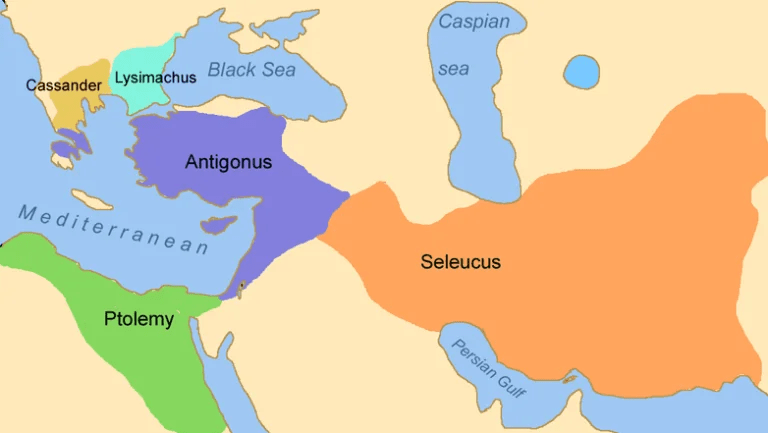
At this great peak, Alexander’s life comes to a sudden end. This is represented in Daniel 8:8 as a “large horn was broken off.” How he died “at the height of his power,” with millions upon millions as his subjects, is uncertain. Some theories are infectious disease, poisoning, or alcoholism. The definitive cause(s) are not known. What is known is that he had no successor. This then led to an eruption of civil strife which led to the Wars of Diadochi (meaning successor). These wars lasted almost for half a century (roughly 322-275 BC) and involved multiple battles and alliances. The most prominent figures in the battles were Antigonus, Cassander, Ptolemy, and Seleucus. These are the four prominent horns in Daniel 8:8. That they grew up toward the four winds of heaven means they eventually carved out their own kingdoms in what became known as the Hellenistic period.  (The word “Hellen” means Greek.) This division resulted in the formation of separate powerful and independent kingdoms:

Ptolemaic Kingdom: Ptolemy established control over Egypt and its surrounding territories. 

Seleucid Empire: Seleucus took control of the eastern regions, including Persia and Mesopotamia. 

Antigonid Kingdom: Antigonus and later his descendants ruled over Macedonia and Greece.

Other: Lysimachus controlled part of Asia Minor and Cassander controlled part of Greece which Antigonus did not. 

This is described in a later chapter of Daniel, as well:

Then a mighty king will arise, who will rule with great power and do as he pleases. After he has arisen, his empire will be broken up and parceled out toward the four winds of heaven. It will not go to his descendants, nor will it have the power he exercised, because his empire will be uprooted and given to others. (Daniel 11:3-4)

A Monumental Shift in Civilization

We will look at the negative implications of Alexander’s conquests in a later article. Yet, the fact is that God used Alexander the Great to prepare the way for advancing His Story of Grace.

Greek Language: Because of Alexander the Great, the Greek language became the common or business language from Egypt to India. Each territory had its own native language, but each one learned to speak Greek. This allowed for rapid communication since the world was able to speak a common tongue. It is for this reason that over 300 years later after Alexander the 27 books of the New Testament was penned in Greek. Everyone could read this and have access to the New Testament letters.

Greek Culture: Not only was there the spread of Greek language, but there was also the spread of art, architecture, philosophy, and political ideas across a vast area. Greek culture did not replace existing cultures but blended with them. This was monumental because it was the first time in which there was a international blending of one culture into many different ones. A result of this is that in many ways Christianity became a blend of Jewish and Greek cultures. Because of the migration of Greek culture to the East, it would forever shape Christian thinking and practice. This is seen first and foremost in the doctrine of Logos (John 1:1) which would lead to our understanding of the Trinity, with the Son at the eternal Logos of the Father.

Other: The spread of Greek culture made possible by Alexander had impacts on political structures, art, architecture, travel, commerce, science and medicine. These would lay a foundation for the growth of what would become the Roman Empire.

Conclusion

What is most noteworthy was that Daniel prophesied the advance of Alexander and the spread of Hellenism. Daniel did not use the name (Alexander) or the term (Hellenism). This was beyond the scope of his prophesy. His purpose was not to focus on the seen realities but to address the unseen spiritual realities behind the seen ones. As Daniel write earlier in his book:

He changes times and seasons;
    he deposes kings and raises up others.
He gives wisdom to the wise
    and knowledge to the discerning.
(Daniel 2:21)

Salamis and the Miraculous Battle For Freedom

So rarely has the consequential unfolding of history been so on the line as the Battle of Salamis (480 B.C.). On this battle held the fate and destiny of Western Civilization itself. On the one side is the massive Persian military under Xerxes with an army considered the largest ever assembled-2,641,000 fighting men, according to Herodotus. Humorously he tells us that when “Xerxes armies drank the whole river ran dry.” The mass of this army is not surprising given that the Persian Empire, the largest to have ever existed at the time, had 70 million inhabitants living within 1 million square miles. This colossal power was intent on crushing the often warring and fractious Greek city-states which had 2 million inhabitants bordered in 50,000 square miles. The Persians were affluent with nearly unlimited resources in contrasts to the Greeks who, by comparison, were poor. This supersedes by any measure a David and Goliath analogy. At stake in this confrontation is the furtherance of personal freedom toward self-determination (represented by Greece), and the authoritarian and absolute rule over the masses by a very few (represented by Persia). In this battle is the literal determination of whether people will be able to form more closely into the image of the Trinity, where there is a heightened empowerment to personal freedom leading to a greater communal unity.

David (Greece) vs. Goliath (Persia)

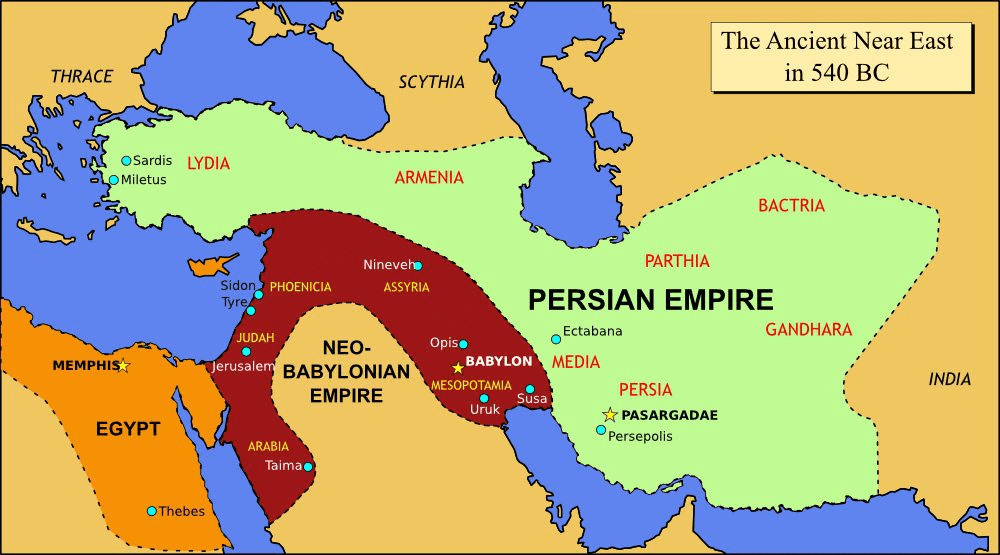
Cyrus the Great led the Persian Empire into its rapid expansion starting in 550 B.C. Before Cyrus, Persia was a small state under the control of the Medes (an ancient Iranian people). But as the map shows, Cyrus controlled most of modern day Iran, parts of Turkey and Mesopotamia by 540 B.C. This is all in one decade. Five kings and fifty years later, by 490 B.C., the Empire expands to more than 2 million square mile (as seen by the map below)–the largest the world has ever known.

Now with Xerxes (485-465 B.C.) in power, his aim is to expand their territory into Greece, which is at the furthest edge of their northeastern border. Xerxes father, Darius (522-486 B.C.) sought to conquer Greece in the Battle of Marathon (490 B.C.). This resulted in a major defeat for the Persians. Xerxes followed his father as monarch and inherited his father’s burden of expanding the Empire toward Greece. To accomplish what Darius had been unable to do, Xerxes inherited the largest and best equipped army at the time. With four years of preparation, in 480 B.C., he headed off to Greece with approximately 1 million men, along with an elite force of 10,000 warriors known as the immortals. It was here that Xerxes would conquer much of mainland Greece, even conquering and burning the great city of Athens, whose 10,000 men were no match for the invading horde. With victory over all of Greece assuredly in his grasps, Xerxes heads toward the isthmus of Salamis.

He is deceptively lured there by Themistocles. This ruse was led by the Greek general, Themistocles. From a young age he prepared himself for political life. He came from a family where governmental influence would not have been open to him. But under the new system of government, he was able to advance as he was motivated by a tremendous sense of ambition and guided by a charismatic personality and daring vision. He used his charm and gifting to ascend to the place of military general. The Greek form of democracy was the only place in the world which allowed a larger number of people like him to climb the social ladder. And it was now under threat of being crushed by Persia.

The Distinctions of East and West

Democracy had been in Greece since 510 B.C, which has been introduced to Athens through the reforms of Cleisthenes. At this point, democracy is about 30 years old. This spirit of democracy allowed for public deliberation by the citizens regarding policies which effected their lives. Further, they were allowed to be critical of their leaders. Property was more widely and freely held. There could be no execution without a proper trial. They had the ability to freely write and speak their opinions. These freedoms in Persia were unknown. The absolute rule of millions were in the hands of a very few. The king and his small court of relatives, which were “the eyes and ears” of the king, thrived through substantial collections of taxes and the vast ownership of estates. The largest farms in Greece were a hundred acres, but in Persia the farms were in the thousands. Criticism or oppositions of the king and his administration would certainly be met with a cruel death. When a nobleman asked Xerxes that his son be exempted from war, he had the nobleman’s son cut in half and required the father to walk between the severed pieces of his body. It is at this historical juncture that we see the formative development of the conflicts of East (Persia) versus West (Greece).

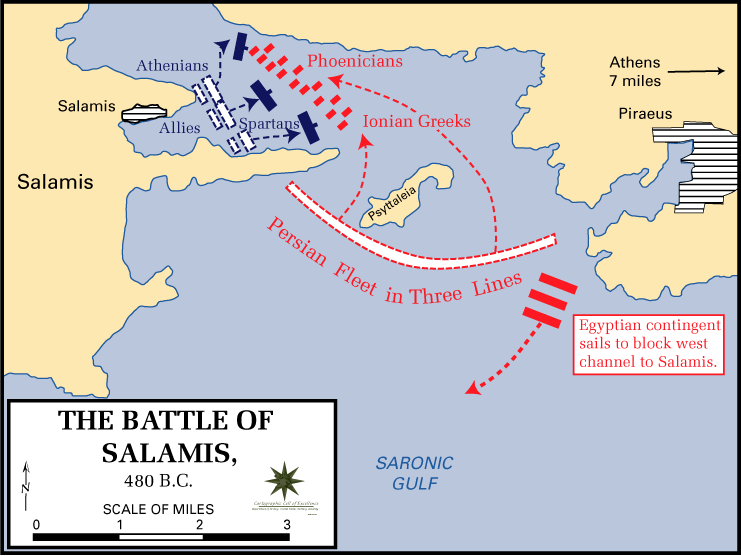
The Persian fleet (in red) entered from the east (right) and confronted the Greek fleet (in blue) within the confines of the strait.

As the Battle of Salamis was to commence, it is nearly impossible to understand how impossible it was from the outmatched Greeks to win. The city of Athens has been abandoned and is going up in flames. There is no mainland to fight from in this area, so a land battle is an impossibility. The only option is a sea battle, yet its recently built fleet of 200 ships, of its 378, was unwilling to engage the enemy’s nearly 800 to 1,000 fighting vessels. (Herodotus and Aeschylus estimate that the Persian armada consisted of over a 1,000 ships with approximately 200,000 men.) A naval battle in the open sea would have led to a crushing defeat for the Greeks. So, Themistocles was convinced that the only hope of victory lay in the straights of Salamis where the superior numbers of the Persians would be less effective. Yet, he could not mobilize the military to confront the imperial giant because many of the commanders believed it to be a suicide mission.

To motivate the fearful leaders, Themistocles sent his slave, Sicinnus, to trick Xerxes into attacking the Greeks. Sicinnus delivered a message to Xerxes that said the Athenians were afraid and going to run away. The message also claimed that the Allied commanders were fighting among themselves. Xerxes believed the message and attacked the Greeks. With this attack, the fearful naval commanders were left with no choice but to defend themselves. Themistocles risky maneuver of trickery and deceit paid off. The Persians were defeated in the narrow straight of Salamis in the 12 hours of fighting. The more easily navigated triremes (Greek ships) were much more suited for this narrow warfare than the heavier ships of their enemies. The Persians were defeated with a loss of 200 ships and the Greeks with a loss of 40.

Legacy of Salamis

The Motivation of Freedom Is Advanced

The Greeks were able to fight and win because of freedom. Freedom created a greater morale and incentive to defeat the enemy. This was the understanding of Herodotus who commented:

As long as the Athenians were ruled by a despotic government, they had no greater success at war than any of their neighbors. Once the yoke was thrown off, they proved the finest fighters in the world.

After the victory at Salamis, Herodotus again tells us, that when the Persians attempted to mediate an agreement with the Athenians, they responded:

We know of ourselves that the power of the Persians is many times greater than ours. There is no need to taunt us with that. Nevertheless in our zeal for freedom we will defend ourselves to the best of our ability. 

A year after the Salamis, Dirodorus tells us that the men in the Greek army were required to swear an oath beginning, “I shall fight to the death, and shall not count my life as more valuable than freedom.” Again, the same author records, that the Greeks dedicated a monument at the sanctuary of Dephi with the inscription, “The saviors of wide Greece set up this monument, having delivered their city-states from this loathsome slavery.”

As the Greeks were considering whether or not to continue in battle with the Persians, the leaders and citizens would engage in frenzied debate, disagreements and discussions. Herodotus characterized these constant deliberations as a “war of words,” and Diodorus described it as an “unrest of the masses.” This required the military’s generals and civic leaders to keep their thumb on the pulse of public opinion in relation to their decisions. In contrast to this, it was unthinkable for those in the Persian empire to express their opinions to Xerxes. This could very well lead to their death. The problem with this is that it shut out many good ideas, and blinded them to many mistakes and errors to avoid. In this major battle, freedom was confronted with a great test and came out the victor. The idea, meaning and reality of freedom was advanced.

The Power of Freedom is Advanced

Georg Hegel in his Philosophy of History reflects on the historic and momentous nature of the Battle of Salamis:

Oriental despotism—a world united under one lord and sovereign—on the one side, and separate states—insignificant in extent and resources, but animated by free individuality—on the other side, stood face to face. Never in history has the superiority of spiritual force over material bulk—and that of no contemptible amount—been made so gloriously manifest.”

It is of importance to remember that the idea of freedom was a couple of centuries old, and democracy itself was around three decades old. The practice of freedom was shared by only a few hundred thousand people in the backwaters of the Mediterranean. Had Salamis been lost by the Greeks it would have ended the eventual rise of Western civilization and its distinct institutions based on freedom altogether. Yet, now with Salamis won, the virus of freedom would be released and spread, and the strongest forces of oppression could not ultimately extinguish it.

The Meaning of Freedom Will Advance

It is not insignificant that when Christ came into the world, he was born at a time which had been greatly influenced by the Greeks.

Paul declares:

But when the fullness of time had come, God sent forth his Son, Christ came in the fullness of time.

Galatians 4:4

It was the Greek influence which allowed the apostles to have language and idea which could more clearly express the realities they experience with the revelation of Jesus and the expanding of the kingdom of God in the church. The New Testament was mainly written in Greek. Many ideas such as the logos (word), ecclesia (church/assembly), psuche (soul) express more of a Greek understanding. The early theology of the church would borrow heavily from Greek categories of thought.

God has ordered all of the nations of the world that they should come into the fullness of his purposes which are designed to advance the Story of Grace which is being written in the world.

26 From one man he made all the nations, that they should inhabit the whole earth; and he marked out their appointed times in history and the boundaries of their lands. 27 God did this so that they would seek him and perhaps reach out for him and find him, though he is not far from any one of us. 28 ‘For in him we live and move and have our being.

Acts 17:26-28