
It is the distinct reality that in God’s Story of Grace, God uses even the wicked for his overall purposes and plans. Scripture testifies to this in many places.
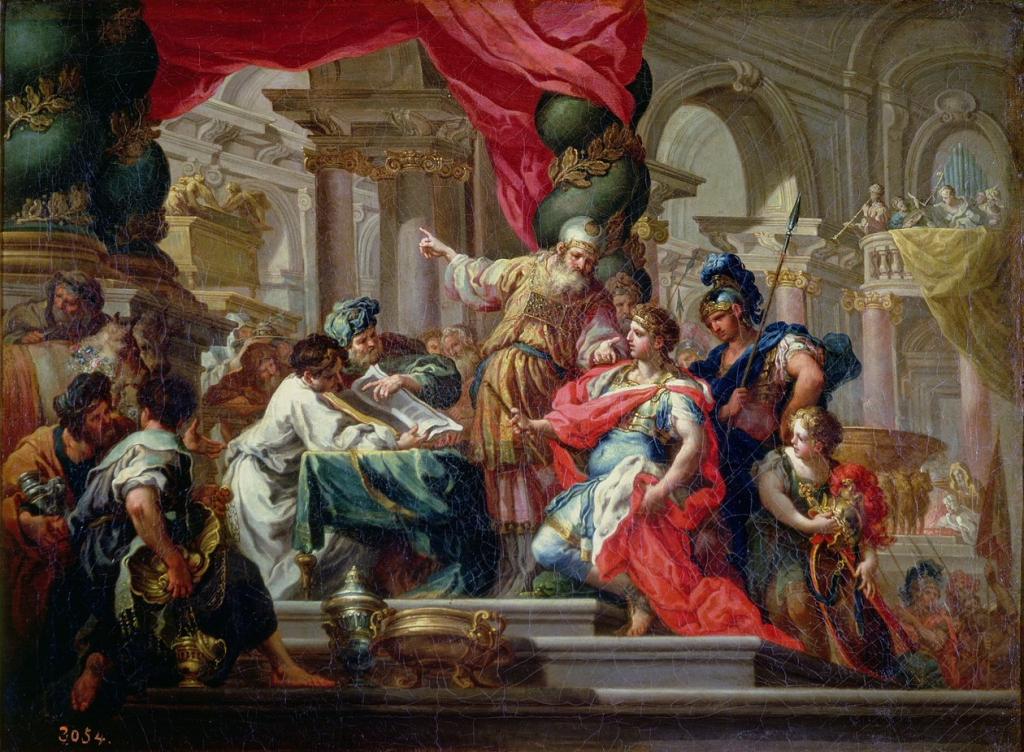
Sebastiano Conca (1680-1761)
“Human defiance only enhances your glory, for you use it as a weapon.”
Psalm 76:10
In this article, we will see four prophecies (these four cover a one year period) where the prophet hydroplanes over four mountain peak events where we see God uses Alexander the Great as an agent of judgement against the pride and wickedness of different regions which were near Jerusalem. Then we will see how the ambitious conqueror, instead of conquering the holy city of Jerusalem, acknowledges the God of Israel and makes sacrifices to him. This shows in a dramatic and definitive way how God is Lord even over those who oppose him. We will see how God uses evil to overturn evil and prepare the way for the Triumphal Entry of Christ to advance His Story of Grace. What will become clear is that the destructive force of Alexander’s army tears down obstinate forms of evil and opens up the way for the grace of the Messiah, Jesus Christ, to come into the world at the proper time.
An Invader From the North (Zechariah 9:1-8)
In the previous article we saw how Daniel 8:1-8 foretold about the rapid conquest of Alexander the Great’s military machine to overtake 200 million square miles of territory over three continents in thirteen years. This prophecy occurred nearly 300 years before Alexander’s time. Then emerges Zechariah, who spoke the Word of God soon after Daniel’s death, from 520 to 518 BC, and forecasted with precision a one year portion (ca. 333-332 B.C.) of Alexander’s 13 year conquest. Like Daniel, he did this with stunning accuracy a few centuries before the actual events unfolded. This is seen through the subduing of three regions along the Mediterranean Sea and then a miracle at Jerusalem.
Syria Invaded
1A prophecy:
The word of the Lord is against the land of Hadrak and will come to rest on Damascus— for the eyes of all people and all the tribes of Israel are on the Lord—
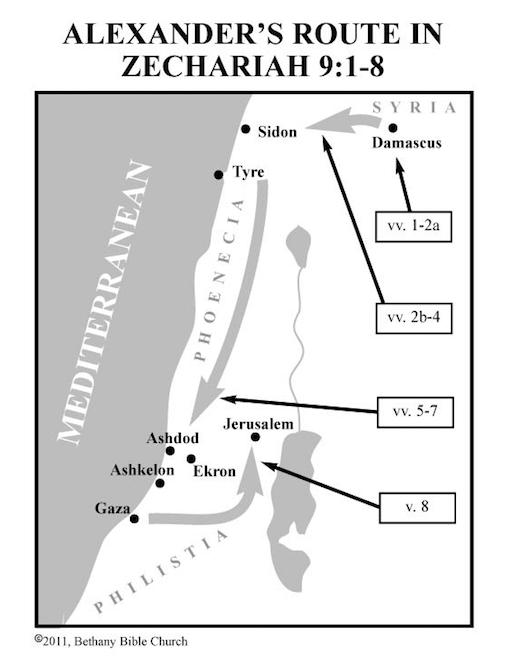
In Zechariah’s time no one would have dreamed that the Greeks could ever constitute a significantly powerful military force which would bolt through the world. In retrospect that is what is depicted in Zechariah 9. The prophecy deals with the punishment that God would visit on various city-states down the Mediterranean coast. It commences after Alexander marched into Syria in 333 BC and defeated the Persian army at the battle of Issus. It is here that the prophecy picks up with Alexander’s conquest into Damascus and will proceed southward. The prophet begins by pointing out in v.1 that God has sovereign power over Hadrach (either an ancient area or city in Syria) near Damascus. This is the only place where Hadrach is mentioned in the Old Testament, though it is mentioned in Assyrian cuneiform tablets. Hadrach may represent the far and obscure reaches of the world. What is shown through this subjugation is that “all people” will acknowledge God’s reign in the world.
Phoenicia Invaded
2 and on Hamath too, which borders on it, and on Tyre and Sidon, though they are very skillful. 3 Tyre has built herself a stronghold; she has heaped up silver like dust, and gold like the dirt of the streets. 4 But the Lord will take away her possessions
and destroy her power on the sea,
and she will be consumed by fire.
In v.2 Hamath is a city to the far north of Syria. The prophet moves over to the area of Phoenicia and references the coastal cities of Tyre and Sidon. In v.3 Tyre is singled out for special attention because of its tremendous wealth, power and security which has “silver like dust, and gold like the dirt of the streets.” Not only did Tyre have great wealth, but it was known for its cunning shrewdness in business and politics. It was a city which was a model of human perfection in many ways. This brought to the leaders of the city a great arrogance. Ezekiel describes the king of Tyre as being filled with an enormous pride at an anti-Christ level, mistaking themselves for God. Ezekiel points out that Tyre was filled with pride claiming, “I am a god:”
1The word of the Lord came to me: 2 “Son of man, say to the ruler of Tyre, ‘This is what the Sovereign Lord says:
“‘In the pride of your heart
you say, “I am a god;
I sit on the throne of a god
in the heart of the seas.”
But you are a mere mortal and not a god,
though you think you are as wise as a god.
3 Are you wiser than Daniel?
Is no secret hidden from you?
4 By your wisdom and understanding
you have gained wealth for yourself
and amassed gold and silver
in your treasuries.
5 By your great skill in trading
you have increased your wealth,
and because of your wealth
your heart has grown proud.
As a result of this swelling arrogance, judgement is coming:
6 “‘Therefore this is what the Sovereign Lord says:
“‘Because you think you are wise,
as wise as a god,
7 I am going to bring foreigners against you,
the most ruthless of nations;
they will draw their swords against your beauty and wisdom
and pierce your shining splendor.
8 They will bring you down to the pit,
and you will die a violent death
in the heart of the seas.
9 Will you then say, “I am a god,”
in the presence of those who kill you?
You will be but a mortal, not a god,
in the hands of those who slay you.
10 You will die the death of the uncircumcised
at the hands of foreigners.
The destruction at the hands of foreigners came in several waves. The Babylonians besieged it for thirteen years from 586 to 573 BC. Cyrus the Great of Persia surrounded it in 539 BC. In both of these cases, though the main land became ravaged, Tyre was ultimately not subdued because it had an island isolated from the mainland. This island was highly fortified and had access to the other countries of the Mediterranean for its supplies. With its great wealth it could sustain itself under siege for years. Though the mainland was taken by conquerors, it remained for Alexander to finally destroy its island fortification. He did this by taking the rubble from the mainland of Tyre and making a causeway to the island. In seven months it was totally destroyed vindicating Ezekiel and Zechariah’s predictions.
Philistia Invaded
5 Ashkelon will see it and fear;
Gaza will writhe in agony,
and Ekron too, for her hope will wither.
Gaza will lose her king
and Ashkelon will be deserted.
6 A mongrel people will occupy Ashdod,
and I will put an end to the pride of the Philistines.
7 I will take the blood from their mouths,
the forbidden food from between their teeth.
Those who are left will belong to our God
and become a clan in Judah,
and Ekron will be like the Jebusites.
Four of five cities of the Philistines are mentioned in vs.5-7. (Gath is the only one not mentioned.) Zechariah predicts that this tribe of people will lose its ethnic identity as a mongrel people will occupy Ashdod. Ekron will be like the Jebusites meaning Ekron will be overtaken like the Jebusites had been, when King David invaded, and it become a mixed race of people. The Greek armies subdued this area after their conquest of the Phoenicians.
Israel Spared (The Miracle!)
The next major city for the ambitious general to overrun was the Hebrew capital of Jerusalem only forty miles to the east of Philistia. This was only logical and was ripe for taking by the unquenchable appetite for conquest of the Greek army. This did not happen because Zechariah declared that Jerusalem would be given divine protection. In v.8 God declares:
8 But I will encamp at my temple
to guard it against marauding forces.
Never again will an oppressor overrun my people,
for now I am keeping watch.
Alexander, while still at the siege of Tyre, sent a letter to the Jews demanding their loyalty. They had previously pledged themselves to Darius the Mede, but when they saw that he was defeated by the Greeks at the Battle of Issus, they changed their minds. Josephus (37–100 AD) details how this prophecy was carried out:
.. [Alexander] gave his hand to the high priest and, with the Jews running beside him, entered the city. Then he went up to the temple, where he sacrificed to God under the direction of the high priest, and showed due honour to the priests and to the high priest himself. And, when the book of Daniel was shown to him, in which he had declared that one of the Greeks would destroy the empire of the Persians, he believed himself to be the one indicated; and in his joy he dismissed the multitude for the time being, but on the following day he summoned them again and told them to ask for any gifts which they might desire …
Not only did he not assault the city, and he also allowed them to practice the laws of their forefathers. Many of the Jews joined Alexander’s army and accompanied him in his mission of conquest.
What Can We Conclude From Josephus’ Account?
- First, in describing Alexander’s Mediterranean conquests, Zechariah declared that Jerusalem would not be taken.
- Second, there is no logical reason why Jerusalem should not have been captured. It was a very wealthy city when compared to some of the others which had just been overrun.
- Third, for some seemingly inexplicable reason, Alexander spared the city and became friendly towards the Jews.
- Fourth, in view of the prophecies, it is most logical to conclude that God was providentially directing the activities of the Greek ruler.
The Real Triumphal Entry
Zechariah will go on to prophesy of another conqueror in 9:9-10:
9Rejoice greatly, Daughter Zion!
Shout, Daughter Jerusalem!
See, your king comes to you,
righteous and victorious,
lowly and riding on a donkey,
on a colt, the foal of a donkey.
10 I will take away the chariots from Ephraim
and the warhorses from Jerusalem,
and the battle bow will be broken.
He will proclaim peace to the nations.
His rule will extend from sea to sea
and from the River to the ends of the earth.
This is a prediction of Jesus Christ coming into Jerusalem on a donkey on His Triumphal Entry the week before his crucifixion. (Matthew 21:1-11, Mark 11:1-11, Luke 19:28-44 and John 12:12-19). Alexander weakened the cities around Jerusalem and strengthened Jerusalem to protect and preserve the coming of the Messiah whose rule will extend from sea to sea and from the River to the ends of the earth. This is incredible evidence of God’s sovereign and providential order over history.
Alexander and Jesus Compared (Christ and Anti-Christ)
| Jesus had a triumphal entry into Jerusalem | Alexander had a triumphal entry into Jerusalem |
| Jesus is God. | Alexander claimed to be God. |
| Jesus died for multiplied millions. | Alexander killed multiplied thousands. |
| Jesus died in his early 30’s. | Alexander died in his early 30’s. |
| Jesus rose from the dead and reigns forever. | Alexander reigned briefly. |
God in His Story of Grace would even use the pride and wickedness of Alexander to pave the way for the triumph of Jesus Christ. God uses even human defiance as a weapon to accomplish his purposes to advance His Story of Grace.
 Story of Grace