
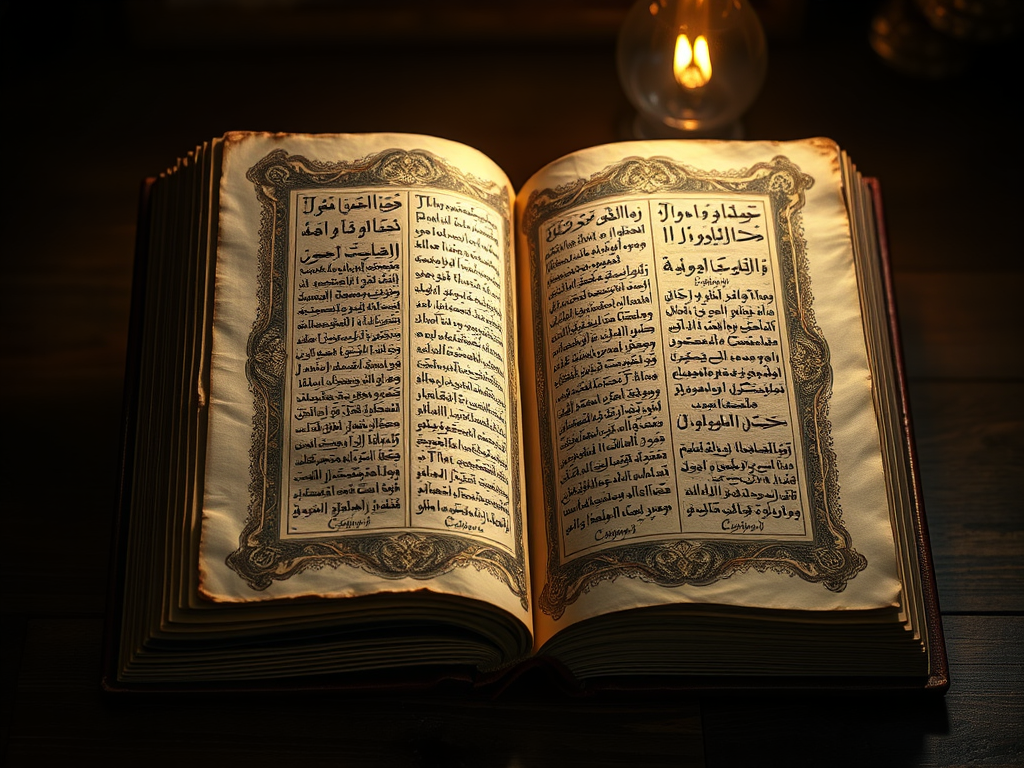
The most important development to emerge as a result of the Alexandrian Library is the creation of the codex of the New Testament. A codex is the earliest form of a book. The earliest codices (plural for codex) we have come from Alexandria due to the importance the city placed upon books (collections of manuscripts). In fact, the oldest copy of the entire New Testament is the Codex Sinaiticus, which came from the Sinai of Egypt and likely originated from Alexandria. The Codex Sinaiticus, also called the Sinai Bible, is an early fourth-century collection of bound manuscripts, containing the majority of the Greek Old Testament (Septuagint) and all of the New Testament (also the letters of Barnabas and the Shepherd of Hermas). This codex laid hidden from the world in a remote monastery in Egypt, near Mount Sinai, from the fourth century until the mid-nineteenth century (nearly 1500 years), when it was discovered by a German New Testament scholar, Constantine von Tischendorf. This codex is a part of a family of approximately 30 New Testament texts originating from this region (Egypt) and time (4th century). These are called the Alexandrian Texts and are considered among the oldest and most reliable for understanding the original New Testament manuscripts.1
They will summon peoples to the mountain
Deuteronomy 33:19
and there offer the sacrifices of the righteous;
they will feast on the abundance of the seas,
on the treasures hidden in the sand.
With a number of factors which could not have been planned or predicted, God has preserved His Word and provided overwhelming authentication of its preservation. The Sinai Bible, along with the other Alexandrian Texts, provides another layer of confirmation and evidence of the authenticity and reliability of the Bible. In this article we will examine the influence of the Codex Sinaiticus, its relationship to the Library at Alexandria, and how it reinforces the authenticity of the New Testament.
The Codex Revolution
What is a codex?
As previously stated, the codex is the ancestor or earliest form of the modern book. The word “codex” comes from the Latin word meaning “trunk of a tree,” “block of wood” or “book.” It basically consisted of individual sheets of papyrus (made from a plant) or vellum (made of animal skins) which were folded and bound together. These were grouped into sections, and then the sections were stitched or bound along one edge, often with a cover to protect the assembled pages.
How did the codex shape Christianity?
Before the codex the common form of writing was the scroll where ink was set down on a roll of papyrus and parchment. When the codex was introduced, it quickly replaced the scroll so that by the 400’s in Egypt, the codex outnumbered the scroll by ten to one. Egypt was front and center for the popularization of the codex because of its rich tradition and expertise in copying from Alexandria. Since there was a significant and influential Christian population in Alexandria, the New Testament and Old Testament became the frontrunners in codex revolution. This new format of collecting writings shaped Christianity in four key ways:
1. It helped to develop the canon. Canon is the term referred to as the books which would be included in the Bible. The codex, with its ability to contain multiple works, encouraged the inclusion of certain writings and the exclusion of others. Over time this process helped to solidify the core writings that would become the twenty-seven books of the New Testament. This provided an authoritative and shared foundation for Christian belief.
2. It strengthened the spread of Christian communities. The codex was more durable and could be more easily transported than scrolls. The papyrus manuscripts would often last for only decades. The codices had a much greater durability, lasting in tact for centuries. They became tools of resilience, ensuring that the scriptures survived, and providing greater accessibility across geographical locations.
3. It made the teaching and practice of scripture more practical. This innovation of the codex meant that Christians could carry their scriptures with them and study them more easily. Gatherings often centered on the reading and interpretation of scripture, with passages recited aloud for the benefit of those who could not read. This accessibility fostered a new way of engagement.
4. It helped shape a new forward looking identity. The codex was not merely a technological advancement. In a world where scrolls were associated with Judaism, Greco-Roman literature, and civic records, the codex marked a departure from tradition. It became a visual and practical representation of Christianity’s newness—a movement that was not bound by the conventions of the past. By embracing this revolutionary format, Christians demonstrated their adaptability.
The Role of Scribes

the Codex Sinaiticus
The transition from scrolls to codices would have been impossible without the tireless efforts of scribes, also known as copyists. The Jewish scribe did the arduous work of copying new manuscripts of the Old Testament. This was a vital profession for the preservation and transmission of the Old Testament ensuring that sacred texts were transmitted faithfully from one generation to the next. Early Christianity inherited this reverence for scribal work from the Jews and the copyists at the Alexandrian Library, as well. A new sense of urgency was added as the apostles’ writings and the gospels needed to be copied, circulated, and preserved as the church expanded across the Roman Empire. For this reason these scribes and copyists occupied a central role in the production and transmission of early Christian texts. Their work often required extraordinary precision and skill; yet it was seen as a sacred service to God and the community of believers.
Codex Sinaiticus and the Reliability Of the New Testament
The discovery of the Codex Sinaiticus provides another layer of evidence to validate the authenticity of the New Testament–that the New Testament writings we have today faithfully represent the original writings. Yet, there are several questions people naturally ask. Let’s address some:
What about the time gap? If the Codex Sinaiticus is the earliest copy of the entire New Testament that we have, and it was written about 300 years later than the originals, how can we trust that it is reliable? When you consider the time gap by ancient standards, the New Testament is remarkably brief. This is especially the case given that we have a section of the Gospel of John (John Ryland Papyrus) written about 40 years after the original writing. Below is a comparison of the New Testament and other ancient writings:
| Work | Date Written | Earliest Copies | Time Gap |
| Homer’s Illiad | 800 BC | BC 400 | 400 Years |
| Herodotus History | 480-425 BC | AD 1000 | 1350 Years |
| Plato Tetralogies | 400 BC | AD 895 | 1300 Years |
| Caesar Gallic Wars | 100-44 BC | AD 800 | 950 Years |
| Tacitus Annals | AD 100 | AD 850 | 750 Years |
| Greek NT (John Ryland Papyrus) | AD 40-90 | AD 130 | 40 Years |
with Other Ancient Writings
In addition, there was a rapid copying of texts which gives us so many to compare. As disciples and churches rapidly grew, there was an increasing need to make copies of the letters to be read. This is why, as already stated, that the skills of the copyists were in such high demand. Because of this, there are an abundance of New Testament manuscripts from this time. This amount of documents gives us assurance that we can discern the content of the original writings despite the time gap from the original documents. Here is a break down of the numbers for the Bible:
- Greek Manuscript total: 5,856
- Non-Greek Manuscripts (Armenian, Latin, etc.): 18,130
- Total Manuscripts: 23,986
This is an astounding number when compared to other ancient documents. If you stack existing manuscripts from the average classical writer, it would measure about four feet high. The NT manuscripts would stack to more than one-mile high.
| Work | total number of manuscript copies |
| Homer’s Illiad | 643 |
| Herodotus History | 109 |
| Plato Tetralogies | 210 |
| Caesar Gallic Wars | 251 |
| Tacitus Annals | 33 |
What about the variations in the documents? We know that the scribes who copied the manuscripts took extreme efforts to get the transmission accurate. Because of the human element in the transmission, there are differences in the texts. But this is completely understandable given the human complexities and difficulties in copying. What is quite remarkable, given this fact, is that the vast majority of biblical texts remain consistent across all of the biblical manuscripts. Of the 5,856 Greek manuscripts, there is 98% agreement as to what the original writing is. Where there is disagreement, none of these effects doctrine.
Most of these variations are no more significant than spelling differences, small changes of word order or misplaced letters. The chart below shows what the nature of most of these variants are like:
| Spelling Conventions | In English this is similar to using “a” versus “an” or “who” versus “whom.” |
| Similar Appearances of Words | In 1 Timothy 3:16, some manuscripts read “He was revealed in the flesh” while others read “God was revealed in the flesh.” The difference is accounted for how “God” and “he” in abbreviated form in the Greek look very similar: “he” (Greek: Ὃς) and “God” (Greek: Θεὸς). Yet, this has no effect on the meaning. |
| Similar Sounding Words | Sometimes scribes would work in teams, with one scribe reading aloud while the other wrote what was spoken. In some cases, a word would be misheard because it had a similar sound. This would be in English like writing “rode” instead of “road” or “there” instead of “their.” |
| Transposed Words | Christ Jesus versus Jesus Christ (Word order in the Greek is not nearly as important as it is in English.) |
Many of these variants are clustered in just a few places over and over again. As they are spotted, it is easy to identify them and make the corrections or clarify the original words. The Codex Sinaiticus contains many scribal corrections to errors they spotted in the copying process. But these are not significant in terms of content and especially doctrine. For example, imagine you come across a copy of a document which reads, “Roses are read, violets are blue. . . .” It’s not hard to see what happened as the original was copied? The correction is fairly simple: “Roses are red, violets are blue…” The scribal corrections are evidence of the importance of and strenuous efforts made toward accuracy. The Codex Sinaiticus (along with the other Alexandrian Texts) is another confirmation that the core message of the Bible has been remarkably preserved.
Conclusion
So, can we trust that the Bible has been accurately translated? YES! The evidence shows a nearly miraculous process which allowed for such a stable transmission. As a result, we can be confident that the translations we have are based on an overwhelmingly strong amount and quality of document sources. The discovery of the Codex Sinaiticus was just another layer of evidence increasing our confidence in the reliable transmission of God’s Word.
“Your word, LORD, is eternal; it stands firm in the heavens.”
Psalm 119:89
The codex advanced God’s Story of Grace by allowing the writings of the apostles and prophets to become more accessible, widespread and diverse communities (many) to become unified (one).
1 Most modern Bible translations are based on the Alexandrian Texts.
 Story of Grace