Two Triumphal Entries: Alexander the Great and Jesus the Messiah (Zechariah 9:1-10)

It is the distinct reality that in God’s Story of Grace, God uses even the wicked for his overall purposes and plans. Scripture testifies to this in many places.

Alexander the Great in the Temple by
Sebastiano Conca (1680-1761) 

Human defiance only enhances your glory, for you use it as a weapon.”

Psalm 76:10

In this article, we will see four prophecies (these four cover a one year period) where the prophet hydroplanes over four mountain peak events where we see God uses Alexander the Great as an agent of judgement against the pride and wickedness of different regions which were near Jerusalem. Then we will see how the ambitious conqueror, instead of conquering the holy city of Jerusalem, acknowledges the God of Israel and makes sacrifices to him. This shows in a dramatic and definitive way how God is Lord even over those who oppose him. We will see how God uses evil to overturn evil and prepare the way for the Triumphal Entry of Christ to advance His Story of Grace. What will become clear is that the destructive force of Alexander’s army tears down obstinate forms of evil and opens up the way for the grace of the Messiah, Jesus Christ, to come into the world at the proper time.

An Invader From the North (Zechariah 9:1-8)

In the previous article we saw how Daniel 8:1-8 foretold about the rapid conquest of Alexander the Great’s military machine to overtake 200 million square miles of territory over three continents in thirteen years. This prophecy occurred nearly 300 years before Alexander’s time. Then emerges Zechariah, who spoke the Word of God soon after Daniel’s death, from 520 to 518 BC, and forecasted with precision a one year portion (ca. 333-332 B.C.) of Alexander’s 13 year conquest. Like Daniel, he did this with stunning accuracy a few centuries before the actual events unfolded. This is seen through the subduing of three regions along the Mediterranean Sea and then a miracle at Jerusalem.

Syria Invaded

1A prophecy:

The word of the Lord is against the land of Hadrak and will come to rest on Damascus— for the eyes of all people and all the tribes of Israel are on the Lord—

In Zechariah’s time no one would have dreamed that the Greeks could ever constitute a significantly powerful military force which would bolt through the world. In retrospect that is what is depicted in Zechariah 9. The prophecy deals with the punishment that God would visit on various city-states down the Mediterranean coast. It commences after Alexander marched into Syria in 333 BC and defeated the Persian army at the battle of Issus. It is here that the prophecy picks up with Alexander’s conquest into Damascus and will proceed southward. The prophet begins by pointing out in v.1 that God has sovereign power over Hadrach (either an ancient area or city in Syria) near Damascus. This is the only place where Hadrach is mentioned in the Old Testament, though it is mentioned in Assyrian cuneiform tablets. Hadrach may represent the far and obscure reaches of the world. What is shown through this subjugation is that “all people” will acknowledge God’s reign in the world.

Phoenicia Invaded

and on Hamath too, which borders on it, and on Tyre and Sidon,  though they are very skillful. Tyre has built herself a stronghold; she has heaped up silver like dust, and gold like the dirt of the streets. But the Lord will take away her possessions
 and destroy her power on the sea,
 and she will be consumed by fire.

In v.2 Hamath is a city to the far north of Syria. The prophet moves over to the area of Phoenicia and references the coastal cities of Tyre and Sidon. In v.3 Tyre is singled out for special attention because of its tremendous wealth, power and security which has “silver like dust, and gold like the dirt of the streets.” Not only did Tyre have great wealth, but it was known for its cunning shrewdness in business and politics. It was a city which was a model of human perfection in many ways. This brought to the leaders of the city a great arrogance. Ezekiel describes the king of Tyre as being filled with an enormous pride at an anti-Christ level, mistaking themselves for God. Ezekiel points out that Tyre was filled with pride claiming, “I am a god:”

1The word of the Lord came to me:  “Son of man, say to the ruler of Tyre, ‘This is what the Sovereign Lord says:

“‘In the pride of your heart
    you say, “I am a god;
I sit on the throne of a god
    in the heart of the seas.”
But you are a mere mortal and not a god,
    though you think you are as wise as a god.
Are you wiser than Daniel?
    Is no secret hidden from you?
By your wisdom and understanding
    you have gained wealth for yourself
and amassed gold and silver
    in your treasuries.
By your great skill in trading
    you have increased your wealth,
and because of your wealth
    your heart has grown proud.

As a result of this swelling arrogance, judgement is coming:

“‘Therefore this is what the Sovereign Lord says:

“‘Because you think you are wise,
    as wise as a god,
I am going to bring foreigners against you,
    the most ruthless of nations;
they will draw their swords against your beauty and wisdom
    and pierce your shining splendor.
They will bring you down to the pit,
    and you will die a violent death
    in the heart of the seas.
Will you then say, “I am a god,”
    in the presence of those who kill you?
You will be but a mortal, not a god,
    in the hands of those who slay you.
10 You will die the death of the uncircumcised
    at the hands of foreigners.

The destruction at the hands of foreigners came in several waves. The Babylonians besieged it for thirteen years from 586 to 573 BC. Cyrus the Great of Persia surrounded it in 539 BC. In both of these cases, though the main land became ravaged, Tyre was ultimately not subdued because it had an island isolated from the mainland. This island was highly fortified and had access to the other countries of the Mediterranean for its supplies. With its great wealth it could sustain itself under siege for years. Though the mainland was taken by conquerors, it remained for Alexander to finally destroy its island fortification. He did this by taking the rubble from the mainland of Tyre and making a causeway to the island. In seven months it was totally destroyed vindicating Ezekiel and Zechariah’s predictions.

Philistia Invaded

Ashkelon will see it and fear;
    Gaza will writhe in agony,
    and Ekron too, for her hope will wither.
Gaza will lose her king
    and Ashkelon will be deserted.
A mongrel people will occupy Ashdod,
    and I will put an end to the pride of the Philistines.
I will take the blood from their mouths,
    the forbidden food from between their teeth.
Those who are left will belong to our God
    and become a clan in Judah,
    and Ekron will be like the Jebusites.

Four of five cities of the Philistines are mentioned in vs.5-7. (Gath is the only one not mentioned.) Zechariah predicts that this tribe of people will lose its ethnic identity as a mongrel people will occupy Ashdod. Ekron will be like the Jebusites meaning Ekron will be overtaken like the Jebusites had been, when King David invaded, and it become a mixed race of people. The Greek armies subdued this area after their conquest of the Phoenicians.

Israel Spared (The Miracle!)

The next major city for the ambitious general to overrun was the Hebrew capital of Jerusalem only forty miles to the east of Philistia. This was only logical and was ripe for taking by the unquenchable appetite for conquest of the Greek army. This did not happen because Zechariah declared that Jerusalem would be given divine protection. In v.8 God declares:

But I will encamp at my temple
    to guard it against marauding forces.
Never again will an oppressor overrun my people,
    for now I am keeping watch.

Alexander, while still at the siege of Tyre, sent a letter to the Jews demanding their loyalty. They had previously pledged themselves to Darius the Mede, but when they saw that he was defeated by the Greeks at the Battle of Issus, they changed their minds. Josephus (37–100 AD) details how this prophecy was carried out:

.. [Alexander] gave his hand to the high priest and, with the Jews running beside him, entered the city. Then he went up to the temple, where he sacrificed to God under the direction of the high priest, and showed due honour to the priests and to the high priest himself. And, when the book of Daniel was shown to him, in which he had declared that one of the Greeks would destroy the empire of the Persians, he believed himself to be the one indicated; and in his joy he dismissed the multitude for the time being, but on the following day he summoned them again and told them to ask for any gifts which they might desire …

Not only did he not assault the city, and he also allowed them to practice the laws of their forefathers. Many of the Jews joined Alexander’s army and accompanied him in his mission of conquest.

What Can We Conclude From Josephus’ Account?

  1. First, in describing Alexander’s Mediterranean conquests, Zechariah declared that Jerusalem would not be taken.
  2. Second, there is no logical reason why Jerusalem should not have been captured. It was a very wealthy city when compared to some of the others which had just been overrun.
  3. Third, for some seemingly inexplicable reason, Alexander spared the city and became friendly towards the Jews.
  4. Fourth, in view of the prophecies, it is most logical to conclude that God was providentially directing the activities of the Greek ruler.

The Real Triumphal Entry

Zechariah will go on to prophesy of another conqueror in 9:9-10:

9Rejoice greatly, Daughter Zion!
    Shout, Daughter Jerusalem!
See, your king comes to you,
    righteous and victorious,
lowly and riding on a donkey,
    on a colt, the foal of a donkey.
10 I will take away the chariots from Ephraim
    and the warhorses from Jerusalem,
    and the battle bow will be broken.
He will proclaim peace to the nations.
    His rule will extend from sea to sea
    and from the River to the ends of the earth.

This is a prediction of Jesus Christ coming into Jerusalem on a donkey on His Triumphal Entry the week before his crucifixion. (Matthew 21:1-11, Mark 11:1-11, Luke 19:28-44 and John 12:12-19).  Alexander weakened the cities around Jerusalem and strengthened Jerusalem to protect and preserve the coming of the Messiah whose rule will extend from sea to sea and from the River to the ends of the earth. This is incredible evidence of God’s sovereign and providential order over history.

Alexander and Jesus Compared (Christ and Anti-Christ)

Jesus had a triumphal entry into Jerusalem Alexander had a triumphal entry into Jerusalem
Jesus is God.Alexander claimed to be God.
Jesus died for multiplied millions.Alexander killed multiplied thousands.
Jesus died in his early 30’s.Alexander died in his early 30’s.
Jesus rose from the dead and reigns forever. Alexander reigned briefly.

God in His Story of Grace would even use the pride and wickedness of Alexander to pave the way for the triumph of Jesus Christ. God uses even human defiance as a weapon to accomplish his purposes to advance His Story of Grace.

How Alexander the Great Prepared the Advance Christianity (Daniel 8:1-21)

Wall Painting of Alexander the Great

Alexander the Great (356 BC – 323 BC) was a world historical force with “god-like” powers to shift the entire directions of nations and continents. In a period of 12 years he conquered the Persian Empire which spanned from Egypt to India and extended his conquests to cover approximately 2 million square miles. He achieved legendary victories in some of the most epic battles which displayed a tactical brilliance of extraordinary skill. As a result he spread the culture and language of the Greeks which would pave the way eventually for the Roman Empire and allow for the rapid advance of Christianity 300 years later. In this article and the next articles we will see how God, in His Story of Grace, used Alexander to expand civilization after the trinitarian image of bringing increased unity (the one) among the nations which carried with it the idea of individual freedom (the many). We will also see that Alexander’s record is tragically mixed.

In this article we will look at Alexander from the perspective of biblical prophecy in Daniel 8. We will understand that the large scale events of history and the world are under God’s hand to accomplish His Story of Grace.

Daniel’s Vision

Daniel received a prophecy regarding the overthrow of the Persian Empire and the advance of the Greek Empire around 553-554 B.C., approximately 200 years before it unfolded. The language is apocalyptic (which means to “unveil”). It opens up the curtain of what is seen so that we may peer beyond what we naturally see to understand bigger realities shaping world events. To do this it uses ideas and concepts we do understand to reveal concepts and ideas we do not as easily understand. Daniel is given the vision of a ram with two horns (representing Persia) and a goat with one horn between its eyes (representing Greece and the conquest of Alexander). The vision reads as follows:

1In the third year of King Belshazzar’s reign, I, Daniel, had a vision, after the one that had already appeared to me. In my vision I saw myself in the citadel of Susa in the province of Elam; in the vision I was beside the Ulai Canal. I looked up, and there before me was a ram with two horns, standing beside the canal, and the horns were long. One of the horns was longer than the other but grew up later. I watched the ram as it charged toward the west and the north and the south. No animal could stand against it, and none could rescue from its power. It did as it pleased and became great.As I was thinking about this, suddenly a goat with a prominent horn between its eyes came from the west, crossing the whole earth without touching the ground. It came toward the two-horned ram I had seen standing beside the canal and charged at it in great rage. I saw it attack the ram furiously, striking the ram and shattering its two horns. The ram was powerless to stand against it; the goat knocked it to the ground and trampled on it, and none could rescue the ram from its power. The goat became very great, but at the height of its power the large horn was broken off, and in its place four prominent horns grew up toward the four winds of heaven.

The vision is interpreted for Daniel by Gabriel the angel. The interpretation reads as follows:

15 While I, Daniel, was watching the vision and trying to understand it, there before me stood one who looked like a man. 16 And I heard a man’s voice from the Ulai calling, “Gabriel, tell this man the meaning of the vision.” 17 As he came near the place where I was standing, I was terrified and fell prostrate. “Son of man,” he said to me, “understand that the vision concerns the time of the end.” 18 While he was speaking to me, I was in a deep sleep, with my face to the ground. Then he touched me and raised me to my feet. 19 He said: “I am going to tell you what will happen later in the time of wrath, because the vision concerns the appointed time of the end. 20 The two-horned ram that you saw represents the kings of Media and Persia. 21 The shaggy goat is the king of Greece, and the large horn between its eyes is the first king.

These identifiers by Gabriel point to the fact that the Ram represents Media (elite rulers of Babylon) and Persia (who overtakes Media). There are, then, several ways this vision demonstrates the spiritual realities behind Alexander the Great and the advance of Greek culture.

Meaning # 1: Alexander’s Rapid Power

a goat with a prominent horn between its eyes came from the west, crossing the whole earth without touching the ground. (Daniel 8:5)

The Macedonians, from which Alexander came, were called “goat people.” Commentator Joseph Benson explains:

This is because, according to one report, their first king was commanded by the oracle to take the goats for his guides to empire. Afterward, seeing a herd of goats flying from a violent storm, he followed them to Edessa, and there fixed the seat of his empire, made the goats his ensigns, or standards, and called the city The Goats’ Town.

After 13 years he conquered an empire that stretched from the Balkans to northern India with his armies travelling some 20,000 miles. Through this he fought 20 major battles with no losses; he named 70 cities after himself, conquering an area spanning three continents covering approximately two million square miles.  

Meaning # 2: Alexander’s Ruthless and Total Conquest

It came toward the two-horned ram I had seen standing beside the canal and charged at it in great rage. I saw it attack the ram furiously, striking the ram and shattering its two horns. The ram was powerless to stand against it; the goat knocked it to the ground and trampled on it, and none could rescue the ram from its power. (Daniel 8:6-7)

When the vision describes “the goat knocked it to the ground and trampled in it,” this describes the ruthless and complete nature of the conquest over Persia. At the battle of Issus, Darius offered concessions of land for peace. Alexander wanted more than concessions; he wanted to be recognized as sole ruler of the Persian territories. Darius was unwilling, and so Alexander mercilessly crushed Persia. In the ensuing battle there are claims that the Greek army killed up to 100,000 in the battle. If this number is true, it would amounted to 200 to 300 men killed a minute for 8 hours. This one battle is illustrative of how this world conqueror brought a level of carnage and destruction which the world had never seen. Historical scholar of Greek antiquity, Victor Davis Hanson, estimates that his armies may, in all of their battles combined, have killed around 1,000,000.

Meaning # 3: Civil War and Division

The goat became very great, but at the height of its power the large horn was broken off, and in its place four prominent horns grew up toward the four winds of heaven. (Daniel 8:8)

At this great peak, Alexander’s life comes to a sudden end. This is represented in Daniel 8:8 as a “large horn was broken off.” How he died “at the height of his power,” with millions upon millions as his subjects, is uncertain. Some theories are infectious disease, poisoning, or alcoholism. The definitive cause(s) are not known. What is known is that he had no successor. This then led to an eruption of civil strife which led to the Wars of Diadochi (meaning successor). These wars lasted almost for half a century (roughly 322-275 BC) and involved multiple battles and alliances. The most prominent figures in the battles were Antigonus, Cassander, Ptolemy, and Seleucus. These are the four prominent horns in Daniel 8:8. That they grew up toward the four winds of heaven means they eventually carved out their own kingdoms in what became known as the Hellenistic period.  (The word “Hellen” means Greek.) This division resulted in the formation of separate powerful and independent kingdoms:

Ptolemaic Kingdom: Ptolemy established control over Egypt and its surrounding territories. 

Seleucid Empire: Seleucus took control of the eastern regions, including Persia and Mesopotamia. 

Antigonid Kingdom: Antigonus and later his descendants ruled over Macedonia and Greece.

Other: Lysimachus controlled part of Asia Minor and Cassander controlled part of Greece which Antigonus did not. 

This is described in a later chapter of Daniel, as well:

Then a mighty king will arise, who will rule with great power and do as he pleases. After he has arisen, his empire will be broken up and parceled out toward the four winds of heaven. It will not go to his descendants, nor will it have the power he exercised, because his empire will be uprooted and given to others. (Daniel 11:3-4)

A Monumental Shift in Civilization

We will look at the negative implications of Alexander’s conquests in a later article. Yet, the fact is that God used Alexander the Great to prepare the way for advancing His Story of Grace.

Greek Language: Because of Alexander the Great, the Greek language became the common or business language from Egypt to India. Each territory had its own native language, but each one learned to speak Greek. This allowed for rapid communication since the world was able to speak a common tongue. It is for this reason that over 300 years later after Alexander the 27 books of the New Testament was penned in Greek. Everyone could read this and have access to the New Testament letters.

Greek Culture: Not only was there the spread of Greek language, but there was also the spread of art, architecture, philosophy, and political ideas across a vast area. Greek culture did not replace existing cultures but blended with them. This was monumental because it was the first time in which there was a international blending of one culture into many different ones. A result of this is that in many ways Christianity became a blend of Jewish and Greek cultures. Because of the migration of Greek culture to the East, it would forever shape Christian thinking and practice. This is seen first and foremost in the doctrine of Logos (John 1:1) which would lead to our understanding of the Trinity, with the Son at the eternal Logos of the Father.

Other: The spread of Greek culture made possible by Alexander had impacts on political structures, art, architecture, travel, commerce, science and medicine. These would lay a foundation for the growth of what would become the Roman Empire.

Conclusion

What is most noteworthy was that Daniel prophesied the advance of Alexander and the spread of Hellenism. Daniel did not use the name (Alexander) or the term (Hellenism). This was beyond the scope of his prophesy. His purpose was not to focus on the seen realities but to address the unseen spiritual realities behind the seen ones. As Daniel write earlier in his book:

He changes times and seasons;
    he deposes kings and raises up others.
He gives wisdom to the wise
    and knowledge to the discerning.
(Daniel 2:21)

The Birth of the World’s Most Important Idea: LOGOS

The emergence of philosophy comes from an obscure philosopher from Ephesus named Heraclitus (540-480 B.C.). As the first philosopher of the West, he gave society, its most foundational and important concept: LOGOS (Word). Little is known about his life, and what we have of his writings exists in 129 fragments (brief proverbs, teachings and statements). He was an alone and solitary figure who did not have much use for the masses. As such, he was not a fan of popular democracy which made decisions based off of the will of the majority. Yet, this solitary figure was the first to coin and inspire a concept which would grow to become the most important idea in Western Civilization and more importantly Christian revelation and theology: the Greek term LOGOS which means WORD.

It was this concept of the LOGOS which would become a central organizing idea for understanding and developing science, mathematics, and psychology. Yet, of even greater importance, the concept of LOGOS became a key basis to formulate the understanding of a unified and transcendent God for the gentiles and later an organizing basis for understanding Jesus Christ and the Trinity. Of the 129 fragments of Heraclitus, 3 of them reference the LOGOS directly (Fragments 1, 2 & 50). In addition, other parts of the fragments provide clues as to the philosopher’s thinking. We will look at the three fragments where the LOGOS is directly mentioned; then we will look at other statements of the fragments which provide additional meaning to LOGOS. Finally, we will examine how, in God’s Story of Grace, the LOGOS concept provided a framework to advance human understanding of science, psychology, mathematics and theology.

Heraclitus and the LOGOS

For Heraclitus, the LOGOS was the underlying reality which brings order through all of the changes to the cosmos.

Fragment # 1

Though this Word is true evermore, yet men are as unable to understand it when they hear it for the first time as before they have heard it at all. For, though all things come to pass in accordance with this Word, men seem as if they had no experience of them, when they make trial of words and deeds such as I set forth, dividing each thing according to its kind and showing how it is what it is. But other men know not what they are doing when awake, even as they forget what they do in sleep. (Fragment 1)

Depiction of Heraclitus

Though a somewhat obscure statement, Heraclitus communicates three principles about the LOGOS:

  1. The Word (LOGOS) is always true (true evermore).
  2. The Word (LOGOS) brings all thing to pass, and is before all things (all things come to pass in accordance).
  3. Men barely comprehend and are largely blind to the Word (LOGOS) even though it is the basis of all existence.

Fragment # 2

Though the logos is common, the many live as if they had a wisdom of their own. (Fragment 2)

In this fragment there are two principles which stand in support of what is already observed in Fragment # 1.

  1. The Word (LOGOS) is not only “ever true” (Fragment 1), but it appears to be ever present (logos is common).
  2. Most do not comprehend it or are willfully blind to it because they live as if “they had a wisdom of their own.”

Though the term LOGOS is not used in Fragment 72, Heraclitus gives additional meaning to what we see in Fragment 2.

Most are at odds with that with which they most constantly associate — the account which governs the universe — and … what they meet with every day seems foreign to them. (Fragment 72)

Fragment # 50

 It is wise to hearken, not to me, but to my Word, and to confess that all things are one. (Fragment 50)

Heraclitus, in Fragment 50, appears to see himself as one who expressed the Word (LOGOS). He sees his task as expressing the truth and wisdom of the LOGOS. There are at least two supporting principles that can be seen in this fragment.

  1. The Word (LOGOS) is accessible to people (hearken…to my Word).
  2. The Word (LOGOS) is the unifying reality in and under everything which exists (all things are one).

Summary

A summary of his thinking on the LOGOS would be as follows:

  • Truth # 1: LOGOS is the creative reality by which everything exists and which everything is sustained.
  • Truth # 2: Men do not perceive its reality and often remain in a foolish blindness.
  • Truth # 3: The task of the philosopher is to lead men to live by the LOGOS.

Additional Concepts of LOGOS

Fire

Depiction of Artemis

These shreds of statements may not seem significant. Keep in mind, however, that this is the very first effort for anyone to systematically express that there is a larger unifying reality behind all that is seen. As Heraclitus is relating to his audience, he references common realities as symbols of LOGOS. One of those is fire. German philosopher Martin Heidegger sees that the ancient teacher of wisdom connects LOGOS to fire because the prominent goddess in Ephesus was Artemis–THE LIGHT-BEARER. Artemis was sometimes depicted as one who carries a torch of light in both hands. Five hundred years later it is seen that Artemis was still the chief deity of the city because when Paul was in Ephesus (the very same city of Heraclitus), he caused an uproar as his preaching of Christ posed a threat. This is reported for us in Acts as Demetrius the silversmith, who made silver shrines of Artemis, leads the city in a revolt against Paul (see Acts 19:26-27).

Martin Heidegger interprets Heraclitus’ use of fire as symbolic of how the LOGOS brings light and clarity, revealing what is concealed. In Fragment 30, the sage uses this symbol of Artemis’ fire as a way of showing that the light Artemis is bearing is the LOGOS. This relativizes Artemis with the goal of pointing people to focus on the LOGOS.

This world, which is the same for all, no one of gods or men has made. But it always was, is, and will be: an ever-living Fire… (Fragment 30)

In Fragment 66, the philosopher indicates that the fire (LOGOS) brings judgement to everything. All that is not in alignment with its order experiences a type of correction.

Fire in its advance will judge and convict all things. (Fragment 66)

Soul

In addition, the Greek thinker advances the idea of the soul. He sees the immaterial soul as greater than what anything in this world can fill. The implication is that the soul is closer to its purpose and meaning in the LOGOS than in the physical world.

You will not find the boundaries of soul by travelling in any direction, so deep is the measure of it. (Fragment 45)

The idea that the soul is not meant primarily for this world, and even finds this world to be destructive to it, is expressed in Fragment 85. We see the soul will fight with desire and pay a cost for it.

It is hard to fight with one’s heart’s desire. Whatever it wishes to get, it purchases at the cost of soul. (Fragment 85)

To this is added the idea that the soul increases the influence of the LOGOS in the world in Fragment 115.

To the soul, belongs the self-multiplying Logos. (Fragment 115)

There is much more we can share in regard to Heraclitus and his understanding of the LOGOS. Another idea to explore, but goes beyond the scope of this article is the idea of the reality of LOGOS realized through the tension of opposites. That can be discussed another time.

Let’s end this article by posing several question and providing answers.

Questions and Answers

Question # 1: What difference did this understanding of the LOGOS make in Western Civilization? In the Greek influenced world (like Ephesus), there was no ordered religion which provided a unified way of thinking. There was simply chaos of the gods. It was often the case that different cities had different understandings of the same gods. This was a significant cause which kept the city-states independent from each other. With the introduction of LOGOS, the idea was now advanced that there was a reality beyond what is seen that holds everything together. The LOGOS would become the source of a more unified and systematic understanding of reality beyond the appearance of disorder and chaos. This would eventually provide a framework for advancing science (an ordered understanding of nature), psychology (an ordered understanding of the soul), mathematics (an ordered understanding of structure) and most importantly theology (an ordered and unified understanding of God).

Question # 2: Why was the term LOGOS used to express this reality? LOGOS, which means Word or Speech, communicates the idea that we see indirectly an intelligible rationality behind the universe. It does so in the fact that words, whether heard through the ear (speech) or seen through the eye (writing), shows the evidence of an intentional and intelligible presence, even when we do not see a person present. This evidence of intentionality and intelligence, logically, points to a personal being behind all of this–God. Though this creative and personal being is not directly seen, his speech is. In the midst of the chaos of the world, there is behind all of it an ordered logic (e.g., math and science) and appearance of a creative purpose (e.g., love and justice). The Bible affirms this in both the Old and New Testaments.

Old Testament

The heavens declare the glory of God;
    the skies proclaim the work of his hands.
Day after day they pour forth speech;
    night after night they reveal knowledge.
They have no speech, they use no words;
    no sound is heard from them. (Psalm 19:1-3)

New Testament

20 For since the creation of the world God’s invisible qualities—his eternal power and divine nature—have been clearly seen, being understood from what has been made… (Romans 8:20)

Question # 3: How does the LOGOS relate to Christ? The gospel of John begins with describing Jesus as the LOGOS.

In the beginning was the Word (LOGOS), and the Word (LOGOS) was with God, and the Word (LOGOS) was God. (John 1:1)

John’s equating of Jesus with the LOGOS was extremely important for the development of how Jesus was revealed and came to be understood in relation to the Father and the Holy Spirit as Trinity. Because Jesus is the LOGOS (The Word of God the Father), that means that the Father and the Son are inseparable. As the LOGOS, Jesus is like the speech of God the Father who created the whole universe. Bruce Hillman adds insight, “When God spoke the universe into creation, it was the Logos that proceeded from his ‘mouth,’ a Word.” This means that the Word was God. There was no time that the Word (the speech/thought) of God did not exist. Hillman goes on to explain:

And when the Logos took on flesh and lived among us, he did not cease being God’s Logos and, therefore, still eternally God. Before the incarnation, the Logos did not have a body, ;but for our sake became man.’ Thus, in his incarnation, the Logos became Jesus, the God-Man. The Logos makes salvation possible because it merges God and Man in the incarnation of Jesus Christ.

“When God spoke the universe into creation, it was the Logos that proceeded from
his ‘mouth,’ a Word.”

Bruce Hillman

Summary

Nearly 500 years before Christ, God had been working through the Greeks to birth a fundamental concept that would clarify not only our understanding of the world, but it would provide the framework and language for the depth of our understanding of Jesus Christ and the Trinity. This was through an obscure philosopher known by the name of Heraclitus.

The Phoenicians and the Origins Of Writing and the Bible

Photo by cottonbro studio on Pexels.com

The Phoenicians were an ancient civilization located in modern-day Lebanon, north of Israel, which are credited with achievements fundamental to the advance of God’s purposes in the world. They were the first to conquer the seas and develop a complex network of maritime trade in North Africa, Spain, Italy, and Greece. They invented glass, a luxury purple dye (which was worth three times the value of gold); but their most significant accomplishment was the development of the alphabet and the widespread use of papyrus, which became indispensable for the formation of the Bible and the spread of literacy. In this article we will look at the remarkable way God protected and used this very tiny group of people to have an outsized influence.

Who Were the Phoenicians?

In Genesis 10 we learn the origins of the Phoenicians with Sidon, whose was father was Canaan.

Canaan was the father of Sidon his firstborn, and of the Hittites, Jebusites, Amorites, Girgashites, Hivites, Arkites, Sinites, Arvadites, Zemarites and Hamathites. Later the Canaanite clans scattered and the borders of Canaan reached from Sidon toward Gerar as far as Gaza, and then toward Sodom, Gomorrah…

Genesis 10:15-18

Sidon, one of the key cities of the Phoenicians along with Tyre and Byblos, was apparently named after the first born of Canaan, according to the passage above. The Phoenicians never ruled as one nation, but rather identified as a common culture or people. In fact, they never called themselves Phoenicians. This name was given to them by the Greeks with whom they traded. The root word for “Phoenician” is the Greek phoinikē, meaning “red,” which could refer to the luxury dye produced in the region. Though it was clear that the Phoenicians were Canaanites and their cities were in the borders of Israel, the Jews did not attempt to conquer them when they invaded. Joshua 11:8 describes the Israelites chasing Canaanite armies “all the way to Greater Sidon.”

So Joshua and his whole army came against them suddenly at the Waters of Merom and attacked them, and the Lord gave them into the hand of Israel. They defeated them and pursued them all the way to Greater Sidon, to Misrephoth Maim, and to the Valley of Mizpah on the east, until no survivors were left.

Joshua 11:7-8

This stopping at Greater Sidon can be seen as an act of God’s grace as we will see later.

About four hundred years later, during the reign of David (ca.1000 BC), he expanded Israel’s frontiers to include Philistia, Ammon, Edom, and the Syrians; but there was one region that David did not touch–just like his predecessor Joshua–Phoenicia. Far from going to war, David and the Phoenicians formed a strong alliance which led to King Hiram of Tyre providing cedarwood, carpenters and masons to build David’s palace.

Now Hiram king of Tyre sent envoys to David, along with cedar logs and carpenters and stonemasons, and they built a palace for David. 

2 Samuel 5:11

The friendship between Israel and Phoenicia continued after David’s death. 1 Kings 5 shows that King Hiram sent a delegation to congratulate King Solomon on his coronation. We also know that Solomon hired the Tyrians to send cedarwood for construction of the temple in Jerusalem.

Solomon sent this message to Hiram king of Tyre: “Send me cedar logs as you did for my father David when you sent him cedar to build a palace to live in.  Now I am about to build a temple for the Name of the Lord my God and to dedicate it to him…

2 Chronicles 2:3-4

The reigns of David and Solomon represent the pinnacle of Israelite-Phoenician relations. Following the death of these two kings, relations between their peoples remained cordial until the time of the dispersion of Jerusalem in 586 B.C. by the Babylonians.

Why God Spared the Phoenicians

The Gift of Writing

Before the Israelites entered the Canaanite territories, the Phoenicians emerged as a people group about 1800 BC. They occupied a narrow strip of coast because stronger kingdoms surrounded them which forced them to become urban and seafaring merchants. This was necessary for survival because of cedar forests to the east and inhospitable territory to the north and south. Their only option for economic survival was to exploit the sea to the west. They became the first world class ship builders and mariners, who engaged in trade in North Africa, Southern Europe and the coastal Levant (modern Israel and Lebanon). This was aided by the abundant cedar trees which grew so close to home that were especially prized for boat building. These cedar trees were highly durable, easy to shape, and resistant to deterioration in seawater. A remarkably preserved 2,000-year-old vessel was found submerged in the Sea of Galilee was made partially from these cedars. Because of the high volume of trade, their business dealings required an increasing number of contracts, record keeping, and documentation. They needed a way to write and transmit information with greater efficiency and found it necessary to utilize and develop a 22 letter alphabet.1

The Phoenician 22 letter alphabet represented a major advance over pictograph writing, where pictures communicate ideas or objects as in hieroglyphs and cuneiform. Pictograph writing could have up to 700 symbols, and only a very few (often religious priests) could effectively understand and utilize it. This meant that the vast majority of people were illiterate without any possibility of reading or writing limiting the flow of information. With the invention and spread of the alphabet, ordinary people, such as traders, could learn to read and write by memorizing a small number of symbols which represented sounds. This meant a far larger percentage of the population could transmit information that was recorded. This increased literacy revolutionized many aspects of life. Among those who were part of this revolution were the Jews because their Hebrew language (which the Old Testament was written in) came from this Phoenician alphabet.

The Origins of the Bible

During 330-64 BC, Byblos became famous as a center for importing and exporting papyrus, a plant grown along the Nile River of Egypt. This papyrus was formed into an early form of paper which was easier to write on. Because papyrus was one of the key articles of trade, the Greeks took the name of the city of Byblos as their word for book (biblos) which we get our name for Bible. In the fifth century A.D., Greek Church Fathers used the word “biblios” to refer to the sixty-six books of the Bible. The English word “Bible” is derived from the Greek name of the city and means “the (papyrus) book”.

Lessons

God has worked out his plan for all nations. Without the Phoenicians the Jews would not have had the Hebrew language for which the Old Testament is written. Without the Phoenicians the Jews would not have had the resources for building the Temple. Through Israel God’s distinctive plan of salvation was given to the nations, but the nations have had the privilege to contribute to that plan.

God advances his plan for the blessing of the world. Through the Phoenicians our world took the next steps toward freedom in realizing the potential of its God ordained image and destiny. Here are some of the ways:

  • The world became more connected through trade which allowed for the expansion of knowledge.
  • Literacy spread.
  • The seeds of democracy were sown as some of Phoenician territories would later become Greek city states.
  • There were advances in architecture as even the temple would be influenced by Phoenician design.

End Note

1It is important to know that a Semitic people living in Egypt may have invented the alphabet, but the Phoenicians developed it and caused it to have widespread use in the Mediterranean world.)

Did God Command Genocide?

The modern era is filled with examples of genocide, the effort to wipe out an entire people group. There are Armenia, Cambodia, Sudan, Rwanda and Darfur. These are tragedies which are worthy of our sorrow and grief. And yet, some ask if the God of the Bible is really any better when He commanded the Israelites to wipe out all the Canaanites.

However, in the cities of the nations the Lord your God is giving you as an inheritance, do not leave alive anything that breathes.  Completely destroy them—the Hittites, Amorites, Canaanites, Perizzites, Hivites and Jebusites—as the Lord your God has commanded you. 

Deuteronomy 20:16-17

How do we understand God’s commandment to “completely destroy?” How could this be remotely compatible with the God who is loving and compassionate to all people? Admittedly, this is a challenging issue and question. To understand, it is necessary to frame this command in four perspectives.

Perspective # 1: The Canaanites had persisted in centuries of unthinkable acts of evil.

The Canaanite culture had a high degree of depravity and barbarism. The foremost act of depravity was infant sacrifice. Harvard Old Testament scholar and archaeologist, G. Earnest Wright explains, “Worship of these gods [Canaanite gods] carried with it some of the most demoralizing practices then in existence. Among them were child sacrifice, a practice long since discarded in Egypt and Babylonia…” Old Testament scholar Gordon Wenham writes, “Molech [a Canaanite god] sacrifices were offered especially in con­nection with vows and solemn promises, and children were sacrificed as the harshest and most binding pledge of the sanctity of a promise.”

The scriptural testimony affirms this:

Do not give any of your children to be sacrificed to Molek, for you must not profane the name of your God. I am the Lord… Do not defile yourselves in any of these ways, because this is how the nations that I am going to drive out before you became defiled. Even the land was defiled; so I punished it for its sin, and the land vomited out its inhabitants. But you must keep my decrees and my laws. The native-born and the foreigners residing among you must not do any of these detestable things, for all these things were done by the people who lived in the land before you, and the land became defiled.

Leviticus 18:21, 24-27

You must not worship the Lord your God in their way, because in worshiping their gods, they do all kinds of detestable things the Lord hates. They even burn their sons and daughters in the fire as sacrifices to their gods.

Deuteronomy 12:31

When you enter the land the Lord your God is giving you, do not learn to imitate the detestable ways of the nations there.  Let no one be found among you who sacrifices their son or daughter in the fire… Anyone who does these things is detestable to the Lord; because of these same detestable practices the Lord your God will drive out those nations before you. You must be blameless before the Lord your God.

Deuteronomy 18:9-10, 12-13

Apologist Clay Jones explains how children were sacrificed to Molech:

Molech was a Canaanite underworld deity represented as an upright, bull-headed idol with human body in whose belly a fire was stoked and in whose outstretched arms a child was placed that would be burned to death…. And it was not just infants; children as old as four were sacrificed….A bronze image of Kronos was set up among them, stretching out its cupped hands above a bronze cauldron, which would burn the child. As the flame burning the child surrounded the body, the limbs would shrivel up and the mouth would appear to grin as if laughing, until it was shrunk enough to slip into the cauldron.

In Canaan there were, also, rampant acts of incest, rape and bestiality.

Perspective # 2: The judgment was not an ethnic cleaning but an ethical cleansing.

Referencing this as a genocide is inaccurate on several levels. At the most basic of them is that the term “genocide” is a compound word consisting of the words “race” (gene) and “killing” (cide). But this was not an ethnic cleansing in any way. First, the Canaanites and Israelites were closely related. Jonathan Laden, writing for the Biblical Archaeological Society, explains this intriguing discovery:

After examining the DNA of 93 bodies recovered from archaeological sites around the southern Levant, the land of Canaan in the Bible, researchers have concluded that modern populations of the region are descendants of the ancient Canaanites. Most modern Jewish groups and the Arabic-speaking groups from the region show at least half of their ancestry as Canaanite.

Second, God warned that the exact same judgement would come upon the Jews if they engaged in the same practices as the Canaanites.

And if you defile the land, it will vomit you out as it vomited out the nations that were before you.

Leviticus 18:28

Third, God spared non-Israelites who turned to him. The rescue of Rahab and her family shows that this judgment was not an ethnic cleansing. Moreover, when the Israelites renewed their covenant with God, we read that foreigners and native-born (Canaanites) were there:

All the Israelites, with their elders, officials and judges, were standing on both sides of the ark of the covenant of the Lord, facing the Levitical priests who carried it. Both the foreigners living among them and the native-born were there. Half of the people stood in front of Mount Gerizim and half of them in front of Mount Ebal, as Moses the servant of the Lord had formerly commanded when he gave instructions to bless the people of Israel.

Joshua 8:33

It is clear that if a Canaanite turned to God they were spared.

Perspective # 3: The Canaanites rejected peace and wanted war.

God waits patiently for people to turn to him, and he is slow to anger. This is shown to be core to God’s character.

And he passed in front of Moses, proclaiming, “The Lord, the Lord, the compassionate and gracious God, slow to anger, abounding in love and faithfulness, maintaining love to thousands, and forgiving wickedness, rebellion and sin. Yet he does not leave the guilty unpunished; he punishes the children and their children for the sin of the parents to the third and fourth generation.”

Exodus 34:6-7

God’s patience and forgiveness is affirmed through the entirety of scripture. In fact, God allowed the Israelites to suffer greatly in slavery for 400 years so that the Canaanites could have an opportunity to change. He didn’t judge them immediately because the sins of the Canaanites did not reach the “full measure.” The full measure means they went beyond the point of no return.

Then the Lord said to him, “Know for certain that for four hundred years your descendants will be strangers in a country not their own and that they will be enslaved and mistreated there…In the fourth generation your descendants will come back here, for the sin of the Amorites has not yet reached its full measure.”

Genesis 15:13, 16

Before the Israelites entered Canaan, they had seen the destruction of Sodom and Gomorrah (Genesis 19:1-29) giving them clear evidence of what God can do. When the Hebrews were on the border of Canaan, the spies who were sent in heard this testimony from Rahab, showing there was an awareness of the power of God:

Before the spies lay down for the night, she went up on the roof  and said to them, “I know that the Lord has given you this land and that a great fear of you has fallen on us, so that all who live in this country are melting in fear because of you. We have heard how the Lord dried up the water of the Red Sea for you when you came out of Egypt, and what you did to Sihon and Og, the two kings of the Amorites east of the Jordan, whom you completely destroyed. When we heard of it, our hearts melted in fear and everyone’s courage failed because of you, for the Lord your God is God in heaven above and on the earth below.

Joshua 2:8-11

Before this, they had the ability to change, but at this point they were unwilling. Understanding the power of God, they refused to surrender.

Perspective # 4: Joshua didn’t engage in cruel and unusual practices.

This is the only offensive war that God ever commanded. All other wars in which Israel engaged were defensive. With that said there are three ways we can put this war in context.

Exaggerated Language: God’s command to “utterly destroy” is likely hyperbolic or exaggerated language. To utterly destroy means a comprehensive victory. Paul Copan uses the analogy of a modern sports fan saying that his team “slaughtered” or “killed” their opponents, which is not to be taken literally.

For example, Joshua 10:20 reads:

So Joshua and the Israelites defeated them completely, but a few survivors managed to reach their fortified cities. 

God warned the Israelites not to intermarry with the Canaanites. But why would God command this if all of the Canaanites were “utterly destroyed?”

But if you turn away and ally yourselves with the survivors of these nations that remain among you and if you intermarry with them and associate with them, then you may be sure that the Lord your God will no longer drive out these nations before you. 

Joshua 23:12-13

Surely these warnings would be useless unless the Canaanites were not utterly destroyed. This exaggerated language applies when it states that women and children are to be killed. There is not record of the destruction of women and children.

Removal not extermination: Some scholars point out that the goal was to drive out the Canaanites. If any fled, their lives would be spared; only those who remained would be killed. Notice the “drive them out” language:

Little by little I will drive them out before you, until you have increased enough to take possession of the land.

Exodus 23:30

As for all the inhabitants of the mountain regions from Lebanon to Misrephoth Maim, that is, all the Sidonians, I myself will drive them out before the Israelites. Be sure to allocate this land to Israel for an inheritance, as I have instructed you

Joshua 13:6

Theologian and philosopher, William Lane Craig clarifies:

The Canaanite tribal kingdoms which occupied the land were to be destroyed as nation states, not as individuals. The judgment of God upon these tribal groups, which had become so incredibly debauched by that time, is that they were being divested of their land. Canaan was being given over to Israel…If the Canaanite tribes, seeing the armies of Israel, had simply chosen to flee, no one would have been killed at all. There was no command to pursue and hunt down the Canaanite peoples.

Restricted fighting: Old Testament scholar Richard Hess argues that the killing in the book of Joshua was restricted to military battles which did not involve civilians. While the accounts of the conquest of Jericho and Ai appear to involve the defeat of a settled city full of civilians, Hess shows how each part of this description could be interpreted in other ways. There is no archaeological evidence of civilian populations at Jericho or Ai. Given what we know about Canaanite life in the Bronze Age, Jericho and Ai were military strongholds.

Conclusion

This was in NO WAY a genocide. That label is a gross misrepresentation. This war was conducted in such a way that gave the Canaanites every chance to turn or flee. It was a war of last resort. God has never commanded a war like this before or since. It was done for the purposes to stop the spread of horrible evils and advance salvation to the world.

Egypt’s Greatest Gift

Photo by Pixabay on Pexels.com

Egypt holds a world of fascination. Along with Moses and the Exodus, such historical monuments as pyramids, mummies, King Tut, and The Great Sphynx inspire ongoing archaeological explorations and historical research. Of course these have inspired an Egyptomania leading to music, dances, movies, novels, and art designs. In addition, Egypt gave humanity one of the earliest forms of writing known as hieroglyphs, the 365 day solar calendar, papyrus sheets for writing, along with tooth paste to name just some of the innovations. Yet, the most important heritage which Egypt gave to the world was not something they invented, but something God had providentially formed over time–the nation state. Egypt was the first territory which unified tribes of people under one government and ruler. This nation state endured for 3,000 years. Before Egypt, most people were governed in collectives of smaller tribes and cities. Those which became powerful would conquer and rule over other cities and tribes for a period of time but then break apart. Egypt, for 3000 years, grouped together nearly 387,000 square miles of cities, tribes, and people groups under one centralized government.

Because of Egypt it was possible for the Hebrews, before they even became a nation, to understand how they were to form the nation of Israel, not just a loosely associated tribes, but on nation with set boundaries. This also created the foundation for other nations to form solid borders in which they would be protected under larger unified cultures in which people could more easily travel and ideas could more easily be transmitted. This is why Paul declared: to the Greeks

“From one man he made all the nations, that they should inhabit the whole earth; and he marked out their appointed times in history and the boundaries of their lands.”

Acts 17:26

Starting from the promise with Abraham in Genesis 12:1-3, we will trace the understanding and importance of the nation state and how the promise could only make sense through Egypt.

The Promise

In the originating promise of the Jewish people are all the seeds for understanding how Israel would form a nation distinct from simply a tribe or people group. The promise reads as follows:

1The Lord had said to Abram, “Go from your country (erets), your people and your father’s household to the land I will show you.

2“I will make you into a great nation (goy) ,
    and I will bless you;
I will make your name great,
    and you will be a blessing.
3I will bless those who bless you,
    and whoever curses you I will curse;
and all peoples
(mishpachah) on earth
    will be blessed through you.
(Genesis 12:1-3)

Here we see all of the distinctions which separate tribes, countries and nation states.

  • people“/mishpachah (v.3)–a group of people over a smaller territory unified together by a common ancestry and practices.
  • “country”/erets (v.1)–a group of people over a larger territory unified together by a common culture or identity without distinct boundaries.
  • nation”/goy (v.2)–a group of people over a larger territory unified together with distinct boundaries and a centralized government.

Egypt is the first territory to be transformed into a nation as defined above by the Hebrew word, “goy.” By the providence of God it would be Egypt that Abraham would travel to escape the famine which was in Canaan.

Now there was a famine in the land, and Abram went down to Egypt to live there for a while because the famine was severe.

Genesis 12:10

Basing his observations on archaeological records, Egyptologist James K. Hoffmeier, in his book, Israel in Egypt, writes:

Egypt was frequented by the peoples of the Levant [Canaan and its surrounding areas] , especially as a result of climatic problems that resulted in drought . . . from the end of… (2190 B.C. through…1550 B.C.). Even during the Empire Period, there are records of hunger and thirst driving people from Canaan and Sinai to Egypt for relief.

So, the Genesis account overlaps with the historical record provided by archaeology.

Eventually it would be in Egypt that the Hebrews would grow into a very sizable population according to Exodus 12:37. In time they would form into a nation state under King David which would reach to its peak of greatness in King Solomon. The forerunner of understanding what the descendants of Abraham would become as a nation (goy) was Egypt.

How Egypt Became a Nation State

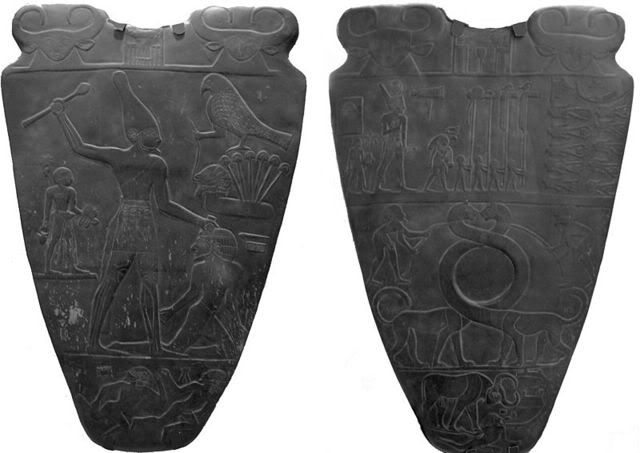
Narmer Palette
Two sides of a stone artifact showing
King Namer’s conquest

Beginning in about 4,000 B.C., Egypt existed in two kingdoms: Upper Egypt and Lower Egypt. These two kingdoms were ruled by different kings. Around 3100 B.C., Pharaoh Narmer brought the two kingdoms together through conquest (pictured in the image), creating a unified Egypt. Though he brought the two kingdoms together, there were geographical changes which occurred over the slow progress of centuries (Acts 17:26) making it possible for Egypt to develop and remain the first unified state.

Factor # 1: Changing Geography

In contrast to the 96% of desert we see in Egypt today, in ancient times the land consisted of marshy and rich environments where there were a variety of rich food resources. Fishing and hunting were abundant. This changed with the recess and stabilization of post-glacial sea levels which originated with the Flood. With the receding of water, the environment became less swampy which transformed into wider, more open, well-drained floodplains.

Factor # 2: Changing Food Source

As the environment changed, Egypt gradually became less rich in these food resources. Over time it would lose a significant amount of its primary food sources. Each succeeding generation would have had a slightly harder job of supporting itself. This would necessitate that the Egyptians shift toward farming. They kept pigs and grew more crops.

Factor # 3: Growing Food Surpluses

As Egyptians took up farming, a wealth of agricultural production developed that was at greater levels than any other area where farming had been practiced. This was because of the Nile River and its annual flooding provided a highly fertile soil which brought increasing surpluses of food. Large groups of people could be organized to carry out irrigation projects and to expand the agricultural wealth of a unified Egypt. The need to administer this surplus created the necessity for a unified state. Benjamin Pennington, professor of archaeology at University of Southampton, writes:

Early hieroglyphics from this time record transactions into and out of the state treasury, while the “capital” and royal court were set up at the obvious place—near modern-day Cairo—binding the agricultural powerhouse of the delta with the older centers of culture upstream.

The managing of these surpluses necessitated the need for a powerful centralized government. Eventually this centralized government made possible the construction of public monuments, such as the pyramids, and other cultural achievements. The geographical changes in Egypt not only helped stimulate farming production, but played a major role in the emergence of the first nation state. This was a major gift to the world.

How God Used Egypt As the First Nation State

As a nation state they were a source of refuge for God’s people.

  • Abraham fled to Egypt during famine (Genesis 12:10-20)
  • Jacob and his family fled to Egypt during famine (Genesis 46:1-34)
  • Joseph took Mary and Jesus to Egypt (Matthew 2:13-18)

Because of the resources of Egypt, it was a place of refuge for the Jewish patriarchs and Jesus.

As a nation state they were a model to other nations.

For Israel and the rest of the world, Egypt was an example of a people developing defined borders, a centralized administrative state, and a common unified culture. With the establishing of nation states, this allowed for the increased flow of information and travel for ideas to spread. For Israel, they could become one (goy) and not just distinct tribes or peoples (mishpachah) because they lived and grew inside of the first nation state.

How Did We Get the Bible?

Photo by RODNAE Productions on Pexels.com

Selling over 80 million copies, Dan Brown’s The Da Vinci Code ignited a worldwide controversy. It advanced the claim made by some skeptics that the Bible is a purely artificial collection of books, perhaps tainted by conspiracy and power plays of powerful religious figures, backed financially by the Roman Emperor Constantine. (AD 272-337)  Here’s how one passage of The Da Vinci Code reveals the plot: 

“Who chose which gospels to include?” Sophie asked. 

“Aha!” Teabing burst in with enthusiasm. “The fundamental irony of Christianity! The Bible, as we know it today, was collated by the pagan Roman emperor Constantine the Great.”

The DaVinci Code is a work of fiction.  It is as nearly fictitious to believe that in early Christianity there was a massive array of documents which vied for attention and authority of the church. A powerful group of bishops, as the story is told, gathered under Constantine and put a swift stop to it all by publishing a list of the letters they liked and systematically wiping out any dissent.  Consequently, the church was left with a set of writings chosen with an arbitrary and politically controlled process.  

How can we be confident that the sixty-six books of the Bible are the ones God wanted?  How did the Bible come to be formed?  The process used for discerning which books would be included in the Bible is known as canonization.  Canon comes from a Greek word meaning “rule” or “measuring stick,” referring to the writings which became the “rule” or “measuring stick” of Scripture.

Old Testament Canon

The process of establishing an authoritative canon of the Old Testament began with Moses (approx. BC 1440):  

So Moses wrote down this law and gave it to the Levitical priests, who carried the ark of the covenant of the Lord, and to all the elders of Israel…After Moses finished writing in a book the words of this law from beginning to end, he gave this command to the Levites who carried the ark of the covenant of the Lord…

Deuteronomy 31:9, 24‭-‬25

Starting from Moses, the books of the Old Testament (OT) were written and collected for the next thousand years, ending with the prophet Malachi. (BC 420)  The thirty-nine books of the OT were well established by the time of Jesus. The Savior, himself, declared: 

For truly I tell you, until heaven and earth disappear, not the smallest letter, not the least stroke of a pen, will by any means disappear from the Law until everything is accomplished.

Matthew 5:18

In addition, the first-century Jewish historian Josephus (AD 37-100) offers a list of OT books accepted by the Jews which matches our current collection.  He writes, “For although such long ages have now passed, no one has ventured neither to add, or to remove, or to alter a syllable.” 

There are other layers of evidence, as well.  What is key to recognize is that the writers of the New Testament (NT) frequently quote the OT without any dispute over the boundaries of the OT canon. In fact, there is no instance anywhere that a NT author cites a book as Scripture that is not in our current thirty-nine book canon of the OT. 

New Testament Canon

As in the OT, when the books of the NT were accepted, Christians did not select them with a choosing finger but received them with an open hand.   

Over and over again when the early church fathers wrote about which books were included, they used language such as “we received” and “these books were handed down.”

Greg Gilbert, Why Trust the Bible?

This point is vital.  They did not “choose” which books to canonize from a large group of undifferentiated books.  Rather, each generation began with a group of authoritative books that they had inherited from the previous generation and which that generation in turn had inherited from the generation before them all the way back to the apostles themselves.

The writers of the NT claimed to write with a God-given authority. John declares in his gospel: 

The man who saw it has given testimony, and his testimony is true. He knows that he tells the truth, and he testifies so that you also may believe.

John 19:35

Paul insists that his words were “the word of God:”  

And we also thank God continually because, when you received the word of God, which you heard from us, you accepted it not as a human word, but as it actually is, the word of God, which is indeed at work in you who believe.   

1 Thessalonians 2:13

By AD 68, the year Peter was martyred by Nero, there were a group of letters which were already acknowledged as Scripture on par with the OT, itself: 

…just as our dear brother Paul also wrote you with the wisdom that God gave him. He writes the same way in all his letters, speaking in them of these matters. His letters contain some things that are hard to understand, which ignorant and unstable people distort, as they do the other Scriptures, to their own destruction.

2 Peter 3:15-16

Similarly, Paul writes around AD 63, citing the gospel of Luke as Scripture to Timothy:

For Scripture says, “Do not muzzle an ox while it is treading out the grain,” and “The worker deserves his wages.”

1 Timothy 5:18

Papias, a leader in the early church, writing as early as AD 110 gives evidence that the apostle John accepted Matthew, Mark and Luke as Gospels, as well as writing one of his own.  

After the apostles died, there was a core collection of books functioning as Scripture.  This is given historical confirmation when in 1740 a writing called the Muratorian Fragment was discovered.  It revealed that most of the NT books were already recognized and accepted as Scripture perhaps by the middle of the second century by the church. This document can be traced back to an apostolic connection.

  • The apostle John died around AD 95.
  • The Muratorian Fragment was written about A.D. 150-170.
  • Polycarp (AD 69-155), a disciple of the Apostle John, refers to the Fragment himself.

This writing shows a line of connection two generations from the apostles. The early Christians coalesced around the NT books remarkably early. Generally speaking, this core would have included the four gospels, Acts, thirteen epistles of Paul, Hebrews, 1 Peter, 1 John, and Revelation. Books that were “disputed” tended to be the smaller books such as 2 Peter, Jude, James, and 2-3 John.  Despite these questions, each of these seven books was eventually accepted. 

Disputed Books

Why were some books disputed?  Around the middle of the second century there were two categories of letters being circulated among churches:

  1. letters which were good but not written or authorized by the apostles
  2. letters which were reported to have been from the apostles but were not 

The church needed to clarify which of the books would be part of the canon.  To do this they asked two main questions: 

Question # 1: Was the book written or authorized by an apostle?  The idea was profoundly simple and powerful: Not just anyone could write about Jesus or give Scripture and expect the church to recognize it as such. No, that level of authority was reserved for those whom Jesus himself had specifically appointed apostles and for a select few close companions of the apostles. For example, though Mark was not an apostle, he wrote his gospel from the knowledge he gained out of his companionship and interaction with Peter.

One interesting thing to notice here is how so many would-be Scripture authors, in the second century and beyond, tried to fool the church by slapping the names of apostles and other first-century followers of Jesus onto their documents! (e.g., Gospel of Thomas, Gospel of Peter, Letter of Paul to the Corinthians, etc.) Why did they do that? It is simple. They knew they didn’t have a chance of being recognized as authoritative unless they could pass off their books as originating with an apostle or an apostolic companion. So, the church needed to verify that the disputed books had apostolic authority.  

Question # 2: Was it from the first century?  This was closely related to the first test. To put it simply, in order for a book to have an apostle’s authority, it would have to be old, dating to the first century. No newbies need apply.  Books written more recently than that simply didn’t qualify because the apostles were all dead by the turn of the second century. Antiquity, therefore, didn’t assure canonicity, but a lack of antiquity immediately prevented it. 

In addition to the questions above, the church also asked how widely had the books been circulated among the churches and did the content square with the received theology coming from the apostles.  Because they did this, they were able to weed out bogus contenders.

Bogus Letters

So, with the books that did not make the cut, what are we missing?  Here are some examples which will put your fears to rest that you are not missing out on some great inspiration: 

The Gospel of James, dated around AD 150, tells of a skeptical woman who doubts Mary’s character-defining purity.  Without warning Mary turns red-hot, sends out a flame like the Human Torch and burns the woman’s hand off.  Here is the woman’s description:

Woe for my lawlessness and the unbelief that made me test the living God. Look, my hand is falling away from me and being consumed in fire.

Fortunately for her, the touch of baby Jesus is all it takes to restore her lost body part.

The Gospel of Pseudo-Matthew, not written by the apostle Matthew, claims that the child Jesus visits with his mother in a cave where the holy duo encounter dragons. Here is how it reportedly went down: 

And, lo, suddenly there came forth from the cave many dragons; and when the children saw them, they cried out in great terror. Then Jesus went down from the bosom of His mother, and stood on His feet before the dragons; and they adored Jesus, and thereafter retired.

From the Gospel of Thomas we are treated to stories of a mischievous and youthful Jesus who makes clay birds and turns them into real ones.  He also lets it be known that he is not to be messed with as he curses and even kills children who try to give him a hard way to go.   

I think the early church fathers were on solid grounds to axe these and others like them from the NT canon.  

In conclusion, New Testament scholar F.F. Bruce wrote:

The New Testament books did not become authoritative for the Church because they were formally included in a canonical list; on the contrary, the Church included them in her canon because she already regarded them as divinely inspired, recognizing their innate worth and general apostolic authority, direct or indirect.