Why Constantine Was Good For Christianity (Hosea 6:6)

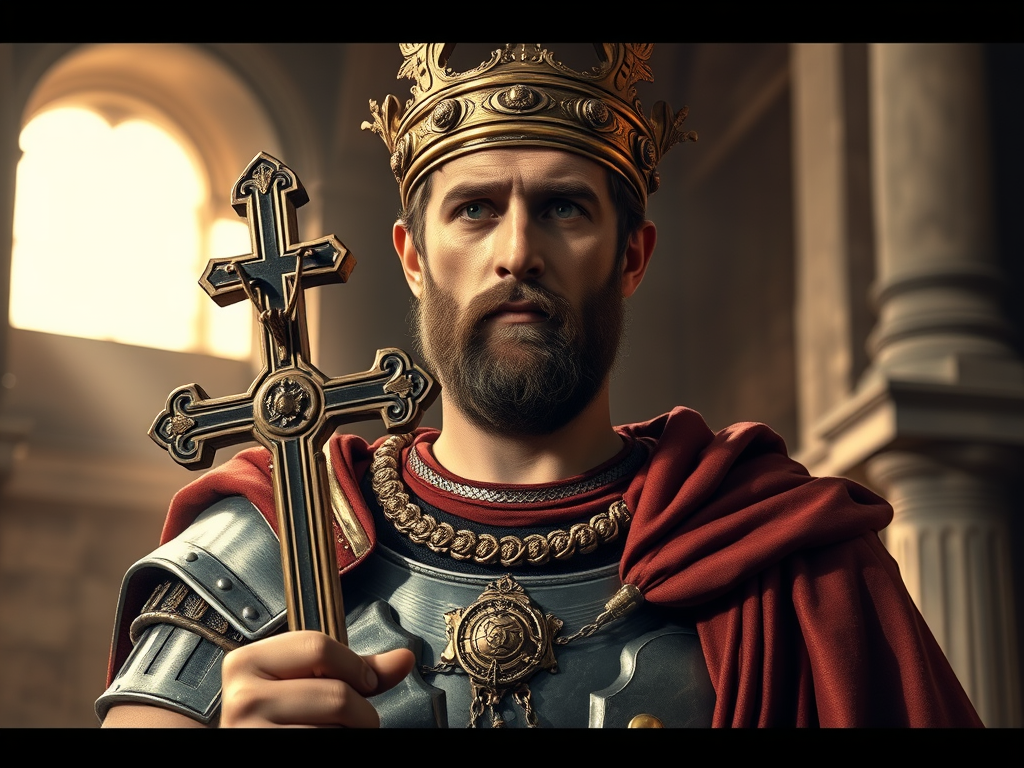
depiction of Constantine

Two rivals, Constantine and Maxentius, met in an earth-shaking confrontation at the Milvian Bridge, north of Rome, over the Tiber River. Maxentius held Rome in his iron grip. As Constantine descended from the north, this brilliant general marched his smaller, battle-hardened army toward Rome. The day before the final battle, Constantine was filled with a familiar anxiety. At midday, his gaze drifted upward, away from the turmoil of his camp. There, he saw a cross of light above the sun itself, with the Greek words “Ἐν Τούτῳ Νίκα” (“In this sign, conquer”) emblazoned upon it. Later that night, another vision came to him in a dream. Christ appeared, bearing the same cross, and commanded Constantine to make this symbol his standard in battle. The symbol was the Chi-Rho, an elegant monogram formed from the first two Greek letters of “Christ.” The next day, he ordered his soldiers to paint the sacred monogram on their shields. Within hours, the two armies clashed fiercely on the plain north of Rome. Constantine’s cavalry, emblazoned with the Chi-Rho, charged with a ferocity that Maxentius’s larger army could not match. It was a decisive victory. After his victory at the Milvian Bridge, what Constantine did next—or did not do—would begin to echo through the ages. The rules of the triumph required Constantine to enter the Roman capital and offer the sacrifice of an animal to Jupiter; Constantine refused. This was because he attributed his win to the Christian God.

Constantine became the first Roman emperor to embrace and then promote Christianity. To some, this royal acceptance is what led to a corruption and decline of biblical Christianity for the centuries ahead. The worldly priorities of state power overtook the founding mission to make disciples given by Jesus (Matthew 28:19). so it is claimed. But what if Constantine had not become favorable to Christianity? Would the church have been stronger as a persecuted and minority faith? The answer is probably not. From the angle of God’s Story of Grace, Constantine was part of a kairos (“fullness of time moment”) that brought a pivotal change: he shifted the dominant religious theme of Rome from the pervasively practiced pagan blood sacrifice to a civic acknowledgment of the completed blood sacrifice of Christ. For all of Constantine’s alleged blessings and flaws, this exchange brought a pivotal shift in Western civilization.

In this article, the claim will be made that the effects of the atonement of Christ, which began to be embraced by the Roman Empire, liberated society from the fear of appeasing angry and volatile deities to providing increasing mercy to increase compassion in society. This would be a turning point for the widespread improvement of civilization reflecting the mutual and self-giving love of the Trinity.

Bloody Rome

The core of Rome’s existence was built on sacrifice. These frequently included animal offerings like rams and ox; but also human slaughter through gladiatorial games, strangling prisoners at the temple, burying prisoners of war alive, among others atrocities. Sacrifices were central to establishing favor with the deities in order to appease them for transgressions or demonstrate devotion to gain their favor. Another way this sacrificial devotion was expressed was the killing of Christians. This occurred at its greatest extent from 303 to 311, just before Constantine ascended to the throne in 312. Diocletian became emperor in 284. In 299, he participated in a sacrifice to seek the favor of the Roman Empire, while in the city of Antioch, that proved alarming. When the liver of a slaughtered animal was examined, the pagan priest said it showed unfavorable signs. For Diocletian this was very disturbing. The very peace of Rome was at stake. Theologian Peter Leithart describes what happens next:

The presiding diviner investigated and concluded that “profane persons” had interrupted the rites, and attention focused on Christians in Diocletian’s court who had made the sign of the cross to ward off demons during the proceedings. Diocletian was outraged and demanded that all members of his court offer sacrifice, a test designed to weed out Christians. Soldiers were required to sacrifice or leave the sacred Roman army. At least at the heart of the empire, in the court and in the army, sacrifices would continue without being polluted by Christians. At the heart of the empire, where it really mattered, gods and men would remain in communion.

Still the problem was not solved. Leithart continues:

Several years after the failed sacrifice, Diocletian was back in Antioch when a Christian deacon, Romanus, burst in on another imperial sacrifice loudly denouncing the worship of demons. Diocletian ordered that his tongue be cut out and sentenced him to prison, where he was executed, but the emperor knew something more needed to be done. Wintering in Nicomedia the following year, Diocletian consulted with his Caesar Galerius about the problem. “Arrogant and ambitious” and a “fanatical pagan,” Galerius urged Diocletian to issue a general order against the Christians.

The Chi Rho Symbol

Diocletian was charged with guarding the frontiers of the empire and maintaining the sacredness of Rome. It was his solemn duty to expel any pollution that might infect it and bring down the wrath of the gods. Christianity was spreading, and Christians were everywhere. From Diocletian’s point of view, Rome could only be saved by a massive sacrifice of Christian blood. What started out in 303 as an arrest and violence against Christian leaders turned into a bloodshed in the most widespread, long lasting and severe persecution which the church had ever faced under the hammer of Rome. The beginning of the end would finally occur at the battle at the Milvian Bridge in 312 and one year later the blood sacrifice of Christians ended in 313 when Constantine issued the Edict of Milan. This gave Christians legal status to practice their faith.

This was the beginning of a series of reforms which would baptize the Roman Empire in a Christian direction away from paganism. He prohibited his provincial governors from offering sacrifices at official functions, thus opening up civil offices to Christians. Eusebius, the ancient historian, claimed Constantine passed a law around 324 that “was intended to restrain the idolatrous abominations which in times past had been practiced in every city and country; and it provided that no one should erect images, or practice divination and other false and foolish arts, or offer sacrifices in any way.” In 325, he issued an edict against the gladiatorial games declaring that “bloody spectacles are not suitable for civil ease and domestic quiet.” Constantine himself fought imperial wars, but his victories were not celebrated as the honor-wars to the gods of previous emperors had done.

With Constantine, the Roman Empire became officially an empire without sacrifice or at least a bloody sacrifice. It still had acknowledgement of sacrifice, but it was the sacrifice provided once and for all by Jesus Christ. The implications had earth-quaking significance. Again, Peter Leithart explains:

Every city is sacrificial, but Constantine eliminated sacrifice in his own city and welcomed a different sacrificial city into Rome. For a fourth-century Roman, eliminating sacrifice from the city was as much as to say, “My city is no longer a city.” For a fourth-century Roman, acknowledging the church’s bloodless sacrifice as the sacrifice was as much as to say, “The church is the true city here.” When Constantine began to end sacrifice, he began to end Rome as he knew it, for he initiated the end of Rome’s sacrificial lifeblood and established that Rome’s life now depended on its adherence to another civic center, the church.

Because Rome couldn’t acknowledge the ultimate and final sacrifice for humanity, it was not free to exercise mercy. Above all God desires from his people “mercy not sacrifice.” (Hosea 6:6)

Pagan Sacrifice to the Sacrifice of Christ

The state became more compassionate. Because the sacrifice of Christ was accomplished “once and for all,” Rome no longer needed to be consumed with the brutal work of appeasing bloodthirsty entities. Rather, it could promote compassion and mercy as expressed through the message of the church. This would, in turn, bring the promotion of more just laws.

  • Crucifixion was abolished.
  • Funding for the poor, orphans, and widows was introduced.
  • The practice of infanticide through exposing unwanted babies was made illegal. Care for unwanted children was provided for from the public treasury.
  • More humane policies toward slaves was put in place.  
  • Branding on the faces of criminals was made illegal. 
  • Prison reform was inaugurated requiring that prisoners be given daylight and fresh air instead of being kept in total darkness. 
  • Gladiator games were banned. 
  • Women were given more rights in regard to their children.
  • A day of rest was put in place , thereby reordering the life of society to make space for Christian worship.1

The mission of the church expanded. The Constantinian revolution created space for Christianity to shape the new society that was being constructed away from paganism. The church put forward a new idea of a separate community within society. No longer did the state control the ultimate meaning of life. The church was a gathered community within the state that brought in God’s Story of Grace in Jesus Christ. The result was a great flowering of Christian expression in art, architecture, law, theology, philosophy, and spiritual literature. None of this was imposed by the state but came as a natural outgrowth of the dynamic movement of Christianity. The number of disciples would mount across the empire. Historian Robert Louis Wilken describes the church’s growth:

The transformation that took place within the empire would be replicated again and again as Christianity spread beyond Rome’s boundaries into northern Europe, among the Franks and the Germans, the British and the Irish, the Scandinavians and the Poles, the Lithuanians and the Bulgars, the Ukrainians and the Russians, into Asia among the Armenians and Georgians, and into Africa among the Nubians and Ethiopians. For all these peoples conversion to Christianity meant a change of public practice in law, in architecture, in calendar, in marriage customs, in political institutions, in social mores, in burial practices, and much more.

Statistically, it would be at the time of Constantine that Christianity would experience an exponential growth.2

Conclusion

In Constantine, God’s Story of Grace would advance primarily with the cross triumphing over paganism, and compassion beginning to overtake the Roman jaws of power. The Christian ethic of human value would advance as a widespread value in Western culture. It would be from this place that the boundaries of Christian mission and influence would be expanded. For the first time, the organic movement of the church would intersect with the force of Roman power, and a new phase of the image of the Trinity would be born into the world. All the parts of Rome (the many) would become more unified as a larger body (the one) under the sign of the cross.3

_______________________________________________________________

  1. Though Constantine would have a revolutionary influence, he did not usher in a “golden age” of Christianity. Over the next decades after Constantine, Christianity would face a battle against Arianism to affirm the deity of Christ as affirmed in the Council of Nicaea. Often those like Athanasius, who affirmed the Nicaean Creed were severely persecuted.
  2. Rodney Stark has provided these stats on the growth of Christianity in the first four centuries: 7,500 Christians by the end of the first century (0.02% of sixty million people); 40,000 Christians by 150 AD (0.07%); 200,000 by 200 AD (0.35%); 2 million by 250 AD (2%)6 million by 300 AD (10%); 34 million by 350 AD (57%)
  3. Under Constantine, the church held its first ecumenical council, which affirmed the doctrine of the deity of Christ at the Nicaean Council in 325.

How A Band Of Brothers Forged The Church’s Most Important Doctrine: The Trinity (Matthew 28:19)

depiction of the Cappadocian Fathers

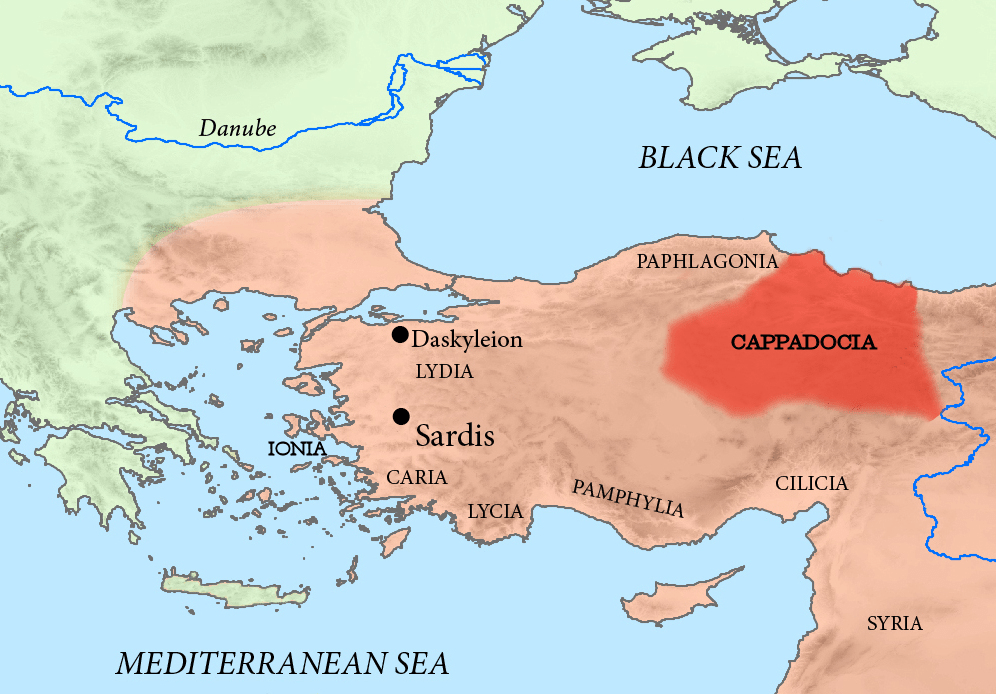
A golden age of biblical exploration and theological development occurred in the fourth century with a band of Christian leaders known as the Cappadocian Fathers: Basil of Caesarea, Gregory of Nyssa, and Gregory of Nazianzus. Their stories and their theological contributions are intertwined. They lived full and adventurous lives as not only theologians but as leaders of the church. But their most important contribution to God’s Story of Grace was solidifying Trinitarian truth for all time–the bedrock of Orthodoxy.1 From the area of Cappadocia (an area of modern Turkey), these three men refined our understanding of the biblical revelation of the meaning of God as Father, Son and Holy Spirit. Their work helped to establish the formula of one God existing in three persons. (one ousia=essence in three hypostasis=person).

In this article we will look at the distinctive contribution of each man to the doctrine of the Trinity and then look at the big implications of this doctrine in the shaping of God’s Story in the world.

Trinitarian Theologians

All three were born after the First Council of Nicaea (325) and so entered into the life of the church in the midst of its aftereffects. The Council of Nicaea did not cease opposition to those upholding the truth it affirmed, namely: Jesus is fully God equal to the Father, very God of very God. On the contrary, in many ways opposition increased. Followers of Arius continued to press a reduced view of the Son claiming that the Son is created, and thus less, than the Father. In fact, by the time the Cappadocian Fathers were on the scene, the new level of attack by the Arians was to claim that the Holy Spirit is a created being, as well.2 The opposition theologically created persecution politically. Arianism, for the next half a century, was backed by the emperors after Constantine– three of them being Constantine’s sons. The bishops who held to Arianism were able to hold seats of influence and power in the church. Because of this the three Cappadocians Fathers experienced serious and sustained resistance and harassment. Nonetheless, their arguments for the deity of Jesus and the Holy Spirit would prevail, and their theological and biblical insights for understanding how God exists as one God in three persons would forever be the standard clarification of biblical revelation. This would be later affirmed at the Council of Constantinople (381).

Cappadocian Fathers

Basil of Caesarea 330-379 (ousia and hypostasis)

To counter heresies like Arianism, Basil emphasized the distinction between the terms ousia (Greek word for essence) and hypostasis (Greek word for person). These words had been used synonymously; Basil was the first to make a distinction.3 In 377 a man named Amphilochius wrote to Basil and asked him to explain the distinction between ousia and hypostasis. Basil responded with the following:

The distinction between essence [ousia] and hypostasis is the same as that between the general and the particular; as, for instance, between [humanity] and the particular [man]. Therefore, concerning the divinity, we confess one essence [ousia]…; but the hypostasis, on the other hand, is particularizing, in order that our conception of Father, Son and Holy Spirit may be unconfused and clear.

Basil’s analysis is helpful as it utilizes a distinction with which we are all familiar. We all know the difference between describing a person as a human being (one who is a member of the human race) and identifying him as a distinct individual (e.g., Bob Smith). But the analogy should not be pushed too far.4 They are distinguished not by their substance but how they exist to and with one another.

Gregory of Nazianzus 330–391 (homousia of the Holy Spirit)

He significantly extended the case for the full divinity of the Holy Spirit, affirming his co-eternal and co-equal status with the Father and the Son. He did this by directly linking the Spirit’s redemptive actions to his divine nature, arguing that only God could perform God-level tasks like sanctification and rebirth which brings the believer into the likeness of God. His argument is that the Holy Spirit is homoousia (of the same essence) with the Father and the Son. To deny the Spirit’s divine essence, he reasoned, would undermine the Trinity and the economy of salvation leading to an incomplete or imperfect Godhead. In salvation and sanctification, the Holy Spirit makes believers “like God.” If the Holy Spirit were a created being–indwelling believers–they would be filled with a creature, who could not make them like divinity. Gregory declared, “If he has the same rank as I have, how can he make me God, how can he link me with deity?” But the Holy Spirit is able to make us like God since he is God.

In this respect, The Holy Spirit causes believers to participate in the very life and reality of the Trinity and makes that very life known and experienced to the Christian. He writes forcefully on this point in his Fifth Theological Oration making several key points. I will break his statements down into four categories:

Category 1: The Holy Spirit is joined with Christ in every step of his ministry.

Look at the facts: Christ is born, the Spirit is his forerunner; Christ is baptized, the Spirit bears him witness; Christ is tempted, the Spirit leads him up; Christ performs miracles, the Spirit accompanies him; Christ ascends, the Spirit fills his place. Is there any significant function belonging to God, which the Spirit does not perform?

Category 2: The Holy Spirit is given exalted titles.

Is there any title belonging to God, which cannot apply to him…He is called “Spirit of God,” “Spirit of Christ,” “Mind of Christ,” “Spirit of the Lord,” and “Lord” absolutely; “Spirit of Adoption,” “of Truth,” “of Freedom”; “Spirit of Wisdom,” “Understanding,” “Counsel,” “Might,” “Knowledge,” “True Religion” and of “The Fear of God.”

Category 3: This Spirit of God fills and sustains the universe.

The Spirit indeed effects all these things, filling the universe with his being, sustaining the universe. His being “fills the world,” his power is beyond the world’s capacity to contain it. It is his nature, not his given function, to be good, to be righteous and to be in command. He is the subject, not the object, of hallowing, apportioning, participating, filling, sustaining; we share in him and he shares in nothing.

Category 4: The Holy Spirit performs all the actions as the Father.

All that God actively performs, he performs. Divided in fiery tongues, he distributes graces, makes Apostles, prophets, evangelists, pastors, and teachers. He is “intelligent, manifold, clear, distinct, irresistible, unpolluted”—or in other words, he is utterly wise, his operations are multifarious, he clarifies all things distinctly, his authority is absolute and he is free from mutability. He is “all-powerful, overseeing all and penetrating through all spirits that are intelligent and pure and most subtle”—meaning, I think, angelic powers as well as prophets and Apostles. He penetrates them simultaneously, though they are distributed in various places; which shows that he is not tied down by spatial limitations.

Gregory of Nyssa 335–394 (distinction but not separation of the hypostasis)

Gregory of Nyssa’s key contribution to this effort was defining the complete unity of the Trinity relating and functioning within the distinctive ways of Father, Son and Holy Spirit. He explained that every divine action from creation to the governance of the universe is a single motion that proceeds in one direction with all persons of the Trinity. Within the unified motion of God there are distinctions of person but not separation.5 In this way he was able to highlight the relational interaction and dynamic of the personhood of the Father, Son and Holy Spirit. For this reason he worked to more clearly define the working order or sequencing6 of the Trinity as seen in the scriptures:

The Son Proceeds From the Father

14 The Word became flesh and made his dwelling among us. We have seen his glory, the glory of the one and only Son, who came from the Father, full of grace and truth…18 No one has ever seen God, but the one and only Son, who is himself God and is in closest relationship with the Father, has made him known. (John 1:14, 18)

 …yet for us there is but one God, the Father, from whom all things came and for whom we live; and there is but one Lord, Jesus Christ, through whom all things came and through whom we live. (1 Corinthians 8:6)

For in Christ all the fullness of the Deity lives in bodily form… (Colossians 2:9)

The Holy Spirit proceeds from the Son and the Father

16 And I will ask the Father, and he will give you another advocate to help you and be with you forever— 17 the Spirit of truth. (John 14:16-17)

But the Advocate, the Holy Spirit, whom the Father will send in my name, will teach you all things and will remind you of everything I have said to you.  (John 14:26)

“When the Advocate comes, whom I will send to you from the Father—the Spirit of truth who goes out from the Father—he will testify about me. (John 15:26)

Unless I go away, the Advocate will not come to you; but if I go, I will send him to you. (John 16:7)

32 God has raised this Jesus to life, and we are all witnesses of it. 33 Exalted to the right hand of God, he has received from the Father the promised Holy Spirit and has poured out what you now see and hear. (Acts 2:32-33)

The Holy Spirit glorified the Father and the Son

13 But when he, the Spirit of truth, comes, he will guide you into all the truth. He will not speak on his own; he will speak only what he hears, and he will tell you what is yet to come. 14 He will glorify me because it is from me that he will receive what he will make known to you. 15 All that belongs to the Father is mine. That is why I said the Spirit will receive from me what he will make known to you.” (John 16)

It is clear from these scriptures that the three divine persons know and love each other. In this love, they are in communion with each other, and freely act together in their common will and purpose.

What Does This Mean?

The Trinity is revealed and understood through history. God continues to make himself known more fully in the relational progress of history. It is only through the outworking of the human experience that we are able to experience, understand and appreciate God’s Story of Grace. What is the reason for this? Finite humans can only perceive the infinite God gradually and can only worship relationally–in real experience. As Gregory Nazianzus wrote in his Fifth Oration: You see how light shines on us bit by bit, you see in the doctrine of God an order, which we had better observe, neither revealing it suddenly nor concealing it to the last. To reveal it suddenly would be clumsy… For God to reveal too much at one time would have created confusion rather than revelation. This is why history itself is the progression of gradual and relational experience, and God makes himself known this way.

The Trinity is the direction and shape of history. God’s decisive acts of creation and redemption are unfolding through the entire scope of history reclaiming and transforming everything to participate in the likeness of the Trinity. It is a movement toward a mutual and self-giving love, a balance of respect for the one (hypostasis) and many (ousia). This makes it fitting that the doctrine and understanding of the Trinity would itself be progressively hammered out and defined in a historical process. It is also fitting that the foundational ecumenical creeds of Nicaea and Constantinople are anchored to these most central and beautiful truths about God–one essence (ousia) in three persons (hypostasis).

____________________________________________________________________________

  1. In ancient Greek, the word “ortho-” means straight or correct. The word “doxa” means judgment or belief. Orthodoxy basically means correct belief which is in the spirit of Jude 1:3: I felt compelled to write and urge you to contend for the faith that was once for all entrusted to God’s holy people
  2. While some anti-Nicenes continued to object to Nicaea, many who wanted to ecclesiastically fall in line with the Nicene decision and its implicit support by Constantine shifted their arguments against the full divinity of the Son to a denial of the full divinity of the Holy Spirit. This was their way of straddling the fence in the controversy.
  3. Hypostasis brings together the two words: ὑπό (hupo), meaning “under” or “beneath,” and στάσις (stásis), meaning “a standing” or “position.” This is an excellent words for the personal distinctions of the Father, Son and Holy Spirit underneath or existing in the one essence of God.
  4. As we have seen, Basil is insistent that the divine substance is incomprehensible. “We do not know what God is in his essence, what kind of being he is, because ultimately he is not a kind of being at all.”
  5. There are several scriptures which witness to this relational unity: 16 As soon as Jesus was baptized, he went up out of the water. At that moment heaven was opened, and he saw the Spirit of God descending like a dove and alighting on him. 17 And a voice from heaven said, “This is my Son, whom I love; with him I am well pleased.” (Matthew 3:16-17); For it is we who are the circumcision, we who serve God by his Spirit, who boast in Christ Jesus, and who put no confidence in the flesh (Philippians 3:3); There are different kinds of gifts, but the same Spirit distributes them. There are different kinds of service, but the same Lord. There are different kinds of working, but in all of them and in everyone it is the same God at work. (1 Corinthians 12:4-6); who have been chosen according to the foreknowledge of God the Father, through the sanctifying work of the Spirit, to be obedient to Jesus Christ and sprinkled with his blood (1 Peter 1:2).
  6. Gregory defined this ordering or sequencing by the Greek word (táxis) means “order,” “arrangement,” or “rank.” The word comes from the verb tássein (“to arrange” or “to set in order”) and originally described military formations before being applied to other contexts, such as the movement of organisms in response to stimuli. 

What Caused the Early Church to Explode in Growth Against All Odds? (Matthew 28:19)

Christianity brought the first nonviolent revolution that changed the world from the inside out through conversion and discipleship. Far from causing violence, in its first 300 years, it was the brunt of periods of localized to widespread and systematic persecution and outright cruelty. This was experienced from the beginning (see Acts 8:1-4). The majority of its adherents were mostly poor, with little to no social status or influence. The Roman Empire consisted of 60 million people living over 2 million square miles (the continental United States is just over 3 million square miles), with over 30 nations and dozens of cultures connected by 250,000 miles of roads. The social and cultural barriers were vast, and the conditions were often hostile and dangerous. Yet, in 300 years, it went from a few hundred adherents to 35 million people (57% of the Roman Empire). Below are the projected conversion growth rates according to Rodney Stark1:

  • 7,500 Christians by the end of the first century (0.02% of sixty million people);
  • 40,000 Christians by 150 AD (0.07%)
  • 200,000 by 200 AD (0.35%)
  • 2 million by 250 AD (2%)
  • 6 million by 300 AD (10%)
  • 34 million by 350 AD (57%)

Nothing like this type of revolution had ever occurred anywhere in the world. To imagine that in its early days (anywhere before AD 250), it would become the dominant religion in the whole Empire would be beyond the wildest imagination. The question before us is how did the liberating power of the Holy Spirit spread from Pentecost to reach and transform millions in just three centuries? The heart and core of the answer lies in the command Jesus gave to his first followers just after the resurrection:

“Therefore go and make disciples of all nations…”

Matthew 28:19

In this article, we will trace the early expansion of Christianity and then examine the core reasons that caused it to grow so dramatically. In this, we will see that Christianity emerged as the first decentralized mass movement of people, bringing new levels of personal freedom to millions while being linked to the same life and truth of the gospel. God further shaped humanity into the trinitarian image with increased liberty (diversity) and one gospel (unity).

Initial Messianic Movement

The Jesus’ movement started within Judaism. At Pentecost (AD 33), there were 3,000 who believed in Jesus as the Messiah. (Acts 2:41) Many of these were visiting Jerusalem from sixteen different locations outside the sacred city, some as far as Rome, 2,500 miles away. (Acts 2:9-10) Among the thousands who embraced Jesus as the Messiah, they would have taken their newfound faith back to the places where they resided and started embryonic churches.2 There was a Christian group in Damascus (about 140 miles north of Jerusalem) maybe as early as AD 34.3

It is largely believed that a church was started in Rome by those who returned to that capital city from Pentecost. Many budding churches started as Jews returned to their places of residence after Pentecost. Nearly twenty-five years later (ca. AD 57), James and the elders at the Jerusalem church affirmed that many thousands of Jews believed:

You see, brother, how many thousands of Jews have believed, and all of them are zealous for the law. (Acts 21:20)

When it is stated that many thousands believed, the Greek term used is μυριάς (muriad), meaning ten thousand. Had there been ten thousand by this date, that would mean, overall, that Jesus’ movement made very little impression upon the Jewish people. Emperor Claudius took a census of the Roman Empire (AD 48), and it revealed that there were 7 million Jews in the Roman Empire, with 2.3 million in Israel.4 Perhaps around 400,000 were in Alexandria, Egypt. If these numbers are accurate, that would mean that 1/10th of 1% of the Jewish population embraced Jesus as the Messiah. That would hardly be a ripple in the ocean of the Jewish world at the time.

Paul and the Gentile Movement

With the conversion of Cornelius (Acts 10), the first Gentile believer, to Jesus’ movement around AD 40, a pivotal shift began to occur. The Christian faith would become predominantly Gentile in a short period of time, maybe as early as the mid-first century. The apostle Paul, though not alone, was central to accelerating this shift. By AD 49, when Paul reached Thessalonica, his opponents proclaimed:

“These men who have caused trouble all over the world have now come here…” (Acts 17:6)

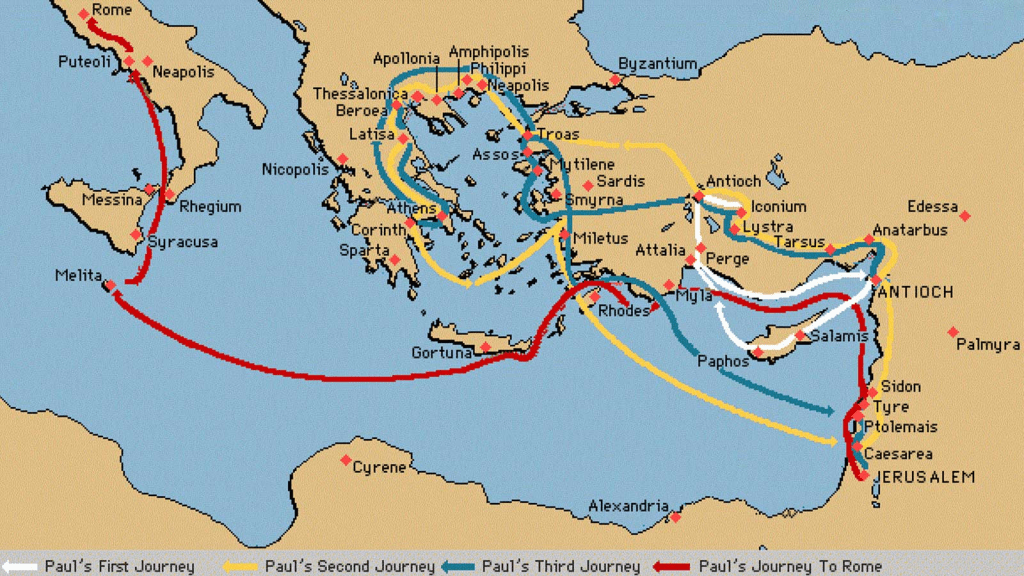
Paul was formidable in taking Christianity in a westward direction (as the map above shows Israel, Syria, Turkey, and Greece) on his three missionary journeys which occurred over 13 years. (Acts 13-14, 16-17, 18:23–20:38) Though Paul was a notable missionary of Jesus’ movement, the spread of the faith took place through thousands of disciples, the vast majority unmentioned in the records of history.

300 Years Into 3 Continents

By AD 100, the Church had been largely established in all parts of the Roman Empire. Rodney Stark points out that of the 17 cities which were 1,000 miles from Jerusalem, 12 had a congregation by AD 100. All of the 17 cities had one congregation by AD 180. Of the 14 cities more than 1,000 miles from Jerusalem, 8 cities had one congregation by AD 180. By AD 250, all of them had a church.

Asia

Antioch: This became the second major home and hub of the Christian movement outside of Jerusalem. It was the third largest city in the Roman Empire, boasting 500,000 residents by the end of the third century. It is here that the gentile identity of Jesus’ movement was formed, as they were the first to be called Christians. (Acts 11:26) The church was predominantly Greek-speaking and spread throughout much of Syria. By the time of the Council of Nicaea (AD 325), the church had no less than 20 bishops from Syria present.5 This indicates the presence of the faith in many towns and cities in several different parts of the region.

Ephesus: We know little of the missionaries who labored here after Paul. One exception is the account of Gregory Thaumaturgos, known as the “Worker of Wonders.” This man, a son of prominent and wealthy parents, was a native of Pontus. In the course of his studies, he became a Christian. In the year AD 240, he was made bishop. He set out to preach the gospel to the pagans of his region. It is said that when he ascended to leadership, only seventeen Christians were there, while thirty years later, at his death, only seventeen pagans remained.

Edessa: The church spread to Edessa (southeastern Turkey). At this point, in the first century, it lay just beyond the Roman Empire, yet it had close ties with Antioch. It was later claimed that the founder of the church there had been one of the 72 disciples of Jesus (Luke 10:1-3), a man named Addai. According to Eusebius in his Ecclesiastical History, a terrible illness had stumped the court physicians of King Abgar, ruler of Edessa. In his desperation, he prayed to Jesus, pleading with him to come to his capital of Edessa. Eusebius records that the apostle Thomas commissioned Thaddeus to go there. “When he came to these places, he both healed Abgar by the word of Christ and astonished all there with the extraordinary miracles he performed.” Serapion, bishop of Antioch in about AD 200, consecrated an Edessene Christian named Palut to be bishop of the capital. From here, the gospel would spread to regions that are now Iraq, Armenia, and India.

Armenia: According to tradition, the disciple Thaddeus (Matthew 10:3) arrived in Armenia in AD 43, where he was joined by Bartholomew (Mark 10:3) in AD 60. Both men are said to have died there as martyrs. We also know that Syriac missionaries from Edessa reached Armenia by the third century. The traditional account, however, honors Gregory the Illuminator (AD 257–331) as one who advanced Christianity in Armenia. Gregory was himself an Armenian, a prince who was educated as a Christian in Caesarea (present-day Turkey). Upon his return, he found himself, like Daniel in Babylon, imprisoned in a pit by the monarch Tiridates III (reigned AD 287–330) for refusing to participate in pagan sacrifices. Gregory was recalled from his pit after twelve years to cure Tiridates, who had descended into a mysterious state of madness.

India: There is a body of evidence that shows the apostle Thomas traveled east, through Syria and Iraq, and reached India. He is believed to have landed on the Malabar Coast (present-day Kerala) and established one of the world’s oldest Christian communities.6

Europe

Rome: Peter preached in Judea and Samaria, before traveling to Antioch, Asia Minor (Pontus, Galatia, Cappadocia, and Bithynia), and finally to Rome.7 Christianity appears to have had a significant presence in the city of Rome by the late AD 40s. This rapid growth can be partly attributed to the large number of Christians who converged on Rome from other parts of the Empire. Paul referenced all of the disciples who had moved there from different parts of the world as evidence of this in Romans 16.8 There were some 30,000 Christians there by AD 250. Most were poorer and spoke Greek, which was the language of the lower classes, as opposed to Latin.

France: Christians from Rome went as missionaries to France, known at that time as Gaul. Irenaeus (AD 130-200), a prominent bishop in France, speaks of using both the Celtic and Latin languages, which would indicate that the church had gone beyond the Romanized people in France.9 By the end of the third century, many churches had been established in Spain.

Africa

Egypt: North Africa became rich with churches. Mark (Acts 12:12, 25; 15:37), who was the writer of the biblical gospel that bears his name and a traveling companion of Peter, was reported to have founded the Church of Alexandria around AD 49. There are further indications that he established the gospel presence in Libya, which was his place of birth. Simon of Cyrene (Matthew 27:32, Mark 15:21, and Luke 23:26), who carried the cross of Jesus, was also believed to be a strong influence in Libya. Alexandria was an especially strong center, producing such Christian thinkers as Clement (AD 150-c215) and Origen (AD 185-254).

Ethiopia: Christianity became the official religion of Ethiopia during the reign of King Ezana (AD 320-360). Irenaeus of Lyons (see above), writing in AD 180, reports that Simon Backos preached “the coming in the flesh of God” in his homeland of Ethiopia. Going back even further, Luke writes of the 1st-century conversion of an Ethiopian official (Acts 8:26-40). Could this official have started the first church in Ethiopia? In that it became the official religion of the nation in the fourth century, it is reasonable to think that it underwent at least a few centuries of steady Christian development.

Tunis & Algeria: There was rapid growth further west in what is today known as Tunis and Algeria. The churches here were the first Latin speaking churches. And out of them flowed some of the great Latin Christian literature of Tertullian and Cyprian, to be followed later by the famous Augustine. Augustine resided in modern day Algeria.10

What Caused Christianity to Grow?

Root Cause # 1: A contagious move of the Spirit. The fire of the Holy Spirit, starting at Pentecost, would ignite a transforming and unstoppable blaze from person to person to person. As God’s Story of Grace spread, millions of people discovered a new identity and empowerment to live lives of purpose beyond anything their culture provided for them. This is what Jesus promised would happen through the power of the Holy Spirit:

But you will receive power when the Holy Spirit comes on you; and you will be my witnesses in Jerusalem, and in all Judea and Samaria, and to the ends of the earth. (Acts 1:8)

Root Cause # 2: The message of the gospel. The message of the gospel was seen as the only and ultimate Good News for all of humanity to bring righteousness before God:

16 For I am not ashamed of the gospel, because it is the power of God that brings salvation to everyone who believes: first to the Jew, then to the Gentile. 17 For in the gospel the righteousness of God is revealed—a righteousness that is by faith from first to last, just as it is written: “The righteous will live by faith.” (Romans 1:16-17)

It was this message that led to a rapid spread:

You became imitators of us and of the Lord, for you welcomed the message in the midst of severe suffering with the joy given by the Holy Spirit. And so you became a model to all the believers in Macedonia and Achaia. The Lord’s message rang out from you not only in Macedonia and Achaia—your faith in God has become known everywhere. (1 Thessalonians 1:6-8)

Root Cause # 3: An exponential reproduction of discipleship among everyday believers. The movement of the Christian faith was a decentralized movement of everyday people who were equipped and trained to disciple more everyday people. As Paul writes:

Brothers and sisters, think of what you were when you were called. Not many of you were wise by human standards; not many were influential; not many were of noble birth. (1 Corinthians 1:26)

One evidence of this is that in the first three hundred years, the church faced several waves of violence and cruelty. In some cases it was very severe and was meant to severely cripple and wipe out the faith. Yet, these persecutions never worked because the early church was faithfully engaged in training and maturing leaders and missionaries to continue the spread of the gospel. As Paul instructed Timothy:

And the things you have heard me say in the presence of many witnesses entrust to reliable people who will also be qualified to teach others. (2 Timothy 2:2)

For example, when severe persecution hit the Jerusalem church, they had to locally disband. Luke records that the persecution had a reverse effect:

1On that day a great persecution broke out against the church in Jerusalem, and all except the apostles were scattered throughout Judea and Samaria. Godly men buried Stephen and mourned deeply for him. But Saul began to destroy the church. Going from house to house, he dragged off both men and women and put them in prison.Those who had been scattered preached the word wherever they went. (Acts 8:1-4)

What is significant is that it was not the apostles who spread out. They stayed in Jerusalem. When Paul was jailed in Rome, he described the emboldening effect it was having on other believers:

12 Now I want you to know, brothers and sisters, that what has happened to me has actually served to advance the gospel. 13 As a result, it has become clear throughout the whole palace guard and to everyone else that I am in chains for Christ. 14 And because of my chains, most of the brothers and sisters have become confident in the Lord and dare all the more to proclaim the gospel without fear. (Philippians 1:12-14)

Because Christianity was so decentralized it led to an exponential spread of the faith. Like interest in an investment, it grew slowly at first but then rapidly gained exponential momentum. At the root of all of this is that the church, in the power of the Spirit, discipled everyday believers, in the gospel of Jesus.

Conclusion

Christianity unleashed a decentralized movement which snowballed from thousands to millions of converts in 300 years. It brought a new movement of compassion and care, equality and dignity, freedom and purpose to everyday people. It expanded the realization of personal freedom in unparalleled ways. The world advanced in the shape of the Trinity coming to greater personal freedom. To make this sustainable, it would need to find a unity within all of the new diversity which was created on three continents and in dozens of countries and cultures. This diversity could lead to schisms and break in the church. God would have a solution to this. So the Story of Grace continues…

_____________________________________________________________

  1. Stark would be the first to admit that those figures are anything but precise, but they provide plausible limits.
  2. Small groups of people with with a loose affiliation who were following Jesus through simple practices of discipleship which were modelled for them. (see Acts 2:42-47)
  3. Because Paul went to arrest and detain Christians there, this is evidence of a church formed very early on. Meanwhile, Saul was still breathing out murderous threats against the Lord’s disciples. He went to the high priest and asked him for letters to the synagogues in Damascus, so that if he found any there who belonged to the Way, whether men or women, he might take them as prisoners to Jerusalem. (Acts 9:1-2)
  4. This number is not agreed upon by scholar. Yet, it is safe to sat that this number is in no way unreasonable.
  5. Church organization consisted of a bishop (higher ranking leader) overseeing several churches in an area.
  6. Sean McDowell writes: Early church writings consistently link Thomas to India and Parthia. Three points stand out regarding their witness to Thomas. First, the testimony that he went to India is unanimous, consistent, and reasonably early. Second, we have no contradictory evidence stating Thomas did not go to India or Parthia or that he went elsewhere. Third, fathers both in the East and in the West confirm the tradition. Since the beginning of the third century it has become an almost undisputable tradition that Thomas ministered in India. In addition to the traditions about Thomas in India, there is additional evidence that Christianity made it to India by at least the second century, if not earlier.
  7. While the Bible doesn’t explicitly state his presence in Rome, many early Church Fathers, like Irenaeus and Clement of Rome, wrote about Peter’s ministry and leadership in the Roman church. 
  8. France was divided into Romanized and non-Romanized areas.
  9. Marg Mowczko writes, “Of the twenty-nine people, ten are women, and seven of the ten women are described in terms of their ministry (Phoebe, Prisca, Mary, Junia, Tryphena, Tryphosa, Persis, and perhaps Rufus’s mother also). By comparison, only three men are described in terms of their ministry (Aquila, Andronicus, Urbanus), and two of these men are ministering alongside a female partner (Aquila with Prisca, Andronicus with Junia). These are numbers worth remembering.”
  10. The theologian Thomas Oden has pointed out that the Christianity in Africa influenced the Christians in Europe well before European Christian would influence Africa.

How the Christian Ethic Of Marriage Improved the Lives Of Women and Children (Matthew 19:1-9)

The original sexual revolution began at Pentecost (Acts 2:1-3) when the Holy Spirit started a movement of restoring men and women to an exclusive sexual union of marriage. This is one man married to one woman in a sacred physical and spiritual connection which brings maturity in love and grows families. This marriage, intended from creation, reflects the mutual and self-giving love which is reflected in the Trinity, where God said:

26“Let us make mankind in our image, in our likeness…  27 So God created mankind in his own image,
    in the image of God he created them;
    male and female he created them… (Genesis 1:26-27)

This brought a complete overturning of the sexual morality of the first century world, as we will soon see. The epicenter of this revolution is described in Jesus’ teaching on the sacredness of marriage. This would be used by the Holy Spirit to radically expand liberation and freedom in the world on a whole new level, especially for women and children. Perhaps few developments would prove to be more important in the ongoing movement of God’s Story of Grace.

In this article we will look at the moral condition of the Roman world when it came to sexual practices, and how the ethic of Jesus would bring a transforming liberation to millions through the ongoing impact of the Holy Spirit increasing a mutual and self-giving love in the world

Sexual Inequity In the Roman Empire

Marriage Inequity

Sexual relations were a major source of inequity between men and women. In the pagan world in which Christianity developed, girls were commonly married off at very young ages to much older men. In some cases girls were married before puberty. This was, of course, without their consent. Many famous Roman women had been child brides:

  • Octavia, daughter of Emperor Claudius, married at eleven.
  • Nero’s mother Agrippina married at twelve.
  • Quintilian, the famed rhetorician must have married a twelve-year-old girl who bore him a son at the age of thirteen.
  • The historian Tacitus married a thirteen-year-old.

Plutarch (AD 46–120) reported that Romans “gave their girls in marriage when they were twelve years old, or even younger.” The historian Dio Cassius (AD 155–229) agreed: “Girls are considered to have reached marriageable age on completion of their twelfth year.” This was considered normal, and the practice had very few objectors.

One reason Roman men married young girls was because there was a shortage of women. This was caused by high levels of infanticide (killing of infants) of girls, often times by abandoning them to nature. Even in large families more than one daughter was hardly ever reared. According to historian Rodney Stark, “a study based on inscriptions was able to reconstruct six hundred families and found that of these, only six had raised more than one daughter.” This meant there always was a considerable surplus of marriageable men. The best estimate is that there were 131 males per 100 females in Rome. The surplus was even higher in other areas of the Roman Empire. Because of this acute shortage, it was common for women to marry again and again, not only following the death of a husband, but also after a divorce. In fact, state policy penalized women under fifty who did not remarry, so second and third marriages became common, especially since most women married men far older than themselves. For example, Cicero’s daughter, Tullia, was not untypical. She married at 16 ,widowed at 22, remarried at 23, divorced at 28; married again at 29, divorced at 33. She died soon after childbirth at 34. Another woman was said to have married eight times within five years.

Class Inequity

In the ancient world sexual agency was solely in the hands of powerful men. Sexual offenses, including rape, could carry a death penalty. Prostitutes, however, were not given this legal protection and the rape of a slave would only be considered a crime if it was deemed to cause property damage against the slave’s owner. Women who married weren’t expected to attain any pleasure or enjoyment, they simply wedded in order to abide by the legal code and procreate. Moreover, the subservient wife was expected to turn a blind eye to her husband’s sexual infidelity. Males were allowed to sleep around as much as they liked so long as their mistress was unmarried.

Tom Holland has summarized the prevailing outlook:

Sex was nothing if not an exercise of power. As captured cities were to the swords of the legions, so the bodies of those used sexually were to the Roman man. To be penetrated, male or female, was to be branded as inferior: to be marked as womanish, barbarian, servile … In Rome, men no more hesitated to use slaves and prostitutes to relieve themselves of their sexual needs than they did to use the side of a road as a toilet.

Divorce and Remarriage

The teaching of Jesus on the sacredness of marriage and sexuality stood in the sharpest contrast from the picture just painted. In distinction from the rampant adultery and divorce of pagan society1, Jesus words came as a devastating rebuke:

And I say to you: whoever divorces his wife, except for unchastity, and marries another, commits adultery. (Matthew 19:9).

The early church was unswerving in its commitment to the standard set by Jesus. This standard of Jesus caused the early Christians to reject the double standard that gave men sexual license. In consequence, Paul taught the equality of union between a husband and a wife:

But since sexual immorality is occurring, each man should have sexual relations with his own wife, and each woman with her own husband. The husband should fulfill his marital duty to his wife, and likewise the wife to her husband. The wife does not have authority over her own body but yields it to her husband. In the same way, the husband does not have authority over his own body but yields it to his wife. (1 Corinthians 7:2-4)

No one in the culture of the day would have struggled with the first part of v.4:

The wife does not have authority over her own body but yields it to her husband.

The second declaration was completely new and shocking to those not sufficiently adapted to the new faith.

In the same way, the husband does not have authority over his own body but yields it to his wife.

With this new ethic, Rodney Stark makes this interesting assessment:

In fact, devout Christian married couples may have had sex more often than did the average pagan couple, because brides were more mature when they married and because husbands were less likely to take up with other women. 

Focused Look at Matthew 19

The chapter begins with the Pharisees coming to test Jesus on divorce and remarriage.

Some Pharisees came to him to test him. They asked, “Is it lawful for a man to divorce his wife for any and every reason?” (Matthew 19:3)

Jesus responds:

“Haven’t you read,” he replied, “that at the beginning the Creator ‘made them male and female,’ and said, ‘For this reason a man will leave his father and mother and be united to his wife, and the two will become one flesh’? So they are no longer two, but one flesh. Therefore what God has joined together, let no one separate.” (Matthew 19:4-6)

When Jesus references the beginning, he is taking his hearers back to the Bible’s first chapters of Genesis when God created the original man and woman:

22 Then the Lord God made a woman from the rib he had taken out of the man, and he brought her to the man.

23 The man said,

“This is now bone of my bones
    and flesh of my flesh;
she shall be called ‘woman,’
    for she was taken out of man.”

24 That is why a man leaves his father and mother and is united to his wife, and they become one flesh.

Here, the phrase one flesh is descriptive of the union of bodies sexually which ties together the life-long marriage. From God’s eyes, sex is marital and marriage is sexual. But Jesus adds a sacred dimension with the phrase: what God has joined together. So, our human partnerships are not merely human; they are orchestrated by God. This means that before God there is no casual sex, and there is no easy divorce. With this stricter standard, Jesus’ questioners press him by appealing to the law of Moses:

“Why then,” they asked, “did Moses command that a man give his wife a certificate of divorce and send her away?” Jesus replied, “Moses permitted you to divorce your wives because your hearts were hard. But it was not this way from the beginning. I tell you that anyone who divorces his wife, except for sexual immorality, and marries another woman commits adultery.” (Matthew 19:7-9)

According to Jesus, not everything in the Old Testament represents the original intention of the Creator. Some Old Testament legislation was a concession to human stubbornness—because your hearts were hard. Jesus’ intention is the restoration of the original pattern as taught in Genesis. Since marriage is for life, divorce is allowed only for exceptions. This means that the Savior is taking all of the sexual energy between men and women and focusing it in on one sacred union. Only in this union does sex become life-giving, bringing the married couple into mature oneness and creating children. This would have major implications in the way men were to treat their wives:

Husbands, love your wives, just as Christ loved the church and gave himself up for her. (Ephesians 5:25)

The ethic of Christianity was a radical overturning of the power dynamic men had over women. Men are now to be servants of their wives. Glenn Scrivener descriptively writes: “Into this world came the Christian revolution, where sex is painted on the canvas of divine romance and where two equals unite in a sacred and unbreakable bond.”

The Changes It Brought to Society

Over time the ethic of Jesus brought incredible improvements to society. Here are three:

The lives of girls and women improved. Unsurprisingly the Jesus movement captured the heart of large numbers of women who had been disregarded or abused. In the 2nd century, Celsus (a critic of Christianity) wrote disparagingly that Christians “are able to convince only the foolish, dishonorable, and stupid, only slaves, women, and little children.” This sneering remark was a boast for the early church. They were honored to give a voice to the voiceless. There was a considerable improvement in the quality of life for many women. A pioneering study based on Roman funerary inscriptions demonstrated that 20 percent of the pagan women were twelve or younger when they married. Four percent were only ten. In contrast, only 7 percent of Christians were under thirteen. Half of pagan women were married before age fifteen, compared with 20 percent of Christians—and nearly half of Christian women (48 percent) had not married until they were eighteen or older. As the power of the Spirit transformed hearts with the ethic of Jesus, most Christian girls married when they were physically and emotionally mature. Most had a say in whom they married which made for more secure marriages.

The Christian population increased. The average fertility of pagan women was so low as to have resulted in a declining population, thus necessitating the admission of “barbarians” as settlers of empty estates in the empire and especially to fill the army. In contrast, the growing Christian communities did not have their sex ratios distorted by female infanticide.

Pedophilia became outlawed. In the ancient world sex with boys and girls was celebrated by writers like Juvenal, Petronius, Horace, Strato, Lucian, and Philostratus. The word they used was pederasty: love of children. Christians were uniformly disgusted by the practice. What the classical world called love, Christians called abuse. In the reign of the Christian emperor Justinian (527–565), pederasty was outlawed and could be prosecuted well after the abuse took place. Here the church influenced the state to legislate against the sexualization of children.

Conclusion

As God’s Spirit empowered men and women to live in the marriage ethic of Jesus, humanity continued to advance in God’s Story of Grace to reflect the mutual and self-giving love of the Father and the Son and the Holy Spirit.

_______________________________________________________________________

  1. A survey of marriage contracts, conducted by Semitic scholar Markham J. Geller, going all the way back to ancient Babylon found that they always contained a divorce clause specifying payments and divisions of property with the cause of divorce needing to be nothing more than a husband’s whim.

How Pentecost Led to Gender Equality (Acts 2:17-18)

As God poured out his Spirit on humanity to advance his Story of Grace, he increased mutual and self-giving love by elevating the status of women. In fact, had Jesus and the movement he started not appeared, the world would be an immeasurably darker place for women. Yet, this promise of true female empowerment was prophesied by the prophet 800 years before Christ.. Peter references this at Pentecost:

17 “‘In the last days, God says,
    I will pour out my Spirit on all people.
Your sons and daughters will prophesy,
    your young men will see visions,
    your old men will dream dreams.
18 Even on my servants, both men and women,
    I will pour out my Spirit in those days,
    and they will prophesy.
(Acts 2:17-18)

In this article we’ll see that Jesus’ example, treatment and teaching provided the way for women to discover and grow up in full dignity which was unprecedented. In God’s Story of Grace this has had an extremely important impact through the centuries for gender rights, freedom, dignity in shaping the world to more closely reflect the mutual and self-giving love that exists between the Father, and the Son and the Holy Spirit.

The Culture of Jesus’ Day

During the days of Jesus, the status of women was considerably low. Consider how women were treated from a Roman, Greek and even Jewish perspective. Roman law placed a wife under the absolute control of her husband. He had ownership of her and all her possessions. This involved the power of life and death over his wife. Divorce was an easy legal formality that could be taken advantage of as often as desired. Women were not allowed to speak in public. In Greek society the woman’s situation was even worse. Because concubines were common, a wife’s role was simply to bear legitimate children and to keep house. Demosthenes wrote:

We have courtesans for the sake of pleasure, we have concubines for the sake of daily cohabitation, and we have wives for the purpose of having children legitimately and being faithful guardians for our household affairs.

In the case of a respectable Greek woman, she was not allowed to leave the house unless accompanied by a trustworthy male escort. A wife was not permitted to eat or interact with male guests in her husband’s home; she had to retire to her woman’s quarters. Girls were not allowed to go to school, and when they grew up, they were not allowed to speak in public. Jewish women, as well, were barred from public speaking. The oral law prohibited women from reading the scriptures out loud. Many Jewish men prayed each morning, “God, I thank you that I am not a Gentile, slave, or a woman.” More will be said of the Jewish attitude toward women as we look at the sharp contrast of Jesus’ attitude and treatment of them.

The Countercultural Ways of Jesus

The low status that Greek, Roman, and Jewish women was categorically challenged with the appearance of Jesus Christ. His actions and teachings raised the status of women to new heights, even to the dismay of his friends and enemies. Nancy Hardesty and Leah Scanzoni, authors of All We’re Meant To Be, make the profound point: “Jesus came to earth not primarily as a male but as a person. He treated women not primarily as females but as human beings.” Females were seen by Jesus, alongside of males, as genuine persons. James Hurly writes: “He did not perceive them primarily in terms of their sex, age, or marital status; he seems to have considered them in terms of their relation (or lack of one) to God.”

Let’s look at three countercultural ways Jesus elevated the dignity of women.

# 1: Jesus Taught Women

Jesus regularly addressed women directly while in public. This may seem like NO BIG DEAL. But in that culture (as described above) this was unusual for a man to do, especially one of prominence. The rabbinic oral law was quite explicit: “He who talks with a woman in public brings evil upon himself.” Another rabbinic teaching prominent in Jesus’ day taught, “One is not so much as to greet a woman.” For instance, the disciples were amazed to see Jesus talking with the Samaritan woman at the well of Sychar. (John 4:7-26)

Just then his disciples returned and were surprised to find him talking with a woman. 

John 4:27

To interact with her required that he ignore the Jewish anti-Samaritan prejudices along with prevailing view that saw women as inferior. This did not stop him from starting a conversation with her in public. We can understand why his disciples were amazed to find him talking to a woman in public. Imagine how it must have stunned this woman for the Messiah to reach out to her and offer to quench the very thirst of her soul.

This example does not stand alone. Jesus also spoke freely with the woman taken in adultery (John 8:1011); the widow of Nain (Luke 7:12–13); the woman with the bleeding disorder (Luke 8:48, Matt. 9:22, Mark 5:34); a woman who called to him from a crowd (Luke 11:27–28); the woman bent over for eighteen years (Luke 13:10-17), and a group of women on the route to the cross (Luke 23:27-31). When Lazarus died, Jesus comforted Martha with this promise containing the heart of the Christian gospel:

Jesus said to her, “I am the resurrection and the life. The one who believes in me will live, even though they die; and whoever lives by believing in me will never die. Do you believe this?

John 11:25-26

To teach a woman was unusual enough, but Jesus did more. He called for a verbal response from Martha.

Another important example is taken from a scene, again, while Jesus was with Mary, Martha and Lazarus, who entertained him at their home. (Luke 10:38-42) Martha assumed the traditional female role of preparing a meal for Jesus, her guest, while her sister Mary did what only men would do, namely, learn from Jesus’ teachings. Mary sits at the feet of Jesus and engages in theological study, much to her sister’s chagrin. The clear implication is that Mary is worthy of a rabbi’s theological instruction. This again shows the countercultural contrast for the time as Jesus made a practice of revealing great theological truths to women. By doing this he violated another rabbinic law: “Let the words of the Law be burned rather than taught to women.”

# 2: Jesus Had Female Disciples

Besides these open discussions, he has female disciples. In a culture where the idea of women travelling around with a group of men or having the status of disciple was seriously questionable, Jesus has a number of women who are included in his circle.

After this, Jesus traveled about from one town and village to another, proclaiming the good news of the kingdom of God. The Twelve were with him, and also some women who had been cured of evil spirits and diseases: Mary (called Magdalene) from whom seven demons had come out; Joanna the wife of Chuza, the manager of Herod’s household; Susanna; and many others. These women were helping to support them out of their own means.

Luke 8:1-3

It is notable that the first evangelist to lead others to Jesus was the woman at Sychar. (John 4:39-42) In addition, the final words of Jesus on the cross were heard by women who were standing there with Jesus before his death. (Matthew 27:55-56) The first people Jesus chose to appear to after his resurrection were women; not only that, but he instructed them to tell his disciples that he was alive. (John 20:17) In a culture where a woman’s testimony was considered of little value, Jesus elevated the value of women to the highest level.

Further, Jesus did not gloss over sin in the lives of the women he met. He held women personally responsible for their own sin as seen in his challenge to the woman at the well (John 4:16–18), the woman taken in adultery (John 8:10–11), and the sinful woman who anointed his feet. (Luke 7:44–50) Their sin was not condoned but confronted. They were called to responsibility because they were called to discipleship.

# 3: Jesus Dignified Women

The full intrinsic value of women is seen in how he spoke to the women he addressed. Jesus addressed the woman with the bleeding disorder tenderly as daughter and referring to the bent woman as a daughter of Abraham (Luke 13:16). Theologian Donald Bloesch explains that when “Jesus called the Jewish women ‘daughters of Abraham,’ thereby according them a spiritual status equal to that of men.” He further showed the value and dignity of women in his teachings by including female imagery. The parable of mending the garment, an everyday image from the female sphere, is coupled with the parable of making the wine, an everyday image from the male sphere (Luke 5.36-39).

Author Dorothy Sayers, a friend of C.S. Lewis, gives a helpful summary:

Perhaps it is no wonder that the women were first at the Cradle and last at the Cross. They had never known a man like this Man—there had never been such another. A prophet and teacher who never nagged at them, who never flattered or coaxed or patronized; who never made…jokes about them, never treated them either as ‘The women, God help us!’ or ‘The ladies, God bless them!’; who rebuked without querulousness and praised without condescension; who took their questions and arguments seriously, who never mapped out their sphere for them, never urged them to be feminine or jeered at them for being female; who had no ax to grind and no uneasy male dignity to defend; who took them as he found them and was completely unselfconscious.

She continues:

There is no act, no sermon, no parable in the whole Gospel that borrows its pungency from female perversity; nobody could possibly guess from the words of Jesus that there was anything ‘funny’ about woman’s nature.

It is because of the counterrevolutionary person and work of Jesus Christ; Paul would make this declaration which stands alone in the ancient world:

There is neither Jew nor Gentile, neither slave nor free, nor is there male and female, for you are all one in Christ Jesus.

Galatians 3:28

This is the golden declaration of gender equality: “YOU ARE ALL ONE IN CHRIST JESUS.” It is a momentous and authoritative assertion of gender worth and co-equality which would go on to bring large political and social sea change as the transforming power of the Spirit would sweep through the world.

Thus in the church the role of women held an unparalleled prominence over such diverse roles and wide swaths of society:

  • Phoebe was mentioned by Paul in Romans 16:1 to be a servant or “deacon” who taught in the Cenchreae church, which was in Greece.
  • Junia, who was in Rome, was considered by Paul outstanding among the apostles. (Romans 16:7)
  • Four women, Mary, Tryphena, Tryphosa and Persis are described as servants who “worked very hard in the Lord,” among those in Rome. (Romans 16:6, 12)
  • Priscilla is a co-worker, who along with her husband Aquilla, were planting a church in Rome. (Romans 16:3) They travelled with Paul to Ephesus (Acts 18:18-19) and while there encountered Apollos who “they invited him to their home and explained to him the way of God more adequately.” (Acts 18:26)
  • Chloe (1 Corinthians 1:11), Nympha (Colossians 4:15) opened their homes where the church met. They were in Greece and Asia Minor (modern Turkey).
  • Tabitha led a benevolence ministry in Joppa, Israel. (Acts 9:36)
  • Philip’s four daughters were all identified as prophets. (Acts 21:8,9) They were in Israel.
  • Women prophesied in the Greek city of Corinth. (1 Corinthians 11:5)

To have this many women listed so prominently in the letters of the New Testament writers displays a sharp counter cultural revolution in the role of women in the church.

Effects of Christianity on Culture

Women continued to be elevated to places of influence. Here is a list of notable examples:

  • In 112, Pliny the Younger noted in a letter to Emperor Trajan that he had tortured two young Christian women “who were called deaconesses.”
  • Clement of Alexandria (150–216) wrote of “women deacons.”
  • Origen (185–254) wrote this commentary on Paul’s letter to the Romans: “This text teaches with the authority of the Apostle that… there are, as we have already said, women deacons in the Church, and that women… ought to be accepted in the diaconate.”

Historians now agree that women held positions of honor and authority in early Christianity that was very distinct from the world around them.

Men and women were equally honored in the early church. A study of Christian burials in Rome, based on 3,733 cases, found that Christian women were nearly as likely as Christian men to be commemorated with lengthy inscriptions. This “near equality in the commemoration of males and females is something that is peculiar to Christians, and sets them apart from the non-Christian populations of the city,” according to Brent Shaw, a scholar of Roman history. This was true not only of adults, but also of children, as Christians lamented the loss of a daughter as much as that of a son, which was especially unusual compared with groups of the time.

Conclusion

As Christianity spread throughout the world, its redemptive effects elevated women and set them free in many ways. With the advance of God’s Story of Grace, the Christian ethic through the power of the Holy Spirit declared equal worth and value for both men and women. Husbands were commanded to love their wives and not be harsh with their children. These principles were in direct conflict with the social and legal norms which gave absolute power of life and death to the husband/father over his family.

To this topic our next article turns…

How Mercy and Compassion Became Universal Virtues (Acts 4:32-35)

God brought within the world a revolution of mercy and compassion where the dignity and value of each human being became recognized and responded to in a way that was largely foreign in the world.1 When the Holy Spirit entered into humanity at Pentecost the worth and dignity of people would be understood and embraced in much greater ways leading to a revolution of compassion and mercy. What this article will explore is looking at the suffering and life of the ancient world and how the advance of God’s Story of Grace brought an understanding of the alleviation of suffering through compassion at a greater level. Christianity developed a social network of communities of support and care that allowed mercy to spread and further shape the world to reflect the image of the Trinity–a world that would come closer to being able to express mutual and self-giving love.

Here is how it began.

The Holy Spirit Rebirths Compassion

After the Holy Spirit entered the 120 in the Upper Room (Acts 2:1-3), his power began to spread into communities where the new believers had a oneness, love and unity that reflected the mutual and self-giving love of the Father, Son and Holy Spirit. For those in their community (the church) who were suffering, the natural goal was to elevate their lives through material and practical support. This reality is first seen with measurable clarity soon after Pentecost:

32 All the believers were one in heart and mind. No one claimed that any of their possessions was their own, but they shared everything they had. 33 With great power the apostles continued to testify to the resurrection of the Lord Jesus. And God’s grace was so powerfully at work in them all 34 that there were no needy persons among them. For from time to time those who owned land or houses sold them, brought the money from the sales 35 and put it at the apostles’ feet, and it was distributed to anyone who had need. (Acts 4:32-35)

This is the first spark which would over time blaze into a spontaneous movement of compassion and relief leading to ongoing ministries of mercy around the world. This was desperately needed in the world the early Christians inhabited.

Life In the Ancient World

Overpopulation

The importance of mercy and compassion for the spread of God’s Story of Grace in the ancient world cannot be overstated. The Christian movement emerged mainly in urban areas which were densely populated. Having its start in Jerusalem it would later have central hubs in Antioch and then Rome. Jerusalem may have had 25,000 people. Antioch (the third largest city of the Roman Empire) had around 200,000. Rome, the largest city in the world, boasted around 450,000 inhabitants. Though cities then were less populated than today, they were significantly more dense. Cities of the first century had a population of 200 to 300 people per acre. That is tightly packed, especially when considering that overly populated cities like Calcutta have 100 to a 120 people per acre.

Housing and Sanitation

Because the cities in the Roman Empire were desirable places for many to live compared to rural areas, immigration mushroomed their size. As population density swelled, houses were tightly built together and not well constructed in many instances. Private houses were rare as people lived in the equivalent of apartments. The collapse of buildings was a regular fear. The only source of heat was wood or charcoal braziers.2 This made homes smoky, especially in the winter. To avoid asphyxiation homes were kept drafty. To make matters worse, to dispose of sewage waste most people used chamber pots and pit latrines. When pots were used they were emptied in nearby ditches which served as sewers. Not uncommonly people would dump their waste into the street. This meant that housing was often smoky, damp and smelly. With these types of conditions, people lived much of their lives in public places away from their homes.

Sickness and Disease

With the type of housing and sanitation conditions mentioned above, disease and sickness was not uncommon. According to Rodney Stark’s, The Triumph of Christianity, a recent analysis of decayed human fecal remains in ancient Jerusalem found an abundance of tapeworm and whipworm eggs signaling this to be a prevalent problem. Infectious diseases like malaria, dysentery, typhoid, and various intestinal ailments were rampant. This suffering was intensified by malnutrition and food shortages. Even Luke records this occurring during the days of Emperor Claudius:

One of them, named Agabus, stood up and through the Spirit predicted that a severe famine would spread over the entire Roman world. (This happened during the reign of Claudius.) (Acts 11:28)

Only the Strong Survive

There was not a lot of motivation to address the suffering on a large scale because in the pagan cultures, they possessed no basis for the concept of the dignity of human persons. Without such a belief, the right to live was granted or withheld by family or society almost at a whim. It was natural for some to hold that the strong were naturally to be dominant and the weak were rightly trampled. From this mindset, mercy was seen as a character defect and compassion a misguided emotion. Tom Holland in his book, Dominion, states that many in the ancient world made a positive virtue of discarding and abandoning the weak. Referring to the practice of casting aside unwanted babies, he writes:

Across the Roman world, wailing at the sides of roads or on rubbish tips, babies abandoned by their parents were a common sight. Others might be dropped down drains, there to perish in the hundreds. The odd eccentric philosopher aside, few had ever queried this practice. Indeed, there were cities who by ancient law had made a positive virtue of it: condemning to death deformed infants for the good of the state. Sparta, one of the most celebrated cities in Greece, had been the epitome of this policy, and Aristotle himself had lent it the full weight of his prestige. Girls in particular were liable to be winnowed ruthlessly. Those who were rescued from the wayside would invariably be raised as slaves. Brothels were full of women who, as infants, had been abandoned by their parents—

Describing the plight of the poor and suffering in the Roman world, Gary B. Ferngren, states in his article, A New Era in Roman Healthcare:

  1. The sick and elderly were routinely left to waste away.
  2. Unwanted children were often left to die of exposure.
  3. If a father determined that the family could not afford to feed another child, that child would be abandoned on the steps of a temple or in the public square.
  4. Defective newborns were routinely left to die of exposure.
  5. Female infants were exposed more often than males, because girls could not really support the family.
  6. The chronically ill were often seen everywhere in the streets, baths and forums of the Roman cities.

A Revolution In Care and Compassion

In the midst of all of this illness and squalor, the power of the Holy Spirit in the church began a revolution of compassion and mercy. The early church voluntarily pulled their resources and distributed them to those in need. (Acts 4:32-35) This was indeed revolutionary, but it was a revolution with good reason. Jesus spent much of his ministry alleviating the suffering of the sick and discipling others to do the same. (Luke 10:9, 25-37) He told his followers that in the day of judgement they would hear these words:

35 For I was hungry and you gave me something to eat, I was thirsty and you gave me something to drink, I was a stranger and you invited me in, 36 I needed clothes and you clothed me, I was sick and you looked after me, I was in prison and you came to visit me….40 “The King will reply, ‘Truly I tell you, whatever you did for one of the least of these brothers and sisters of mine, you did for me.’ (Mathew 25;35-36, 40)

The apostle James declares:

15 Suppose a brother or a sister is without clothes and daily food. 16 If one of you says to them, “Go in peace; keep warm and well fed,” but does nothing about their physical needs, what good is it?(James 2:15-16)

The apostle John writes in a similar manner:

17 If anyone has material possessions and sees a brother or sister in need but has no pity on them, how can the love of God be in that person? 18 Dear children, let us not love with words or speech but with actions and in truth. (1 John 3:17-18)

Another way the New Testament church practiced compassion and mercy was their love (agape) feasts. (1 Corinthians 11: 17-22, Jude 1:12) It was a weekly meal of the church, surrounding the celebration of the Lord’s Supper, which afforded outcasts an opportunity to fellowship with more well off members of society as equals. This was a setting where social barriers were removed bringing dignity to people deprived of it. For many it supplied needed nourishment from hunger. This movement of compassion developed into extended networks of care for those hurting and in troubling situations. (1 Corinthians 16:1-3) This approach would evolve into an organized system of care for widows. (1 Timothy 5:3-16)

This spark led to a flame that over time turned into a blaze.

From A Flame to a Blaze

The church began a revolution of mercy and compassion which exists today. This work continued on in movement and growth. Here are a few examples:

  1. Within a couple of centuries the church in Rome ministered to 1,500 widows and others in need. It has been estimated that the Roman church spent annually 1,000,000 sesterces—an equivalent of several millions of dollars in today’s currency—on ­benevolent work. This is an astounding amount.
  2. Starting with the ministry of deacons3 (Acts 6:1-6, 1 Timothy 3:8-13), Christians had been developing infrastructure in their own churches to help the sick. This would grow into a deacon-led care in which churches offered care for the sick. Most who served in this way did not have professional training.

This revolution would grow to an ethic of universal care. The churches’ program of benevolent care expanded to even those who were not part of the church. An epidemic of possibly smallpox or measles began in AD 250 in Ethiopia and spread to Rome. It lasted 15 to 20 years, and at many points killing thousands a day. Public officials did nothing to prevent its spread or care for the sick. By AD 251 the plague swept into Carthage. Cyprian, a Christian leader in Carthage, called the city’s Christians to care for the diseased and suffering. He urged the rich to donate funds and the poor to volunteer their service for relief efforts. Cyprian made no distinction between believers and pagans. This marked a new chapter. For the first time, Christians extended their medical care to pagans as well as Christians.

In the first two centuries, the church is the only organization to systematically care for the poor and sick of society. This brought the expansion of God’s Story of Grace in that it further advanced an understanding of the world where even the least among society was offered greater dignity and care. This began a revolution that is still in operation today. That story continued to expand, and it will be told in later articles.
____________________________________________________________________________

  1. Israel was commanded toward compassion toward the poor and suffering. But this compassion was more civil than a cultural movement. Sometimes rulers would exercise relief toward their subjects, but this was never ongoing or widespread. In other cases there were grain laws to subsidize the poor with grain to stop social unrest.
  2. A pan or stand for holding lighted coals.
  3. Deacon is derived from the Greek word diakonos which means servant.

The Big Bang of All Lasting World Revolutions (Acts 2:1-13)

We come to the event in God’s Story of Grace which will cause the transforming purposes of God fashioning all of creation into the mutual and life-giving unity of the Trinity to speed up with intensity–Pentecost. This event is unrepeatable, but its effects will be reproducible in time and space throughout all of history. God will come closer into the world and bring the legacy of his work through the ages (Israel, Greece, Persia, Babylon) and spread it throughout the earth with revolutionary impact and power. This is because God has come closer to humanity, not only changing political structures, scientific knowledge and philosophical ideas but transforming lives.

This article will explore the origins of where this began as it establishes the original energy and movement to to heal and reshape a broken world.

What is Pentecost?

Pentecost is the beginning of the church–where God dwells in people–and through these people enters into a transforming mission in the world. Luke, writing in the Acts, describes the event as follows:

Reaping

When the day of Pentecost came, they were all together in one place.  (Acts 2:1)

In the Jewish calendar there are three major feasts where the Jews were required to go to Jerusalem: Passover, Pentecost, and Tabernacles.  Passover was a week long event.1 In the last days of Jesus on earth, the Passover week started with Jesus’ triumphant entry into Jerusalem and lasted until the Saturday before his resurrection. Pentecost (which is the Greek word for 50), celebrated the first fruits of the wheat harvest2 and occurred 50 days after Passover. So, what was originally celebrated as an agricultural harvest now is celebrated as a harvest of lives. On this day 3000 people will come to be followers of Jesus from fifteen different nations and people groups. (see Acts 2:41) These are the first fruits of the spiritual harvest that comes to Christ from His death and resurrection. 

Regeneration

Suddenly a sound like the blowing of a violent wind came from heaven and filled the whole house where they were sitting. (Acts 2:2)

What is described is what sounds like a violent wind. This is, of course, an appearance of the Holy Spirit, who comes with decisive and unmistakable gale force intensity to inaugurate God’s accelerated transformation of the world. This is the equivalent of a spiritual big bang which would bring a new order into the world. The Holy Spirit filled the whole house, but he does not stop there. The wind of the Holy Spirit will enter into the gathered 120 to become the transforming power to send them on mission to reshape the world into God’s mutual and self-giving unity. On a person-by-person basis he will uplift humanity above the the gravitational pull of self-centeredness and social disorder with his regenerating (born again) power. In the development of God’s Story of Grace, the Holy Spirit will now democratize (more widely distribute to everyday people) the power of his influence. History will now be centered with greater scale upon the larger movements of everyday people rather than on powerful kings and elites.  

Resources

They saw what seemed to be tongues of fire that separated and came to rest on each of them. All of them were filled with the Holy Spirit and began to speak in other tongues as the Spirit enabled them. (Acts 2:3-4)

As we see the tongues of fire descend on each person, God will change his address where he dwells from the Temple in Jerusalem to the church (people who follow God). His very presence will not be in stones but people; it will not be stationary but mobile. His presence will be spreading throughout the localities and the world as God’s people are in movement. Originally God came to dwell closely in the earth by inhabiting Solomon’s Temple.3 Now he comes as close as he possibly can by inhabiting people.

Result   

Now there were staying in Jerusalem God-fearing Jews from every nation under heaven. When they heard this sound, a crowd came together in bewilderment, because each one heard their own language being spoken. 7 Utterly amazed, they asked: “Aren’t all these who are speaking Galileans? 8 Then how is it that each of us hears them in our native language? 

Imagine a group of people who are not formally educated, from an area that is far away from a city, comes to a city and, all of a sudden, has this capacity to speak in another language with perfect pronunciation: no mistakes and clear articulation. This would be startling. But then it is even more astounding that those people are speaking multiple languages altogether: fifteen to be exact. This is seen by the fifteen countries listed below:

Parthians, Medes and Elamites; residents of Mesopotamia, Judea and Cappadocia, Pontus and Asia, 10 Phrygia and Pamphylia, Egypt and the parts of Libya near Cyrene; visitors from Rome 11 (both Jews and converts to Judaism); Cretans and Arabs—we hear them declaring the wonders of God in our own tongues!” (Acts 2:9-11)

If you looked at a modern-day map, you see they are coming from Northern Africa, the Middle East and Southern Europe. The clear message is that there is no language or culture that has priority over each other because of the outpouring of the Spirit.

What does this mean?

God’s Story will more intensely encompass all nations and every culture. The key means of widespread cultural transformation in the past (before Pentecost) was war and conquest. Now, through the work of the Holy Spirit, change will be centered on transformed lives through the gospel. This will turn the nature and order of the world upside down. This will lead to such social and political developments as: ordered democracy, large scale care for the poor, the overturning of slavery, human dignity and rights as a basis for governmental authority, elevation of the status of women, among others.4

God’s Story will honor and renew every culture. What was built through God’s work in all of the nations, Christianity would go on to accelerate the understanding and application of these gifts and transform much of paganism. From established legal codes of the Code of Hammurabi to the practice of astronomy in Babylon to the birth of understanding universal human rights in Persia, to the idea and practice of democracy, or the artistic expression of theater, to the theological conception of logos in Greece to the foundations of representative law from Rome. This would foreshadow what Haggai 2:7 calls the desired of all nations. The core longing of every nation and culture points to and has its fulfillment in Jesus Christ. If all of the world could gather up all of her right desires and consolidate their truest wishes into one request, it would find its fulfillment in Jesus. If all of the world’s philosophers could extract wisdom from all of their theories and condense them into wisdom, it would come down to heart cry of needing a God-made man–Jesus. And in Jesus Christ this is what was given. It is the Holy Spirit who makes his presence and reality known and lived.

And at Pentecost begins the amazing Story of Grace of how the world will be further turned toward the purposes for which it was created: to reflect the mutual and self-giving trinitarian life of God.

_____________________________________________________________

1. “‘These are the Lord’s appointed festivals, the sacred assemblies you are to proclaim at their appointed times: The Lord’s Passover begins at twilight on the fourteenth day of the first month. On the fifteenth day of that month the Lord’s Festival of Unleavened Bread begins; for seven days you must eat bread made without yeast. On the first day hold a sacred assembly and do no regular work. For seven days present a food offering to the Lord. And on the seventh day hold a sacred assembly and do no regular work.’” (Leviticus 23:4-8) In the days of Jesus, the fourteenth day (v.5) would have been Good Friday. On the fifteenth day, Saturday, would have been the Feast of Unleavened Bread as Jesus lays buried in the tomb.

2. 15“‘From the day after the Sabbath, the day you brought the sheaf of the wave offering, count off seven full weeks. 16 Count off fifty days up to the day after the seventh Sabbath, and then present an offering of new grain to the Lord. (Leviticus 23:14-15)

3. Notice the similarity of fire entering the Temple at its dedication with the fire that descended into the 120 at Pentecost: 1Now when Solomon had finished praying, fire came down from heaven and consumed the burnt offering and the sacrifices, and the glory of the Lord filled the house. 2 The priests could not enter into the house of the Lord because the glory of the Lord filled the Lord’s house. 3 All the sons of Israel, seeing the fire come down and the glory of the Lord upon the house, bowed down on the pavement with their faces to the ground, and they worshiped and gave praise to the Lord, saying, “Truly He is good, truly His lovingkindness is everlasting.” (2 Chronicles 7:1-3)

4. This is testified in such books as Tom Holland’s, Dominion: How The Christian Revolution Remade the World; Rodney Stark’s, The Rise of Christianity; Glen Scrivener, The Air We Breathe: How We All Came to Believe in Freedom, Kindness, Progress, and Equality.  

Fire From the Throne, Light In the World (Excursus on Daniel 7)

This is a second article providing an excursus (a more focused discussion) on the purpose and scope of the Story of Grace project. As stated in the first article on What the Story Of Grace Is All About (Excursus on Colossians 1:15-17):

It is the understanding of how God’s decisive acts of creation and redemption are unfolding through the entire scope of history reclaiming and transforming everything to participate in the likeness of the Trinity.

In this referenced article above, three guiding truths are elaborated from Colossians 1:15-17:

  1. In God’s Story Jesus is Creator and Redeemer of all creation.
  2. In God’s Story everything is being renewed into the likeness of the Trinity.
  3. In God’s Story redemption and renewal is universal in scope.

In this second excursus, we will examine these very same three claims through another scriptural lens: Daniel 7. Daniel 7 is notable in that it is either quoted or alluded to a total of 58 times in the New Testament.1 These fours beasts (which we will soon see) represent four empires which cover about 1,000 years of history.2  Why are each of these nations called beasts? It possibly highlights their predatory and beast like behavior apart from the power of God. Because the taming power within these empires which limits their destructive deadliness is the restraining and overruling grace of God as seen in vs.9-10 and vs.13-14. Through this passage, we will see another picture of God’s Story of Grace unfolding with a central revelation God gives in the midst of history’s sweep.

Premise # 1: In God’s Story Jesus is Creator and Redeemer of all creation.

Daniel, writing in his mid 60’s (553 B.C.), begins the record of his dream:

In the first year of Belshazzar king of Babylon, Daniel had a dream, and visions passed through his mind as he was lying in bed. He wrote down the substance of his dream. (Daniel 7:1)

It is significant that Daniel receives this dream at this time because Belshazzar would be the last king of Babylon before Cyrus of Persia would overtake them. Daniel was recording this revelation at the beginning of Belshazzar’s reign.

Daniel said: “In my vision at night I looked, and there before me were the four winds of heaven churning up the great sea.” (Daniel 7:2)

The four winds of heaven churning up the great sea represents the chaos of the world in which the four beasts (vs.3-8) are about to emerge. This is the beast like and predatory world which has fallen away from the order of God’s creative purposes. The world is not naturally good. As Thomas Hobbes wrote in Leviathan about man in a state of nature is “solitary, poor, nasty, brutish, and short.” Daniel’s dream provides a picture of this brutish nature apart from the grace of God.

He goes on the describe these four beasts which covers a period of around 1,000 years.

Four great beasts, each different from the others, came up out of the sea.“The first was like a lion, and it had the wings of an eagle. I watched until its wings were torn off and it was lifted from the ground so that it stood on two feet like a human being, and the mind of a human was given to it.“And there before me was a second beast, which looked like a bear. It was raised up on one of its sides, and it had three ribs in its mouth between its teeth. It was told, ‘Get up and eat your fill of flesh!’“After that, I looked, and there before me was another beast, one that looked like a leopard. And on its back it had four wings like those of a bird. This beast had four heads, and it was given authority to rule. “After that, in my vision at night I looked, and there before me was a fourth beast—terrifying and frightening and very powerful. It had large iron teeth; it crushed and devoured its victims and trampled underfoot whatever was left. It was different from all the former beasts, and it had ten horns. (Daniel 7:3-7)

These four beast can be outlined as follows:

Lion…Babylon. (v.4)  605 – 539 BC

Bear…Persia.  (v.5) 539 – 333 BC

Leopard…Greece. (v.6) 333 – 146 BC

Ten Horn Beast…Rome. (v.7) 146 BC – 476 AD

Verse 8 goes on to elaborate in regard to the fourth beast (Rome)

“While I was thinking about the horns, there before me was another horn, a little one, which came up among them; and three of the first horns were uprooted before it. This horn had eyes like the eyes of a human being and a mouth that spoke boastfully. (Daniel 7:8)

Some see this verse as catapulting Daniel way into the future with a picture of the anti-Christ in a revived Roman Empire before Christ returns to earth. (see Revelation 13:1-4) Others see this as representing a historical figure coming out of the Roman Empire. Whatever the interpretation may be, what stands out in the sharpest contrast is what is revealed next in vs.9-10:

As I looked,

thrones were set in place,
    and the Ancient of Days took his seat.
His clothing was as white as snow;
    the hair of his head was white like wool.
His throne was flaming with fire,
    and its wheels were all ablaze.
10 A river of fire was flowing,
    coming out from before him.
Thousands upon thousands attended him;
    ten thousand times ten thousand stood before him.
The court was seated,
    and the books were opened.
(Daniel 7:9-10)

This is a revelation of God calmly coming to take his place as ruler and judge. As Ancient of Days:

  • Nothing gets by him.
  • Nothing surprises him.
  • He never learns anything.
  • He never misunderstands anything.
  • He is never caught off guard.
  • There’s never been a time he wasn’t fully in charge.

He is in no way shaken by these beasts.

What unfolds over the next five verses is a revelation of the Trinity. Daniel says that there were thrones (plural) set in place. There is more than one ruler and judge, one who sits along side the Ancient of Days. From the context of this verse the only other ruler and judge can be the Son of Man (Jesus the Messiah) as seen in vs.13-14, which we will view shortly.

The Father

The title Ancient of Days is a highly revered reference to God the Father.

The Holy Spirit

9His throne was flaming with fire,
    and its wheels were all ablaze.
10 A river of fire was flowing,
    coming out from before him.

What is described with the picture of the throne with wheels ablaze is the moving omnipresence (everywhere presence) of God which extends his reach through a flowing river of fire that is coming out from before him. This fire flowing from the throne of God appears to be a symbolic picture of the Holy Spirit present on the earth carrying out the rule of the Father. The scriptures often equate the Holy Spirit with the presence of fire.3 It is this fire (the Holy Spirit) which will be poured out upon the earth at Pentecost in an intensified way.

The Son

In the midst of all the beastly activity, there is a rule which is taking place which overrides all other activity on the earth. Daniel’s vision highlights the ascension and the return of Jesus Christ.

13 “In my vision at night I looked, and there before me was one like a son of man, coming with the clouds of heaven. He approached the Ancient of Days and was led into his presence. 14 He was given authority, glory and sovereign power; all nations and peoples of every language worshiped him. His dominion is an everlasting dominion that will not pass away, and his kingdom is one that will never be destroyed. (Daniel 7:13-14)

The designation Son of Man is, of course, a revelation of Jesus Christ. It is the most common title that Jesus uses for himself in the gospels–a total of 88 times. He references himself more often as the Son of Man that he does the Son of God. Having its origins in the verses above, this is the highest and most exalted visualization of the messiah in the Old Testament. There are three distinctives which stand out about the Son of Man in the verses above:

  1. He is given authority, glory and sovereign power which is a divine status which cannot be given to any created being.
  2. All nations and peoples of every language worshiped him which is another divine status which cannot be given to any created being.
  3. He will have an everlasting dominion that will not pass away, and his kingdom is one that will never be destroyed. This is another divine status which cannot be given to a human being.

When does this reign occur? It appears to occur after the victorious resurrection from death and is pronounced by Jesus in the preface to the Great Commission:

All authority in heaven and on earth has been given to me. (Matthew 28:18)

In Daniel 7:13-14 appears to be the ascension where this reign is carried out through the mission of the church. This authority was given because Jesus accomplished the finished work of redemption on the cross for all that he created. Then he went on to express how and for what reason his authority will be exercised as seen in the next premise.

Premise # 2: In God’s Story everything is being renewed into the likeness of the Trinity.

As Jesus gives the Great Commission as the Creator and Redeemer of everything, all of the world eventually is to be immersed in the trinitarian reality of God. On the way to that eventuality, the followers of Jesus are to baptize (immerse) those who are a part of the church into the name (reality) of the Father and of the Son and of the Holy Spirit.

19 Therefore go and make disciples of all nations, baptizing them in the name of the Father and of the Son and of the Holy Spirit, 20 and teaching them to obey everything I have commanded you. And surely I am with you always, to the very end of the age. (Matthew 28:19-20)

Those baptized are the firstfruits of the Spirit (Rom. 8:23), being immersed into the larger reality of God’s work of fashioning all of creation into his image into the mutual and life-giving unity of the trinity causing increased shalom and flourishing in the world.

Premise # 3: In God’s Story redemption and renewal is universal in scope.

So, as the Story of Grace continues, it will now address how the gospel advances the image of the mutual and self-giving unity of the trinity throughout the world. This can be seen in three theological truths:

Truth # 1: The grace of God is working within history. There is obviously in the text of Daniel 7 a sharp contrast between the picture of the beasts (vs.3-8) and the Ancient of Days (vs.9-10) and the Son of Man (vs.13-14). This contrast is meant to show that without the grace of God4 through the Holy Spirit flowing within the world, the only experience we would have would be a predatory and warlike existence. Because of the Father, Son, and Holy Spirit the beasts of the four kingdoms are restrained in their evil and the work and reign of God is still unfolding in history.

Truth # 2: The grace of God working within history laid the foundations for civilization.

  • Beast # 1: From Babylon (v.4) the world received a foundational understanding of law in the Code of Hammurabi, and the practice of the seven day week, which came through their magi who were star gazers.
  • Beast # 2: Through Persia (v.5) was born the experience of universal human rights through Cyrus.
  • Beast # 3: From Greece (v.6) the world is gifted with the idea and practice of democracy, the art of theater, the theological conception of logos, and the discipline of philosophy. Through the work of Aristotle came the foundational understandings of logic, biology, and ethics. From Aristotle’s student Alexander the Great comes the most important intellectual event ever, the Library of Alexandria. This established that the pursuit of wisdom and knowledge is to be a universal aspiration.
  • Beast # 4: Out of Rome (v.7) was the development of a greater application of law with the Twelve Tables which brought greater ordered equality of rights between the elite rules (patricians) and the common workers (plebeians). This desire for order equality based in law would provide for us the ideas of a senate, a republic, checks and balances, e pluribus unum (out of the many, one).

Truth # 3: After the death and resurrection of Jesus, the scope of God’s Story of Grace transforming the world intensifies. The changing of the world into the mutual and self-giving presence of the Trinity will happen at a greater scale because of the outpouring of the Holy Spirit and the missional movement of the church. The fire that we see flowing from the throne of the Ancient of Days is poured out onto the earth in a greatly intensified way through the Holy Spirit at Pentecost. (Acts 2:1-4)

It is now to the post-ascension outpouring of the Holy Spirit that the Story of Grace will proceed.

_______________________________________________________________

  1. This is perhaps the most referenced and alluded to Old Testament chapter in the New Testament thus showing its centrality to understanding the revelation of God.
  2. How long one sees this period depends on the length that they see the Roman Empire being extended.
  3. John answered them all, “I indeed baptize you with water, but he comes who is mightier than I, the strap of whose sandals I am not worthy to loosen. He will baptize you in the Holy Spirit and fire. (Luke 3:16) When the day of Pentecost arrived, they were all together in one place. And suddenly there came from heaven a sound like a mighty rushing wind, and it filled the entire house where they were sitting. And divided tongues as of fire appeared to them and rested on each one of them. And they were all filled with the Holy Spirit and began to speak in other tongues as the Spirit gave them utterance. (Acts 2:1–4) Out of the throne proceed lightnings, sounds, and thunders. There were seven lamps of fire burning before his throne, which are the seven Spirits of God. (Revelation 4:5) The Holy Spirit is as personal as the Father and the Son, yet within the Trinity he is most pleased to be described in less personal and more analogous ways like fire.
  4. This grace can be referred to in the category common grace. Common grace encompasses God’s provision of daily blessings, the restraint of sin’s effects, and the delay of judgment, all experienced by both believers and non-believers. To draw to clear a distinction between common grace and saving grace (redemption and restoration offered to those who believe in Jesus Christ) is problematic because they are closely linked. Common grace can lead to saving grace, as Paul states, Or do you show contempt for the riches of his kindness, forbearance and patience, not realizing that God’s kindness is intended to lead you to repentance? (Romans 2:4)

What the Story of Grace Is All About: An Excursus on Colossians 1:15–20

The Story of Grace, as a theological project, highlights how God reveals Himself through creation and redemption. The Triune God—Father, Son, and Holy Spirit—unfolds a tale of love, inviting all things into communion with Him. This story is more than just history; it shows a purpose, supporting Jonathan Edwards’s idea that “the great end of all God’s works is the glory of God,” seen in the ongoing redemption of creation. Within this narrative, divine grace and human actions connect, emphasizing the need for faith and obedience in accepting God’s call. The various stories that emerge showcase different aspects of grace, linking to our own challenges and victories. By understanding grace, we see not only the larger story of redemption but also our roles in this divine journey, deepening our understanding of our relationships with God and one another.

Started in June 2023, this project explores early religion and the idea of divine economy (oikonomia) as explained by Irenaeus of Lyons, who viewed Christ’s redemptive work as a “recapitulation” (anakephalaiosis) of all creation, reversing Adam’s fall and restoring harmony in the Trinitarian life. Central to this is the early Christian hymn from Colossians 1:15–20, which Paul uses to declare Christ’s cosmic authority, interweaving protology (origins), soteriology (salvation), and eschatology (ultimate ends) into a unified tapestry of grace that shows the unity and diversity of God.

This hymn, resonant with the Wisdom traditions of Proverbs 8 and the Logos theology of John 1, declares:

15 The Son is the image of the invisible God, the firstborn over all creation. 16 For in him all things were created: things in heaven and on earth, visible and invisible, whether thrones or powers or rulers or authorities; all things have been created through him and for him. 17 He is before all things, and in him all things hold together. 18 And he is the head of the body, the church; he is the beginning and the firstborn from among the dead, so that in everything he might have the supremacy. 19 For God was pleased to have all his fullness dwell in him, 20 and through him to reconcile to himself all things, whether things on earth or things in heaven, by making peace through his blood, shed on the cross. (Colossians 1:15-20)

In this passage, the apostle presents a Trinitarian story where the Son, as the image of the Father, conveys the Father’s creative command and the Spirit’s life-giving presence, promoting shalom—a complete flourishing that looks forward to the new creation mentioned in Isaiah 65:17–25 and Revelation 21:1–5. This story highlights the deep connection between the three divine persons: they are united without losing their individuality, as Tertullian explained in Against Praxeas, describing the Trinity as “three persons, one substance,” distinct in their roles but unified in essence.

The implications for eschatology are significant: the Story of Grace ends with the idea that “God may be all in all” (1 Corinthians 15:28), a universal healing that mends the brokenness of sin and turns conflict into a harmonious unity that reflects the nature of the Trinity.

Three Truths of Story of Grace

Truth # 1: In God’s Story Jesus is Creator and Redeemer of all creation.

The Son is the image of the invisible God, the firstborn over all creation…And he is the head of the body, the church; he is the beginning and the firstborn from among the dead, so that in everything he might have the supremacy. (Colossians 1:15, 18)

Transcendence (God Above All) and Immanence (God Within All)

The term prōtotokos (firstborn) when referring to Christ highlights His unique position, not just in time but in essence. According to Karl Barth in Church Dogmatics (IV/1), Jesus is both the Creator and Redeemer, connecting the eternal with the present world.

Being the firstborn signifies not only Christ’s authority over all creation, similar to the “thrones or dominions” noted in Colossians 1:16, but also emphasizes His intimate relationship with all creation, filling it with divine life. This idea connects to Boethius’s view of eternity as “the simultaneous and complete possession of infinite life” in The Consolation of Philosophy, where eternity meets time through Christ’s life, making the invisible God (theos aoratos) truly present in our world. This dual nature of Christ also points to future renewal, as Athanasius mentions in On the Incarnation, “He became what we are that He might make us what He is,” meaning that humanity and creation are invited to share in God’s glory.

Romans 8:19–21 describes creation’s struggle as it waits for freedom from decay, leading to the “freedom of the glory of the children of God,” with Christ referred to as the “firstborn among many brothers and sisters” (Romans 8:29). Therefore, the resurrection starts a new age, where, as Jürgen Moltmann writes in The Coming of God, Christ brings about a “new creation” that redeems both people’s souls and the material world, suggesting a renewed environment filled with grace where decay gives way to lasting life.

Truth # 2: In God’s Story everything is being renewed into the likeness of the Trinity.

For in him all things were created: things in heaven and on earth, visible and invisible, whether thrones or powers or rulers or authorities; all things have been created through him and for him. (Colossians 1:16)

Reciprocating Love From the Trinity

The prepositions “through” (dia) and “for” (eis) Christ describe a relationship based on the mutual love within the Trinity, where creation comes from the Father’s generous love for the Son, and is brought to life by the Spirit. As Charles Spurgeon said, “just as they are united in creation, they are united in salvation, working together as one God for our salvation.”

This reflects the harmonious unity and diversity of the Godhead, which Herman Bavinck refers to as the “archetype of man” and all creation, where “unity and diversity coexist without harming each other.

Philosophically, this relates to Hegel’s concept of thesis-antithesis-synthesis, but reinterpreted in Christian terms as a peaceful harmony, where diversity enhances unity without conflict. Biblically, Ephesians 1:9–10 supports this idea: God “made known to us the mystery of his will… to unite all things in him, things in heaven and things on earth,” showing a Trinitarian coming together that opposes chaos with abundant life, as seen in Genesis 1’s repeated mentions of “all” and “every,” symbolizing God’s overflowing creativity (with 87 million species estimated today). In the future, this suggests a fulfilled order in Revelation 22:1–5, where the river of life flows from God’s throne and the Lamb, nurturing a restored creation in lasting communion, free from the curse (Genesis 3:17–19).

Truth # 3: In God’s Story redemption and renewal is universal in scope.

For God was pleased to have all his fullness dwell in him, and through him to reconcile to himself all things, whether things on earth or things in heaven, by making peace through his blood, shed on the cross. (Colossians 1:19-20)

The plērōma (fullness) that lives in Christ represents the complete nature of God (Colossians 2:9). It brings about a cosmic apokatallassō (reconciliation), as Irenaeus’s theory suggests: Christ “summed up all things in Himself,” restoring the broken universe.

This wide-reaching scope—covering “all things” (ta panta)—challenges ideas that focus only on humans for salvation, extending even to the suffering creation (Romans 8:22). John Piper emphasizes that “Jesus isn’t just the means. He is the great end,” the purpose of history.

Theologically, this connects with Augustine’s City of God, where grace changes selfishness into love for others, reflecting the Trinity’s unity (John 17:21–23). Looking to the future, Hebrews 1:2–3 describes Christ as heir and supporter, whose cleansing work points to the “world to come” (Hebrews 2:5), a renewed universe where “the wolf shall dwell with the lamb” (Isaiah 11:6), suggesting the end of harmful structures and the establishment of peace.

Implications of the Scope of God’s Story of Grace

First, God’s Story unfolds through salvation history. This means that God reveals Himself slowly over time, as Edwards suggests, allowing people to understand gradually without being overwhelmed. This helps them grow spiritually towards the ultimate vision. The story of Israel—from slavery in Egypt to freedom (Exodus 19–20), judges to kings (1 Samuel 8–2 Samuel 7), and exile to recovery (Ezra 1–6)—shows God’s qualities: grace, greatness, and loyalty. It all leads to Christ, who says, “Whoever has seen me has seen the Father” (John 14:9). This history points to the end times, where people can see God’s ultimate glory (1 John 3:2).

Secondly, God’s Story unfolds through the nations. Acts 17:26–27 tells us that God sets times and places “that they should seek God,” guiding cultural strengths towards a reflection of God’s nature. For example, Athenian democracy, developed from its unique conditions, sports, and theater, encourages unity in diversity, which is further enhanced by the inclusive values of Christianity (Galatians 3:28). This idea comes together in Revelation 7:9–10, portraying a diverse group worshiping Jesus, fulfilling God’s promise to Abraham (Genesis 12:3) in a beautiful diversity.

Third, God’s Story touches all cultural expressions. Language, stories, ideas, social connections, and artifacts can all be used for divine purposes. For instance, the Phoenician alphabet and papyrus allowed the creation of the Hebrew Scriptures, with “Bible” coming from Byblos, showing God’s guiding hand in history. In the end, this hints at a renewed way of understanding in the new Jerusalem, where “the leaves of the tree are for the healing of the nations” (Revelation 22:2), turning cultural creations into tools for eternal connection.

Conclusion

This project, developed over thirty years and starting in 2023, aims to understand God’s redemptive influence, bringing joy to life within the Trinitarian story. Just as Edwards’s unfinished work inspires modern extensions like Gerald McDermott’s A New History of Redemption, the Spirit—seen in Colossians 1:8–9—enables participation in divine glory (John 17:5). In this Story of Grace, the unity and diversity of creation reflect the Trinity, moving toward a future where all is made new, continuously echoing the Father’s love through the Son in the Spirit.

The Bible Behind Your Bible (The Codex Sinaiticus)

Image of a Codex

The most important development to emerge as a result of the Alexandrian Library is the creation of the codex of the New Testament. A codex is the earliest form of a book. The earliest codices (plural for codex) we have come from Alexandria due to the importance the city placed upon books (collections of manuscripts). In fact, the oldest copy of the entire New Testament is the Codex Sinaiticus, which came from the Sinai of Egypt and likely originated from Alexandria. The Codex Sinaiticus, also called the Sinai Bible, is an early fourth-century collection of bound manuscripts, containing the majority of the Greek Old Testament (Septuagint) and all of the New Testament (also the letters of Barnabas and the Shepherd of Hermas). This codex laid hidden from the world in a remote monastery in Egypt, near Mount Sinai, from the fourth century until the mid-nineteenth century (nearly 1500 years), when it was discovered by a German New Testament scholar, Constantine von Tischendorf. This codex is a part of a family of approximately 30 New Testament texts originating from this region (Egypt) and time (4th century). These are called the Alexandrian Texts and are considered among the oldest and most reliable for understanding the original New Testament manuscripts.1

They will summon peoples to the mountain
    and there offer the sacrifices of the righteous;
they will feast on the abundance of the seas,
    on the treasures hidden in the sand.

Deuteronomy 33:19

With a number of factors which could not have been planned or predicted, God has preserved His Word and provided overwhelming authentication of its preservation. The Sinai Bible, along with the other Alexandrian Texts, provides another layer of confirmation and evidence of the authenticity and reliability of the Bible. In this article we will examine the influence of the Codex Sinaiticus, its relationship to the Library at Alexandria, and how it reinforces the authenticity of the New Testament.

The Codex Revolution

What is a codex?

As previously stated, the codex is the ancestor or earliest form of the modern book. The word “codex” comes from the Latin word meaning “trunk of a tree,” “block of wood” or “book.” It basically consisted of individual sheets of papyrus (made from a plant) or vellum (made of animal skins) which were folded and bound together. These were grouped into sections, and then the sections were stitched or bound along one edge, often with a cover to protect the assembled pages. 

How did the codex shape Christianity?

Before the codex the common form of writing was the scroll where ink was set down on a roll of papyrus and parchment. When the codex was introduced, it quickly replaced the scroll so that by the 400’s in Egypt, the codex outnumbered the scroll by ten to one. Egypt was front and center for the popularization of the codex because of its rich tradition and expertise in copying from Alexandria. Since there was a significant and influential Christian population in Alexandria, the New Testament and Old Testament became the frontrunners in codex revolution. This new format of collecting writings shaped Christianity in four key ways:

1. It helped to develop the canon. Canon is the term referred to as the books which would be included in the Bible. The codex, with its ability to contain multiple works, encouraged the inclusion of certain writings and the exclusion of others. Over time this process helped to solidify the core writings that would become the twenty-seven books of the New Testament. This provided an authoritative and shared foundation for Christian belief.

2. It strengthened the spread of Christian communities. The codex was more durable and could be more easily transported than scrolls. The papyrus manuscripts would often last for only decades. The codices had a much greater durability, lasting in tact for centuries. They became tools of resilience, ensuring that the scriptures survived, and providing greater accessibility across geographical locations.

3. It made the teaching and practice of scripture more practical. This innovation of the codex meant that Christians could carry their scriptures with them and study them more easily. Gatherings often centered on the reading and interpretation of scripture, with passages recited aloud for the benefit of those who could not read. This accessibility fostered a new way of engagement.

4. It helped shape a new forward looking identity. The codex was not merely a technological advancement. In a world where scrolls were associated with Judaism, Greco-Roman literature, and civic records, the codex marked a departure from tradition. It became a visual and practical representation of Christianity’s newness—a movement that was not bound by the conventions of the past. By embracing this revolutionary format, Christians demonstrated their adaptability.

The Role of Scribes

A Salvaged Page from
the Codex Sinaiticus

The transition from scrolls to codices would have been impossible without the tireless efforts of scribes, also known as copyists. The Jewish scribe did the arduous work of copying new manuscripts of the Old Testament. This was a vital profession for the preservation and transmission of the Old Testament ensuring that sacred texts were transmitted faithfully from one generation to the next. Early Christianity inherited this reverence for scribal work from the Jews and the copyists at the Alexandrian Library, as well. A new sense of urgency was added as the apostles’ writings and the gospels needed to be copied, circulated, and preserved as the church expanded across the Roman Empire. For this reason these scribes and copyists occupied a central role in the production and transmission of early Christian texts. Their work often required extraordinary precision and skill; yet it was seen as a sacred service to God and the community of believers.

Codex Sinaiticus and the Reliability Of the New Testament

The discovery of the Codex Sinaiticus provides another layer of evidence to validate the authenticity of the New Testament–that the New Testament writings we have today faithfully represent the original writings. Yet, there are several questions people naturally ask. Let’s address some:

What about the time gap? If the Codex Sinaiticus is the earliest copy of the entire New Testament that we have, and it was written about 300 years later than the originals, how can we trust that it is reliable? When you consider the time gap by ancient standards, the New Testament is remarkably brief. This is especially the case given that we have a section of the Gospel of John (John Ryland Papyrus) written about 40 years after the original writing. Below is a comparison of the New Testament and other ancient writings:

WorkDate WrittenEarliest CopiesTime Gap
Homer’s Illiad800 BCBC 400 400 Years
Herodotus History 480-425 BCAD 10001350 Years
Plato Tetralogies400 BCAD 8951300 Years
Caesar Gallic Wars100-44 BCAD 800950 Years
Tacitus AnnalsAD 100AD 850750 Years
Greek NT
(John Ryland Papyrus)
AD 40-90AD 13040 Years
Comparison of Time-Gap of New Testament
with Other Ancient Writings

In addition, there was a rapid copying of texts which gives us so many to compare. As disciples and churches rapidly grew, there was an increasing need to make copies of the letters to be read. This is why, as already stated, that the skills of the copyists were in such high demand. Because of this, there are an abundance of New Testament manuscripts from this time. This amount of documents gives us assurance that we can discern the content of the original writings despite the time gap from the original documents.  Here is a break down of the numbers for the Bible:

  • Greek Manuscript total: 5,856
  • Non-Greek Manuscripts (Armenian, Latin, etc.): 18,130
  • Total Manuscripts: 23,986

This is an astounding number when compared to other ancient documents. If you stack existing manuscripts from the average classical writer, it would measure about four feet high. The NT manuscripts would stack to more than one-mile high.

Worktotal number of manuscript copies
Homer’s Illiad 643
Herodotus History 109
Plato Tetralogies 210
Caesar Gallic Wars 251
Tacitus Annals 33
Number of Copies of Classical Writings

What about the variations in the documents? We know that the scribes who copied the manuscripts took extreme efforts to get the transmission accurate. Because of the human element in the transmission, there are differences in the texts. But this is completely understandable given the human complexities and difficulties in copying. What is quite remarkable, given this fact, is that the vast majority of biblical texts remain consistent across all of the biblical manuscripts. Of the 5,856 Greek manuscripts, there is 98% agreement as to what the original writing is. Where there is disagreement, none of these effects doctrine.

Most of these variations are no more significant than spelling differences, small changes of word order or misplaced letters. The chart below shows what the nature of most of these variants are like:

Spelling ConventionsIn English this is similar to using “a” versus “an” or “who” versus “whom.”
Similar Appearances of Words In 1 Timothy 3:16, some manuscripts read “He was revealed in the flesh” while others read “God was revealed in the flesh.” The difference is accounted for how “God” and “he” in abbreviated form in the Greek look very similar: “he” (Greek: Ὃς) and “God” (Greek: Θεὸς). Yet, this has no effect on the meaning.
Similar Sounding WordsSometimes scribes would work in teams, with one scribe reading aloud while the other wrote what was spoken. In some cases, a word would be misheard because it had a similar sound. This would be in English like writing “rode” instead of “road” or “there” instead of “their.”
Transposed WordsChrist Jesus versus Jesus Christ (Word order in the Greek is not nearly as important as it is in English.)
Examples of the Kinds of Variants in NT Copies

Many of these variants are clustered in just a few places over and over again. As they are spotted, it is easy to identify them and make the corrections or clarify the original words. The Codex Sinaiticus contains many scribal corrections to errors they spotted in the copying process. But these are not significant in terms of content and especially doctrine. For example, imagine you come across a copy of a document which reads, “Roses are read, violets are blue. . . .” It’s not hard to see what happened as the original was copied? The correction is fairly simple: “Roses are red, violets are blue…” The scribal corrections are evidence of the importance of and strenuous efforts made toward accuracy. The Codex Sinaiticus (along with the other Alexandrian Texts) is another confirmation that the core message of the Bible has been remarkably preserved.

Conclusion

So, can we trust that the Bible has been accurately translated? YES! The evidence shows a nearly miraculous process which allowed for such a stable transmission. As a result, we can be confident that the translations we have are based on an overwhelmingly strong amount and quality of document sources. The discovery of the Codex Sinaiticus was just another layer of evidence increasing our confidence in the reliable transmission of God’s Word.

“Your word, LORD, is eternal; it stands firm in the heavens.”

Psalm 119:89

The codex advanced God’s Story of Grace by allowing the writings of the apostles and prophets to become more accessible, widespread and diverse communities (many) to become unified (one).

1 Most modern Bible translations are based on the Alexandrian Texts.